
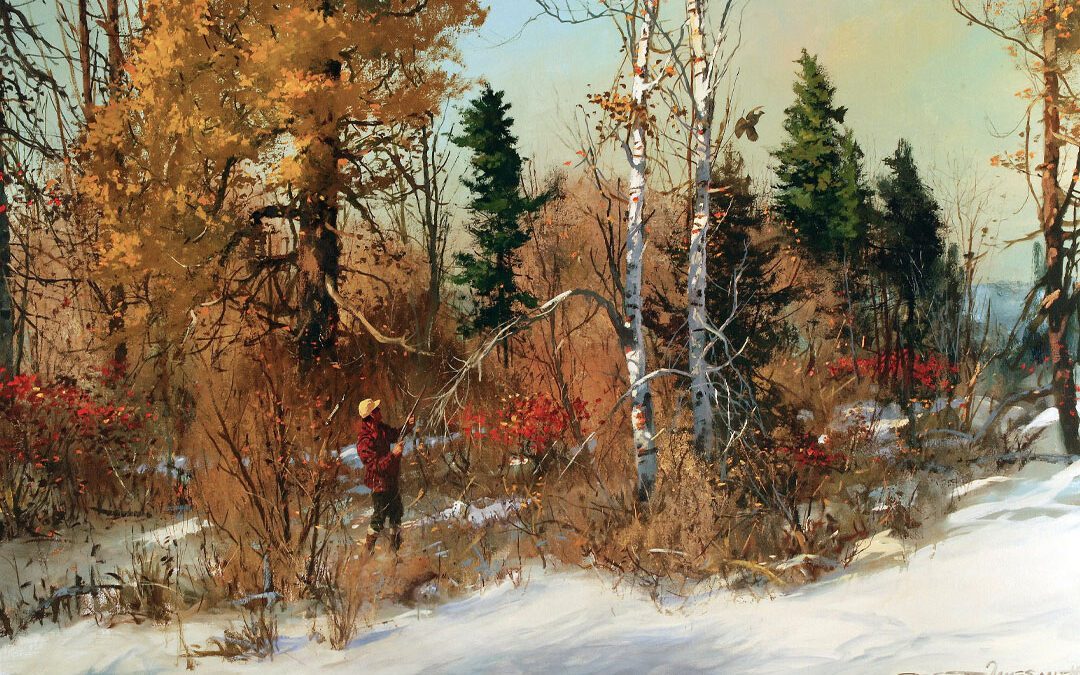
When I stepped out on the balcony that cold, damp, late February evening to sniff the weather, the stars had disappeared. It was very still, and felt like snow. Re-entering the warmth of our little apartment, I heard the phone ringing. It was Gary calling to discuss our plan for a last-day-of-the-season hunt the next morning. “It’s going to snow tonight, heavily they predict” he said. “Let’s see what happens and talk again in the morning.” That evening, I placed my boots, vest and shotgun by the door and, before going to bed, stepped outside one more time. It had indeed begun snowing.
Gary and I were hunting buddies. Our relationship was somewhat unusual in that he was a full professor in our department, and I was a grad student. Upon arriving on campus three years earlier, I had heard that Gary was an avid duck hunter. Learning that, I found my way to his office and introduced myself. Feeling each other out, we talked of common experiences in our East Coast upbringing and tidal duck gunning—boats, blinds, decoys, guns and places.
We were both fans of open water bluebills. Being from Long Island, he called them broadbill, and decoys, plural, as “stool,” as in “the broadbill roared over the stool.” We also discovered a common love of ruffed grouse. We spoke of his experience with mountain grouse and mine with New England pa’tridge and of our love for good sporting literature.
Over time, and after a few more discussions about our common passions, Gary invited me to hunt with him. Being particular about things and serious about his sporting pursuits, Gary had previously spent his time afield alone. But, before long, our occasional forays together transitioned to a comfortable partnership of kindred spirits. On campus, we maintained a professional relationship, but off campus we were just friends. For a couple of years, we enjoyed each other’s regular company duck hunting on the local river and following his visla, Gypsy, over the hillsides and through the hollows of the local mountains.
That was back in the days before personal computers, Google Earth, 24-hour weather channels and social media. It was also back in the days when Appalachian grouse numbers were such that it made it worthwhile to own a bird dog. Serious grouse hunters spent much time perusing topo maps and investigating remote, mountain-side clearings, fingers crossed that all of the leg effort would pay off with the discovery of an abandoned farm and prime bird cover. I loved scrutinizing the local quadrangles, looking for those faint dotted lines that meandered up mountainsides and ended in promising small white clearings amongst the green contour lines.
As predicted, it snowed heavily during the night and was still snowing when the phone rang again after breakfast the next morning. Gary didn’t waste any time with chit-chat. “The weatherman says the heaviest snow is over and it will peter-out by mid-day. If the roads are clear enough, and we can make it up there, I’d really like to try this cover before the season ends.”
The highway was slippery, but I made it up the mountain to Gary’s in my old pickup with the sandbags in the back over the axle for traction. This was an era before the common ownership of expensive SUVs and 4×4 trucks. The road was deserted and I felt a twinge of excitement about the impending adventure. Gary and Gypsy were waiting in the driveway when I pulled in; his little sedan warmed up, scraped of snow and ready to go. We transferred my gear and headed north up the highway, him driving cautiously and me riding shotgun with tiny little Gypsy lying on the floor between my feet.
Gypsy was a sweetheart. Gary had taken a risk on a less popular breed of grouse dog a number of years previously and it had paid off. His quiet, timid puppy had matured into a wonderful pet and careful, close-working mountain grouse finder. Although she was small, she had the perfect combination of stamina and the pace of an all-day-in-the-mountains hunting companion. I seldom heard Gary raise his voice with her, and never saw her range out of cow bell hearing. They obviously adored one another.
As he carefully negotiated the abandoned, snowy highway, Gary chatted excitedly about showing me the mountainside cover he had discovered across the state line at the end of the previous season. He had named it Stone City after a recent grouse hunting story by the not-yet-famous E. Annie Proulx. “I hope we can make it in there,” he worried aloud.
After leaving the highway and making several turns on rural roads, we turned on to the dirt road in the valley leading up to Gary’s parking spot. The road had not been plowed, and there were no vehicle tracks. After skidding along for a half mile, we decided that we had better stop before we got stuck. “We’ll have to walk,” Gary said.
We donned our vests, grabbed our guns, made sure we had enough shells and let Gypsy out to scurry about snuffling in 10 inches of light powder. We fastened her bell and began walking up the dirt road as the snow continued lightly falling.
After about a mile, Gary said, “this is where I normally park. Let’s head into the woods here. The place is up at the head of this ravine.”
We slowly made our way up the ravine through a winter wonderland of undisturbed snow under a canopy of mature, leafless hardwoods; Gary on one side of the little creek that trickled down the valley and me on the other, our footprints the only disturbance in the smooth white carpet. Gypsy worked half-heartedly in front of us in the open woods. It was cold and damp, but we warmed-up quickly.
A half mile up the ravine, the slope flattened out and the woodland started to look more birdy with smaller trees and more undergrowth. Breaking out of the cover, the view opened up to a black and white vista of overgrown, abandoned fields nestled in a south-facing, bowl-shaped depression in the mountain side. At the head of the bowl stood a lonesome chimney, barely visible through the falling snow. The tiny stream we had been following up the ravine appeared as a dark slash in the snow as it crossed the field from a spring near the abandoned house. The fields were grown up in patches of red cedar, dogwood, hawthorn and grape. A beautiful stand of white pine loomed darkly on the south end of the bowl. It was absolutely quiet and still as the snow continued sifting down out of a windless, gray sky.
After a hurried pause to eat our sandwiches, we moved into the cover and began hunting along the field edge toward the old house. Gypsy immediately became business-like and, before long, with her stubby little tail going a mile-a-minute, she slowed down, crept ahead and locked into a point that said, “the bird is RIGHT HERE!”
I was closest and moved toward her, expecting a typical wild flush way out in front. As I moved abreast of her, nothing happened. She looked like a statue, so I took a few steps ahead of her and the bird exploded into the air right at my feet with snow flying everywhere! I was so surprised by the close flush that I rushed the shot and missed. My heart pounding, I called to Gary as I reloaded, “Did you see that? The bird waited until I stepped on it!”
We continued to hunt up toward the chimney and, once there, poked around a bit. The chimney was a crude structure made of local stone. The mason had known his business though as the mortar was still solid, holding the chimney upright in defiance of the years of sun, rain, wind and cold, long after the surrounding wooden structure had collapsed into the cellar hole. The spring arose close to the house and must have been the family’s water source. The water that flowed from it was cold and clear.
Downslope from the foundation, a handful of naked, scraggly apple trees were silhouetted against the snow-white background. I wondered what variety they were. Pippins maybe? Did the homesteaders make apple sauce? Maybe a pie at Thanksgiving? Baked lovingly in a wood-fired oven in a cozy kitchen? Out back, overgrown by vines and brush, was a small cemetery with a handful of rudimentary headstones—inscriptions worn away by years of weathering.
The whole place had a melancholy feel to it on this gray, dreary, snow-spitting afternoon and I wondered what had become of the family that had staked their dreams there. Had the toil and hardship worn them down to the point where they gave up and moved to town? Had sickness been a factor? Was there evil involved as in Ms. Proulx’s story? Who owned the land now and what would become of it? All mysteries on this snowy February afternoon.
The landscape beckoned and we continued on, hunting the wonderful edge cover and into the overgrown sections of the field, guns held ready, thumbs on safeties, footsteps muffled by snow, Gypsy almost constantly birdy. The snow stopped, but a heavy overcast persisted. And the birds were there. Many times that afternoon Gypsy locked-up in that now familiar “RIGHT HERE” stance as we moved in to flush those close-holding grouse from the snow. What a thrill!
Looking back at my journal notes I see that we didn’t flush a record number of birds that day. We moved six that afternoon and took three. Yes, shooting .500 on ruffed grouse is a special day, but my memory of that day is not of the number of birds we took. Instead, although it was a long time ago, I have a vivid recollection of the unique and special nature of the place, the weather, the companionship, the dog work and of those wonderfully wild, close-holding mountain grouse.
Late in the afternoon, as blue-sky patches appeared through the clouds and the temperature dropped, we called it quits with the warm feeling that we had just experienced something unique and special, of which durable memories would be made. As we retraced our tracks down through the snowbound ravine, the pleasant sensation of our harvest bumping against the small of our backs, leaving behind that lonely old farm hunkered down in the mountainside bowl, I realized that this was my last grouse hunt of that era. I would finish my degree in the coming summer and move on to other unknown places, new friends, momentous life events and new hunting opportunities.
Many years later, I often reminisce about my time in the mountains as a young man with strong legs, hunting grouse. I am reminded of our special hunt by the abandoned farm houses overgrown by vines and reverting back to the earth that I occasionally see where I live now.
I have tried electronically to re-trace our steps and find that old farm via satellite imagery, but I just can’t remember how we got there and my old, dog-eared topographic quadrangle has not survived the passage of time. Maybe I can’t locate it because the old dirt road is now a four-lane? The old farm now a housing development?
Maybe it’s better that I don’t know what’s happened there over the years and that I assume the old chimney is still standing sentinel over that wonderful bird cover where grouse forage on drops from the old apple trees and roost in the big white pines at the south end of the bowl. And maybe it’s better that I just relish the vivid memory of that snowy hunt with my good friends, Gary and Gypsy, long ago in that special place called Stone City.