
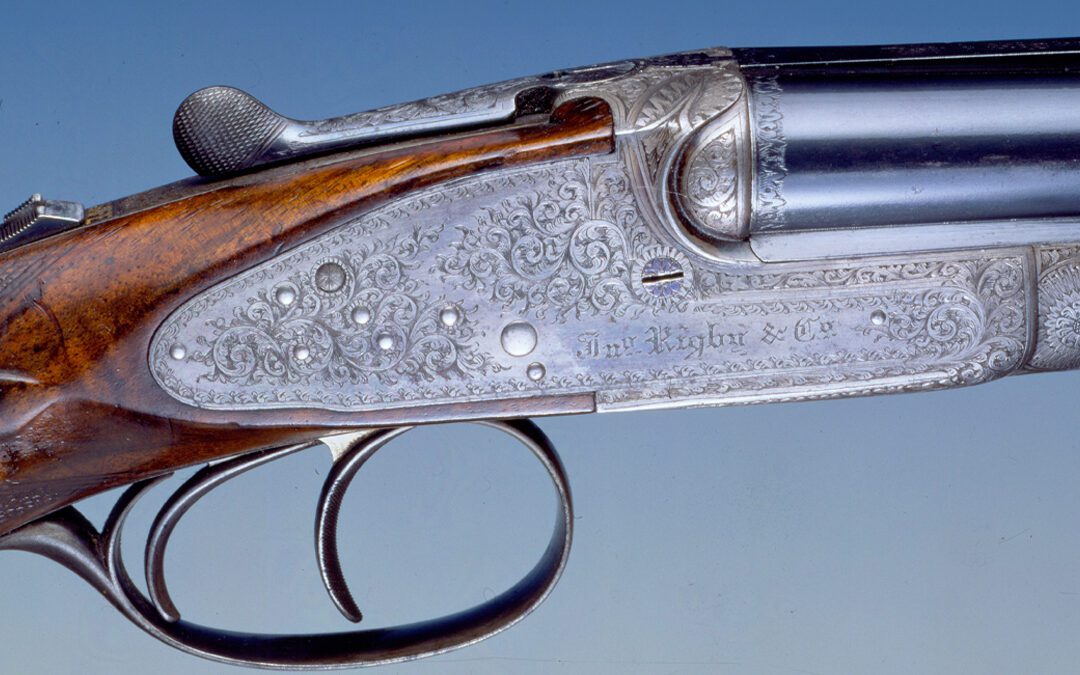
What better way to celebrate a lifetime achievement than with a British Best gun.
There is no one in the world who doesn’t like being rewarded for hard work. Whether it’s a book well written, service to the nation or success in popular entertainment, the good and the great have, throughout history, imagined themselves possessing the best of expensive luxuries. Here, then, are a handful of the rich and famous who thought themselves worthy of Best British guns and rifles.
The Bookish
If the thought that literary liberals once hungered for London doubles doesn’t fill you with doubt, read on. Russian author Ivan Turgenev, whose efforts to free the serfs produced the Sportsman’s Sketches, bought a Joseph Lang gun. Ernest Hemingway acquired a Westley Richards while Isak Dinesen, famed for her farm in Africa, was gifted a John Rigby.
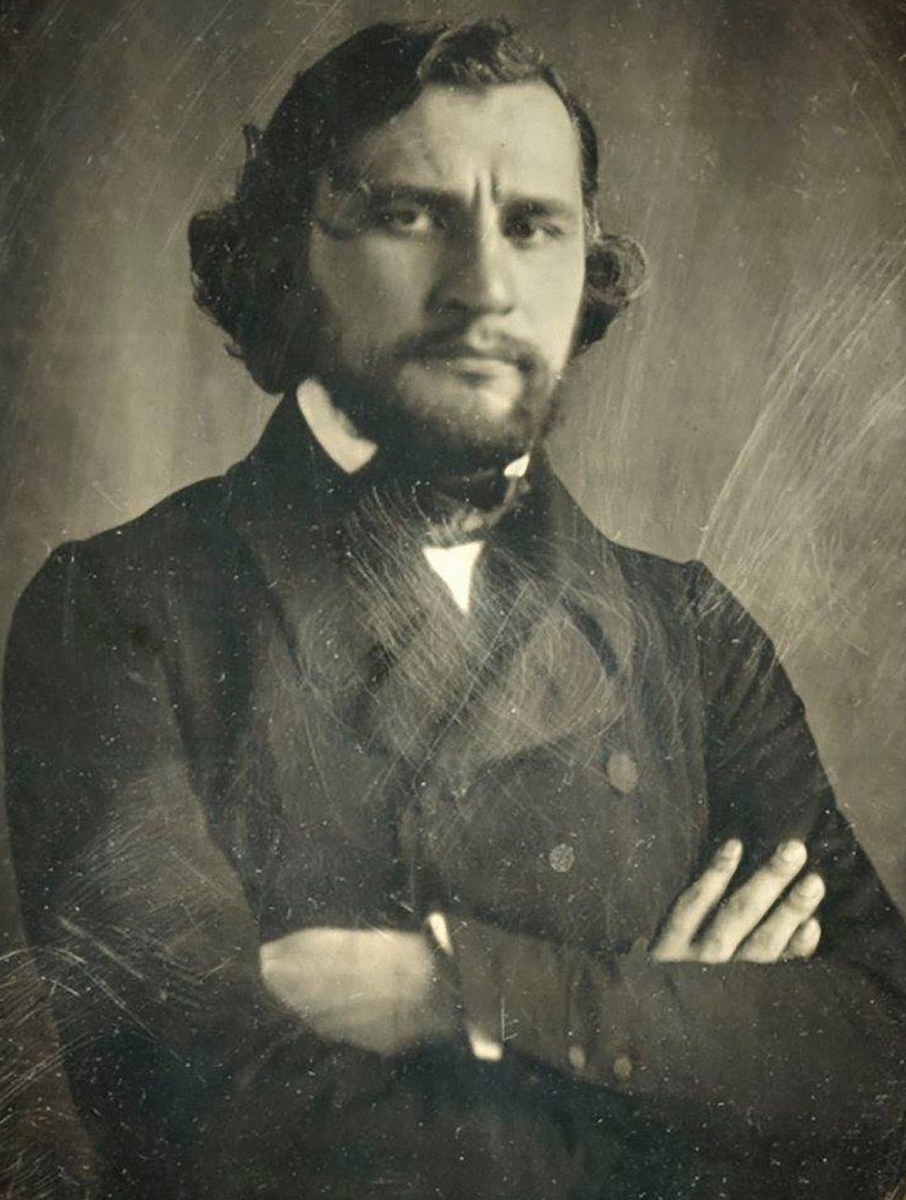
Ivan Turgenev, circa 1847-1850.
“Turgenev had discovered the existence of the gunsmith Joseph Lang, of Cockspur Street,” wrote biographer Patrick Waddington in Turgenev and England. “Some years earlier, Lang had brought to Britain the new Lefaucheux shotgun and made some improvements in its performance. For Turgenev, ‘Leng’ (as he pronounced the name) was simply the world’s best craftsman.”
The Russian émigré paid £41 for his breechloader and wrote: “How beautiful it is! It makes you feel like going down on your knees! And what an aim it has!”
In reality, the “aim” took some adjustment since Turgenev fired 50 shots to bag just 11 brace while walking up grouse on the 12th at Fincastle near Pitlochry in 1871.
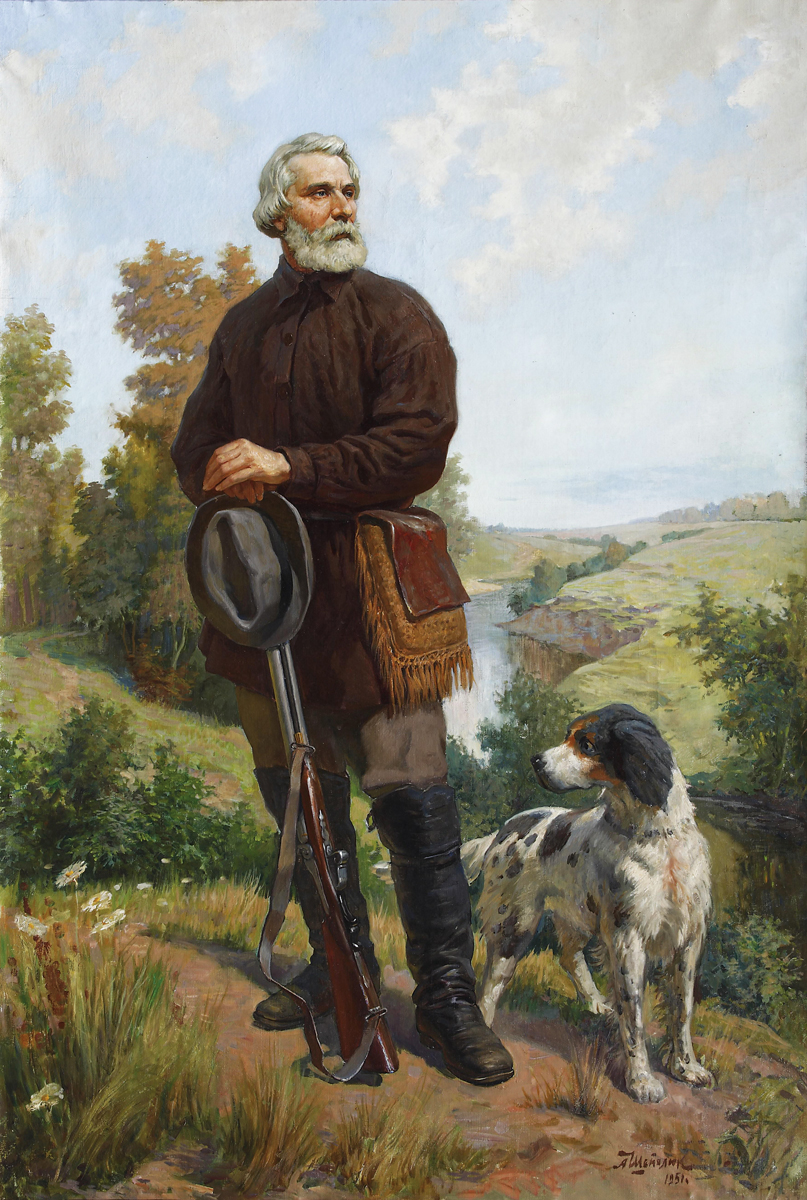
Russia’s Ivan Turgenev: Arguably the greatest literary bird hunter of all time. Credit: Alamy Photo/Ivan Turgenev Literary Museum, Oryol, Russia.
Turgenev’s clipped sentences and snapshot characterization influenced Ernest Hemingway’s writing sometime after Sylvia Beach encouraged Papa to read Sportsman’s Sketches. Hemingway borrowed the book often from Beach’s Left Bank lending library and appeared to have learned its lessons well.
In 1953, Hemingway indulged his appetite for adventure with an East African safari. His stopping weapon was a Westley Richards 577 Nitro Express rifle. This huge double featured an Anson & Deeley action, but even a modest boxlock has the dignity of lineage.
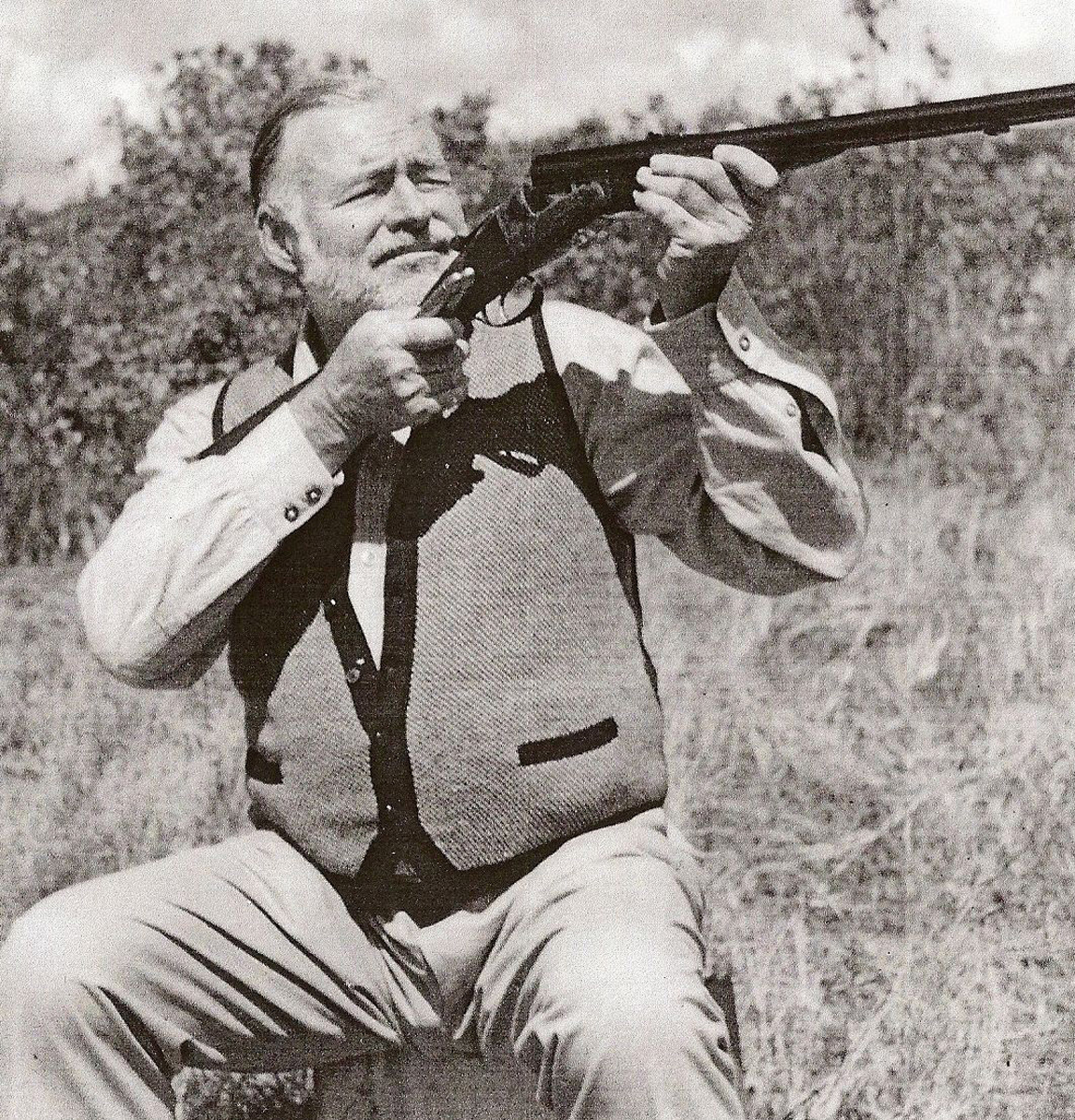
Papa Hemingway cleans his big elephant rifle while on safari in Africa.
Westley Richard’s boxlock is a simple, low-maintenance design with few moving parts, ideal for a fellow an ocean away from his gunmaker. Subtly modified through successive iterations by the time Hemingway acquired his, the A & D was fastened by a Purdey under-bolt and featured hand-detachable locks.
Hemingway was not the gun’s first owner, however. The rifle had been built for Captain Stephen Henry Christie of the 20th Hussars who was killed on the Marne in the opening weeks of the Great War. Hemingway acquired it from Winston Guest, great-grandson of John Spencer-Churchill, 7th Duke of Marlborough.
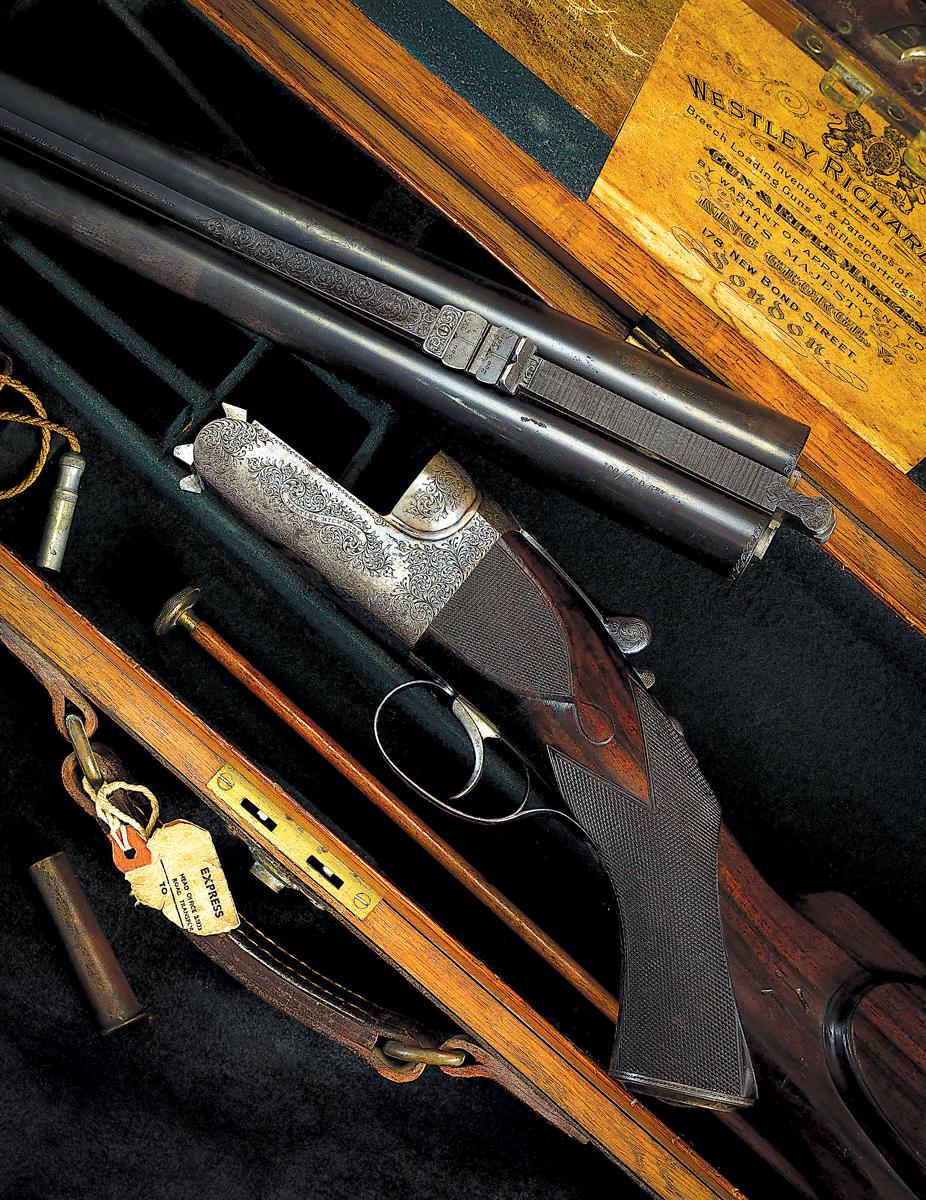
Ernest Hemingway’s Westley Richards 577 Nitro Express. Photo courtesy Westley Richards.
The barrels are engraved “Westley Richards 178 New Bond St. London Gun Makers By Appointment to His Majesty George V Rex Et Imp,” a reference to the royal warrant Westley Richards used as the frontispiece of its 1912 catalogue.

During the Second World War, Hemingway took his elephant gun to Cuba where he intended to shoot U-boats. He was fortunate the Kriegsmarine eluded him, since even the 750-grain bullet of his 577 is a dagger at a gunfight when compared to a German 88mm deck gun.
One of Papa’s guests in Cuba was Baron Bror Fredrik von Blixen-Finecke, of whom celebrated author Beryl Markham wrote: “He is six feet of amiable Swede and, to my knowledge, the toughest, most durable white hunter ever to snicker at the fanfare of safari or to shoot a charging buffalo between the eyes while debating whether his sundown drink would be gin or whiskey.”
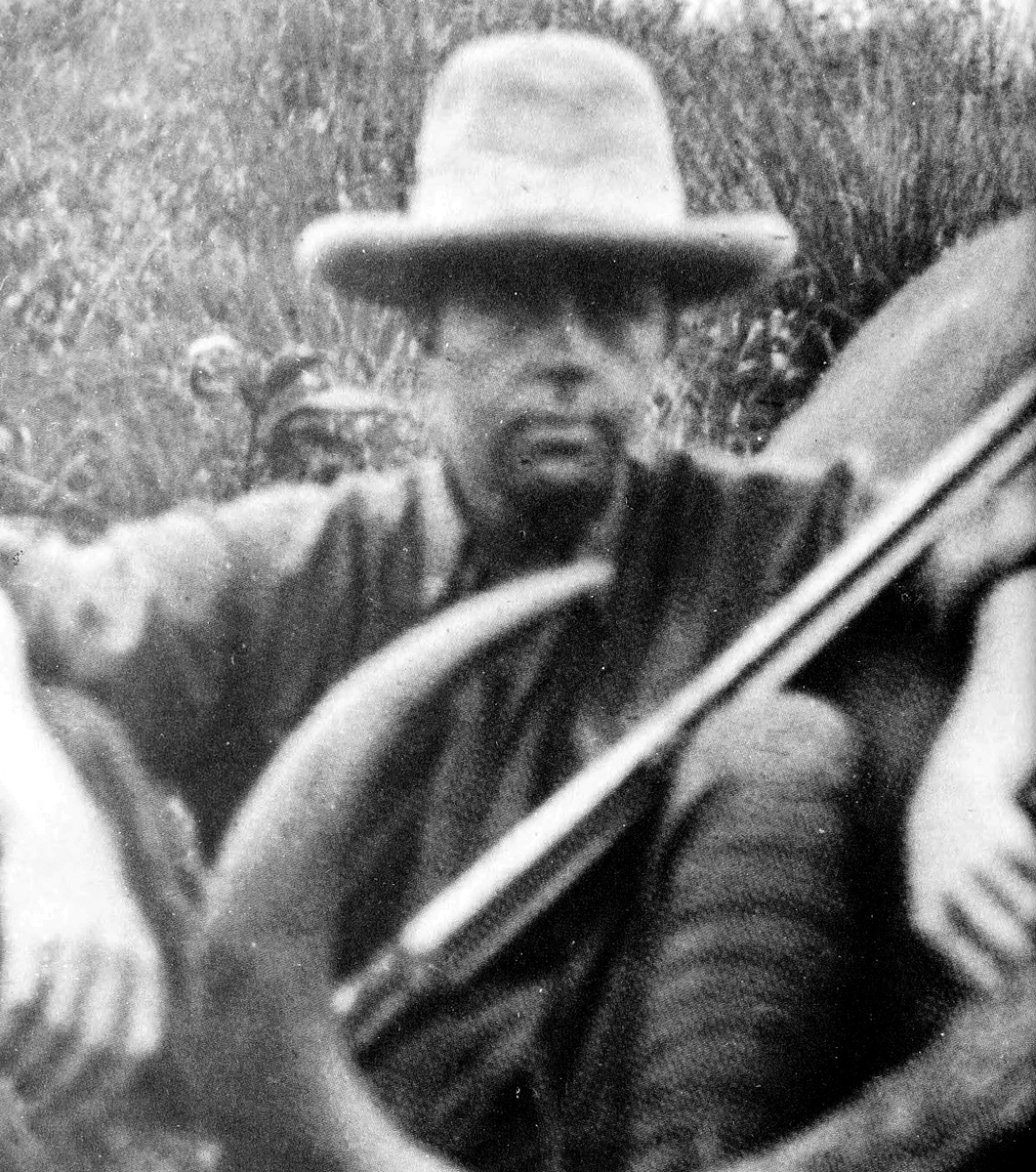
Baron Bror Fredrik von Blixen-Finecke
Early in 1917, the Baron took delivery in Mombasa of a double rifle in 220 Savage Hi-Power from John Rigby and Co. Rigby’s reputation rests firmly on its rifles. Their dipped edge lockplates are a signature feature every bit as recognizable as Louboutin’s lacquered red soles.
Serial number 17,873 is a trifle of a thing weighing 7 pounds, 3 ounces. It was shipped in a case featuring a coronet and the initials “K.B. F.” Years later, after the Baron died, the rifle was described in Sotheby’s auction as a “small-bore lightweight rifle . . . made to accommodate the requirements of a lady shot.”
The rifle was clearly intended for the Baron’s first wife and second cousin Karen Blixen-Finecke, who wrote under the nom de plume Isak Dinesen.
Although the 220 is an unlikely caliber for dangerous game, it is explicitly proffered to make people dream. Its appeal, for the Baron, may have been that its relatively low recoil wouldn’t prove too distressing for his wife. It’s not difficult to imagine a whiff of cordite, a wreath of smoke and the Baroness hooked on the safari lifestyle.
The Upper Tier
Safari was once a rite of passage for Royals. In 1921, the Prince of Wales shot sandgrouse, jungle fowl, pea hens and parrots with a pair of 16-bore Purdeys while touring the sub-continent. But the day before he met Wallace Simpson in 1931, he ordered a pair of Churchill best Premier Quality sidelock ejectors with signature XXV barrels and shortly thereafter sold his Purdeys.
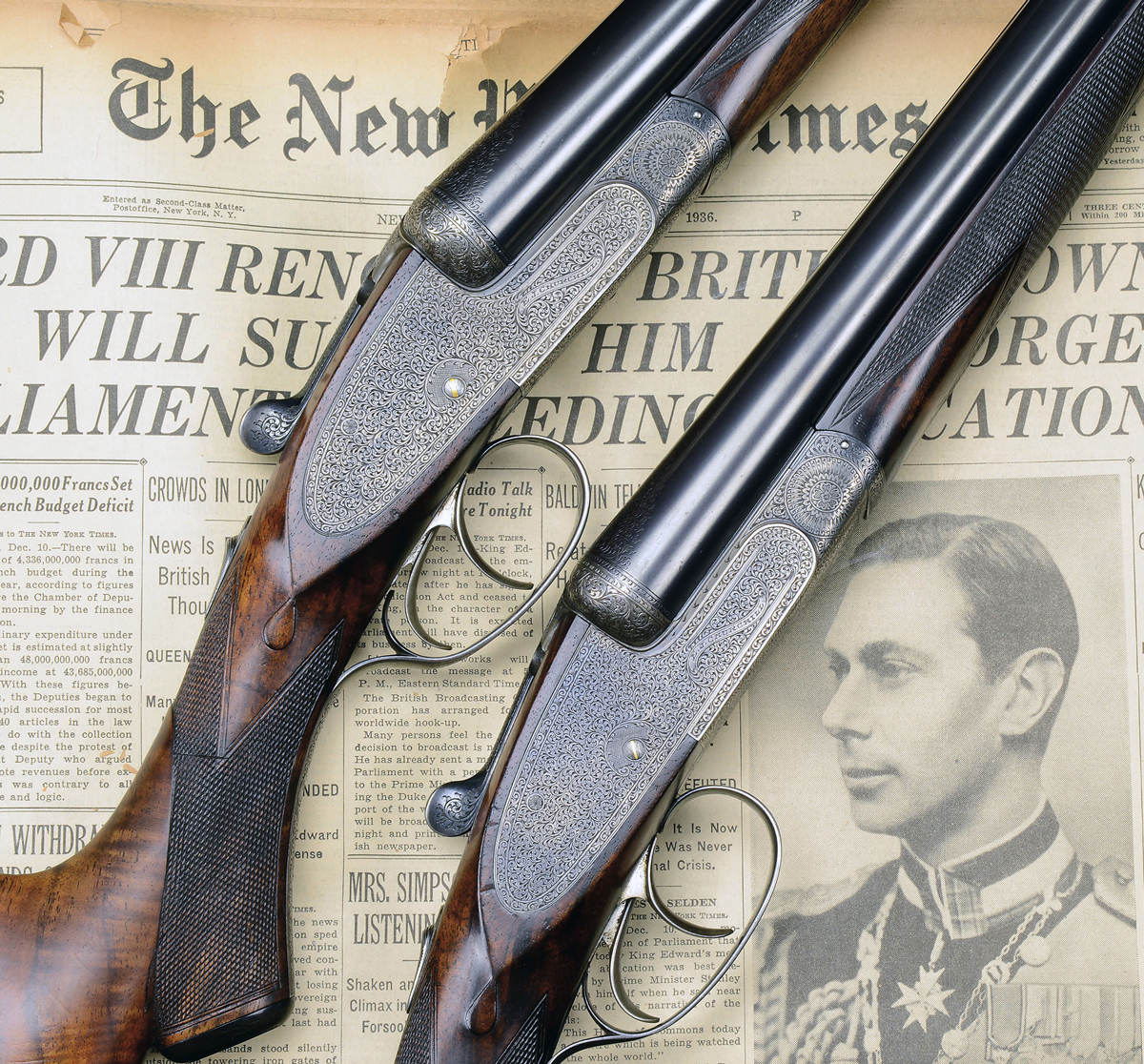
These E.J. Churchill guns were built for the Prince of Wales who went on to become King Edward VIII.
The newspaper story covers his abdication from the throne so he could marry an American. Photo courtesy Morphy Auctions.
The XXV had been favorably received and Churchill strenuously promoted it as a “revolutionary development . . . better balanced, far less tiring to use and carry, more comfortable to handle and quicker to shoot.” He cunningly pioneered his short guns as ideal for “average or poor shots with higher aspirations.”
Robert Churchill combined his short barrels with a special high tapered rib that gave the shooter an optical impression of length.
Despite controversy, XXVs were a hit. Both boxlocks and sidelocks in every quality were offered, and more celebrated gunmakers paid Churchill the ultimate compliment by offering short-barreled, lightweight guns of their own. Neither Robert Churchill nor The Prince of Wales were tall, and part of the appeal of stubby, lightweight guns may have been the ease with which they could be handled by men of smaller stature.
One London maker who made a specialty of small-bore guns was Thomas William Watson. He was the son-in-law of revolver maker William Tranter, and opened for business in 1875 in what had been the premises of Durs Egg, one of the great gunmakers of the Regency.
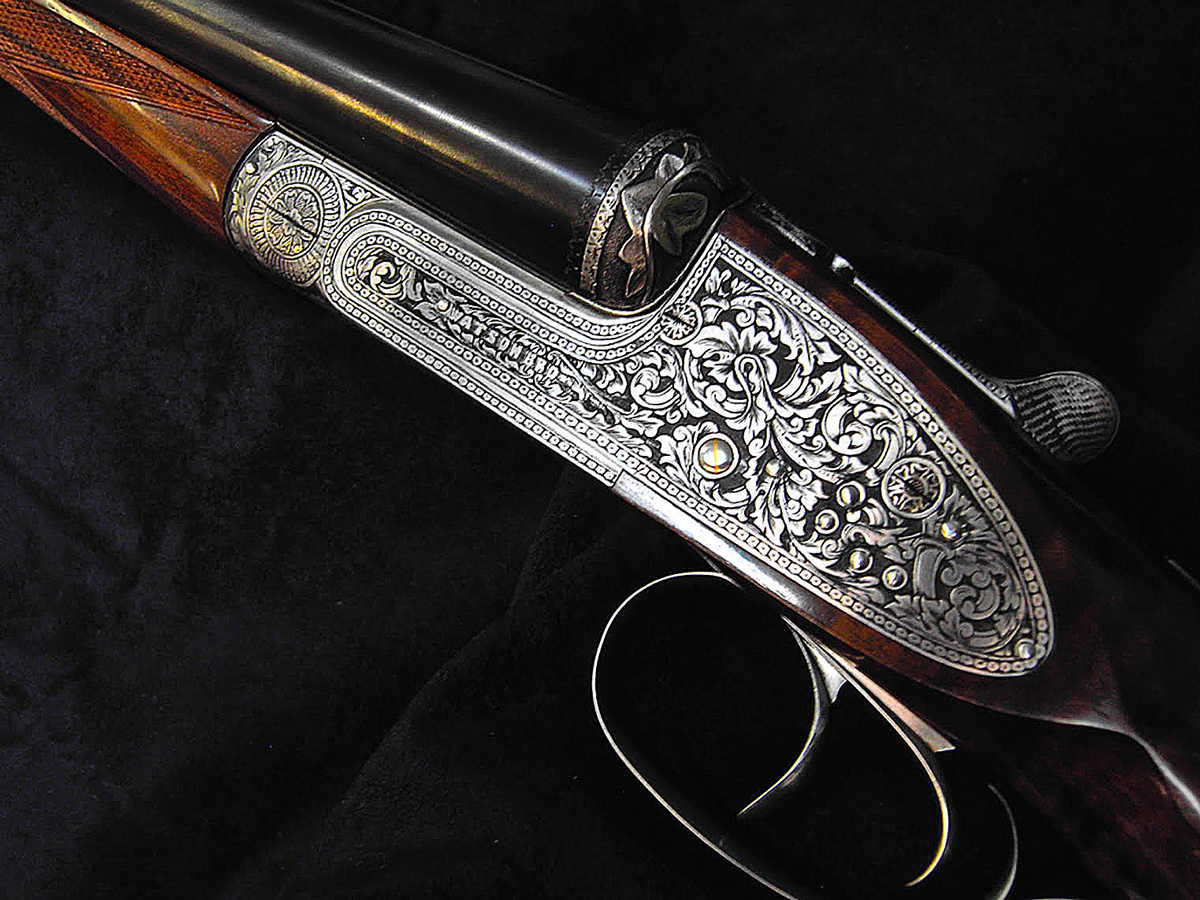
Embellished by master engraver Harry Kell, this Watson Brothers sidelock was built for the Sultan of Turkey in the late 1880s.
In 1884, Watson took his brother, Arthur Henry, on board and the firm became Watson Brothers. It was an expansion that may have been made possible by the success of a barrel-cocking, hammerless gun called the Carlton.
A lightweight version of the Carlton, called the Phantom, was available with 24-inch barrels and was clearly intended as a child’s gun. The Phantom 28 bore weighed just 4 pounds 2 ounces.
In the late 1880s, Watson Brothers received a royal warrant from the Sultan of Turkey, but Abdul Hamid II shot a Purdey he’d ordered in 1886, and it’s likely that his small-bore Watson was intended for the boys among his 17 children. Watson Brothers altered their trade label to pay tribute to the Ottoman’s patronage. It read: “By appointment to his Imperial Majesty the Sultan of Turkey,” a boast that would be inked over in 1915 when the United Kingdom opened hostilities against the Axis powers.
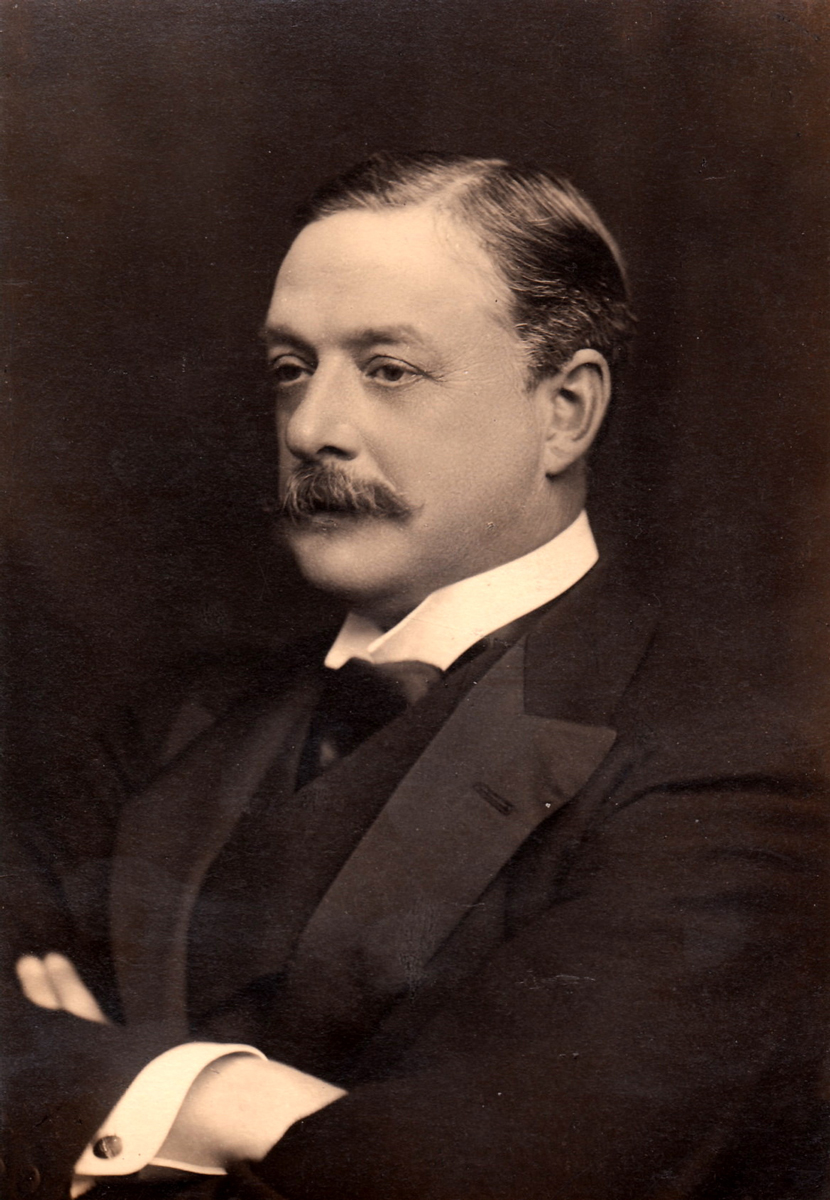
Ferdinand William Cavendish-Bentinck,
8th Duke of Portland.
Ferdinand William Cavendish-Bentinck, 6th Duke of Portland, bought his guns from Boss & Co. In 1880, he ordered a pair of side-pedal hammer guns with back-action locks by Stanton, which he later replaced with hammerless guns by the same maker. Just before World War I, he welcomed Archduke Franz Ferdinand, heir to the Austro-Hungarian throne, at Welbeck Abbey, his country seat. During a shoot on the estate, an incident occurred that the Duke later recorded in his memoirs, Men, Women and Things.
“One of the loaders fell down. This caused both barrels of the gun he was carrying to be discharged, the shot passing within a few feet of the archduke and myself. I have often wondered whether the Great War might not have been averted, or at least postponed, had the archduke met his death there and not at Sarajevo the following year.”
Popular Entertainers
In 1939, before the U.S. entered World War II, movie star Robert Montgomery enlisted in London for American field service and drove ambulances in France until the Dunkirk evacuation. In a break from helping British heroes, he acquired a pair of guns from James Purdey & Sons, a firm known for its acclaimed actions and preeminent patents, in addition to its export efforts.
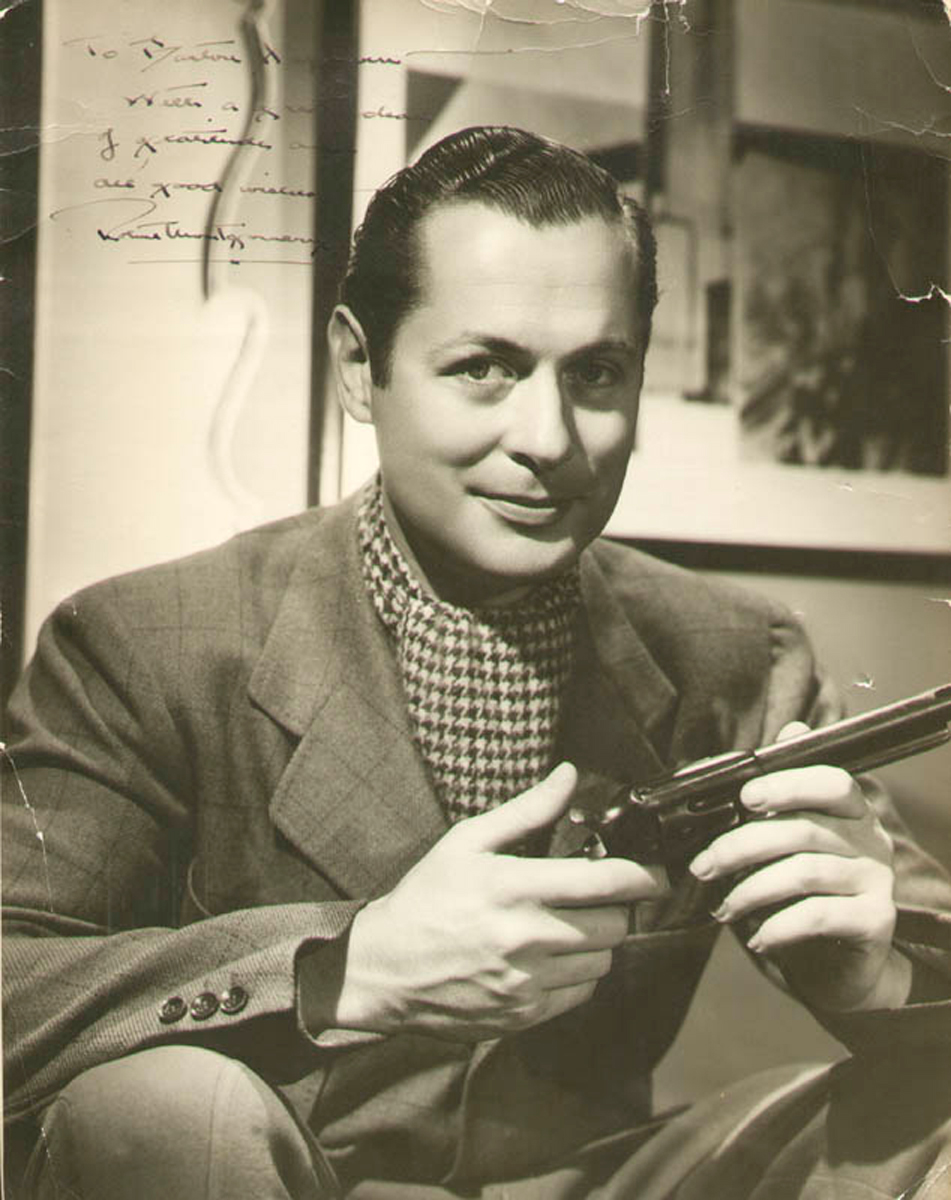
Studio shot of actor Robert Montgomery with a Colt revolver.
“The company’s links with America were fostered by frequent visits from its directors and especially strong links were built up with the film industry,” said gunwriter Geoffrey Boothroyd. “An example of this was a pair of Purdey guns bought by film star Robert Montgomery in 1939.”
Guitar great Eric Clapton’s purchases included sidelock ejectors by Boss & Co., Holland & Holland and James Purdey & Sons, but it was with his William Evans guns that he best expressed his love of the shooting sports. Clapton’s pair of 20-bore, single trigger self-openers feature pin-less locks engraved by Marcus Hunt that depict Clapton fishing and bird-shooting.
Few TV celebrities can match the onscreen charm of a Robert Montgomery or the passionate following of an Eric Clapton, but one who can is Tom Selleck who loves Holland & Holland.
“I’m not much of a hunter,” Selleck said. “I shoot a lot of clay targets. To me, the excitement is in ordering a fine shotgun, going through the process that everybody who has bought one has gone through for 100 years. You order it, make a significant down payment, and then you wait three or four years for the gun to be custom-made for you. They’re not making these guns much differently from the way they were made in 1920. That’s why it takes so long.
“I know shotguns are politically incorrect,” he said, “but it’s too late for me to be concerned about such things. And the shooting sports are very misunderstood nowadays. Shooting clay targets is a very cleansing experience. It’s very relaxing. It takes a lot of concentration. It’s also very social, since you’re usually shooting with friends. You can talk and forget about almost anything else that’s on your mind.”
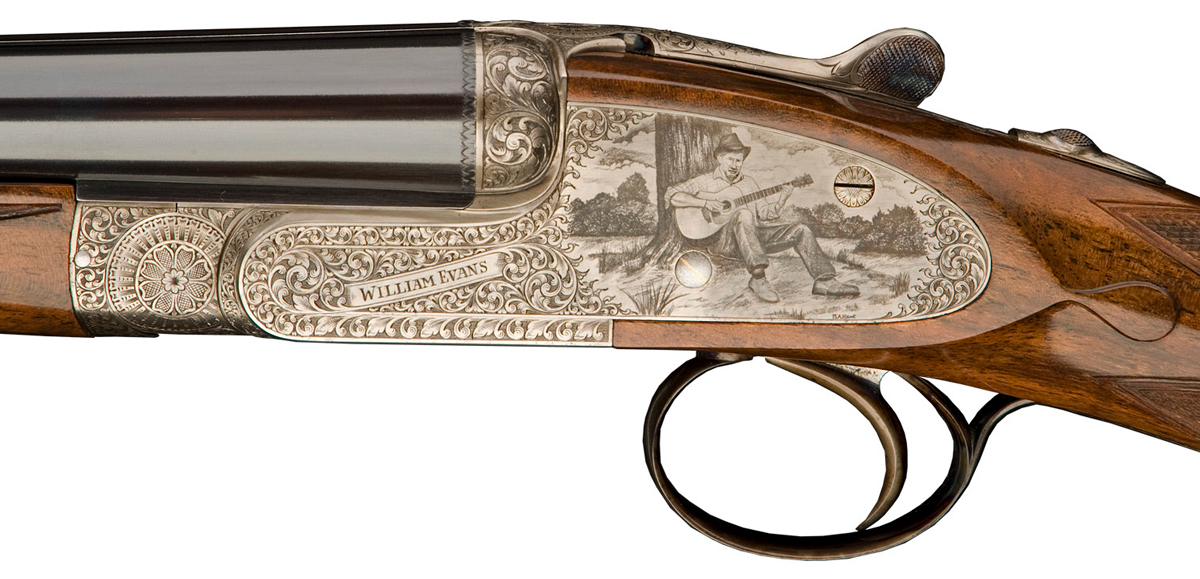
This William Evans 20-bore is one of a matched pair once owned by Eric Clapton. Engravings on both guns show the celebrated guitarist fishing and shooting partridge. Photograph: Nick Holt.
So what do these admittedly tenuous tales add up to? One answer might be that the talented, the successful and the rich will always imagine themselves possessing the very best of affordable luxuries.
Tom Selleck, who bought his Holland & Holland pair to celebrate the success of his hit television series Magnum PI, said: “We ought to commemorate our wins; instead, we tend to forget them and remember other things.”
What better way to celebrate a lifetime achievement than with a timeless best British shotgun or double rifle?
LEGENDARY BRITISH GUNMAKERS
The firms gratuitously stroked in this feature include:
Atkin Grant & Lang
agl-uk.com
Westley Richards & Co. Ltd
westleyrichards.com
John Rigby & Co. (Gunmakers) Ltd.
johnrigbyandco.com
E. J. Churchill
ejchurchill.com
Watson Brothers
watsonbrosgunmakers.com
Boss & Co.
bossguns.com
James Purdey & Sons Ltd.
purdey.com
William Evans
williamevans.com
Holland & Holland
hollandandholland.com