
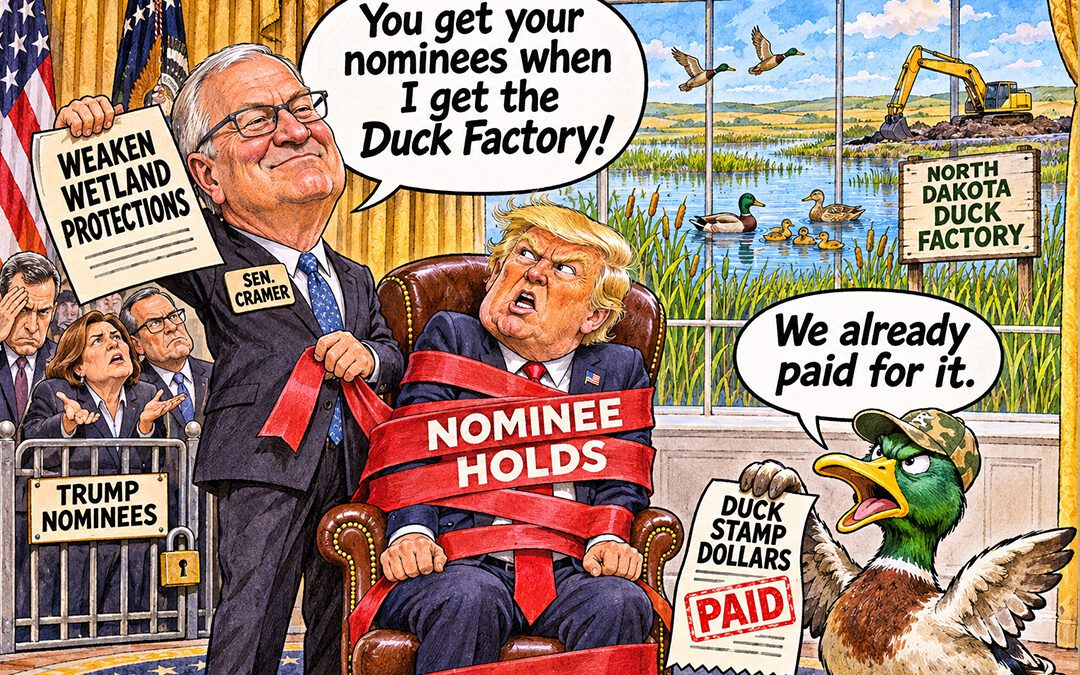
Senator Kevin Cramer appears to have discovered a new use for America’s duck habitat: collateral for getting presidential nominees confirmed. Somewhere in Washington, someone apparently decided the way to drain the personnel backlog was to entertain demands that could help drain the Duck Factory. An elegant solution, provided nobody asks the people who paid for the wetlands.
The Washington Examiner reports that the White House is confident it can resolve Cramer’s blockade of most executive branch nominees. His price involves changing federal protections governing drainage near prairie wetland easements. No completed agreement has been announced. That leaves President Trump time to consider whether pleasing one senator is worth introducing his administration to a couple million thoroughly irritated duck hunters.
They tend to get up early. They will have time to make calls.
First, dispense with the fairy tale that these easements are some fresh federal confiscation. Landowners voluntarily sold permanent wetland protections to the government. The land stayed private. Compatible farming continued. Hunters helped finance the purchases through Duck Stamps, supplementing that investment with private conservation dollars. Calling the resulting restrictions a land grab requires overlooking the part where somebody agreed to the transaction and received payment.
Apparently, honoring contracts is now a radical environmental position. Somebody alert the Chamber of Commerce.
Cramer argues that federal drainage setbacks reach beyond the acreage covered by easements and unfairly restrict farmers. Legitimate mapping errors and excessive restrictions deserve correction. But underground drainage outside a protected wetland can still drain that wetland. Water has stubbornly refused to retain a property attorney. The 2024 rule establishes a process for calculating setbacks and gives complying landowners protection from liability if an approved system nevertheless drains protected habitat.
Changing that rule would not automatically erase every easement. Weakening it enough to permit drainage, however, could leave hunters holding permanent protections on permanently diminished wetlands. Congratulations, America: your conservation investment still exists on paper. Please direct all incoming mallards to the filing cabinet.
As I wrote previously, Cramer’s campaign predates this nomination fight. His 2022 legislation proposed limiting new federal conservation easements to 50 years and offering ways to renegotiate or buy out existing agreements. Permanence apparently needs an expiration date when the senator dislikes the purchaser.
Before Trump signs off on anything resembling that bargain, somebody should explain Duck Nation.
Washington may see camouflage and assume political camouflage works equally well on the people wearing it. These are fellows discussing retriever pedigrees over gas-station coffee. How much trouble could they cause?
Ask who bought the gas station.
Ducks Unlimited and its allies have devoted generations to connecting people across occupations and income brackets. The volunteer selling banquet tickets may work construction. The person buying the auction shotgun may run a bank. Their hunting partner may know the senator whose call the White House needs returning. Assuming this community lacks access to power because its preferred footwear smells like marsh mud would be an expensive education.
DU and its sister organizations’ recent continental campaign raised $4.06 billion. That suggests a constituency with considerably more organizational capacity than a coffee can beside the cash register. Its supporters know how to raise money and sustain relationships. They also know when someone is treating them like an ATM with waders.
The warning has already arrived. DU reported that more than 219,000 people responded to the federal review of drainage setbacks. Major waterfowl organizations jointly warned Interior Secretary Doug Burgum that their members had invested hundreds of millions in these easements. Those people have noticed. Negotiators should probably stop behaving as though the meeting is confidential.
Farmers are necessary conservation partners, and plenty hunt ducks themselves. Washington should solve genuine problems with landowners while honoring what the public purchased. Turning this into farmers versus hunters is convenient for politicians who would prefer neither group examine the paperwork.
Republicans should examine their electoral assumptions, too. Hunters’ support comes with expectations beyond an annual photograph of a candidate holding a shotgun like an unfamiliar kitchen appliance.
Democrats have openly courted sportsmen, including through Hunters and Anglers for Harris-Walz in 2024. I regard campaign camouflage with considerable suspicion. A hunter-themed political decoy still needs something convincing beneath the paint. But Republicans make the sales pitch easier when they offer actual hunters another reason to feel politically homeless.
That discontent could reach donors, volunteers and voters well beyond North Dakota. DU’s conservation work is nonpartisan; its supporters retain their own checkbooks and ballots. Nobody needs an organizational endorsement to decide that a party has taken him for granted.
Mr. President, get your nominees confirmed. Correct genuine administrative abuses. Honor the habitat agreements Americans bought.
But if Cramer’s price is the Duck Factory, tell him the property already has a buyer.
We paid.