
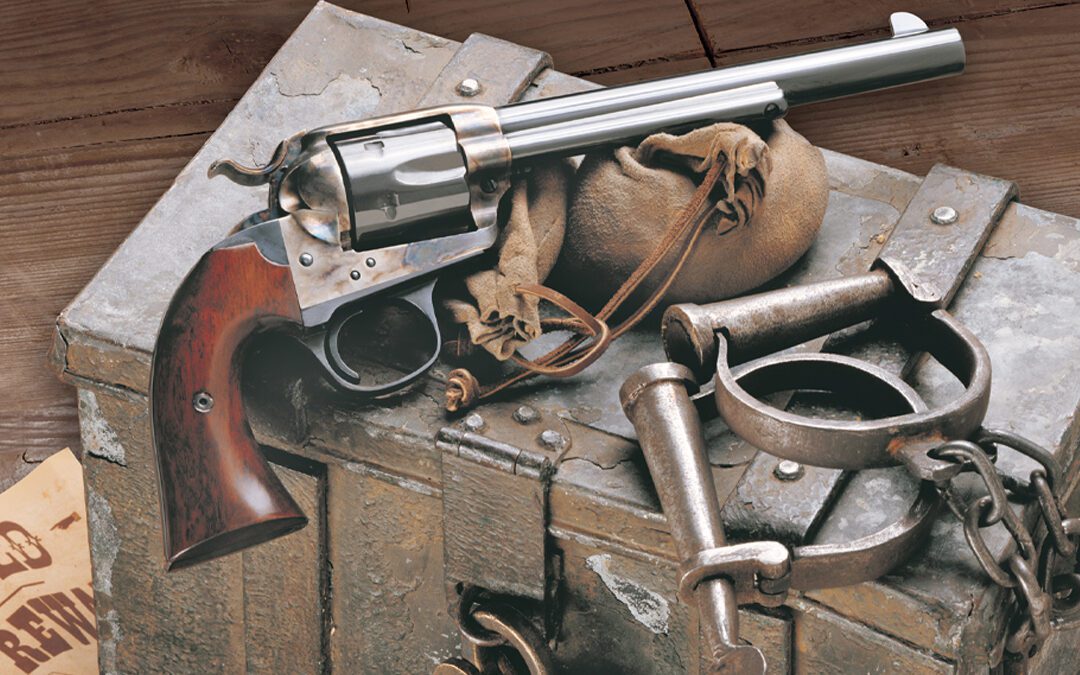
I was once a wanted man, a man on the run with a woman in hot pursuit, one of my exes with a .44. It was for a trifling indiscretion, or so it seemed at the time. All I had was my overdue Visa and a quarter tank, but my Ford was faster than her Volvo. Never assume the Scandinavians are a peaceable race. The Norwegians raise some tolerable berserkers, I am here to testify.
Cape buffalo in heavy cover? Bear or boar grunting up revenge?
Been there, done that, no comparison.
I wouldn’t have fretted had it been a 44 Magnum. Few men and almost no women can handle that bellering behemoth to any satisfaction. But it was an old Smith & Wesson top-break Schofield, dead-on with every shot, named for the Army major who perfected the locking system, which was of purely academic interest right then.
Down the road we went, the dust and gravel a-flying, bless her heart. Insult to injury, I had given her that old Smith for Christmas. “Pinckney, you are a damn fool,” all my friends said.
Yep.
But the episode had a successful conclusion, no powder burned, no blood shed and no britches fouled, but almost. I snuck back to the shack when I reckoned the coast was clear, collected my shotguns and shirts. I looked for the Schofield, couldn’t find it.
I can almost laugh about it now.
John Wesley Harding was a friend to the poor.
He travelled with a gun in every hand,
All across the countryside he opened many a door,
But he was never known to hurt an honest man.
Bob Dylan wrote that and he got it wrong. It’s John Wesley Hardin, not Harding. And if he was ever a friend to the poor, it was because the poor didn’t have anything worth stealing.
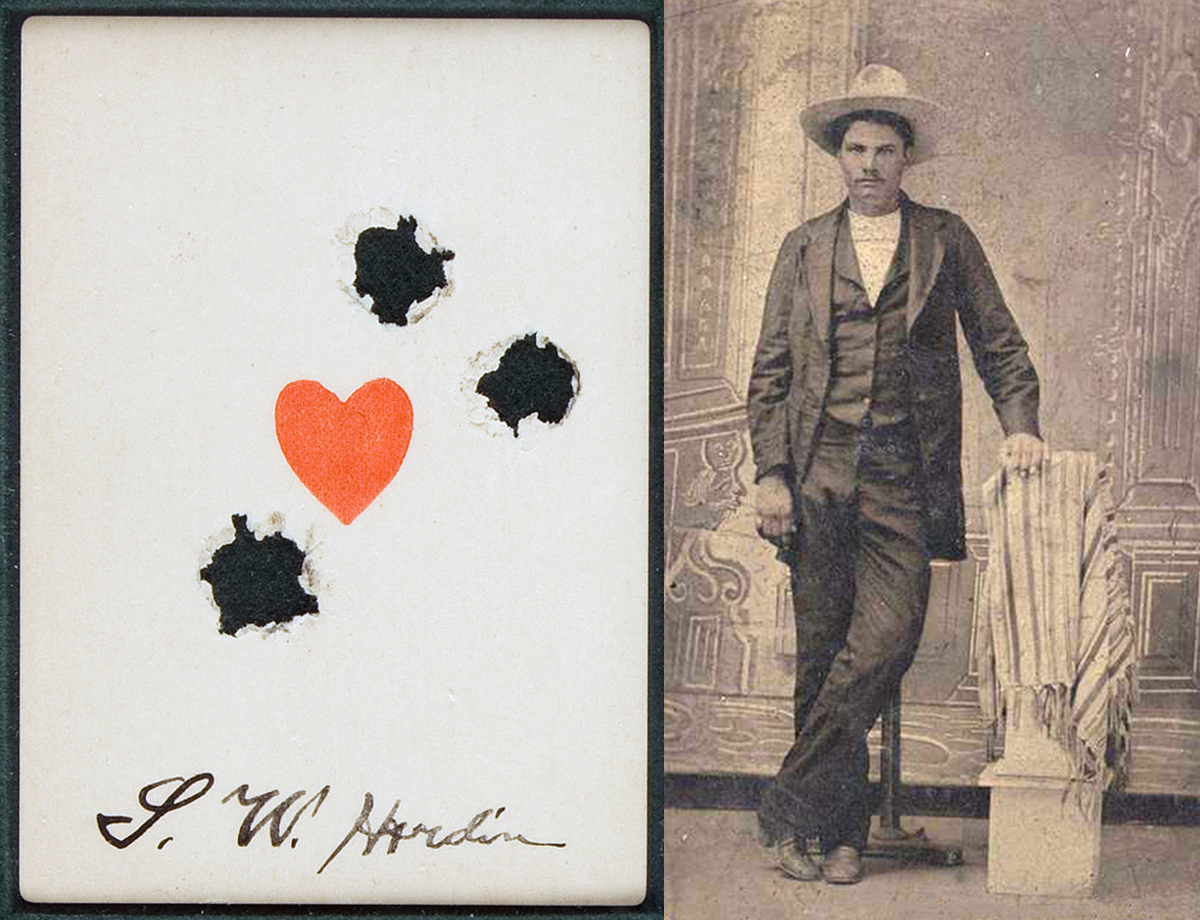
A 1871 tintype of John Wesley Hardin. Abilene, TX.
Hardin was a preacher’s son who killed his first man at 15 and went on, by his own account, to kill 43 others, Indians, Mexicans, blacks and whites, lawmen and outlaws alike without prejudice, even one man on Christmas day and another for snoring. Hardin drove cattle up the Chisholm Trail, rustled others back down it. He gambled, drank and whored from Texas to Florida, married a 16-year-old, studied law, was admitted to the bar, taught Sunday school while in prison and even once got the drop on Wild Bill Hickock.
Hell of a resume.
Hardin died shooting craps in 1895, shot in the back of the head by an El Paso policeman who did not wish to be corpse number 45. His effects included an engraved 45-caliber pearl-handled Colt Lightning, a gold Elgin pocket watch, two decks of cards, one unmarked, the other not and a rap sheet 30 years long.
Hardin’s career began with Colt cap-and-ball Civil War revolvers and included shotguns with buckshot, Winchester rifles, a couple of derringers, Colt Peacemakers, Lightnings and Thunderers and finally a pair of Schofield .44 Smiths retained in cross-draw holsters sewed to the insides of his vest, one of which recently fetched up a cool $625,000 at auction.
Talk about a gunslinger? Hoteliers recalled him after hours in his room, palming, flipping and rolling his pistols ’til he got it perfect. Folks said if he had been at the OK Corral with the Earp’s and Doc Holliday, the gunfight would have lasted only about eight seconds. It is rumored Bat Masterson was faster, but the two never met in mortal combat.
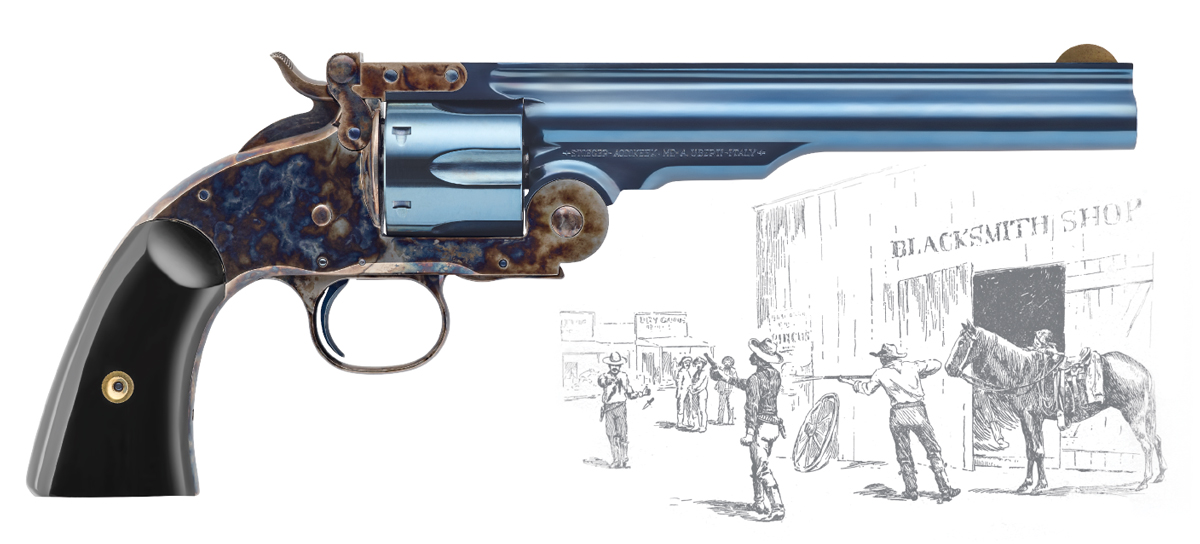
This illustration from Hardin’s autobiography shows Hardin and his accomplice, Jim Taylor, gunning down Sheriff Jack Helm. Hardin used a 12-gauge caplock shotgun. taylor, a six-gun.
You can imagine my considerable surprise and satisfaction when I learned the Italian firm Uberti, the maker of fine reproduction firearms of the Old West, had brought out a Schofield as part of its “Outlaws and Lawmen” series, appropriately named The Hardin. “Be part of the legend” the ads proclaim. Hell, I figure I already was.
God may have created man, but Colonel Colt made men equal. The 1873 Colt, the Equalizer, the Peacemaker or Single Action Army, gets all the Hollywood glory. Yes, it is one tough gun and it fits the hand most wonderfully. You could grind coffee with the butt in the morning, drive fence staples with it in the afternoon and ventilate opponents in between. But it’s tedious to reload even without arrows or bullets compromising a man’s concentration. Laying in the dirt like Bogart, sweating, ejecting and stuffing shells one at a time?
But flip the latch on a Schofield, tip the barrel, six empties go flying and she’s ready for refreshment, 26 seconds total Smith & Wesson bragged. Virgil Earp, Billy the Kid and even Teddy Roosevelt carried Schofields.
Both the Schofield and the Colt were withdrawn from service in 1892 and replaced by a Colt double-action revolver in the anemic 38 Long Colt, generating only 200 foot-pounds of energy at the muzzle, but along came a nasty little war we call the Philippine Insurrection.
Filipino tribesmen, called Moros, had been fighting the Spanish for years and once the U.S. took possession of those islands in 1898, they were not about to trade one white master for another. High on jihad and jungle juice, they’d come boiling out of the bushes swinging their heavy bolo knives, targeting American officers armed with the 1892 Colt .38, which did little to impede their fervor. Schofields and Colts were rushed to the battlefield, which had an entirely different effect on the proceedings, and is why in 1910 when the Army went looking for a new pistol, they mandated it be in 45 caliber and we got Old Slabsides, the Colt 1911.
Now I would carry a Schofield…again.
I must have opened it, but I don’t remember. It seemed to jump right out of the box. With a deep cobalt blue, a casehardened frame and a brass blade front sight, I cannot imagine the originals looked quite so fine, even factory new.
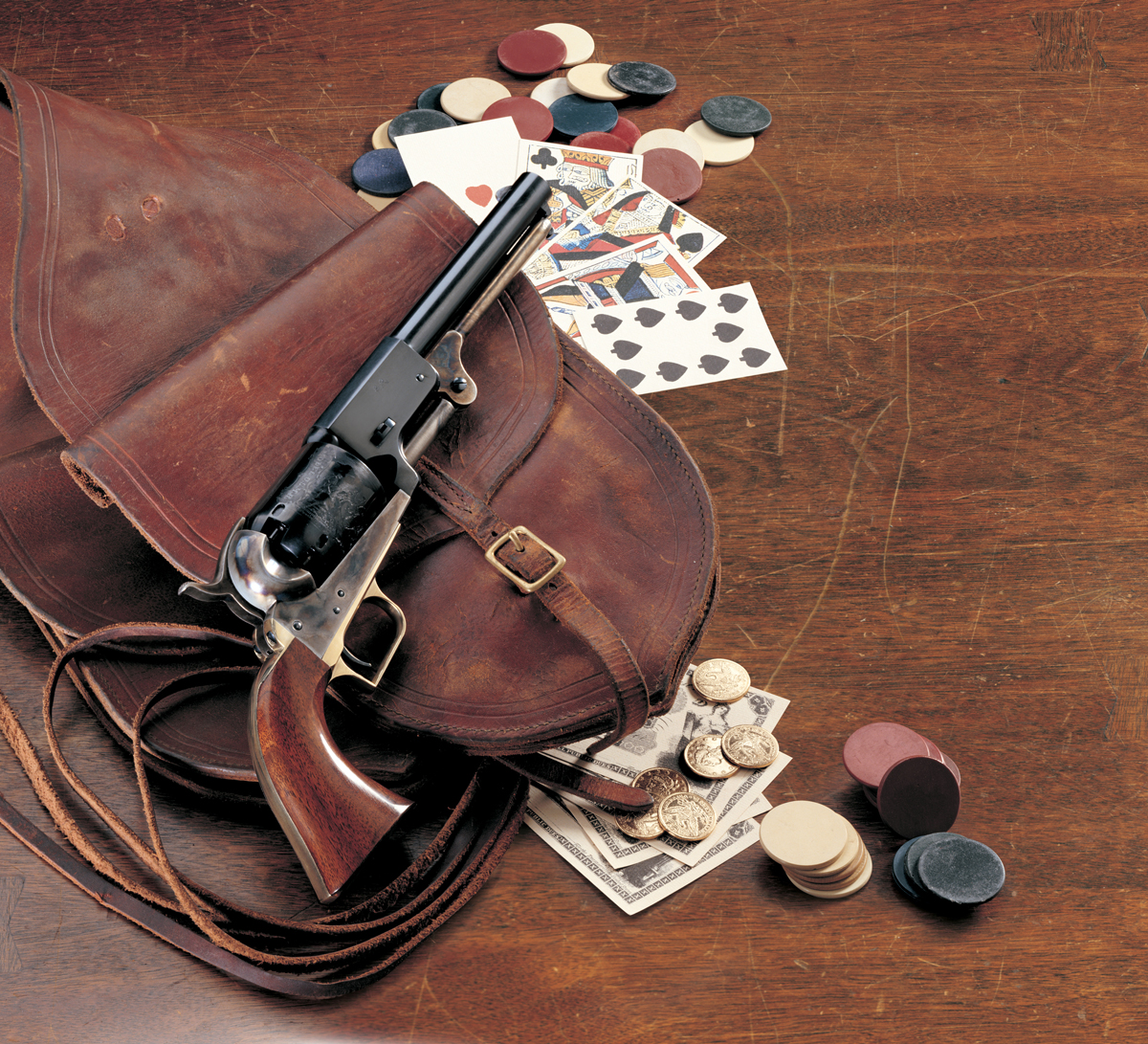
Know when to hold ’em. Uberti’s 1848 Dragoon blackpowder revolver.
The original Schofield’s—officially the Smith & Wesson Number 3—came in 44 Russian, 44-40, 38-40 and a shorter version of the 45 Colt, called the 45 American, all dead as mutton these days, except maybe the 44-40, but you will wither and grow old looking for a box. Uberti has solved the problem nicely, lengthening the cylinder slightly to accommodate the 45 Colt, which after nearly 150 years and making the transition from black- to smokeless powder, remains a primo attitude adjuster for man or beast. And yes, the Uberti Hardin can handle modern smokeless loads, tested by the Italian national proof-house.
With the spring-loaded ejector, the Hardin is a complicated bit of machinery, eight moving parts there alone, but the mechanics are positive and crisp and the cylinder locks like the snap of a jazzman’s fingers. Good steel here as you can expect as Uberti and Beretta hail from the same Italian region that has been producing firearms for more than 500 years. Uberti offers 50-odd replicas, everything from a cap-and-ball Colt Walker to a 20-inch barrel double 12 gauge suitable for “riding shotgun” next to a stagecoach driver, yippie-yi-yo, pass me a slug of Old Tanglefoot and let her rip!
Sweet stuff indeed.
The human frame has grown over centuries. Most of our heroes and villains were somewhat smaller than us and their clothes when displayed in museums seem almost tailored for children. So, while the Hardin’s grip might seem smallish to a contemporary shooter, it is period perfect and the expected muzzle rise is mitigated by its 43-ounce weight, its seven-inch barrel with integral rib, ditto for a shorter rib below the barrel, which houses the ejector spring. But still, with a 250-grain flat-nosed lead bullet at 700 plus feet per second generating 400 foot-pounds of energy, this pistol speaks with authority on both ends.
But oh, what a sweet shooter!
Even with the ongoing ammo shortage, I was able to scratch up 50 rounds from Georgia Arms, a company doing business some 40 years that had somehow escaped my attention. Located in a former north Georgia gold town of Villa Rica, the burg has a rich history complete with shoot-outs, horse thieving and vigilantes—perfect.
My range is safe but a somewhat lackadaisical affair, targets taped to pizza boxes stapled to pallets propped before dirt and sandpiles adjacent to my deer lease, but the neighbors don’t mind and the bullets don’t care. All shooting was done from a measured 25 yards, what I imagined was typical range for a gunfight or cavalry dust-up.
I knew better than to expect much out of the first six rounds from a new gun so the first cylinder full was offhand just to get a feel for the beast. Results were predictable but tolerable, a group the size of my hand. The “new” thus shot out of the bore, I set a couple of boat cushions upon the hood of the Jeep and got down to some serious shooting.
This revolver did not disappoint. Ammunition having tripled in price in recent years, I don’t do as much recreational shooting as I used to. With every shot, I hear a cash register ringing up a sale and the strength in my gun hand shows it. Typically, you could cover all the holes with a cat-head biscuit—except the last shot—invariably a flyer. But that’s my fault, not the Schofield’s.
This Uberti was a loaner, of course. But I knew soon enough I was going to have trouble sending it back. It’s that good.