
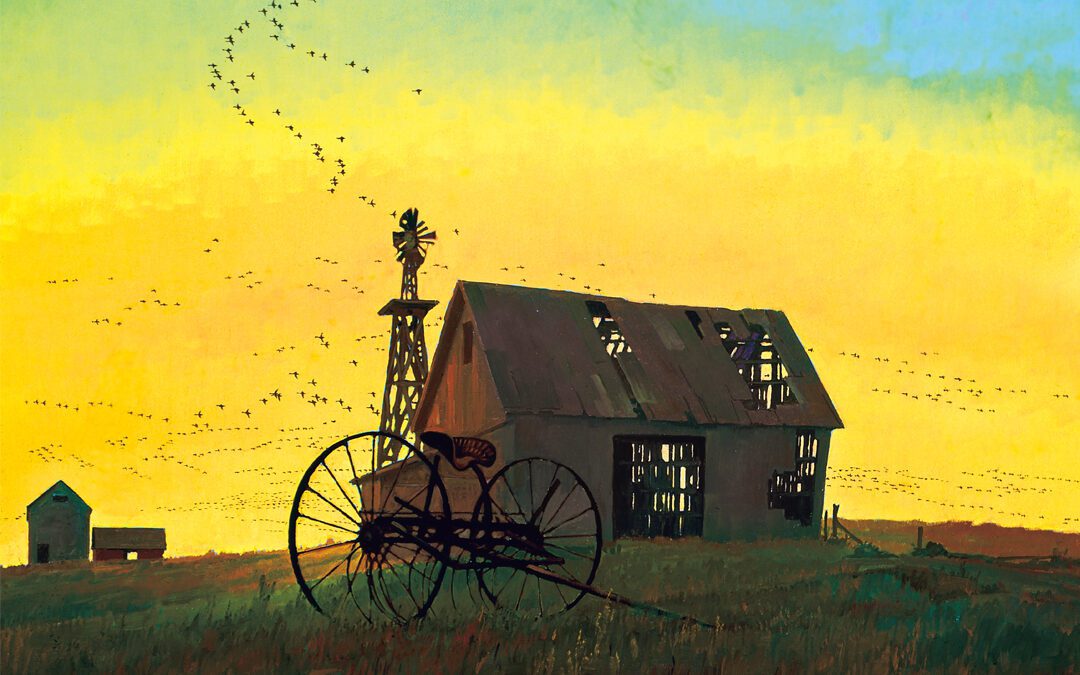
It had been 35 years since his father had killed the strangely colored goose, a feat that had set him apart from ordinary men. And now, hanging almost stationary overhead, its big wings fighting the howling winter wind, was his own legend.
Carl Oberg saw the bronze goose when he was a boy of ten. His father, who farmed a quarter-section a mile east of the Missouri River bluffs in South Dakota, had shot the Canada honker one wintry afternoon just before Christmas. When Carl came home from school that day, his father was standing in the doorway of the kitchen shed, waiting. He summoned Carl peremptorily, which was unlike him, and led the boy to the kitchen table, whereon lay the bird.
The goose was a large one, as Canadas go, scaling perhaps 11 pounds, even though it was not in full flesh. But the remarkable feature was its coloration. The breast was a peculiar yellow-brown, rather than the usual gray. Everything about the bird indicated a worn oldness. The black of its head and neck was shot through with odd, rusty streakings, and the cheek patch, ordinarily white, was the dull yellow of a wet chamois cloth. Its bill had the seams one notices in the faces of old men who have endured much weather. The scaly feet and legs were scarred deeply, and the claw of one toe was missing.
In her practical way, Carl’s mother recognized the age of the bird. “No use to cook that one,” she said. “He’ll be too tough to eat.”
But his father paid her no heed. He sat down and talked to Carl about the goose, describing the hunt and how he had killed the bird. Then he took the goose and hung it on a nail high on the shed wall. Next day he carried it into Preecely and showed it around and left it at Pete Larson’s cafe for further display. Pete carelessly put it in his woodshed overnight, and neighborhood dogs left only remnants of skin and feathers strewn about the alley. But men had seen it and wondered.
Around Preecely the bronze goose became a legend. The bird gained its title from Carl’s father’s description of the moment of glory when the sun gleamed on the feathers as the great form winged past him, almost at eye level, up the ravine between two knobs. It was a loner, a bird that left the river, fed and returned to it always alone. There were a few such geese each year, invariably old birds who had lost their mates.
The taking of the bronze goose had set his father apart, and men up and down the river came to hear the story firsthand. Those who had seen it declared the bird was of great age – 75 and perhaps 100 years old. His father had been a market hunter and was renowned for his big kills, but the bronze goose set him even further above ordinary men.
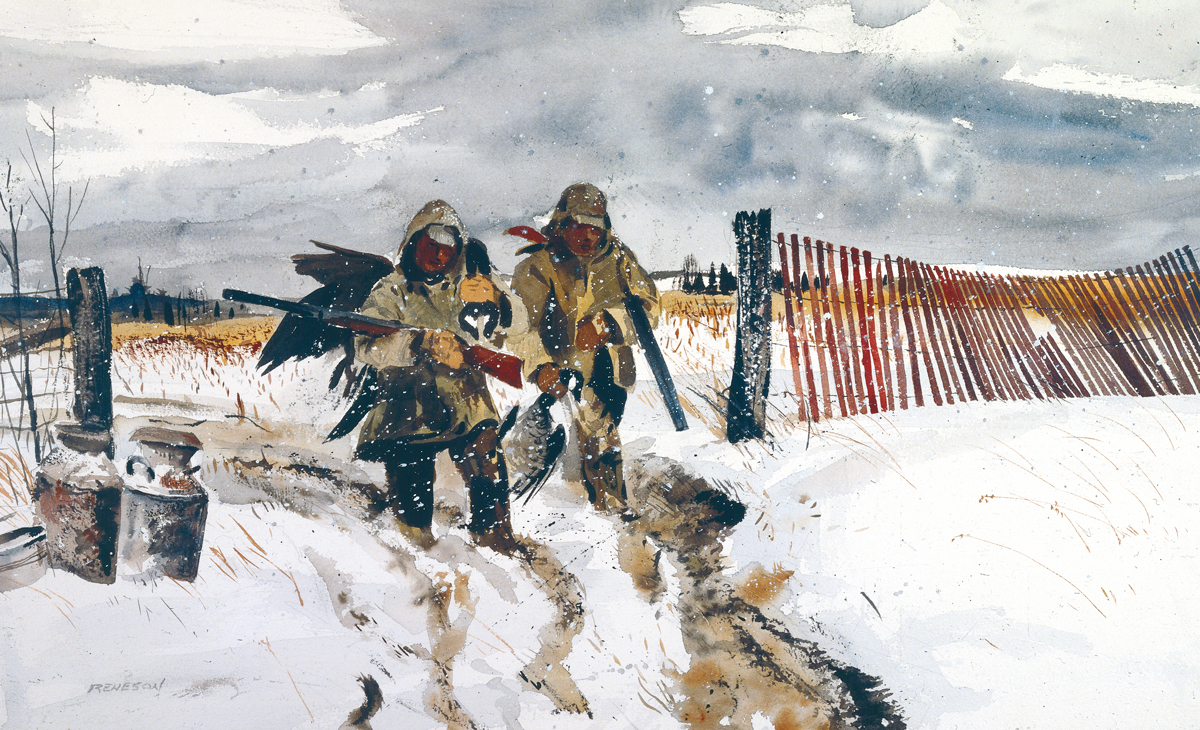
Snow Squall by Chet Reneson
Carl was thinking of those long-gone days as he sat in his grocery store office on a December day 35 years later. His eyes were on the frosted windowpane, and his ears heard the fierce gusts of the morning wind.
This wintry day marked the closing of the waterfowl season, and Carl had not hunted geese all fall. He and Dick Johnson, his longtime friend and hunting companion, had gone out for sharp-tailed grouse west of the river, enjoyed several duck shoots on their favorite slough, and taken a few cock pheasants. But a vast uneasiness worked in him concerning his beloved Canada honkers.
Paul, his son, coming up 12 years old, was involved in his refusal to hunt geese that fall. The boy was like the young Carl of the old days – same wiry-tough build, same shock of light hair, same alert blue eyes.
Come February, Paul would be 12. Then his father would present him with his first shotgun, a single-barrel .410. So Carl had promised and so it would be, but now he was troubled by the unquiet feeling that fathers have when they wonder if they are doing the right thing. It did not involve Paul’s safety; Carl believed boys should grow up with guns, under proper supervision. It went far deeper than that.
Carl stepped close to the window and scraped away a little of the frost. Winter whirled outside. Fine, hard granules of snow fled down the alley and spilled from the roof in quick smoky bursts.
Carl turned away again, weary with his problem, despairing of its solution. Again the question racked his mind: “How can I be selfish enough to give him a love of wildness and wild things when soon none will be left for him to love?”
For years the waves of migratory waterfowl that swept from Canada’s breeding grounds each autumn had been diminishing. Unthinking men might not have noticed it, for this region had always been a stopping-off place for mallards and Canadas. But everywhere the sloughs were being drained. It was like a fever among farmers in the state, this eagerness to ditch and tile. Where once the glistening, reed-bordered sloughs had been common, now a man could drive for miles and see no water.
In the old days, goose hunting had been a matter of talking with friends who farmed beside the river bluffs, then waiting along the fencerows of the stubble fields and cornfields, or up on the hills for the flights. But then, gunners began to multiply and farmers got the notion of selling hunting rights on their property. Some would even guarantee a goose, and to make good they built elaborate decoy setups and pits. They let the corn stand, picking 10 or 15 rows twice a week to keep the geese coming to the fresh gleanings. Baiting was illegal, but this was not. Hunting became a commercial thing, an ugliness where once was joy.
It was a pitiful remnant he was leaving to his son, he and all the other men who had shot strongly and well – perhaps too well – from their youth on. The legions of wildfowl funneled down the Saskatchewan breeding grounds through the Mississippi Flyway, thousands remaining in the Preecely vicinity until the blizzards in their white fury buried the forage fields. Even so, incredibly, a few thousand wintered in the flats, honkers and mallards, gorging themselves when the wind or a thaw removed the snow from the knolls. Carl had even seen them alighting in feedlots, flatly treading beneath the cattle in their hunger. Before a blizzard, they sensed the change, and in the old days when winter shooting was allowed, he had killed mallards so stuffed with corn that their breast skin split open when they struck frozen ground. The old days . . .
Yes, a small heritage to leave a son. Then he thought, Maybe I’m all twisted around. Does my son – does any son – want what I’ve loved so well? Today’s kids were different. They had so much more, and so much less. Were mothers changing too? In this day the outdoors had been a boy’s natural home, a gun or fishing rod his companion. Anna, his wife, took a cool view of hunting. “Paul and the other children have television,” she had said one day. “Let them watch it. They learn things; they’ll be smarter than we ever were. I always know where they are when they’re home. Let things be. Don’t go putting ideas in his head.”
Carl was shaken and angry. “Hunting’s better than television, at least. It’s better than staring at that screen all the time.”
“Television’s civilized – it’s not like lying out all day in the mud like a savage, waiting for a bird to shoot at.” She stared at Carl. “It would suit me fine if you’d stop talking about hunting to him – stirring him up.”
Maybe that was it. Maybe he was building up a love in Paul for something the boy could never attain. Maybe that was cruel, though he did it in all kindness.
This torment was too much, too much. Suddenly Carl felt he must get into the storm, face it, buckle into the raging wind, and shout his lungs out in fury at time and men – who take and do not give back. With a gesture of decision he strode into the outer store.
“Mary,” he said to his niece (and only clerk), call Dick and tell him I’ll pick him up in half an hour. No goose in his right mind will fly higher than a telephone wire today.”
Mary’s eyes widened in surprise. She had been well aware of his inner turmoil, though she couldn’t quite fathom the reason for it. Now she smiled warmly, her ear at the phone, as he put on his coat and walked to the door.
She’s glad for me, thought Carl. Then it’s been showing! His mouth twisted wryly. As if a man could shoot geese almost all his life and then abruptly refuse to hunt them, and the strain, the turmoil, not show!
He hunched into the wind and the stinging grains of snow. Winter had come early, more bitter to the cheek than February would be when a man was used to it. He shivered, excitement beginning to tingle in him. A wind like this and a hunt impending – would it ever be otherwise, this lifting of the head, this sniffing the raw wind, this feeling of elation like that of a small boy hurrying to the fair?
Give it up? Carl shook his head, thinking, not today, Let this be the last of it, if it must be, but for today, live it, live it! Maybe, when he was on the bluffs of the Missouri, lying on the snow waiting for the honkers to come off the sandbars, watching the black mass of them far below, something would tell him what he must do.
His wife met him at the door, a worried look in her eyes. “What’s the matter, Carl? Did you forget something?”
He shook the snow from his storm-coat and hung it carefully on the hallway hook. “No, Dick and I are going after geese.”
Her mouth went flat. “I knew you’d give in. I’ll bet he bothered you all morning.”
“Haven’t seen him,” said Carl. “I had Mary call him for me.”
“Carl, I thought – ” His wife paused. “Never mind, I’ll fix you a lunch.”
“Make the coffee good and strong.”
He loaded the car, carefully checking each item; heavy flight pants, sheepskin coat, wool-lined helmet and mittens, the box of magnum 2s. It felt good to handle the maggie loads again. The heavy sheepskin coat, pants and helmet he would not put on until they reached the hunting ground.
In the kitchen Anna was packing lunch in his rucksack. Without forethought he said, “Too bad Paul’s in school. He could go along.”
Anna tucked the vacuum bottle in the rucksack, paused a long moment, then turned and fitted the strap on his shoulder. She shook her head slightly, but her eyes held a fond, humorous tenderness. “You’re hopeless. And Paul is just as bad. When I tell him you went for geese, he’ll have a fit. But tonight you tell him there’s always next year. Go on. Dick’s waiting.”
Carl stooped and kissed her cheek roughly, embarrassed, and patted her shoulder. He nodded. “Next year. We’ll see.”
When he pulled to a stop at the curb, Dick rushed down the walk, laden with gear. He flung the armload in the back seat and leaped in beside Carl. “You old devil! It’s a good thing Mary called when she did, or I’d have been long since gone. I gave you up for lost two months ago.”
Carl grinned. “I figured somebody had to show you how to hunt geese.” Swiftly he meshed the gears and drove down the wintry street.
In some places the blowing snow almost obscured the road. It was a ground blizzard; faintly overhead the sun shone. The fields lay barren to the eye without a dab of brightness anywhere, as if gaudiness had no place on the winter plains.
Wind beat against the car, and streamers of fine snow raced across the gravel. Strong winds, snow-laden, made geese restless. On the sandbars small groups would be rising out of the main body, winging heavily into the wind a few feet above the sand, slighting a short distance away. A continual lifting and settling would go on, without purpose.
Carl turned south off the gravel onto the section-line wheel ruts. The unused road was drifted shut. Blowing snow obscured the outlines of the bluffs a mile away. Dick grunted. “I figured she’d be blocked. Is it worth the hike or shall we take our chances on the public shooting grounds? The road might be open into them.”
“Let’s try here,” said Carl. “Looks like we’ll have it all to ourselves.”
They pulled on the heavy outer clothing and slipped the guns from their cases.
“Leave your lunch and binoculars in the car,” said Dick. “I’ll carry mine and you can carry the geese.”
The northwest wind lashed them as they crossed the fence and plunged through a knee-high drift. The fury of driven snow was blinding. They headed south, following the fencerow. The flat haylands gave no indication of the river’s nearness, but seemed only an endless prairie land. The road ended at the final fenceline. Gasping, they floundered through a drift in a slight depression and attained bare ground beyond. The wind pushed them up a gradual incline, and abruptly they were on the brink of the valley. The suddenness of its appearance never ceased to affect Carl.
Across the huge sweep of the bottoms swarmed the loose, dry snow, almost obscuring the opposite ridges, whose summits were four miles away. The river here followed a southeast tangent for three miles, the curve southward beginning two miles downstream from where they stood. The wind roared and it seemed impossible that any living creature could long endure it in the open.
A hundred yards to the east the stubble of a cornfield was containing the bulk of the driven snow. Carl silently jerked his head in that direction and they moved toward the field. Behind them the little arcs of drifts formed by their feet vanished instantly. At the edge of the cornfield the blizzard ended as though a solid wall had been upthrust, and the wind howled much less furiously.
“They’re there, all right,” Dick shouted. “They’ve kept a pothole open just this side of the trees.” He unstrapped the binoculars from about his neck and handed them to Carl.
In the lenses the geese were a black mass the size of a saucer. Two or three thousand birds, guessed Carl, and he sighed aloud.
“How shall we work it?” asked Dick.
Carl lowered the glasses and peered at the place where the geese were gathered. Now he could see nothing of the black saucer. But knowing the location, he had to figure where the geese would come out across the bluffs – and that might be at any point in the five miles of heights. Then, too, the utmost range at which Carl would shoot was around 50 yards. Many factors had to be weighed before they picked their blinds.
Carl knew that once the leader of a flock became used to certain ravines, it preferred to take its flock out through one of them. But wind direction was important. The geese always chose to buck the wind, as all birds do, being then in absolute control, their feathers lying tightly against their bodies. Against a storm of too great velocity, though, they could not make sure headway; so they’d quarter, flying at an angle into the blast until they cleared the bluffs, then turning upwind. In a gale they often flew downriver with the howler on their tails, then gradually turned and raised the bluffs with the force still behind them – “hindquartering,” Carl called it. This last offered the most difficult of shots for the hunter, since the birds hurtled past and were usually at the extreme limit of range.
Carl squinted into the haze, gauging the wind’s strength, its exact direction. Within him his “goose feeling” was working, a thing he could not explain. But it was a true indicator composed of the experience of other days – wind velocities, blown snow, biting cold and flights materializing out of the wintry scape. So now he let the thing work in him.
Dick always chided him about it, but had respect for it all the same. He was grinning now. “Stomach rumbled yet?”
Carl pointed a mittened hand across the slopes. “They’ll come out across that section. Some of them, not all. They’ll be broken up today. Only a few bunches. The rest will go out with the wind down below.”
“Where shall we dig in?”
“You take the head of that ravine. I’ll stay this side of you about a block.”
Dick lifted his fist, pulled it down twice in their old salute – a gesture of hoped-for-success or of success attained – and plunged away through a drift. Carl watched him go, smiling. Then he peeled his sheepskin sleeve back to get at his watch. Eleven o’clock. It wouldn’t be long, if the geese were coming out this way.
He followed Dick’s tracks until he came to the nearer edge of the long ravine. His partner was busily kicking snow ten yards below the summit on the farther side. Carl slid down the hill and found a gouge four feet deep, cut by a spring freshet. He cleared the snow from it, alternately scraping and packing till he had a level stand for his feet. Then he placed a tumbleweed in front of him, leaned his gun against it, lifted his earflaps and listened intently. He heard nothing but the wind.
The air was not so thick with flying snow down the long ravine. He could make out dimly the shadow of the trees on the river bottom, and see quite clearly the network of the years below him. He had a quick, warm feeling that only yesterday he had stood on these same bluffs with his father, when the wind keened a song of hot-blooded youth, not of age and disillusion mournful with loss past recovery.
He heard a faint shout, instinctively he crouched behind his tumbleweed, seizing his gun. His heart pounded. He peered through the twiggy mass, slipped off his right mitten and thumbed the safety, letting his eyes rove the sky, seeing no movement.
Dick shouted again, unintelligible. At the same moment he heard it – faint, far and shrill, the sound like no other on earth or in heaven, the crying of geese in flight. The great, crushing weight of regret dropped away from him. Then he glimpsed the powerful, sustained rhythm of beating wings.
A bunch of five had begun their feeding flight. They were already across the first low ridges and but a mile away, quartering the wind toward the blinds. Which ravine would they follow? A trembling began in Carl. He slid the safety forward on his gun.
The flight began to lift slightly for the snow-rising mounds. On it came, the cries clamoring through the valley. Peering at the geese through the tumbleweed made them seem within range, so hugely they loomed. But Carl remained crouched as if frozen. Wait, wait, scarcely breathing, bare hand stiffening in the cold, praying for them to come over, the ancient hunter’s prayer with eyes fixed on the quarry, “Come, come, keep coming, come, come.”
Then, when it seemed certain they must pass within range, they shifted gradually upward and followed the ravine to his right, momentarily disappearing from view behind the hill, reappearing to struggle over the height a scant ten yards above the ground. Their cries diminished until he couldn’t hear them no more.
Carl shivered and stood erect, his knee joints aching. More would be coming, he knew. He had selected their positions well; he and Dick should get shooting. But the thought was in him. What if that flock were the last of all the honkers on the continent, vanishing over the bluff into nothingness forever? The wind sound was the more desolate now for their having given it life. How irreplaceable were the creatures of the air and earth!
Cries began again down the valley; more flights were on the wing. For an hour the flocks continued to come. Several times Carl was tempted to shoot, but the birds were wide. His magnum would bring them down at that distance, but he did not want to take a chance of crippling.
Dick was shooting. Carl looked in time to see one of a flock of nine falling heavily. As Dick leaped from his blind, Carl shouted, lifted his arm and gave the salute. Dick waved. My turn now, thought Carl.
A flock of four, which he had believed would pass as wide of him as the others, heavily attempted the bluff to his right, but could not gain headway. Four straining bodies gave ground, swinging over Carl’s ravine, lowering to 20 yards above the twisting bed. They came directly at him.
Carl let them come until the brim of his helmet hid them from view. He waited five more seconds till their cries were a torrent overhead, then rose. Instantly they flared, shrill alarm in their throats. He picked the last and laid the ribbed barrel just ahead of its bill. It collapsed at his shot. Instinctively he swung on the next bird, had it full fair above the barrel – but did not press the trigger. The three remaining geese crossed the ridge.
Carl stepped out of his blind. His bird lay motionless at the bottom of the slope. But before he could move to retrieve it, he heard Dick’s yell. A warning note was in the shout, and instantly he leaped into his blind. A flock was working in front of him a mile away but too far to the west; they would break over at least three ravines away. What was the matter with Dick anyway?
He almost rose, but the single plaintive utterance, which could only be that of a loner, caught him in time. The bird was close, very close, but where? Frantically, he searched the sky before him. It was maddeningly difficult to place the position of a loner by its cry. He was afraid to move his head, knowing the bird must be almost within range.
Then, from almost directly above him, the single note came again. Carl came up in one smooth motion, bringing the gun to his shoulder. The loner was above him, slightly wide, hanging in the wind high enough above the snow gusts, perhaps 50 yards, for the sunlight to strike the feathers. The glow on the burnished breast was unmistakable – a dull yellow, like no other, the color of bronze.
Carl brought the tube in front of the almost stationary head. A squeeze of his finger would have tumbled the bird in a stone-dead fall, but the goose emerged before the barrel slowly and hung beating there. Then, unable to make headway, it flared with the wind under its wings and fell away down the slope into the ravine, where lesser air currents enabled it to turn and throb slowly up over the summit to disappear in the blowing snow.
Dick arose from his blind, picked up his goose and half ran in excitement to Carl. He dropped on his knees, panting, eyes alight, a broad grin on his face. “Wasn’t that a sight! You sure folded your bird. What happened, your gun jam on that lone bird?”
“Yeah,” said Carl slowly. “Yeah. Could you see him very well from where you were?”
“Not too well. Looked like a big one, though. What’s wrong with you? You look like you saw a ghost.”
Carl attempted a smile. “Just half froze is all. You’ve got a nice young one there.”
“Hey, I’ll get yours,” Dick plunged down the slope.
Carl gazed up at the bluff over which the loner had gone. It could not be – yet he had seen it. He had a sense of unreality as though he were his father on these hills. But his father had taken his bronze goose – and he had not.
Dick returned, hefting the goose critically. “Same as mine . . . about eight pounds. A pair of table birds.”
Carl took the birds. He thrust his fingers through the gray breast feathers, stroked the black sheen of the head and neck, thinking: So I could be holding the bronze goose this moment.
“Let’s eat and coffee-up,” said Dick. “Looks like the flight’s about over, but we ought to stick it out. The wind will go down this afternoon. Won’t have to buck it back. We might pick up the other two birds we’re allowed.”
“Okay,” said Carl. He felt a little sick.
The wind began dying at four o’clock, and at sundown the air was still. Only one more flock had left the river, and it had passed far to the east of them. The river valley was visible as far as the eye could see. The ancient folds lay frozen in the trance of winter. Not a solitary living creature was visible. They emptied their guns and stiffly climbed the bluff. At its summit they paused.
“Listen,” said Dick.
Faintly, then Carl heard them. Swiftly he searched the sky.
“Look at them come,” Dick pointed.
Against the bright, luminous sky one sees just after sunset on clear, cold days the geese were etched, flock upon following flock. Those farthest away bore on with steadily beating pinions, the nearer birds beginning their glide, great wings cupped. It was beautiful beyond speech, almost heartaching to behold, and suddenly back across his curved arm, and without reason (but with a certain knowing), he saw that the gun gave the sight a greater beauty, for it was his hunter’s soul that transfixed him at the sight of the living splendor overhead.
“I pray to God,” said Carl, “this never leaves us, or we shall be poor men.”
“Amen,” said Dick.
Carl thought. If men always love it, they will never lose it. But how can men – youths now – like Paul love it if they never get to know it.
Then he knew what he must do. Banish despair, for despair was lack of faith in his son, other sons – a generation of them. His father had been a market hunter and Carl himself had killed beyond need in his own youth. Why could he not teach his son moderation, instead of letting him learn it with pain, as he had so late?
Strangely it is the hunter who loves the birds most, who grieves at their passing – not because there will be no targets aloft for his gun but because he knows best, by being closest, the glory he has inherited, along with the struggle, on the bleak plains.
The words he had read of the New Englander, the hermit who was so fiercely engaged in man’s well-being, the man Thoreau, came to him now. “We cannot but pity the boy who has never fired a gun; he is no more humane, though his education has been sadly neglected.”
And Carl thought. How shall I be close to my son save in these things? And with a fierce gladness he realized he had left Paul a bronze goose too – even if the boy never saw it.
“I hate to go,” said Dick, “but maybe we’d better. Here, I’ll carry your goose.”
“No,” Carl said. “He’s not so heavy as that, nor I so old.”
Carl lifted his bird and hoisted it over his shoulder, pausing for a final look at the valley. Far out over the river, the last flocks were spiraling swiftly in corkscrew fashion to join the others on the sandbars. As they always would.
Editor’s Note: Kenneth Otterson lived in Sioux Falls, South Dakota, when this article appeared in December, 1956 issue of Field & Stream.