
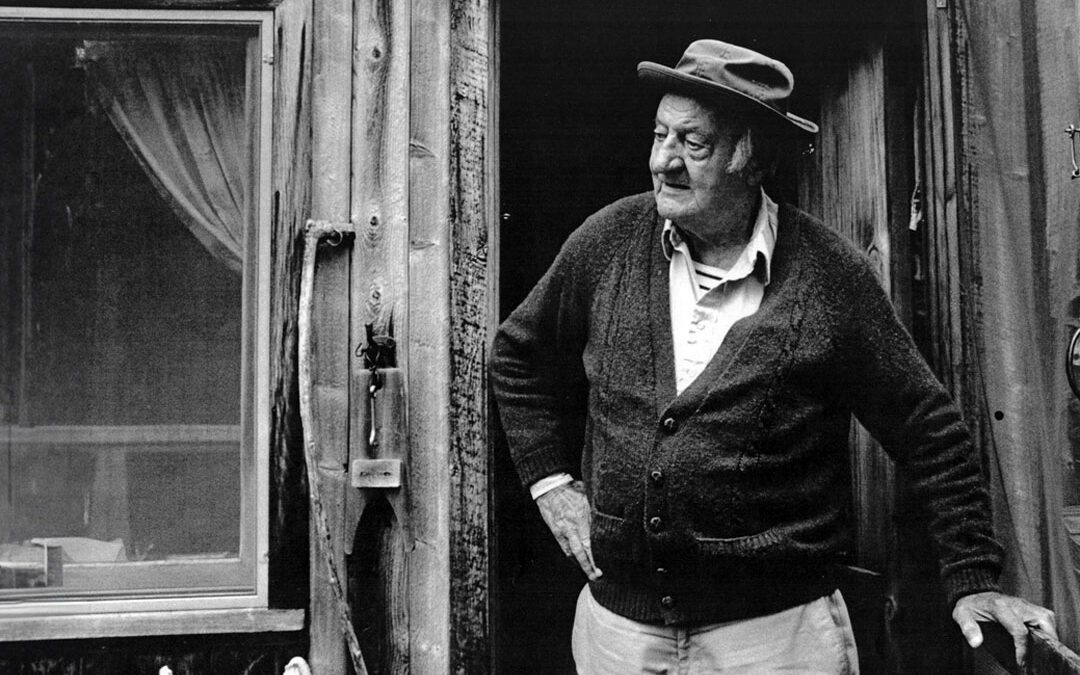
More years ago than it is completely comfortable for me to ponder, I wrote a series of profiles on celebrated angling writers for a little publication, Fly-Fishing News. The bimonthly offering, featuring noted sporting scribes such as John Gierach, Lefty Kreh and Paul Schullery, has long since gone the way of countless other short-lived periodicals devoted to covering one aspect or another of the outdoors. I wrote for enough of those extinct offerings to plant a tiny, niggling doubt in the recesses of my mind to the effect: “Did you contribute to their demise?” There’s little likelihood my scribblings made a scintilla of difference on the economic front. Moreover, I can take comfort in the fact that my byline has appeared in the present magazine almost since its inception, and Sporting Classics continues rolling right along. Accordingly, I’ll not worry too much and get directly to the matter of the moment.
One of my early profiles in Fly-Fishing News focused on Robert Traver, the pen name used by John Voelker. I completed a fairly lengthy piece on him in 1987. He was already in his 80s and would only live for a few years after the article’s appearance. Fortunately, the vignette met with his approval and produced a totally unexpected but most welcome reaction from him. In the course of a lengthy and delightful phone conversation, he invited me to head northward and visit him in his beloved Upper Peninsula of Michigan haunts. “We’ll catch some brook trout and drink some bourbon from tin cups,” he said. “I think you’ll find the experience enjoyable, and I guarantee there won’t be people everywhere you turn.” We would have presumably operated out of his beloved cabin adjacent to the retreat he called Voelker’s Cabin.
To my lasting regret, I didn’t take advantage of this gracious gesture, and it has to be reckoned as one of the bigger mistakes I’ve made in a career communicating the outdoor experience—and rest assured, I’m made a passel of ’em. A few short years later the grand old man was gone (he died in 1991, not far shy of nonagenarian status). With his passing vanished the opportunity to share that most precious of all commodities, time, with a master of his craft. For master he was, leaving us a legacy of delightful reading that belongs on the shelves of every fly fisherman and indeed in the library of anyone deeply interested in sporting literature in general.
One merely has to read a short excerpt from his beautifully crafted “Testament of a Fisherman” to realize that he was an individual with a deep, penetrating understanding of what linkage to the wild world meant:
I fish because I love to; because I love the environs where trout are found, which are invariably beautiful, and hate the environs where crowds of people are found, which are invariably ugly. My fishing is at once an endless source of delight and an act of small rebellion; because trout do not lie or cheat and cannot be bought or bribed or impressed by power, but respond only to quietude and humility and endless patience.
Those words express, simply and wonderfully well, the mental state that brings us to the water and soothes our troubled souls once we are there. Moving as they are, these thoughts are wonderfully complemented by those with which Traver completes his “Testament.” He reckons that he fishes “…not because I regard fishing as being so terribly important, but because I suspect that so many of the other concerns of men are equally unimportant—and not nearly so much fun.”
The individual who brought this type of wisdom to the printed page has become, thanks to three eloquently written and rightly treasured books on fly-fishing, a sort of cult figure among fly-fishing literati. In Trout Madness: Being a Dissertation on the Symptoms and Pathology of this Incurable Disease by One of Its Victims (1960), Anatomy of a Fisherman (1964) and Trout Magic (1974), Traver captures much of the sport’s elusive essence. Add to that stellar trio of books a posthumous collection edited by Nick Lyons, Traver on Fishing: A Treasury of Robert Traver’s Finest Stories and Essays About Fishing for Trout (2001), with two profiles of Traver included, and you have many an hour of delightful leisure reader in the offing.
The man who left us this fine legacy was born John Donaldson Voelker in Ishpeming, Michigan, in 1903. He called that small town home for virtually all his life and once told me: “I like it here and I’ve never been much of one for travel.” He was the youngest of six sons born to George Oliver and Annie Isabella Voelker. Ishpeming was a mining and logging town near Lake Superior and his father was a saloon keeper who married the local public school music teacher. To this union Voelker laughingly ascribed the fact that he loved “to drink and listen to music.” Always a man who enjoyed a tipple with the locals, he reckoned this was only fitting since “my father ran the longest bar on the whole Upper Peninsula and my grandfather built three breweries.”
Voelker showed precocious literary leanings and wrote his first story—a piece about a bear—at the age of 12. His reminiscences about this initial foray into writing typify the humorous, introspective outlook he exhibited throughout his long life: “My mother thought it a work of genius, though when pressed she conceded the characterization was a trifle thin—a comment sometimes made by less ecstatic critics about my later work.” That peculiar impulse, muse or whatever force compels dedicated writers, was present in Voelker throughout his life. Even though he achieved considerable distinction in his judicial career, in his middle years, not long after publication of the blockbuster Anatomy of a Murder (1958—the novel, based on a real murder, became a hit Hollywood product through the efforts of filmmaker Otto Preminger), Voelker decided that literary endeavor was his true métier.
At the time he had just been elected to a second eight-year term as a justice on Michigan’s Supreme Court. The conflicting demands of a full-time judicial career and the pull of writing became too stressful for him, and as he subsequently stated: “A writer cannot always predict or control his literary impulses.” Something had to give, and Voelker made the decision in a manner that says much about the crusty yet endearing nature of the man. One day when the clerk of court brought him his judicial robes, as was the custom before the commencement of each session, Voelker simply said: “I’m through. I’m going fishing.” Many of us, while likely lacking the determination to carry such thoughts to fruition, can readily identify with his “take this job and shove it” sentiments.
Anatomy of a Murder was actually Voelker’s fourth book although his first venture into fiction. Previously he had written Troubleshooter (1943), Danny and the Boys (1951) and Small Town D. A. (1954). He would produce other novels, Hornstein’s Boy (1962), Laughing Whitefish (1965) and People Versus Kirk (1981). None of them enjoyed anywhere near the success of Anatomy of a Murder, although a collection of essays on the law with autobiographical overtones, The Jealous Mistress (1968), did garner appreciable acclaim.
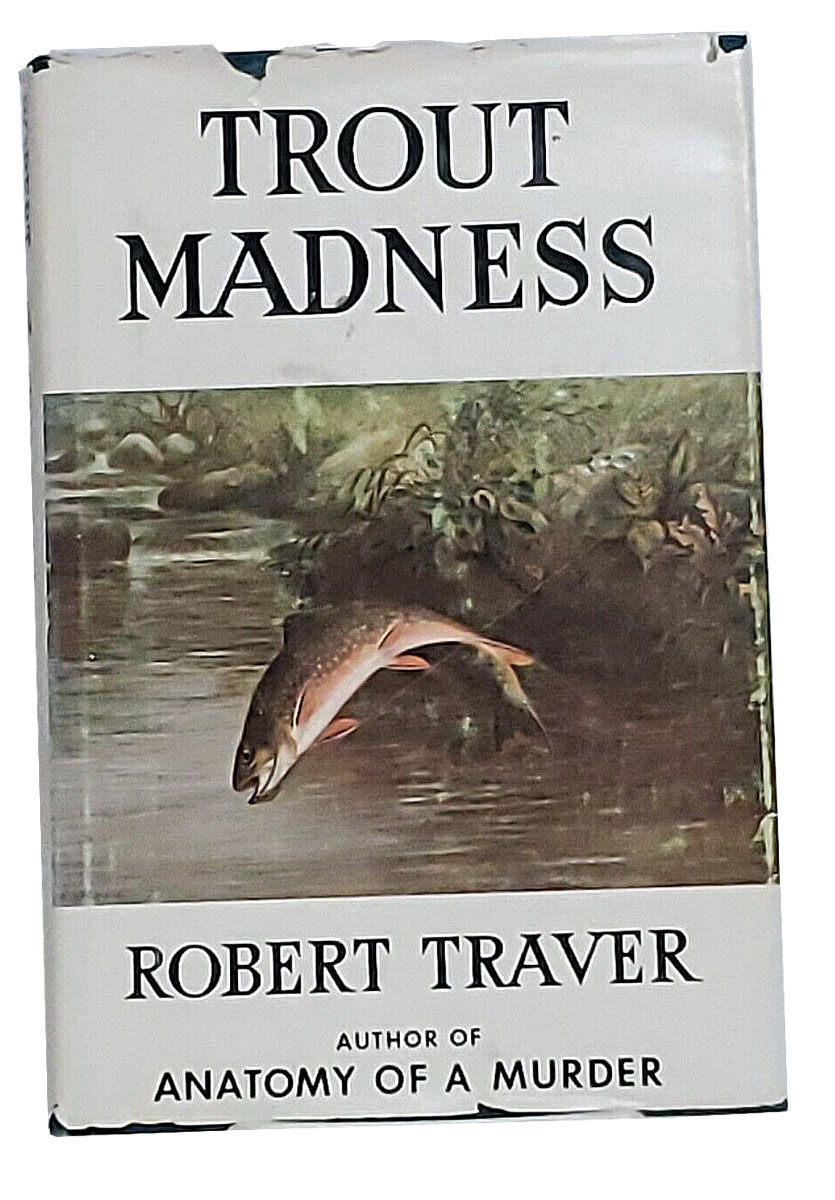
His first fishing book, Trout Madness, was a different matter. For one thing, it enjoyed fortuitous timing thanks to being published close on the heels of Anatomy of a Murder and, according to Traver, “publishers and magazines were bidding for it furiously.” Within its targeted audience the book enjoyed near universal acclaim, as did the two fishing book sequels. Selections and chapters from the last volume in the trilogy, Trout Magic, first appeared in national magazines such as Esquire, Sports Afield, Fly Fisherman and Field & Stream. Trout Madness was also made into a movie, and the author appeared in the production.
Voelker’s angling writings earned him increasingly widespread recognition and multiple honors. He garnered a number of conservation awards, was acclaimed as Rod & Reel magazine’s Fisherman of the Year, appeared in Charles Kuralt’s “On the Road” television series and in 1982 was recipient of the Arnold Gingrich Award. When I once asked him about these plaudits, Voelker seemed bemused but then indicated that he did find the Gingrich Award particularly satisfying, echoing, as he did so, Gingrich’s thought that “fly fishing is such great fun that it really ought to be done in bed.”
He was a complex figure and undoubtedly what folks in the area of the world where I grew up, North Carolina’s Great Smokies, like to describe as a “sho nuff quair character.” That depiction isn’t meant to be disrespectful in any sense. Rather, it is a way of describing someone who is delightfully different —curmudgeonly but genial, grouchy yet gracious, opinionated though open to the views of others. Voelker was such a man. He had simple yet strong passions—a love of gathering mushrooms, sharing a drink with fellow anglers or local buddies, offering unfiltered opinions on political figures and conservation issues and playing cribbage. He once asked me: “Sir, do you play cribbage?” I answered in the affirmative but hastily added that my skills in the game were rather indifferent. His immediate rejoinder was, “Well, you’d be welcome in my home.” Obviously he readily recognized a sacrificial lamb begging to be offered up at the game board.
A man with his kind of zest for simple pleasures, along with a rare talent for capturing the essence of what gives fly-fishing its singular appeal, is a treasure beyond measure. To share his insights, through the pages of his books, is to be at once enchanted and energized. In the former regard, his writing is so sure and pure it mesmerizes, and all the while as one reads your mind is being infused with deep appreciation for the things in life that are truly important. The man angling posterity knows as Robert Traver not only understood priorities, he had the guts, in mid-career, to act on them. For that we owe him a sizeable debt of gratitude.
Jim Casada, longtime Editor at Large and Books Columnist for Sporting Classics, has written a number of books on fly fishing. To learn more about them, visit his website, jimcasadaoutdoors.com. Also, one of them, which he considers among his most important works, award-winning Fly Fishing in the Great Smoky Mountains National Park: An Insider’s Guide to a Pursuit of Passion, is available through the Sporting Classics Store at sportingclassicsstore.com
or by calling (800) 849-1004.