

Ernest Hemingway, Wallace Stephens, Mark Twain and a Cock-eyed Consideration of Time and Space
Wallace Stephens wrote an obtuse poem, “An Idea of Order at Key West,” wherein this gal was singing on the beach at sunset, about 1934 near as I can figure, and Stephens was walking along with his buddy Ramon Fernandez. It was early summer, the pink shrimp were running and the trawlers were anchored and all lit up when the Pulitzer Prize Poet busted loose:
Oh, blessed rage for order, Pale Ramon.
The maker’s rage to order words of the sea,
Words of the fragrant portals,
And of ourselves and of our origins,
In ghostlier demarcations, keener sounds.
I reckon this means to you the same as it meant to me first time I read it, not a damn thing. But halfway to a PhD in English, Almost Doctor Pinckney got it deciphered: Lay it out, line it up, sort it out and you can figure it out, this Blessed Rage to Order. It turns the seawind and a fleeting song at sunset into poetry and life into literature.
But there was no order at Key West, then or now and if you’re ever tarried there, you will know this is true. Stephens walked up the dock and got his nose busted by Ernest Hemingway in a bar-side boxing ring. Pale Ramon should have talked him out of it. Hemingway had a mighty right arm from cranking in marlin and tuna and he used a right hook to considerable effect. Pappa won the fight and—20-odd years later—the Pulitzer, too, but for The Old Man and the Sea, not for busting Stephens’ nose. There was no prize for that.
This blessed rage to order. And there seems to be nothing more important than the rage to order Time and Space.
“Let there be lights in the sky,” the Good Book says, “for signs and for years and for days and for seasons.”
Our ancestors watched the sky, nothing much else to do after dark, feed the fire, gnaw bones, try not get snatched by a saber-tooth. They had a quarter million years to ponder the heavenly Rolex. But there were problems. The stars and the moon and the sun do not easily fit the blessed rage. Like Grandpa at the kitchen table playing solitaire with a deck of 51, oblivious to the great clash of heavenly clockwork above the sheetrock, we struggle yet.
The earth rotates around the sun in 365 days, a number that defies regular mathematical division. Worse yet, it’s not exactly 365 days, but 365 and one quarter days, necessitating months of varying lengths and leap years to keep everything in sync. Various attempts at ordering the days have resulted in at least two calendars in recent times, the Gregorian and the Julian. The Russians used one, the rest of Europe the other, so if you study Russian history, you’ll have to memorize two dates for each event.
At least the wobble and tilt of the world upon its axis is regular, but it puts Christmas in the winter in Manhattan but summertime in Buenos Aires where the one-horse open sleigh is a patent absurdity.
The moon, meanwhile, goes its cold, silent and lonesome way, revolving around the earth exactly every 28 days, moving women and the tide, which rises an hour later each day, even when women are punctual. For a good laugh, read Hemingway’s telling of a late-night conversation between two Spanish sentries in For Whom the Bell Tolls, debating the advantages of solar versus lunar months where the frustrated solar advocate ends the conversation in a literal translation of Spanish, “Inseminate thee and this of thy moons!” And if you know Hemingway, you know he did not make this up.
’Nuther consideration, if you need one. Twenty-four hours in a solar cycle, the earth is 24,000 miles around at the Equator, easy math for once, one time zone every thousand miles, but it necessitates an International Date Line where one day becomes yesterday, or tomorrow, depending which way you cross it. And the time zones mean absolutely nothing to a waterfowler when legal shooting is generally at legal sunrise or sometimes half an hour before, giving a goose hunter west of St. Paul a 17-minute jump on one west of Fargo.
A practical use of this aggravation was noted back in 1675 when King Charles, II commissioned a royal observatory at Greenwich, England, where the precise time of the rising of the sun was noted on the best clocks in the realm. In typical modesty, the English then drew a line through Greenwich from pole to pole and named it the Prime Meridian. Get a clear shot of the sunrise from the deck of a ship, note the time and you will know how far east or west you are from Greenwich, your longitude. Latitude, your distance north or south of the equator, is fixed by determining the degrees of certain stars at certain times above the horizon, a nice trick in foul weather. Nearly 500 years later, GPS satellites will still give you your position, rain or shine, based on that imaginary line from King Charles’ day and the world-wide standard time is Greenwich Mean Time.
But Congress had to get involved by mandating Daylight Savings Time as an energy saving gimmick during World War I and like the income tax, we’ve been stuck with it ever since, the “spring ahead, fall back” bovine excrement.
Though the time change comes at great social cost, everything from milk cows bellering come milking time when milling time is an hour away or an hour ago, to heart attacks, car wrecks, tardiness at the workplace, a spike in juke-joint stabbings and miscellaneous incidents of spousal abuse, the delusion persists.
It didn’t fool the Indians, though, who generally refuse to wear watches, no matter their setting. “White man so dumb, he cut top off blanket, sew on bottom of blanket, and think he got more blanket.”
Amen.
The “pointing stars” of the big dipper line up with Polaris, the North Star across a vast sweep of sky. A man can always find his way out of dark woods if he knows where to look. But the Dipper is invisible in the Southern Hemisphere where they have the Southern Cross instead. The Cross includes its own pointers, a line through the top star to the bottom star always points to polar south, good enough for Dead Reckoning, where you find your position by noting direction, speed and elapsed time. It’s aptly named, as if you don’t reckon right, you are dead.
And don’t even think about magnetic North, different from true North, the caller of compass needles since the Vikings. It meanders across the tundra, x-number of miles per year and the annual deviation in degrees is duly noted on navigational charts but if you’re mushing across the high arctic, magnetic north can actually be east, west or even due south.
These sundry abstractions and absurdities were compounded in late December 1899 aboard the SS Warrimoo, a fast steam mail packet out of Honolulu bound for Australia. Near midnight on December 31, the navigator called the captain to the bridge, pointed their position on the chart and suggested a prank. The captain concurred and the helmsman adjusted speed and course accordingly. On exactly midnight, Warrimoo diagonally crossed the juncture of the equator and the International Date Line. The bow of the ship was in summer on January 1, 1900, while the stern was in winter on December 31 1899. Warrimoo was thus simultaneously in four hemispheres, in two seasons, on two dates, in two different months, in two different decades in two different centuries and two different millennia.
Mark Twain famously noted in the introduction to Huckleberry Finn, “He told the truth, mostly.” Twain made the trip in 1895, not 1899, but he claimed to have been aboard for the sake of this yarn: There was a baby born aboard at that particular instant, he claimed, and the poor boy never knew his birthday or the place of his birth, or even his zodiac sign if he believed in such notions. He was lost in time and space and forever frustrated in his Blessed Rage to Order. He was doomed to a life of failure and never amounted to much.
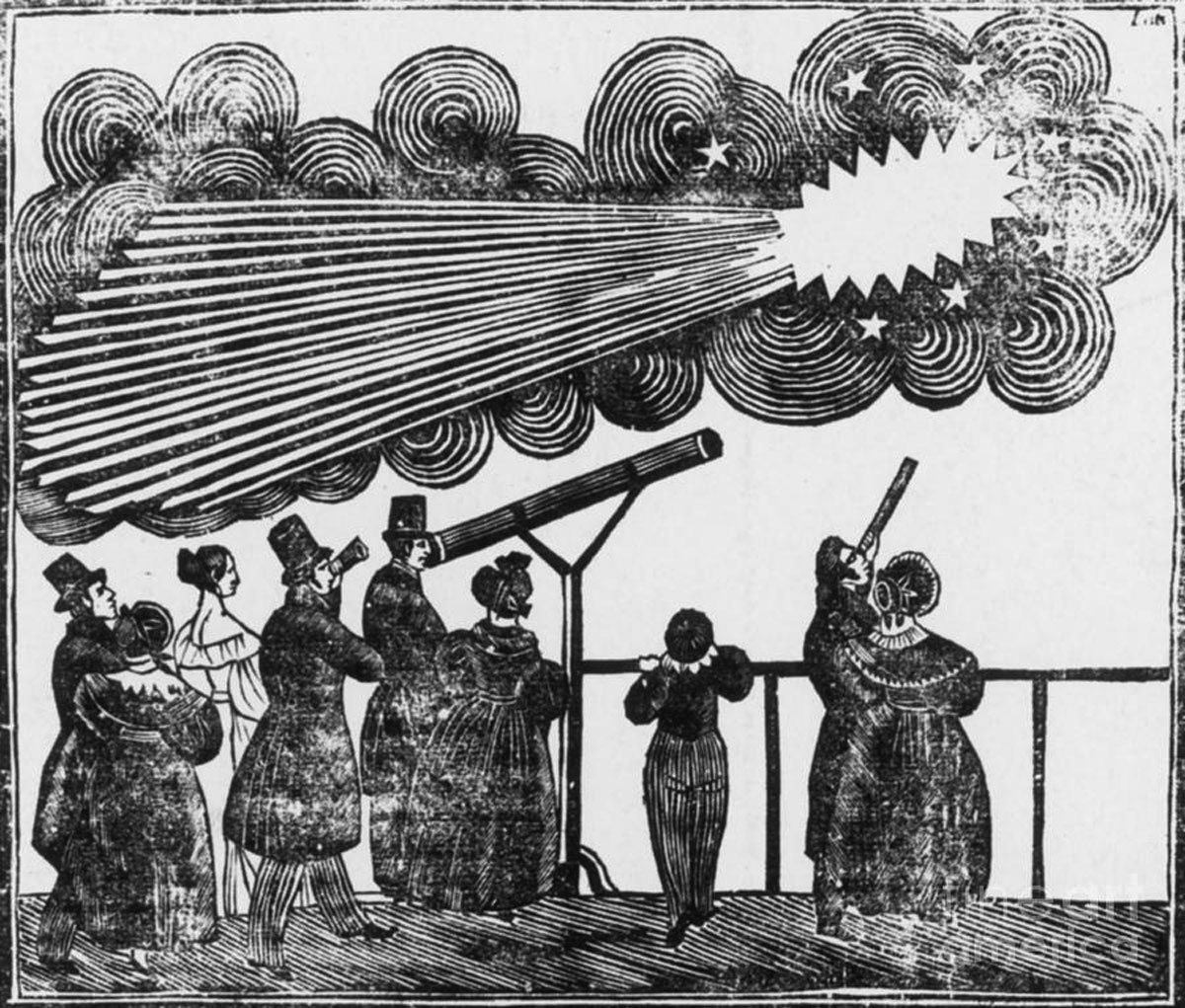
Let there be lights in the sky for signs. Twain was born in 1835 on a year of Halley’s Comet’s appearance. He and the comet were “two freaks of nature,” he reckoned. He predicted his death would be 1910, the year of its return.
The comet was right on time.
This blessed rage to order, Pale Ramon.