
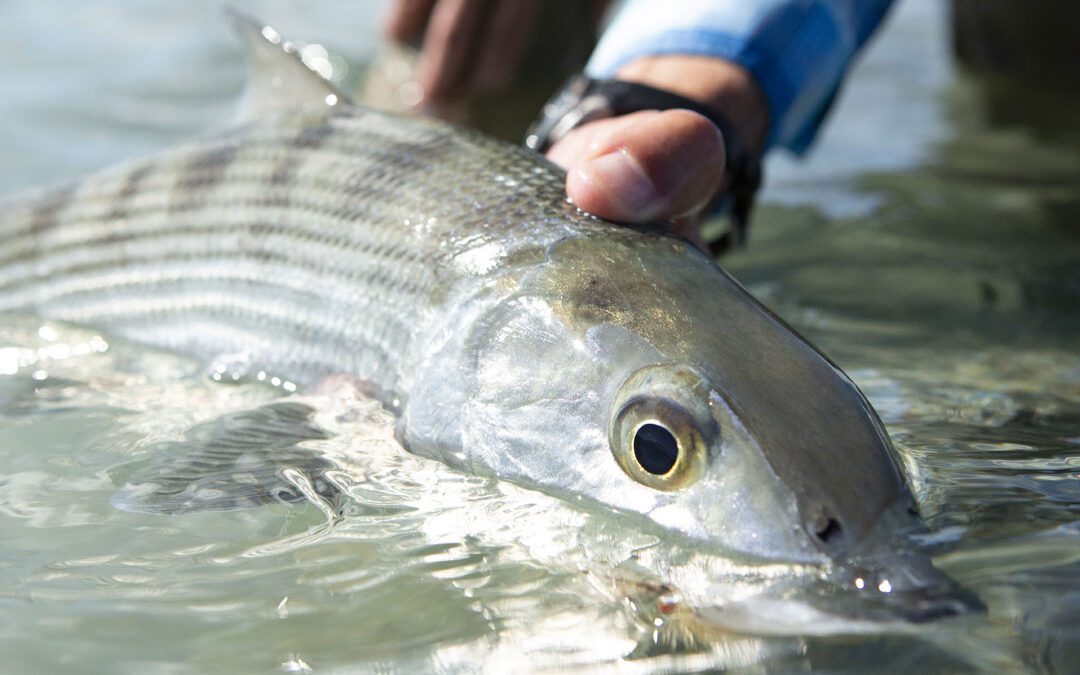
Hawaii’s bonefish are bruisers, as large as Keys bonefish, but without the guide-given names.
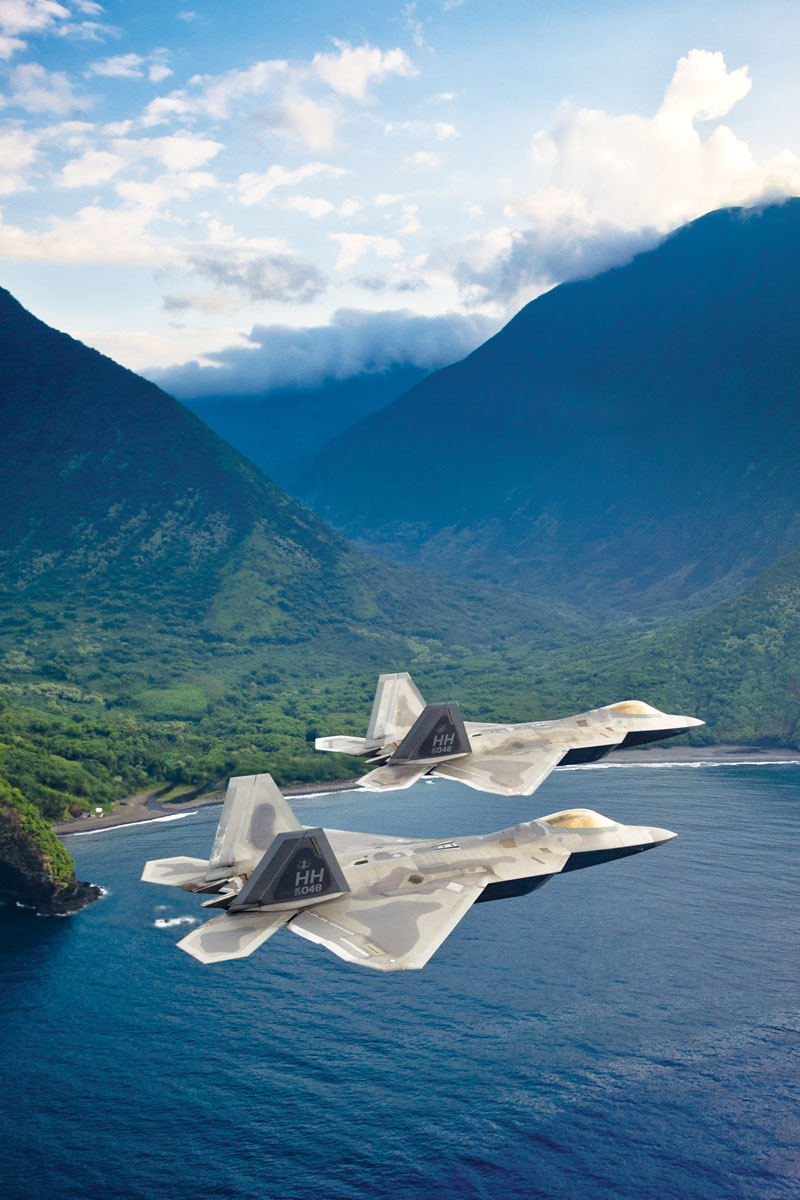
They came in sorties of twos and threes, launching off the runway at Hickam Air Base, one by one, then banking hard to starboard as they ascended into the sky above Mamala Bay, their afterburners glowing red hot as the fighter jets rocketed away into the blue ether above the Pacific, soon disappearing from view as echoes of their low-altitude exploits reverberated across the Ke’ehi Lagoon where I stalked bonefish with my guide, Edward.
Ed had told me that we might see some tailers first thing that morning. The tide was coming in and though it would amount to a rise of only a few inches on this December day, the water was moving, which told me the fish were, too. Less than 15 minutes after stepping out of Ed’s yellow boat and onto the flat, I spotted a tail glistening in the dappled morning sunlight. Ed saw it too.
“Oh my God,” he said, pointing. “There’s one right there.”
Ed was an Oahu native and a veteran of countless angling expeditions. Catching bonefish was, for him, like watching a college football game is for someone from Norman or Athens or Tuscaloosa. And yet, whenever he sighted a fish, he became so excited that one might easily believe it was his first time wading a tidal flat.
As I moved into position and prepared to cast, the large tail submerged and the fish disappeared: the gray ghost of the flats.
“If we see tails like that,” Edward said, pointing to where the fish had been, “they’re big fish.”
He wasn’t kidding. A few minutes later he spotted a pair headed our way. I adjusted my sunglasses, straining my eyes. But I saw only the dark, choppy surface of the wind-whipped water. These bonefish were tough to see, especially given the cloudbank to the east and low angle of the sun.
“Twenty feet! Cast right there!” he said, pointing with my backup fly rod.
I cast the fly—a large, Keys-style shrimp pattern I had tied for another trip. It featured a size 2 hook. Ed was intrigued. He wanted to find out if these Hawaii bonefish would take such a substantial fly. After all, his box was filled with three or four patterns tied on size 4 and 6 hooks, earth-colored flies that looked as if they would blend perfectly with the coral and sand on which we walked. The fish attacked the fly. When it felt the hook it turned and bolted toward the open sea, moving at a high rate of speed. Ed was talking but I couldn’t hear him. My reel was screaming and another air force jet had just taken to the sky.
As I fought the fish, I reflected on what Ed had told me only a few seconds after meeting him that morning. He began the day by explaining, as he munched on a link sausage from the bento box on his boat deck, how much some Hawaiians enjoy eating O’io, or bonefish, and how they prepare them. “They freeze them for three days,” he said. “Then they take them out, thaw them and butterfly the fish. They grill them until they’re done. Then they use a fork and scrape the meat away from the bones. They use it to make fish cakes.”
I had no doubt that bonefish were tasty when prepared that way. But I wondered, with so many other delicacies swimming these waters, such as tuna or wahoo, why anyone would bother with bonefish, especially when they pull so hard and make a fly reel sing.
I fought the fish for several minutes before it broke off on a coral head. Seventeen-pound test, cut in two. I replaced this with a heavier leader and we resumed the hunt.
Downtown Honolulu stood in the near distance, shaded by the clouds now shrouding the verdant mountains just beyond. Rain was falling on part of the city and seemed to be heading our way.
I hoped it would hold off.
We creeped across the flat, stopping frequently to study the water around us. With the clouds and wind, visibility was so poor that Ed commented that it was like hunting for Easter eggs. The bonefish were basically at our feet before we saw them. Occasionally, the sun would emerge from behind the clouds and we’d have a welcome but sadly evanescent window into the water. Still, they were tough to see. Unusually tough. Whenever I spotted one, what I saw was its dark eye and a greenish apparition surrounding it, subtly suggesting the shape of a fish. There were no reflections or shadows, no wakes or nervous-water indicators betraying their presence. These fish were stealth.
“Oh my God!” Ed said, trying to keep his voice low. He pointed with the fly rod and nearly touched the fish. “Right there! Toss the fly!”
I moved to make a backcast.
“No,” he said. “Toss the fly! With your hand!”
Too late. I’d already made a roll cast and landed the fly near the fish. Then I twitched the rod tip. The fish pounced, bit and bolted toward the horizon.
“I wanted you to just throw it out there with your hand, but that worked. Enjoy the ride,” he said as he lit a cigarette.
The fish made a couple of long runs and pulled hard. After a few minutes I landed what I guessed was a five-pound bonefish, which Ed pronounced average for this fishery. “That’s a good fish. But there are some big ones in here,” he added.
I reflected on how different this fishery was from the Florida Keys, the sport’s big-league arena for this species, where I had first cast to the gray ghost as a beginning fly-fisherman 30 years earlier. My casting, as I recalled, was just as precise back then. Maybe even better. The difference was that I had less confidence once the fly touched down on the bottom. I wasn’t as competent at provoking those pressured, persnickety fish into biting. Hawaii bonefish, on the other hand, seemed refreshingly aggressive, like those in the Bahamas. Only these were bruisers, as large as Keys bonefish, but without the guide-given names. The flat we were fishing, while expansive, was nothing like the vast miles of flats surrounding the Keys. By contrast, it was quite limited. And yet Ed told me that on a good day, meaning a day with good visibility, one could expect to see 80 bonefish, easily. A poor day, like this one? Maybe 40. “But you’ll spook many more before you see them,” he said.
I released the bonefish and, as we resumed our hunt, I realized how hungry I was. Having driven to Honolulu that morning from my rental on Oahu’s north shore an hour away, and having stopped only for a cup of coffee, I suddenly wished for a hot, hearty breakfast. What I got instead was the aroma of one—well, part of one. The smell of toasting bread floated over the lagoon. My stomach swirled. My mouth watered. When I mentioned it to Ed, he said there was a bakery nearby. Never before had toast smelled quite so good. I made a note to stop in after my day on the flats.
Honolulu was providing the most unique experience I’d had on a bonefish flat. Every few minutes a Hawaiian Airlines jet lifted off from the runway, angling sharply upward. I wondered if passengers could see Ed and me down in the lagoon, fly-fishing. By late morning, helicopters began to appear, shuttling tourists back and forth across the bay. If I looked closely, I could see cars moving along the edge of the city in the distance, tall buildings flashing in the momentary splashes of sunlight, then fading in the low clouds. Now another plane came off the runway, this one’s exhaust note higher, sharper. The leaden fighter jet lifted and immediately banked hard, accelerated and vanished. These were certainly no remote bonefish flats. We were in the middle of the city, it seemed, and though the incessant noise was distracting at times, Ed said it made no difference to the fish.
“They hear these planes every day,” he said, raising his voice over the urban noise. “It doesn’t bother them.”
The clouds had pressed in around us further limiting our visibility such that we began spooking fish before we saw them. Some of them were nearly close enough to kick.
“Let’s stop here for a minute,” Ed said. “As long as we don’t move, we’re just another log or piece of coral to these fish.”
While we watched and waited, I thought of the surfers up on the north shore. The world’s three dozen best were up there waiting for the ideal conditions that would herald the competition that had drawn them to Oahu. I’d spent the previous several days photographing them, watching them rip and shred through the green waves that were already larger than those that crash onto our mainland shores. The waves were large enough that some of the surfers would catch air at times, flying 10 or 12 feet into the sky, showers of water droplets glinting like emeralds in the morning light. Others, finding their line, would ride these big waves for some time, force and momentum propelling them at greater and greater speed until the waves spilled across the sandy beach, frothy and white and finally reclaimed by the sea.
I had missed the shot I really wanted. As I drove through one of the island’s small towns, I spotted an old man waxing his surfboard. He looked like Santa Claus with his bushy white beard. I had been driving a bit too fast to have put on the brakes so suddenly, and when I finally reached a turnaround and doubled back through town, the wise old surfer was gone. I could have parked and scoured the beach and probably found him, but I would have only been in the way of someone wanting to catch waves on a warm December day.
As we stood waiting, Ed spotted a fish 50 feet out. It was moving away from us. He said it was a big one.
“Come back,” he said to himself, as if talking to the fish, a cigarette dangling from his lips. Then, a moment later: “Oh my God! Here he comes! Get ready!”
When Ed pointed, I cast the fly. Nothing. He said that while my line was in midair, the fish had turned away to investigate something on the bottom. I left it and waited.
“Don’t move the fly until I tell you,” Ed said. “Come on, turn around,” he said to the fish. Then, to me, “This is the one you want to hook.”
I was thrilled to hear this, and relieved that he could see the fish and follow its movements through the water. I still couldn’t see it. As I waited to catch a glimpse of the bonefish, it occurred to me why. I’m color-blind. Well, shade-blind, as I learned in the military. After I’d failed the second color-vision test, I was told the news. “You’re as color-blind as a bat,” they’d said. Strange thing was, I always felt as though I could see all colors. Most of them I can. But detecting the specific gradations from, say, purple to black, is a challenge—so much of a challenge that I can seldom identify them, even in good light. Evidently, Oahu bonefish are close enough to the color of the island’s inshore waters that I could barely see them, and then only when they were right in front of me. This was frustrating, as I was completely dependent upon Ed’s vision. But his animated play-by-play kept me well informed as I waited to manipulate the fly.
After what seemed a full minute, Ed nodded and I gave the fly a short strip in an effort to get the fish’s attention. Somehow, it worked. Seeing the fly, the bonefish turned and raced to it. I could see it. It attacked with such force that it nearly pulled the fly rod out of my hand. Then, once again, fighter jets appeared in the sky, one by one, their afterburners glowing as they raced away to infinity. When I looked back at where the fish had been, it was gone. Then I heard my reel screaming and, a moment later, the clicking of my backing knot ticking through the guides and still more screaming from the reel.
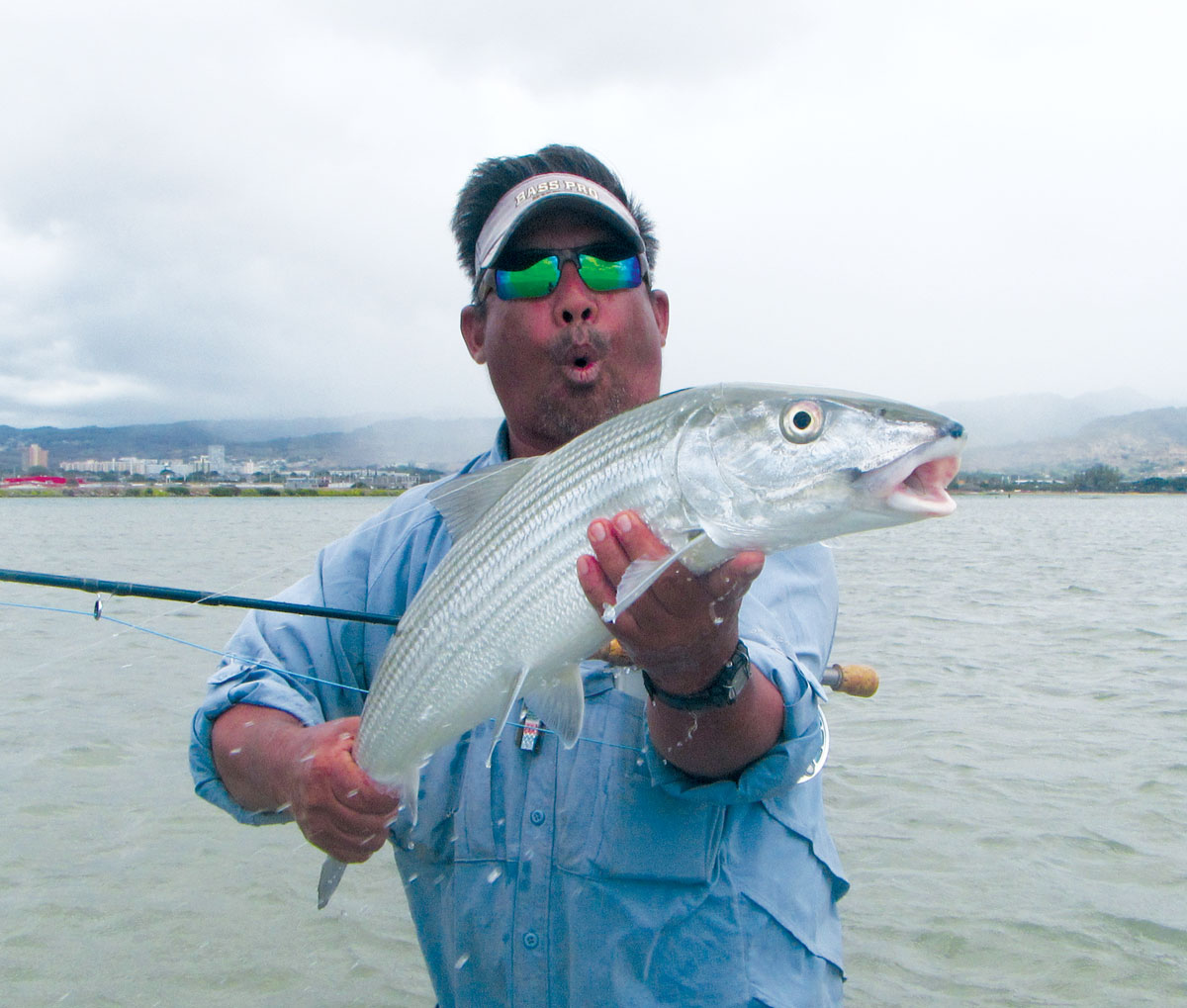
The bonefish made four long runs. It was my sixth fish on a day when sighting them required, evidently, normal color perception and otherworldly vision. And it wasn’t yet time for lunch. I don’t know how large the fish was, but it was the biggest bonefish I’d caught. It was large enough that, after I landed it, Ed pointed to its head and observed, “when they get big, their head is about one-third the length of their whole body.” I don’t know if this one qualified as such, but it was close.
As I released the fish, I wondered—What if those who enjoy eating bonefish could catch one, a large one, on a fly rod? Would they still want to eat them? Cultures and cuisines aside, the specimen I’d just caught was another reminder of why bonefish are so special and a classic case for conserving them.
The website of the fly shop through which I’d booked my trip with Ed had explained that local populations of O’io had suffered over the years after generations of catching and consuming them. That may well be the case, or maybe the shop was just trying to level my expectations for Oahu bonefishing, but I could see no sign of a fishery in decline, especially when, five minutes after releasing my big bonefish, we spooked an even larger one right in front of us, a fish we hadn’t seen in time to cast to.