
As long as live, I’ll never forget two simple numbers and one letter, 26-B. That was the federal housing number of the home my mom, dad and I lived in during the tumultuous, worldwide war years of the 1940s. The small, country town we and several thousand other newcomers suddenly found ourselves transplanted in made local residents as shell shocked as troops fighting overseas. A new Army airbase was being built just outside Fairfield. My father, and many others like him, would work on the bombers being readied for war raging in the Pacific.
This sudden influx of souls overloaded the few small rentals that were quickly scooped up, overcrowded the town’s one and only local school and saw lines formed outside the grocery store with customers waiting their turn to get inside. To give us some place to live, the federal government purchased and plowed flat 33 acres of weeds and brush, building government housing called Waterman Park. Some others less friendly termed them “the projects.”
Waterman Park was named after a turn of the century sea captain who navigated coffee-colored sloughs and back bays just south of town, hauling seed grains to the small community then going 70 miles back against stormy bay waters to the already bustling city of San Francisco, set hard against the mighty Pacific Ocean. If the old captain could have magically been transplanted forward into the 1940s, he wouldn’t have believed what his namesake had spawned. Waterman Park was put up as fast and simply as stucco walls and tarpaper roofs were legally allowed. When we moved in, men were still up on the roof swinging hammers.
The buildings were long rectangles with four family units in each unit marked A, B, C and D. We lived in 26-B. These numbers began at 1 and went up to more than 100. It was a new little town inside of a barely larger old one. For me and kids my age, the single saving grace for adventure was an old, rusting, single track railroad line running just on the other side of a barbwire fence on the park’s northern perimeter. At one time, the rails actually ran right into town but were eventually taken up. The tracks ran in a huge semi-circle far out beyond the park and town for miles past fields of cattle, sheep and horses, then through a tall eucalyptus grove surrounding the town’s cemetery. They continued on to major rail hook ups many dozens of miles away.
It was those long, rusting rails that gave us kids lucky enough to own our first 22-caliber single-shot rifles a wide-open hunting world beyond measure.
My old boyhood pal Jim and I both got our little bolt-action rifles at the same time. Hiking down the tracks with our single-shot Remingtons over our shoulders, we talked and dreamed of the day we’d pack other rifles of more power, going after real big game such as deer, elk and maybe even a black bear or cougar that prowled in the picturesque, Coast Range Mountains on the skyline west of town.
This huge step of leaving behind the limited range of our Red Ryder BB guns and hunting sparrows and blackbirds to real bolt rifles firing deadly cartridges had great significance to us. We left some friends behind, too, whose parents wouldn’t let them have a real rifle yet. Jim and I walked a little taller because of it. We were on our way to becoming bona fide American riflemen!
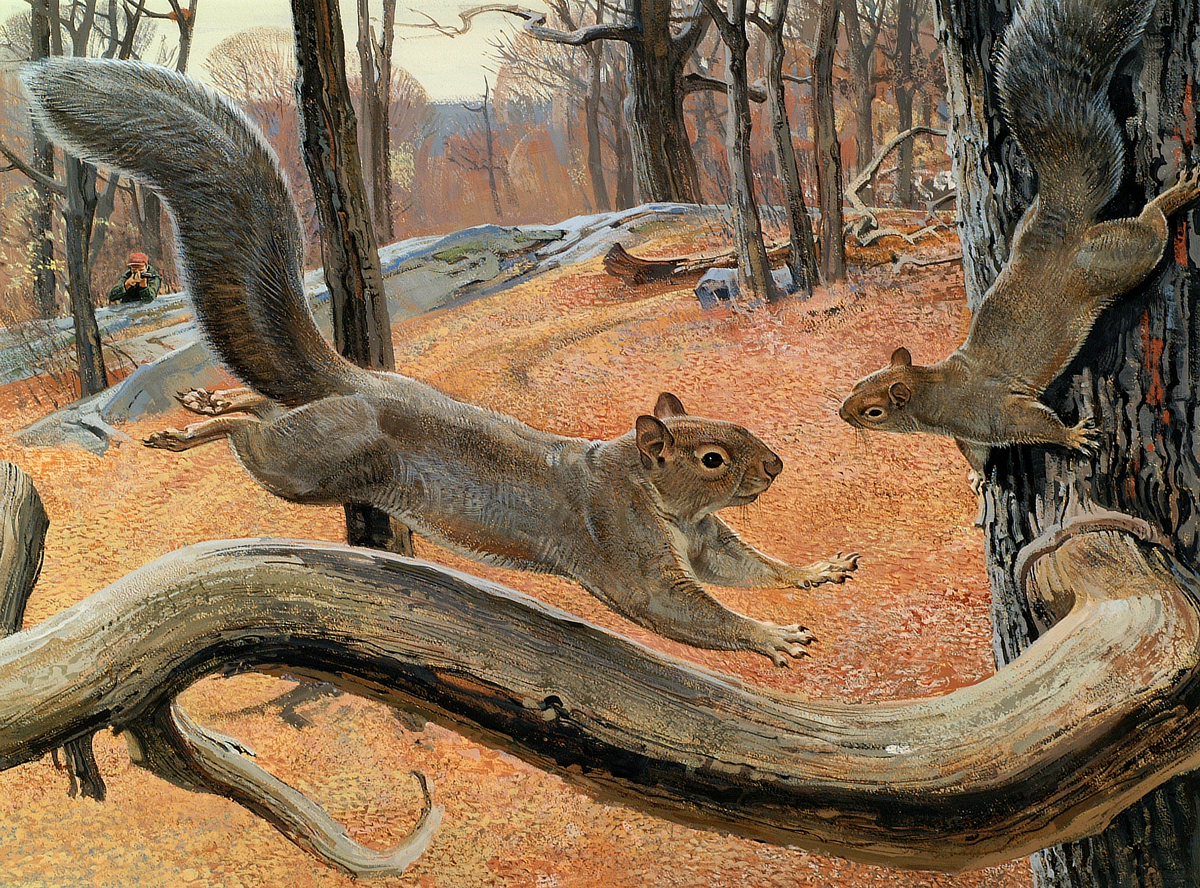
Out on a Limb by Bob Kuhn. Remington Art Collection.
Now we went after bigger game such as long-eared jackrabbits streaking through star thistles, always cautious ground squirrels standing on mounds next to their dens and ever wary crows squawking danger at our approach. We learned the timetables of this new game, where they lived and when the best time was to catch them out.
At this same time, we were learning even more about the wonderful new rifles we were blessed to own and hunt with. We quickly learned proper rifle hold, sight alignment, hold over on long shots and leading running game like rabbits and squirrels caught away from their holes. All that was done through the most basic iron sights and simple leaf adjustments for elevation. We became deadly accurate at short to moderate range with the light, fast-handling little single-shots.
Farther out open iron sights didn’t work nearly as well. It was a problem Jim was first to solve. He talked his folks into letting him buy a 4-power scope and mounted it on his rifle. Just as quickly, range accuracy doubled and sometimes even tripled. I was green with envy until I had one put on my Remington.
On that mile of rail out beyond the park where they did a long, slow curve going east right through the center of the cemetery and its tall grove of ancient, eucalyptus trees is where flocks of pigeons and crows loved to gather high up in the leafy tops. We always hunted them being doubly careful never to step directly on a grave site, as we pussy-footed behind one marble headstone after another, trying to get open angles to shoot up. We considered it an unforgivable sin to desecrate a grave by stepping directly on one. I don’t know who told us that, but we never forgot, or violated it.

One day Jim told me to come down to his house, which I think was 17-B. I wondered what was so important. He wouldn’t tell me until I arrived. When I did, he led me into the bedroom and bunk beds he shared with his younger brother, Billy.
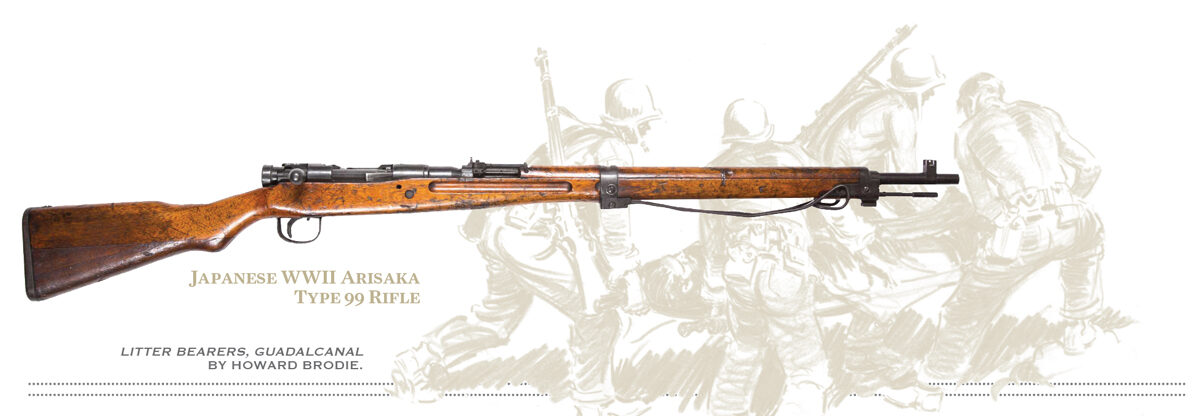
“Look at this,” he said, lifting a long, heavy bolt rifle off the bed. Both our eyes riveted on the strangely dangerous looking big rifle. This was no single-shot 22. It was a real, man-size rifle—a killing rifle. Its long, black barrel was encased in some kind of odd, light-colored wood I’d never seen before on any rifle. Strange inscriptions neither of us understood were stamped on the top breach followed by a design that looked like a flower. Jim showed me an odd fixture on the end of the barrel that was to attach a long, sword-like bayonet. As I got my hands on it feeling its solid weight, he filled me in on details of how he’d received such a stunning gift. His uncle, fighting in the Pacific during the war, had captured the rifle from Japanese troops. He knew of Jim’s growing interest in rifle hunting and had it sent to him as a gift of conquest. Standing there, both handling the gun, we couldn’t help but wonder if it had been used in a desperate, bloody bonsai charge, like the kind we’d heard about on the radio, against our own solders.
We viewed the rifle with a strange mixture of awe, fear and unanswered questions about who carried it. Was he killed, or who might he have killed using it? I walked back home that day with a strange, uncomfortable mix of feelings I’d never had before about any rifle and how they could and had been used in the hands of waring men.
Yet, beyond all that, I would have given my right arm to own one like it.
We classified the ammunition for our little bolt rifles by what we expected to be hunting down the tracks. For blackbirds and sparrows, we shot standard, grey topped 22 Longs. But out after bigger game such as jackrabbits, ground squirrels and sometimes even crows, we filled the chambers with special, copper-coated, Long Rifle hollow-points for their explosive striking power. These hollow-points were also the most expensive. We held onto them like misers, saving them only for those special hunts.
That rusting, old rail line held even more learning adventures I’d never considered. It would be the place where I hunted and shot my first ever, legal gamebird. On many rifle hunts during warming days of early summer, I noticed the sudden arrival of small, grey birds that flew like the wind with a corkscrew motion on simitar wings. They vanished during fall and winter.
They were mourning doves and as it grew hotter, so did their numbers, sometimes streaking by two or three to a bunch. I also noticed their flyway religiously followed the old rail line. Already being a dyed-in-the-wool rifle hunter, I never lifted my gun barrel on one. But when I learned down at our town’s one and only sport shop that there was actually a season and bag limit on the little birds, I immediately decided to become a dove hunter, too.
I already knew one of their flyways.
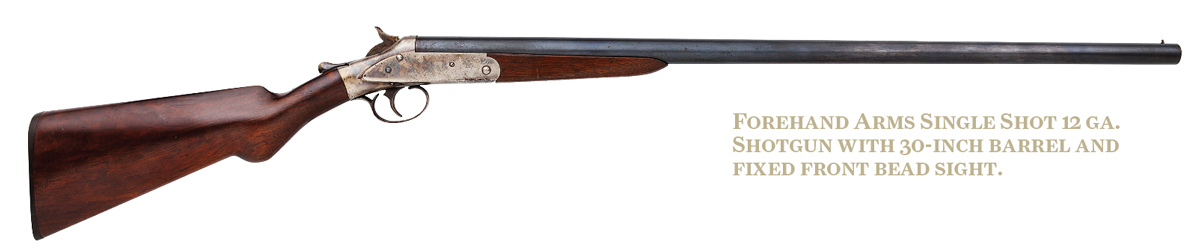
I briefly put my 22 aside, switching instead to my single-shot, hammer 12-gauge “mule gun” and when I say mule, I mean every letter of it. The gun was all barrel and butt stock, with a steel plate for a recoil pad. I don’t think it weighed more than five pounds. That meant that when you fired it, you “ate” all the recoil. A sore, black-and-blue shoulder was the result of any prolonged shooting.
I purchased a box of red waxed, Winchester low-base No. 8 shells and headed out down the tracks opening morning before sunup, with hope in my heart. The long hike took me out to set up just short of the cemetery and those tall eucalyptus groves. Situating myself in tall weeds along the fence line right-of-way, I waited as the first small crescent of sun peeked over gentle Protrero Hills east of town. Long shafts of golden rays through the eucalyptus lit the land in morning light as I waited for something to happen. It didn’t take long.
First, far away I heard the distant “thump” of a shotgun, then another and another in quick succession. I knew dove season had just opened, and I had an unnamed brother somewhere out there doing the same thing as me. Straightening up, I stared down the tracks into that rising sun, straining to see beyond it. More distant shots followed, some closer, others farther out. Still, the old, silver-worn shotgun stayed cold in my anxious hands. The first edge of worry crept over me.
The sun rose higher, its blinding light blocked now by trees. I stood again searching down empty rails. Where had all the birds I’d seen so often rifle hunting disappeared to? Had all the sudden shooting run them off, changed their flight lines or timing? I thought about starting back home. My eager plans had evaporated into nothing. I began to feel foolish for even trying. I certainly wasn’t going to tell Jim what I’d done.
Standing to exit my weed patch blind, I took one more long look down the tracks. Was that a small, dark dot twisting closer on pulsing wings? I shielded my eyes with one hand, staring harder. It was a bird barreling closer. It had to be a dove! My heart jumped in my chest. Without even thinking, I thumbed the hammer back on the mule gun. The feathered rocket streaked past lettered gravestones, out beyond tall eucalyptus, still coming straight down center tracks right at me. The scattergun came to my shoulder as the bird whizzed by opposite me. I pulled the trigger. The dove tumbled in mid-air with a puff of grey feathers gently floating slowly down between steel rails. I was dumbfounded by my own fast single-shot success. I never even felt the recoil!
Today the once tiny Fairfield of my youth has grown to more than 100,000 souls.
I moved away long ago, but memories do not. Unfortunately, almost all small towns suffer this fate. Those old, rusting steel rails curving out beyond Waterman Park and town taught Jim and me how to become hunters and riflemen before either of us could shave. Today, those rails only run in my memory. They’ve been taken up to make way for new streets, green laws and custom homes. It makes me wonder and worry, too, about other young boys today who want to experience that same, unforgettable thrill of getting that first 22 in their hands. Will they have the chance to become American riflemen, connected over centuries to our historical blood brothers who were the Minute Men of 1775? Is there some abandoned old railroad line, riparian field with streaking jackrabbits or hillside colonies of ground squirrels scurrying for their holes in their future? I must admit I do think about these questions now, more than ever. I can only hope my wondering is for naught.