
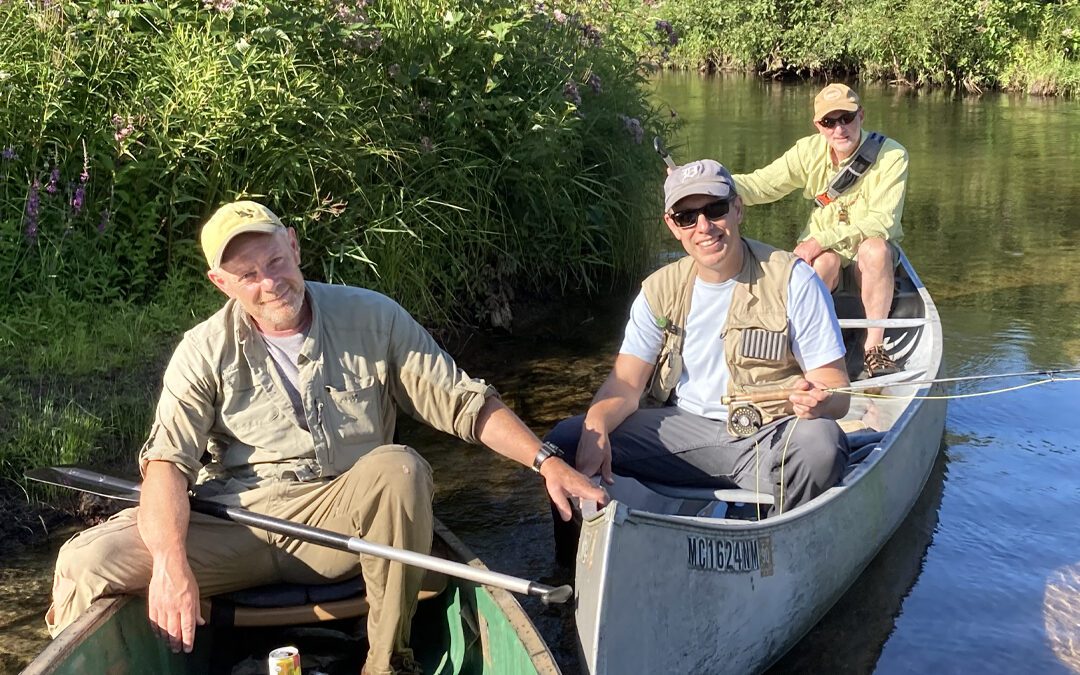
Twenty-five years had passed since I had gone fishing with the Smith brothers. Thirty years had passed since I had seen the Love Shack. I had never seen Oz. Jake was sleeping in his tent by the river. Chris was sleeping back home with his wife. I was sleeping with Oz in the Love Shack. Sounded like the set up to a horror movie.
But while driving down to meet the gang, fear was the farthest thing from my mind. Chris and Jake Smith had organized the gathering to celebrate the publication of Northwest of Someplace. Jon Osborne and the Smiths go back a long way. Working for their dad at Game & Gun fresh out of college, my ties go back farther. Editor, artist, police swat team member and teacher/river guide, our lives stretch along the west coast of Michigan. However, we shared a common interest in faith, family and fly-fishing (not to mention books, writing, hunting, guns and dogs, but those topics kind of mess up the alliteration).
Driving my truck down the highway, the windows were down, and the rushing air felt good. Until a large bumblebee hit me in the face and tumbled into my lap. Frantically trying to fling it away, I swerved across the center line. Apparently, the subconscious fears a bee sting more than a head-on collision.
I’d been looking forward to returning to the river where my father taught me to fly-fish 35 years ago. We didn’t fish the Boardman often, but I have memories—some fond, others not. Father/son coming of age stories are often dipped in chocolate. Truth be told, an adolescent boy can be a pain in the ass. At least I could. One night in particular, I immediately lost my hex fly in the bushes and launched into a bout of negativity. My father wisely bid me adieu and waded upstream. Hmmph! I flipped open my fly box, threw on a wooden bass popper painted like a frog and repeatedly slapped it down on the water in a 16-year-old’s version of a hissy fit. It was engulfed by a hefty brown while my selfless father went fishless.
So that’s the water I wanted to see—the bend at The Forks campground where the brown was caught all the way down to the Love Shack. Driving it, nothing seemed familiar.
But a lot had happened since 1985, so maybe the memory distortions were excusable. The Love Shack hadn’t changed, though. It was still as charming and idyllic as I remember. The cedar-shake, weather-beaten, two-room cabin sits close to the water on a high bend overlooking the Boardman. It’s far enough above the river to be prominent and low enough to be intimate. A one-man porch and railing at ground level look like a front street saloon out of a dusty western. So do the bleached and faded antlers in the roof’s gable. All it needs is swinging double doors and you’d expect someone with a tall, black Stetson to step out, fly rod in one hand and six-shooter in the other. It was my dream river cabin while growing up. Still is.
Traverse City natives Mike and Corin Drilling had purchased it, adding an outdoor kitchen on the edge of the meadow. They built their home far in the background, leaving a hedge that protects the feeling of wilderness while staying at the cabin. Years ago, Mike had taken pity on the Smith boys while they were still in high school. Watching them slog through the swamp to fish the far bank during the hex hatch, they struck up conversation night after night, year after year, until Mike eventually invited them to drive up to his house and access the river from there. Others might have placed trip wires and punji traps on the opposite bank of their favorite hole. Mike’s a nice guy.
Arriving at the cabin, introductions were made.
Jake handed each one of us a finger of Michter’s bourbon. We toasted the river and the chance to be together.
“Wow! That’s good stuff,” I said, as I gasped for air. You always say it’s good stuff when the price climbs over $40 a bottle. Truth be told, Jake was tossing pearls to swine. An IPA while making dinner suits me fine as does a shot of Old Crow after a night chasing hex. The gesture is what you’re buying with an expensive bottle of bourbon—the attempt to show someone you care about them. Even a swine can appreciate that.
We loaded two beat-up metal canoes into Chris’s beat-up metal pickup truck. Then we placed Mike’s kayak on top of that. Watching five guys decide how to strap a load into a truck is like watching the Three Stooges change a lightbulb. There are as many ways of doing it, all of them inefficient, as there are mosquitoes in the woods. We finally decided on sticking Oz in back with the whole load to keep it in place. The Beverly Hillbillies would have been proud. The local law enforcement, not so much. But since we were anchoring it with our own law enforcement officer, we figured it was excusable.
Launching at The Forks, we set off downriver with Jake in the bow and me in the stern. Oz and Chris shared a canoe behind us. In his kayak, Mike zipped between our canoes like a fighter plane escorting two bombers. We’d float, alternately taking the lead, find a good bend to fish, stop and wade while the other boats did the same. It worked.
The sun sparkled through the water, lighting up all the beautiful rocks and logs below. It warmed the back and gave satisfaction to the cooling chill of the river on bare legs. But it was also moving toward the horizon, creating some dark shadows along undercut banks where wary trout could lie.
Jake held up a delicate soft hackle he tied. “You think this will work?”
“Sure.”
Chris tried a small ant, a logical late August choice.
“You fish ants much?”
“They’re too small. My guests can’t see them.”
“Yeah, but this one has a little bit of white foam. You can see that.”
Being a river guide, people always ask my opinion on flies, rivers and water conditions. But most of the questions can’t be answered definitively. I’ve come to believe that just like politics and religion, people see what they want to see and believe what they want to believe. Unlike politics and religion, in fly-fishing no one gets hurt because of it.
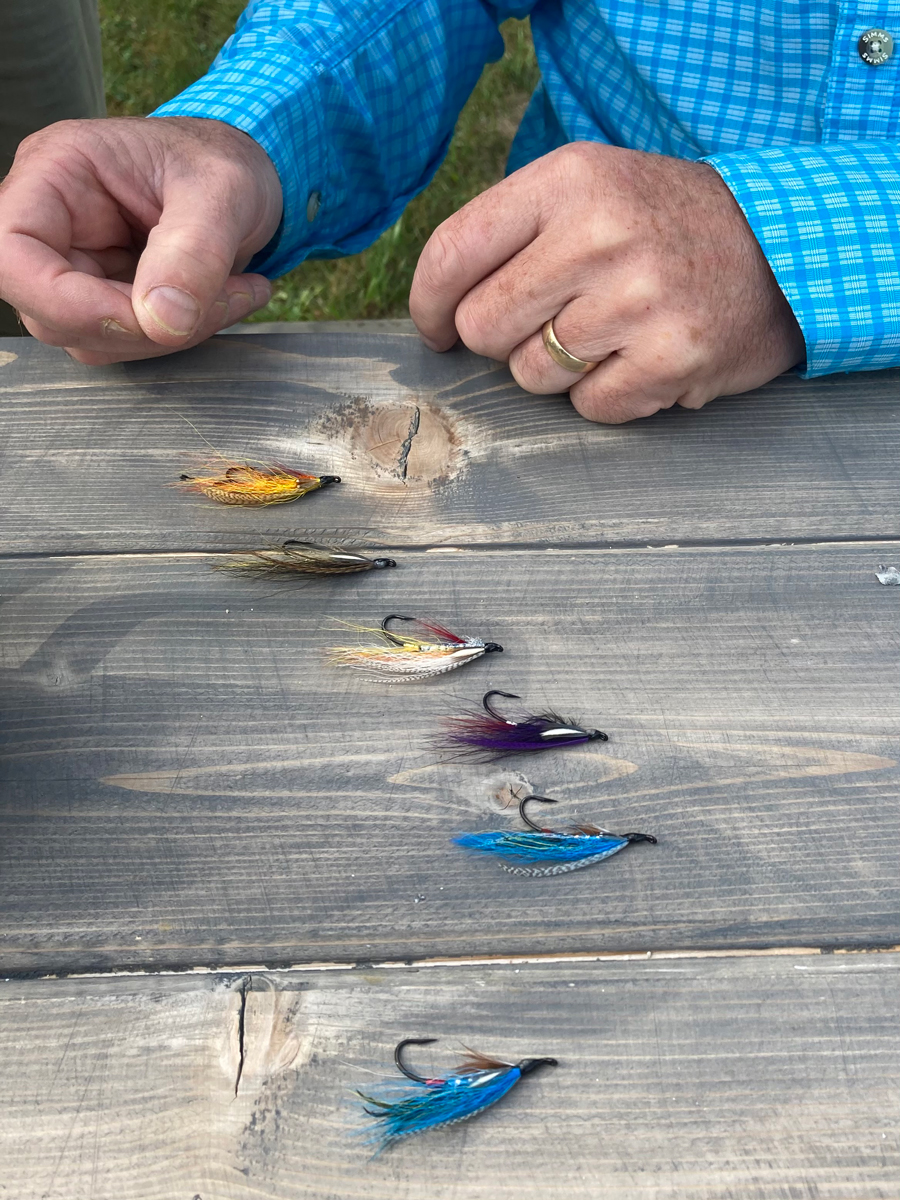
In fact, it’s kind of fun. Jake loves tying and fishing delicate dry flies and soft hackles. He fills little flecked-paper sketchbooks with these immaculate drawings of his creations, footnotes on the bottom and thoughtful commentary along the margins. They’re beautiful creations, each one a work of art. He names them, too. The Gypsy Strangler has been sitting on my nightstand stuck in a little cork pedestal for the past 25 years. It sits next to other favorite talismans, such as tiny glass jars of dried sage, millet, acorns and mushrooms from special places I’ve visited. The Gypsy Strangler never touched the water because it was too pretty to lose. Chris gets Jake’s “Meh” flies.
The first time it came up in a text, I was confused.
“What’s a Meh fly?”
“You know. How did it turn out? Shrug of the shoulder. Meh. It’s okay.”
Oz and Chris follow along the lines of Jake. Bamboo rods, small dry flies, delicate soft hackles, precision, patience. Do it right or don’t do it all. They all probably have labeled cubbies for their children’s shoes and book bags.
There’s always a black sheep. I tied on a purple, cone-head woolly bugger with white rubber legs. If I’m feeling conservative, I fish a black one instead. When fishing with guests, flies are changed often. That’s what guides are paid for, to keep experimenting until something works, despite my personal preference of fishing that one silly rubber-legged fly.
Midway through my 30 years of guiding, a young fly-fishing addict, a guide I enjoyed and respected, gave me some advice. I think it was in regard to a question about when and how often to switch flies.
“The best thing you can give these people is hope. Hope that keeps them casting. That’s all that really matters because, as you know, you never know.”
Dude…I had to sit down.
Streamers have always been fun to fish. Slap a streamer down, strip, strip, move. Slap, strip, move. I’m impatient. I don’t care that much if I catch fish, but if I do, I’d like it to be one nice fish rather than four little ones. That’s how I find joy on the river—not in a competitive, restless sense but more in a happy-to-be-there-enjoy-the-process-over-the-product sense. Which makes for happy days as a river guide. Fishing vicariously, enjoying the scenery, listening to my guests’ stories, teaching and learning at the same time. It’s good stuff. If you want definitive answers and reasons about the mysteries of the ecosystem, I’m not your guy.
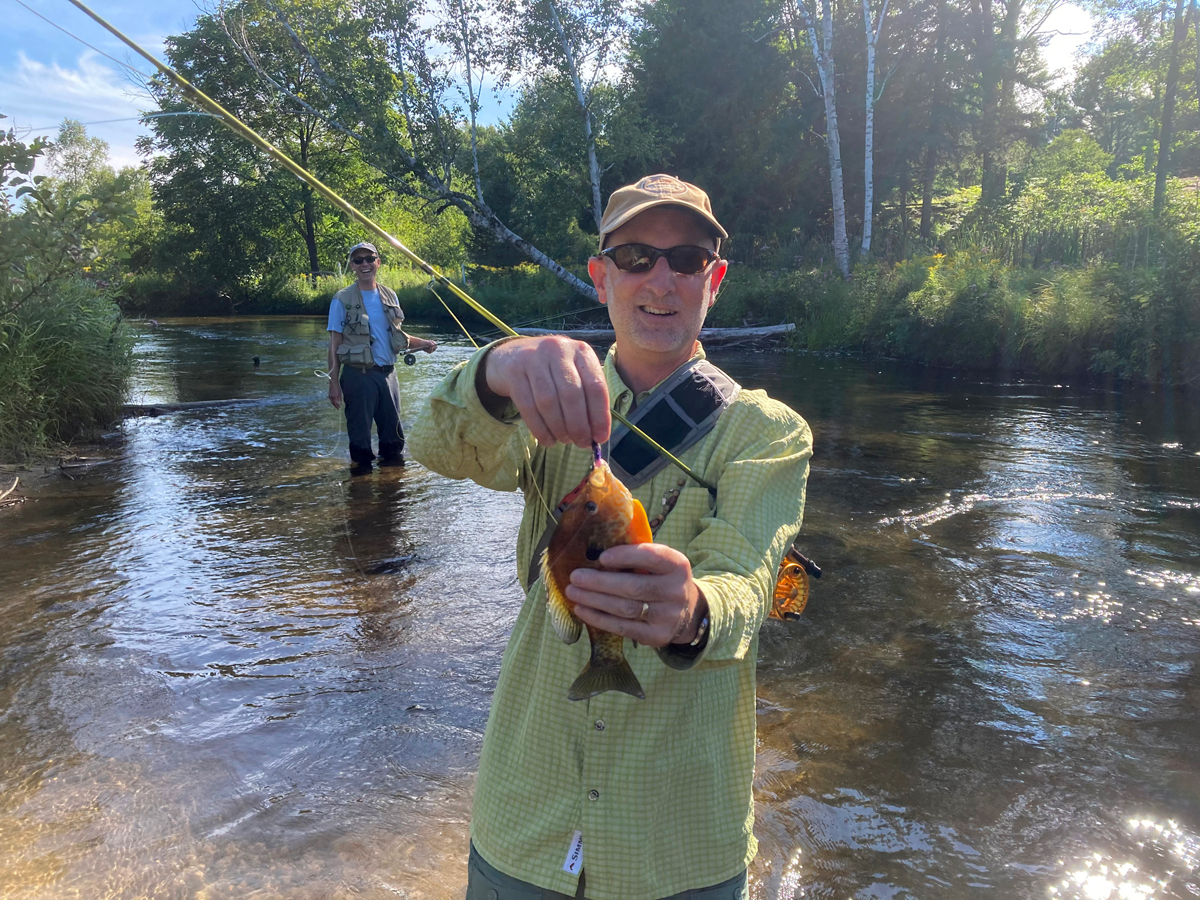
We floated downstream, Mike, Jake, Chris, Oz and me, leapfrogging one another, all playing our little game the way we wanted to play it, and all enjoying it thoroughly. That’s when we came to a sharp bend in the river with a slight sandbar on the inner bank. Jake was changing flies for the 14th time. Mike slid onto the sandbar to stretch his legs and sip a beer. Chris and Oz drifted slowly toward us. On the far bank, what appeared to be a little feeder creek trickled into the main branch. A big log stuck out close to it, and the water looked deep and foreboding—like a small aquatic dragon could live down there (or a really big brown trout). The woolly bugger splashed down hard, sank and pulsed when I gave it a quick strip. Bam! The rod bent, I set the hook and jerked the hook right out of the fish’s mouth. Nice job, guide.
I cast again, hoping for a second hit. Miracles do happen, and this time I was ready for it. The take was hard and the set was firm. My rod doubled over amid hoots and hollers from the entourage. The timing couldn’t have been better. I felt like a rock star. Rarely does a guide get to show their greatness in front of his or her peers. After all, this was no small fish. Big browns are caught in northern Michigan, much bigger than this one. But they are almost always caught at night. This felt like a 16- to 18-inch trout, which on the Boardman River in daylight was akin to winning the Masters, the Super Bowl and the World Series all in one day.
The behemoth fought hard and valiantly, but I fought harder and valiantry-ier. Finally, it came to net, just at the opportune moment when Chris and Oz had floated down to the front row to witness the awe-inspiring skills of one Boyne Outfitters guide. And…it was a sunfish. A brilliant orange and red sunfish slightly bigger than the palm of my hand. In the world of sunfishes it was a respectable fish, not outstanding, but really nice. In the world of the Boardman River, it was unheard of. Laughs, hoots, hollers…the entourage was not impressed.
“Where in hell did that come from?”
It was a valid question. Warmwater species such as bluegills and bass often frequent rivers but in slower, warmer water much, much farther downstream. A sunfish in the upper Boardman was about as common as the Detroit Lions holding their lead through the last three minutes of the game. That’s when we investigated the “feeder creek.” Turned out it was more of a feeder canal or a feeder ditch. Mike explained that the property across the river was a large tract with lots of high fences and locked gates. No one knew exactly what existed in Shangri-La, but apparently there was some sort of man-made lake stocked with sunfish. This particular brave soul had somehow escaped to find freedom in the Boardman River. How it jumped the dike before traveling down the canal that led it into the river was anyone’s guess.
Before anyone could suggest keeping it, I released the sunfish. Mike’s wife was hoping for a fish for dinner and, though it would have been perfectly logical and ethical to kill a stocked species, a sunfish in the upper Boardman was akin to an albino deer. Against all odds, it had been raised by humans, planted in a private lake, escaped to a foreign environment and, displaying bad judgment, had eaten a purple woolly bugger with white rubber legs. Lesson learned. Be free and be smarter, my tie-dyed friend. (And head downstream about 16 miles until you find the proper habitat and similar species to spend the rest of your days with.)
That was it. As the sun dropped lower, Chris, Oz, Jake and Mike caught fish—real trout—on their dry flies while I got cold. Really cold. I had one more good take on the streamer. Something rushed out of a log jam and wouldn’t rush again, but action matched my core temperature. It wasn’t cold out, not at all, but after wet wading all afternoon and sitting rather motionless in the stern of a canoe, I had no idea how cold I really was.
When we at last came to the Love Shack and dragged the canoes up the riverbank, my joints weren’t moving so well. I had a hard time standing up, let alone stepping out of the canoe. Perhaps this was what it felt like when you were drugged by the bad guys and about to be drowned in your own bathtub. Wait—thinking back to the horror movie setup, maybe that’s a bad analogy. I tottered stiff-legged toward the cabin. The “Tin Man” in need of an oil job, threw on a pair of jeans, a hoody and dry, warm socks.
Chris atoned my sins of releasing the sunfish by catching a 10-inch brown trout for Mike’s wife minutes from the landing. We grilled the fish alongside a rare fungus Oz had found on the way north. This particular mushroom was called chicken of the woods. Turkey of the woods or Costco of the woods might have been more fitting. It was big and beefy, and there were lots of them. Apparently, there is a tree leaning across a river somewhere between Holland and Traverse City that grows them. I’m not saying which tree and which river because I don’t know, but Oz does. He checks it every year, and every year there are chicken of the woods growing on it. None of the rest of us had ever heard of it. The real question was who would eat it?
My mom had always eaten beefsteak mushrooms she found at our hunting camp, until one day she became feverish and puked her guts out. Then she stopped eating them. That was my only reference point for what happens when you eat mushrooms that A) are not morels or B) are not purchased at the grocery store. According to the MSU Extension website, there are 2,500 mushrooms in Michigan, but only 60 to 100 of them are edible. That’s interesting. A range. What about the 40 that MIGHT be edible? Can’t we agree on that? Apparently, harvest time, handling, preparation, cooking and allergies all play a part. Therefore, the range.
Oz explained that for some people beefsteaks can be toxic, and the toxicity needs to accumulate before its effects are known. Hence, Mom ate lots of beefsteaks with no problem until the day she nearly killed herself with them. Sounded like Oz knew what he was talking about. I ate his chicken of the woods, fresh off the grill, and they indeed tasted like…chicken, albeit the fungus chewy kind of chicken. MSU Extension’s website later informed that chicken of the woods gathered from hardwood trees are edible, but those gathered from conifers or locusts are frequently toxic. I didn’t ask Oz what kind of tree was leaning over the river. Surely it was a hardwood. Surely.
We closed the night by the campfire, the stars glorious and demanding. No “Alice in Wonderland” dreams disturbed my sleep, so evidently the mushrooms were safe. The following morning dawned gray and emotionless. We had books to sign, breakfast to eat, and one last section of the river to explore. When the trip was planned, someone mentioned going to church on Sunday morning, which kind of sounded invasive to the thought of getting away from society, but the idea of a campfire devotional was floated. We all liked it, bringing God’s word to the river as opposed to leaving the river for God’s word.
We all agreed to bring our favorite piece of scripture and share it around the campfire. Chris went first, then Jake. Jake was jotting down notes in his journal when Oz began reading. I’m not sure exactly what Oz said, but I’m pretty sure it was something about God. The problem was that while we were sitting around the morning campfire sipping coffee, Mike was launching a drone off the picnic table 20 yards away.
The drone was there to film the excavator. The excavator was there to cut a new trail through the brush around Mike’s home. The excavator had this little bobcat-type machine with big chains on the front and the back to protect everyone from the stuff that would go flying as it chewed up anything smaller than a 100-year-old oak tree in its path. And it made a beeping noise similar to big trucks that back up and run over people. Mike decided that before filming the historic footage of the new trail being made, the drone should hover about 40 feet above us.
“Come to the garden alone,” Beep! Beep! Beep! Crash, thunk, crack, splinter—the sounds of unstoppable destruction—death to all woody plants, “and you will find peace.” SZZZZZZZZZ! The incessant high-pitched buzzing of a wasp on steroids hovered about us.
I still didn’t know what Oz was talking about, but all I could picture was the scene from “Avatar” when the industrial dump trucks rolled into the military compound with arrows sticking out of tires taller than humans. I started laughing. You can’t make this stuff up.
“Why don’t we go fishing?”
And so we did. Chris and Jake took the lead floating dry flies while Oz and I followed dropping big streamers. The strategy made sense. Dry flies are much less intrusive than a big streamer slapped down in a trout’s face.
We talked writing and editors, comparing notes from someone who used to type on a typewriter and send self-addressed stamped envelopes for rejections (me) to someone who has only been writing in the digital world (Oz).
Long cast by Oz under an overhanging tag alder.
“Perfect. There should be a fish there. Nice float,” I say.
“Try that rock, the one by the willow.”
“Killer spot. There’s got to be a fish behind that.”
There wasn’t.
Fishing matters, but not that much. It’s more like a background to a conversation, a way to connect. We both love this river. I might have had a hard time talking to Oz, this man I’ve never met, but not on the river. Here we have common ground, a love of the place and an appreciation for the skills of fly-fishing. Life is good. But it was always supposed to be. Look at the Boardman if you don’t believe me.
Downriver, we come upon a huge brown trout. A very dead, fungus-covered brown trout, but a huge one, nonetheless. It could have died after fighting to the point of no return with a fake hex, or it could have died of disease and old age. Who knows? Jake is downriver. Unsuspecting. His brother is plotting with Oz and me.
“Hook it to Oz’s line. Make it real.”
“He’s not gonna fall for it.”
“He might.”
So we give it our best effort. The dead fish doubles Oz’s rod in the current.
“Keep it up! Keep tension!” I yell.
Oz leans back into the rod. Grunts a lot. Hurts his back. Gesticulates (I think). If he could have made the sound of fly line screaming off his reel, he would have, but our special effects are limited.
“Don’t lose it!” I thrash downstream, net at the ready position. Tom Cruise would be writing notes. Jake has now appeared on the high bluff 50 yards downstream, taking in the scene. Even from that distance, he’s not buying it. The valiant scoop. The triumphant lift.
He’s shaking his head.
“Whatever. Show me the dead fish.”
“It’s a really nice dead fish. What gave it away?”
“Your overacting.”
Crushing. I thought it was very realistic. We admired the old brown trout for several minutes before slipping it back into its watery grave. It would drift downstream where crayfish and raccoons could hopefully benefit from its demise.
And just like that, our 24-hour detour from the slipstream of daily life was over. We found a trail that led us out of the 1,300-acre Brown Bridge Quiet Area and returned to the world, leaving the Love Shack on the Boardman waiting.
—
Every day afield holds something to discover, and these hunting, fishing, and outdoor stories from the affable members of The Lost Branch Sportsman’s Club reveal that it’s not always what we expect. Reminiscent of the outdoor storytellers of their youth, Greg Frey, Chris Smith, Jon Osborn, and Jake Smith share their experiences – both reflective and humorous – in the field and woods and on the water in four unique voices. Stressing connections to the places, the people, and the fish and game, you’ll find yourself recalling your own memories and rediscovering the “something more” that awaits us outdoors. Now available for the first time in this hardcover Collector’s Edition are the first three complete volumes: Northwest of Someplace, Another Day Afield, and Around the Next Bend, along with a bonus story from each author, with artist Chris’s pencil illustrations throughout. Order your copy today!