
The dean of American gunwriters was perplexed. His brow was furrowed more than the average 60-year-old to start with, but now the wrinkles had transformed into deep crags reminiscent of the sheep country he loved so much. He rocked back from his well-used desk, and in a not-so-rare moment of distraction, he pondered over hunting brown bears instead of white sheep for a change.
Every other letter in his large daily stack of fan mail seemed to be about Alaskan brown bears, and he was having a hard time understanding their fascination. The gunwriter had only hunted brown bears once, and he wasn’t exactly bowled over by the experience.
At a time when the “Big Three” outdoor magazines were filled with stories about giant Alaskan brown bears, Jack O’Connor seldom gave them a mention; his 1956 Outdoor Life feature story “Deadline” a lonely exception.
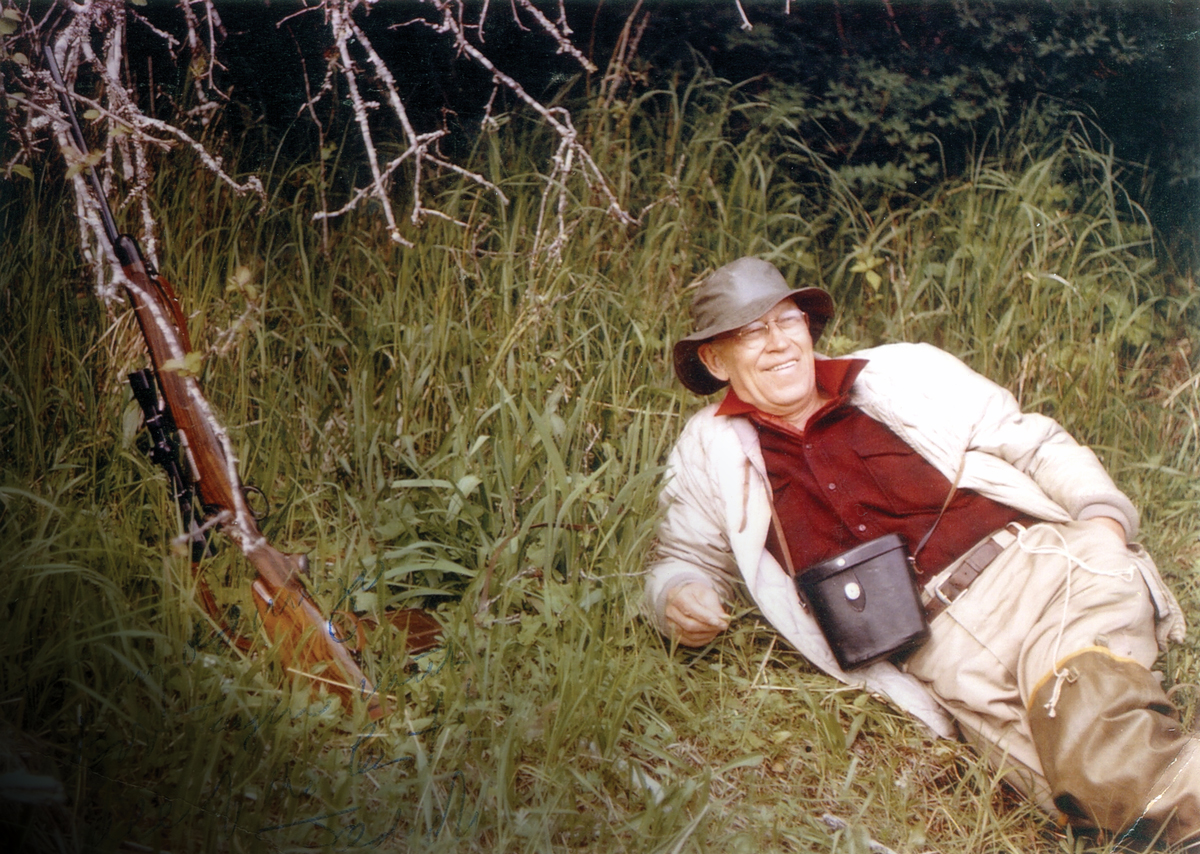
“Deadline” chronicles a hunt that Jack made with Lew Bulgrin, the owner of Badger Shooting Supply in Owen, Wisconsin. The men headquartered from outfitter Ralph Young’s boat, The Umatilla, anchoring off Admiralty Island and going ashore by skiff to hunt. The hunting was tough, and the trio fought icy rain and cold winds the entire time. Despite the poor conditions, Jack managed to kill the two brown bears his license allowed and two black bears as well. All four of the bears were taken with his Griffin and Howe .375 H&H, a rifle that Jack dearly loved and hunted with extensively.
Photograph courtesy Eldon “buck” Buckner.
In the story, Jack notes that, to his knowledge, his .375 was one of only a few rifles to have ever taken a lion, tiger, and brown bear. A few years later he gave the rifle to his friend and Tanganyika Professional Hunter John Kingsley-Heath, who along with his clients settled the score on another 50 lions before the rifle was retired in the early 1990s.
The story also hints, however subtly, that Jack may have been mildly disappointed with the size of the brown bears taken on his trip, both of which were smaller than some of the interior grizzlies he’d killed. It leaves the reader thinking that brown bear hunting was not Jack’s cup of tea.
Still, at some point in 1961 or ’62, Jack made plans to hunt a second time with guide Ralph Young.
Whether he planned a repeat hunt with the hopes of finding a bigger trophy or whether he felt that the brown bear’s popularity among his loyal readers simply deserved another story is purely conjecture. Regardless of his motivation, he wanted a new bear rifle, and it came as little surprise to those who knew him that he chose a .338 to replace the .375 he had given to Kingsley-Heath. Jack had been a fan of the cartridge since its debut, and he thought it a fine choice for even the largest North American big game.
The cartridge, introduced by Winchester in 1958, was based on a shortened .375 H&H case necked down to .338 that delivered incredible performance with 200- to 250-grain bullets.
In a revised edition of The Rifle Book, Jack opined: “The .338 and the .375 were so much alike that a hunter could use them alternately for a lifetime and never be able to tell the difference.” He went on to say, “The .338 should do nicely on Alaskan brown bear, on tiger, and as the medium-bore in an African battery.”
The rifle project was entrusted to his old friend, Al Biesen of Spokane, Washington. It would be the first of three custom .338s that Jack would order over the next ten years, and he had some very specific ideas on how it should be built. Al’s shop in Spokane was only a two-hour drive from Jack’s home in Lewiston, Idaho, but Jack hated driving anywhere, and even short trips brought fits of his near-famous “vapors.” The driving aside, he dearly enjoyed his visits with Al, and Jack’s praise of the master riflemaker kept the talented Biesen busy with clients from around the world.
It is not known exactly when Biesen started work on Jack’s .338, but the rifle was delivered in 1962, in plenty of time for Jack to work up a load and get it ready for his 1963 bear hunt with Ralph Young.
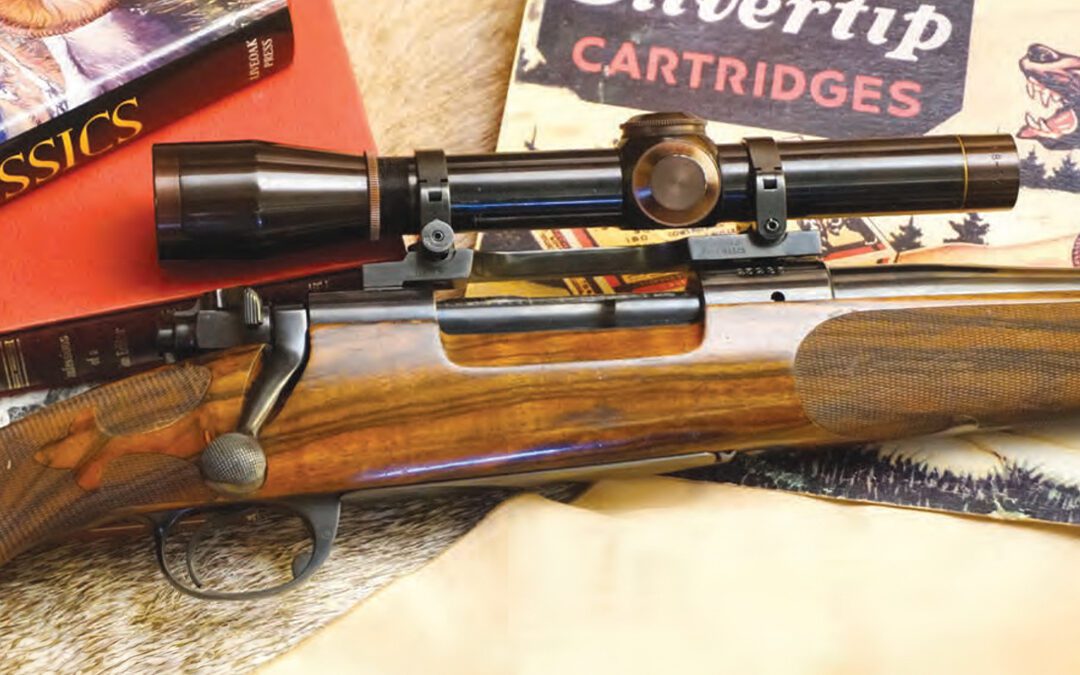
The rifle was built on a pre-war Model 70 action, serial number 25235, originally a .30-06 when it left the factory shortly before Winchester’s conversion to wartime production sometime between 1938 and 1940. Biesen stocked it in a beautiful piece of caramel-colored, darkly streaked French walnut set off with his signature grip cap, a solid-red Winchester pad, and flawlessly executed fleur de lis checkering. The origins of the blank have been lost to the vagaries of time, but it was likely a piece that Biesen already had in inventory, as Jack was not prone to spending excessive amounts of money on fancy wood.
Jack requested the barrel to be crowned at 22 inches and the total weight with scope to be no more than about 81/2 pounds, considerably lighter and shorter than the 25-inch barrel on the .375 he’d carried on his first brown bear hunt.
Biesen reworked a Tilden one-piece mount for the Leupold 4X scope, though photographs exist of the rifle wearing a Redfield 4X Bear Cub at one point during its long career. Biesen jeweled the bolt and magazine follower, a touch out of character for Jack’s understated taste in rifles, but no doubt something he requested.
The new rifle would set well with Jack’s intended partner on the trip, Robert Chatfield-Taylor. A friend of Jack’s for 20 years who owned a ranch near Tucson, Chatfield-Taylor’s wealth allowed him a good bit of time to fool with rifles and design cartridges, including the .380 Taylor and the later, more well-known .416 Taylor. He had been a test pilot during World War II and had once been married to a famous debutante and heiress. Like Jack, he was a total rifle nut, and they enjoyed each other’s company immensely.
Eleanor grudgingly went along on the hunt, undoubtedly thrilled at the prospect of being marooned while the men enjoyed spirited conversation about rates of twist, shoulder angles, and proper primer pockets.
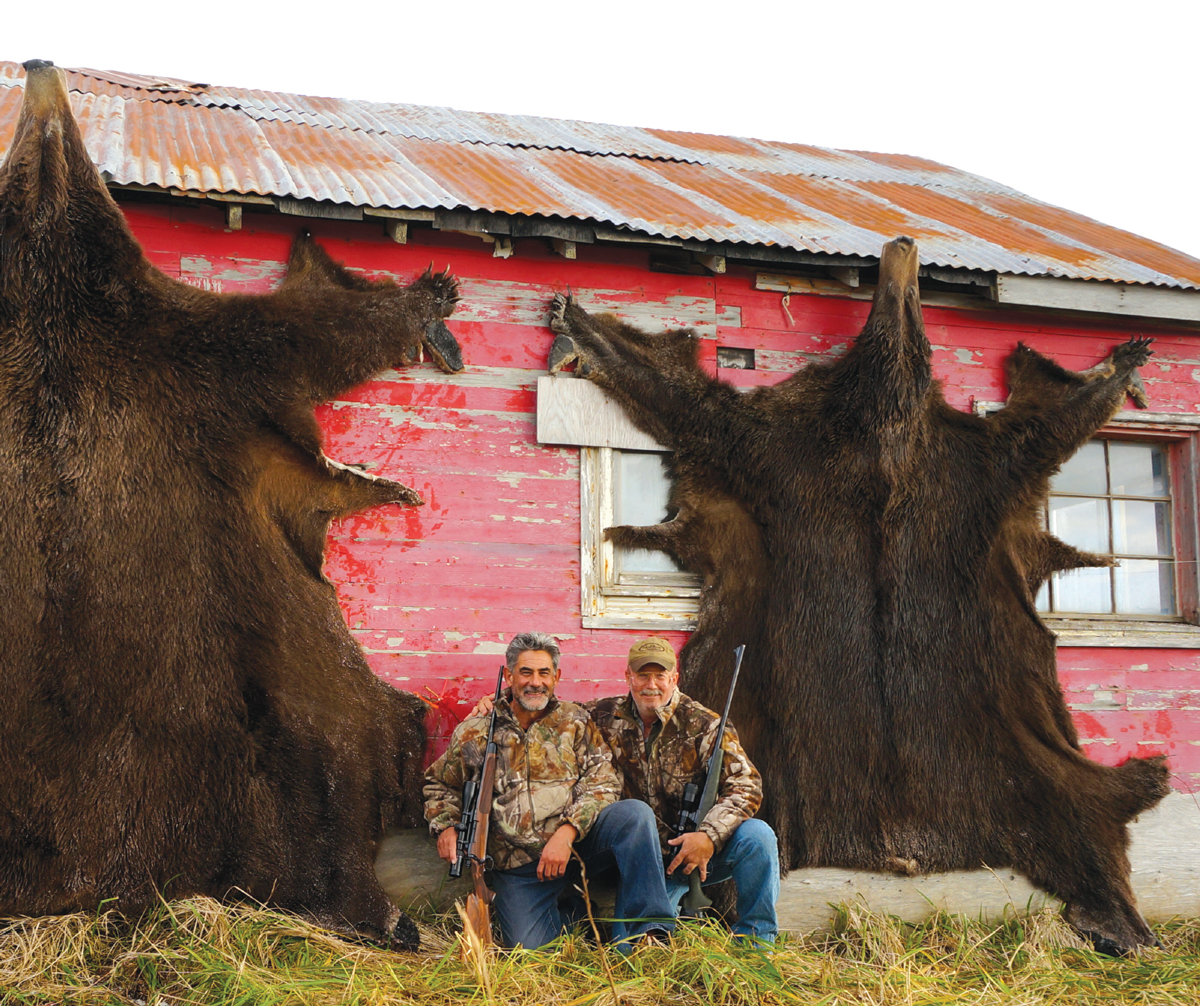
Caligiuri and Jim Fredericksen pose with the huge skins of their Alaskan brown bears.
With the new rifle in tow, Jack and Eleanor met up with Chatfield-Taylor in Petersburg, Alaska, where they purchased their licenses and loaded supplies aboard the sturdy Umatilla. They hunted hard for several days, but the brown bears were few and far between. Chatfield-Taylor managed to kill a boar that squared a little less than nine feet, and Eleanor took a black bear with her 7×57 Mauser.
Jack failed to find a suitable brown bear; indeed, the only time that his new rifle bolted a cartridge was when he acted as the back-up gun on the bear that Chatfield-Taylor shot.
It was the last time Jack ever hunted brown bears of any variety, though the .338 went on to serve him well both stateside and overseas, where he used it on large plains game, including a big sable bull in Zambia on a 1969 safari with Eleanor and his son Bradford.
Outdoor Life published a long-lost story about that safari in a 1997 feature titled “Sables in the Brush.” Found in an Outdoor Life file cabinet and published more than 20 years after his death, it speaks volumes to Jack’s popularity long after his name had disappeared from the magazine’s masthead.
That same safari saw Jack become increasingly disappointed in the poor performance of the day’s .338 bullets in brush and, shortly after his return home, he gave the rifle to his bird hunting pal Peter Alport, who owned the outdoor clothing concern of Norm Thompson Outfitter.
Rich Koch, a doctor and rancher from Pilot Rock, Oregon, acquired the rifle from Alport sometime in the 1970s. Both Alport and Koch were frequent pheasant hunting companions of Jack, so the rifle probably had some sentimental value to both.
O’Connor continued to write about the .338 long after he gave it away, though his own memories did not always contain the same pleasant sentiment. In an elk hunting story for Petersen’s Hunting, he opined: “I had a .338 once that had a 22-inch barrel and weighed 81/2 pounds. It kicked like hell, but it was light and handy. It was an unlucky rifle, and I never saw an elk when I had it out.”
Buck Buckner, my good friend and mentor as well as the de facto expert on all things O’Connor, acquired the rifle in 2009 from Rich Koch’s son-in-law, Wayne Low. Buck used it to take a tremendous mountain caribou on a hunt later that same year in the Yukon.
A couple of years ago, when he decided to thin out a few of his many O’Connor rifles, he called and offered me first crack at it. I could not get “yes” out of my mouth fast enough, having been a dedicated Jack O’Connor fan since I was old enough to read.
As a kid, I would stay up long past my allotted bedtime, scanning the pages of Outdoor Life with an old army surplus flashlight, pouring over Jack’s hunting adventures around the world. I waited anxiously for each month’s new arrival and reserved hard-earned cash for a monthly membership in the magazine’s namesake book club. Jack’s writings fueled my desire to go to journalism school, followed by several years as a freelance outdoor writer and eventually a long career in the hunting industry.
I have followed his boot-prints through the sheep mountains of the Yukon, British Columbia, Arizona, and Mexico, sometimes staying in the same camps. We both killed our first rams at age 33, albeit his 55 years before mine, and like Jack, mountain sheep are my favorite animal.
Forty years after I read it for the first time, I still fall asleep with an old inscribed copy of Sheep and Sheep Hunting on the nightstand. Along with Buck and Jack’s son Bradford, I had a hand in convincing Winchester to build the Jack O’Connor .270 tribute rifles that quickly sold out a few years back. With so many connections to Jack and his rifles, I cooked up a scheme to take the newly acquired .338 back to Alaska to fulfill its original purpose of taking a brown bear.
In 2007 I had hunted brown bears on the Alaskan Peninsula with two old friends, Jim Fredericksen and Vic Cimino. The hunt was outfitted by Dan Montgomery and Loren Karo of Alaska Trophy Adventures, and we all took dandy bears. Vic’s bear was the biggest of the three, and Jim and I often talked of returning to the peninsula to look for a “Victor Bear.”
Dan is considered one of the best in the business, extremely respected in serious hunting circles. In 2017 he was bestowed one of the Wild Sheep Foundation’s highest honors and named the recipient of the organization’s Frank Golata Outstanding Outfitter award. By coincidence, the namesake of that award, Frank Golata, happened to be one of Jack’s all-time favorite outfitters, and the pair shared many a campfire on British Columbia’s famed Prophet Bench.
Our guide for the hunt would be Dan’s right-hand man and protégé, Hank Flatow, well known for his prowess in finding big bears and sheep. I was very familiar with Hank’s abilities, having been the hunter on his very first trip as an assistant guide during a Dall sheep hunt in 2003.
Hank had just arrived in Alaska from his native Montana that same summer, a 20-year-old kid with a smile as wide as his three-foot strides. We had a grand time, taking a big Dall ram, then packing out a long ten miles through the Chugach Range.
Hank is also a bit of a romantic, and the notion of taking O’Connor’s bear rifle back to Alaska tickled him to no end. By pure coincidence, his bear back-up rifle is a .416 Taylor, built on a pre-’64-style Model 70-type action. Jack and Chatfield-Taylor had conceived the hard-hitting .416 Taylor over lunch at the swanky 21 Club, Jack’s favorite New York watering hole. It would have thrilled Jack greatly had he known his old .338 would be back in bear country backed by a .416 Taylor.
A month or so before our departure date, I started wringing out the rifle on a near-daily basis at the little range I had built below my house. It performed perfectly with a variety of factory ammo and seemed to really like heavier bullets. If Jack felt the rifle unlucky, it certainly was not because of its tendency to shoot well.
Al Biesen had carefully sealed the rifle’s French walnut stock inside and out, so I had no worries about it holding up to the adverse weather in Alaska, though I fretted over the 50-year-old scope until finally deciding to switch it out for something a little more modern, an act that Jack’s son Bradford later good-naturedly declared as one of pure blasphemy.
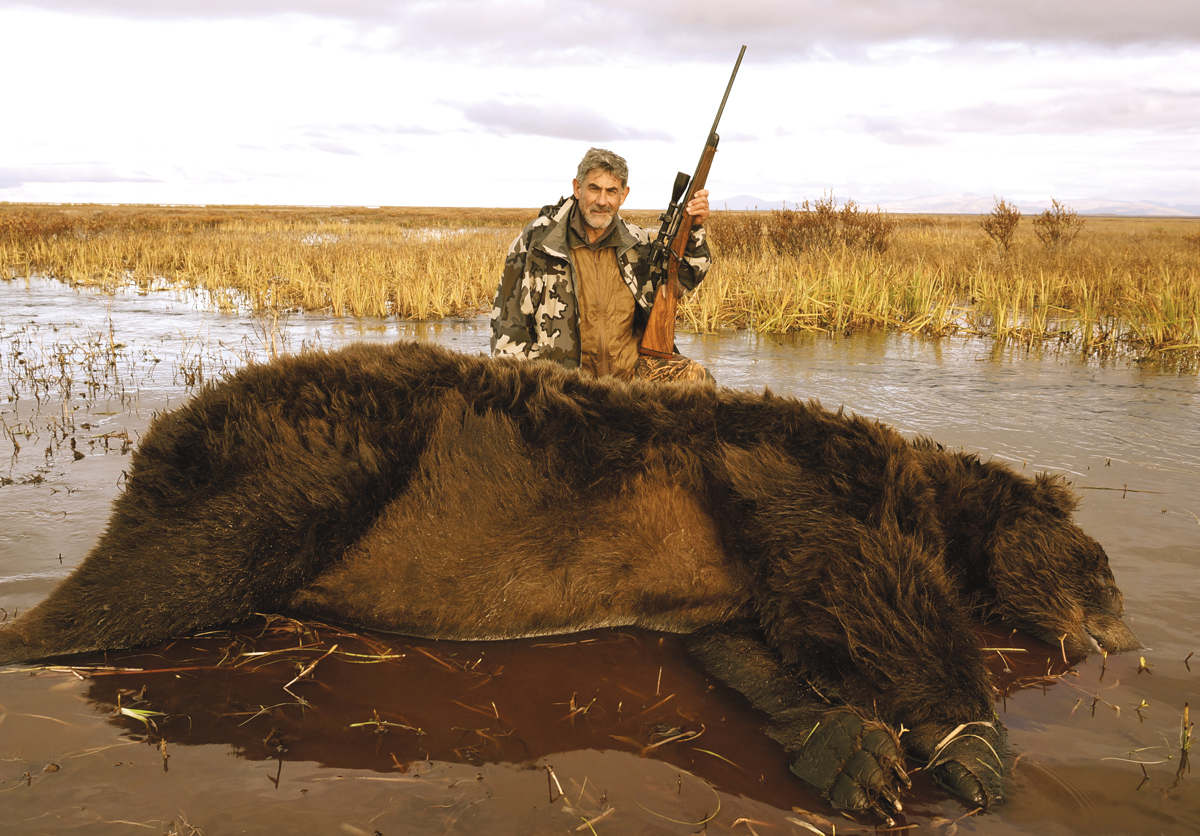
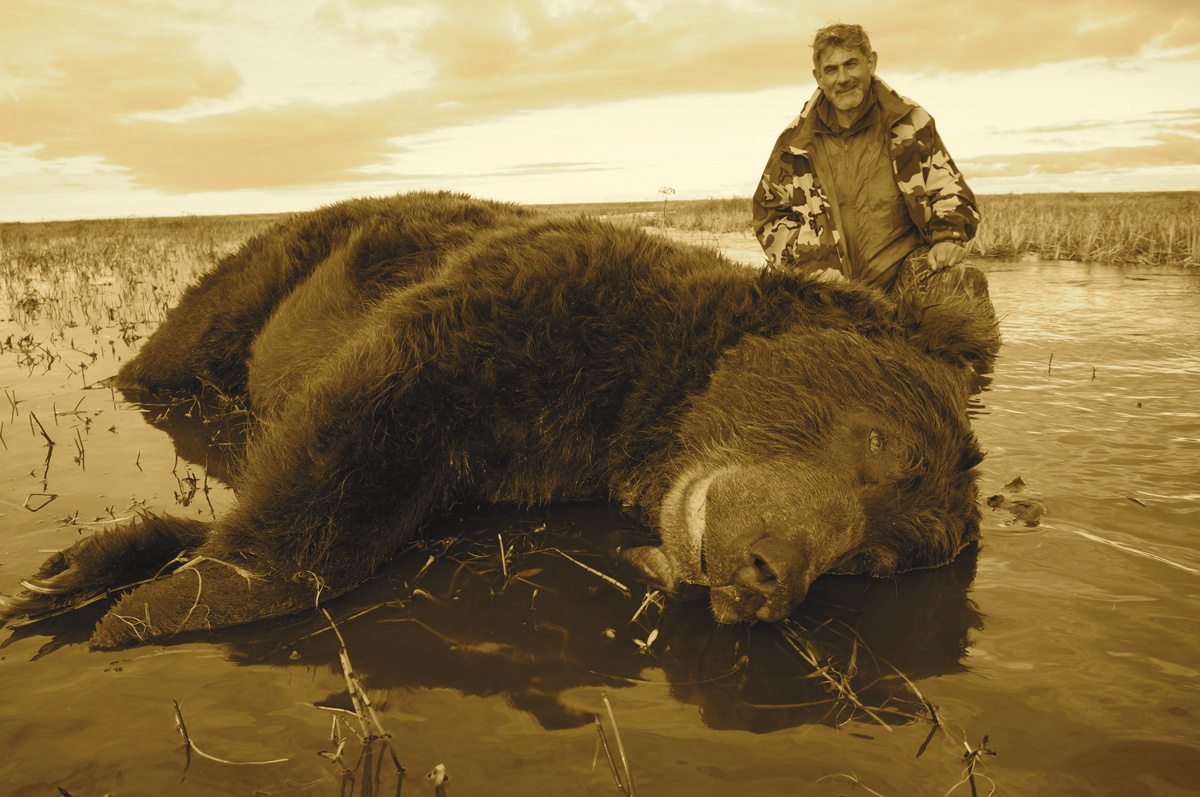
Tony Caligiuri and the massive brown bear he took with O’Connor’s .338 rifle.
After a long flight Jim and I arrived in Anchorage, where we caught a charter to Port Heiden. There we were met by the same bad weather that had made hunting so difficult for O’Connor on his bear hunt some 60 years before. While we waited out various storms and squalls, Loren and her nephew, Parker Hodges, who also happens to be a professional chef, fed us well before the wind let up enough for Dan to shuttle us one by one to “Swamp Camp” in his float-equipped Super Cub. Besides the normal array of bear-hunting gear, we also brought a small inflatable raft, a necessity for traversing the deep streams that crisscross the swamp.
In addition to being the only place dry enough to pitch two tents, “Swamp Camp” sits at the junction of several major bear thoroughfares where the big predators are known to gorge on salmon that swim shoulder to shoulder in the dozens of streams that surround it.
With the aid of a ten-foot stepladder unfolded a few yards from our tent door, we took turns glassing from early morning until dark, searching for distant dark specks as far as our binoculars could reach.
Each day brought the same routine: Pull on your waders, eat a quick breakfast, load your pack, ready your rifle, and then glass until your eyes wear out. Pretty leisurely hunting, at least until a dark speck is spotted, and then it’s down the ladder like a fire-house pole, hitch Hank to the raft, and splash out through waist-deep water to close the distance. Unfortunately, most of our sightings were false alarms. The speck would turn out to be a sow, or a small boar, a big boar that caught our wind, any one of ten other bad things that can happen, leaving our two- to three-mile sloshes through smelly salmon water little more than an exercise in frustration.
Jim and I had agreed to rotate turns whenever a good boar was spotted, and our third day found Jim up to bat first. A little before noon Hank spotted a distant bear, which, judging from its size and color, appeared to be a big boar. Knowing it would be at least a four- or five-hour push through the swamp, Hank and Jim loaded their packs with some extra food and took off, hoping to catch the bear by evening.
About midnight I climbed the ladder and scanned the black swamp for signs of my two campmates, now gone more than 12 hours. My binoculars finally caught a far-off flicker as headlamps danced like distant stars. I perched a lantern on top the ladder so they would have a visual reference for their GPS heading.
An hour later a very weary guide and hunter stumbled into camp with no bear to show for their herculean efforts. They spent a few minutes trying to make me believe their long walk was all for naught, but their smiles soon belied the real story. The bear turned out to be a giant old boar that Jim dumped with his .375 H&H. They packed the bear as far as they could, finally caching the huge brownie near a small lake a mile or so from camp. They were so worn down, they feared that if one fell face down in the frigid water while packing a hundred pounds of wet bear hide on their back, the other might not be able to get him back up before he drowned.
Jim said it was the toughest hike he’d ever made, even worse than the nastiest of sheep hunts, and he declared that there was no big game animal worth what he had just been through. He was dead-tired, and his legs cramped to the trembling point. As soon as he crawled into his down bag, his legendary snores were shaking the tent. Ten hours of sleep dimmed his memory of the miserable hike back to camp, and the next morning Hank plied him with strong coffee as they set off to finish packing out the bear.
After Jim and Hank had gone for the morning, I climbed the ladder to see what might have moved into glassing range from the night before. A small sow had taken up residence near an especially productive fishing hole a mile or two to the west, and eventually a herd of barren-ground caribou joined the show, their capes already snowy white in anticipation of the coming winter. They would inquisitively venture to within 50 yards or so of my perch, only to whirl and run away time and again.
I was putting the last touches on a gourmet lunch of hot Spam sandwiches when Hank and Jim splashed in from their bear-hide recovery trip. Over lunch, Hank expressed concern about the increased activity of other outfitters in the area and felt we should move to a less-crowded place. He was going to call Dan on the satellite phone the next day and, weather permitting, have him come get us.
The morning of our planned move brought a welcome sunrise that lit up the normally monotone swamp in a warm array of reds and yellows. While Jim and Hank started to break camp, I climbed the ladder for one last look and saw that the sow was still fishing at her favorite spot, but for some reason she looked bigger than usual. Hank climbed up beside me and confirmed my suspicion. After a long look, he calmly ascertained that the sow had turned into a boar—and a big one at that.
We scrambled to gather our guns and gear, and then slogged through the water, hell-bent toward the bear. Hank strained under the load of the cumbersome raft, pulling like an Amish draft horse hitched to a two-bottom plow, Jim right behind him, and me bringing up the rear. After a few hours of plunging along, using the raft to ferry the three of us one at a time across several streams teeming with salmon, we found ourselves about 250 yards from the bear with the wind in our favor.
Making short, quick stalks each time the bear took a break from fishing, we closed the distance to less than 70 yards, finally stopping by a large stream between us and the bear. The stream was framed by a natural berm on the far side that the bear would frequently dip below, giving us only a glimpse now and then of his head and backside.
We calmly waited, hoping at some point the big boar would eventually rise up and offer a shot. After an hour spent bent down in the knee-deep water, the bear stood up, and a thin smile crossed Hank’s face as he whispered to get ready.
I brought up the .338, hoping it would not falter on the final leg of its 50-year journey. Hank and Jim hollered, “Hey, bear!” and the brownie turned to face the sound. The .338 cracked, and the bear crumpled into the stream, dead before he touched the water. The 250-grain bullet had disintegrated his heart.
It was the biggest-bodied brown bear any of us had ever seen, with thick, dark fur and a snout scarred by a decade defending his crown as King of the Swamp. Big enough maybe to even excite the hard-to-impress Jack O’Connor.
The old rifle had finally fulfilled its intended purpose. In the end it proved to be pretty lucky after all.