
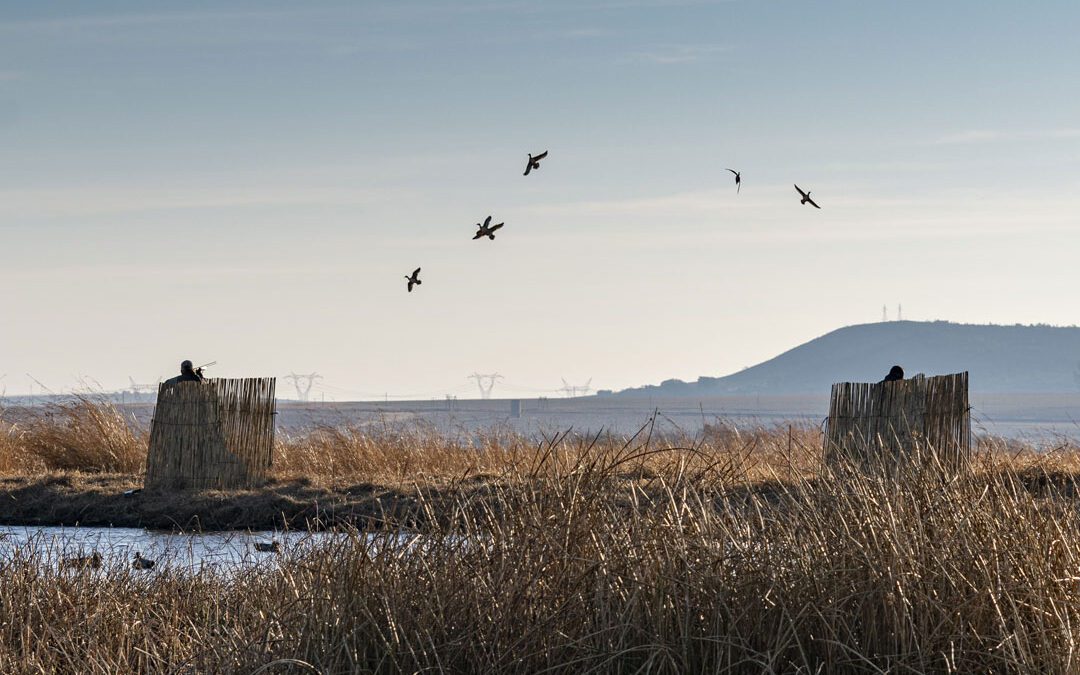
For South African Trevor Comins, perfection is a safari on the fly.
The beast is dead, but that’s when it becomes dangerous. Forty yards in the sky, the 22-pound spur-winged goose plummets toward my blind like a feathered meteorite. When calculating the lead on the bird, I neglect to consider what might happen if my shot is indeed successful. The headlines fly through my mind: Kamikaze Goose KO’s Nimrod or something like: Bird Brains Hunter. The thought of leaping into the water to miss the projectile flits through my thoughts in the slow motion of the moment until I remember the crocodile that patrolled past my hide only a few minutes earlier. During my indecision, the bird smacks the earth behind me with a bone-crushing thud. Of the world’s sporting birds, the spurwing comes the closest to being dangerous game, especially during an uncontrolled descent.
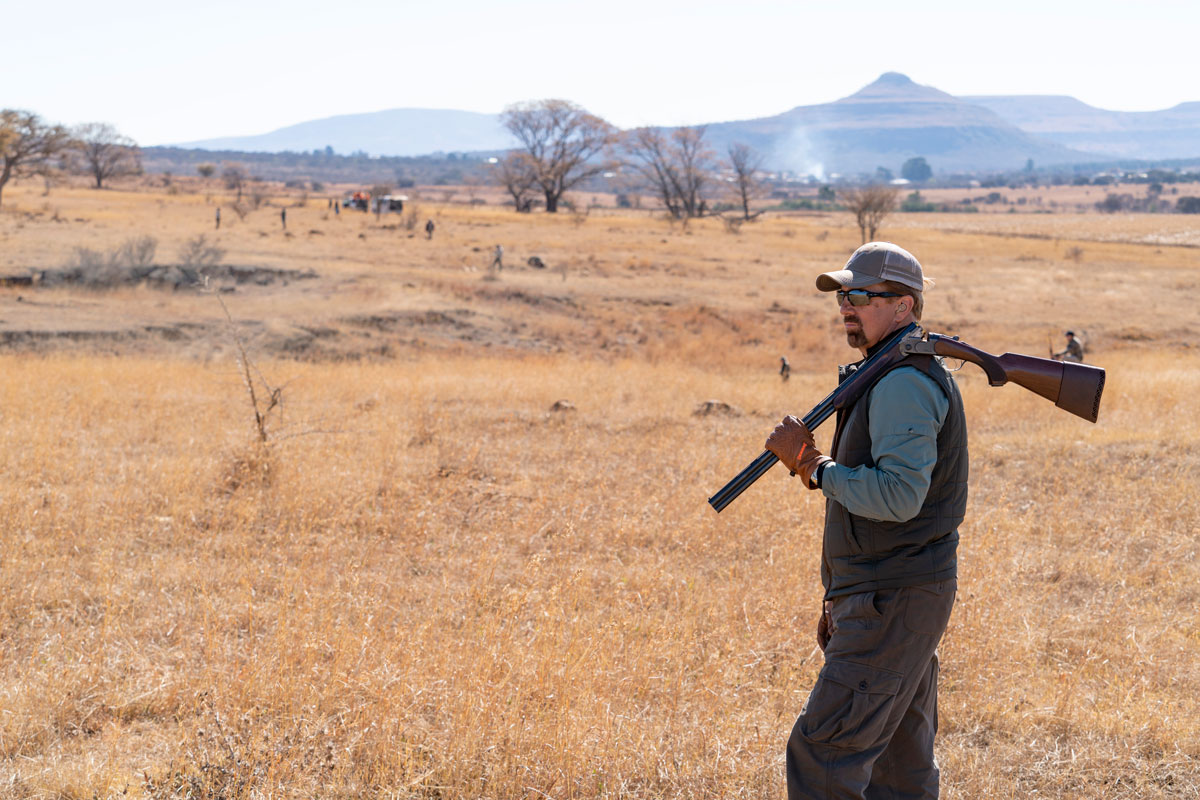
Dorsey waits at the end of a line of guns for a guinea fowl drive to commence. Driven guinea shooting is just one of many bird hunting options found throughout South Africa—a country that offers exceptional wingshooting despite being best known for its plethora of big game.
The spurwing is seemingly a throwback to the Mesozoic, a bird one might imagine as the successor to the pterodactyl. The most distinguishing feature of the spurwing is its sheer size. The largest goose on the planet with a wingspan more than six feet, the spurwing appears to lumber swan-like into the sky and, once airborne, it’s about as maneuverable as the Spruce Goose.
I share a blind with Mississippian Bob Cooke while farther down the bank of the river sit Richard and Marci Welker, a Michigan couple enjoying their first African wingshooting safari. Our blinds stand some 20 miles from the Indian Ocean, along a river channel lined with open dirt banks framed by towering canes. We are in South Africa’s KwaZulu Natal region, a bird-rich area once known simply as Zululand, a name that rolls easily off the tongue.
The open banks along the watercourse are preferred rest areas for spurwings, and Comins arranges a few dozen homemade silhouette spurwing decoys, plywood cut-outs, along with several Canada goose shells he’s imported from America. The silhouettes are enormous, all of five feet long and four feet high and a goose could undoubtedly see them from as far away as Kilimanjaro.
There’s a biological term called “super normal stimuli,” which explains why a bird is attracted to outsized objects. That’s why you can put a blind in the shape of a giant decoy in the middle of a spread and not only will it not flare approaching geese, they’ll be ever-more drawn to it. Which perhaps explains why some men find breast implants the size of watermelons attractive. Biologists studying the phenomenon have put artificial tern eggs three times the size of real eggs in nests only to witness the terns as they attempt to incubate the artificial giants at the expense of the actual eggs that they wind up pushing out of the nest.
“Mark right!” shouts Comins from the cover behind us. A flock of white-faced whistling ducks approaches, announcing their presence with their distinctive three-note whistles. This handsome, long-necked duck is found in both South America and Africa, inhabiting tropical lowlands across the eastern half of the Dark Continent. The long form of the birds in flight—almost like a wading bird—and their peculiar white faces make them easy to identify. Welker plucks one of the birds from the flock before they flare to other waters.
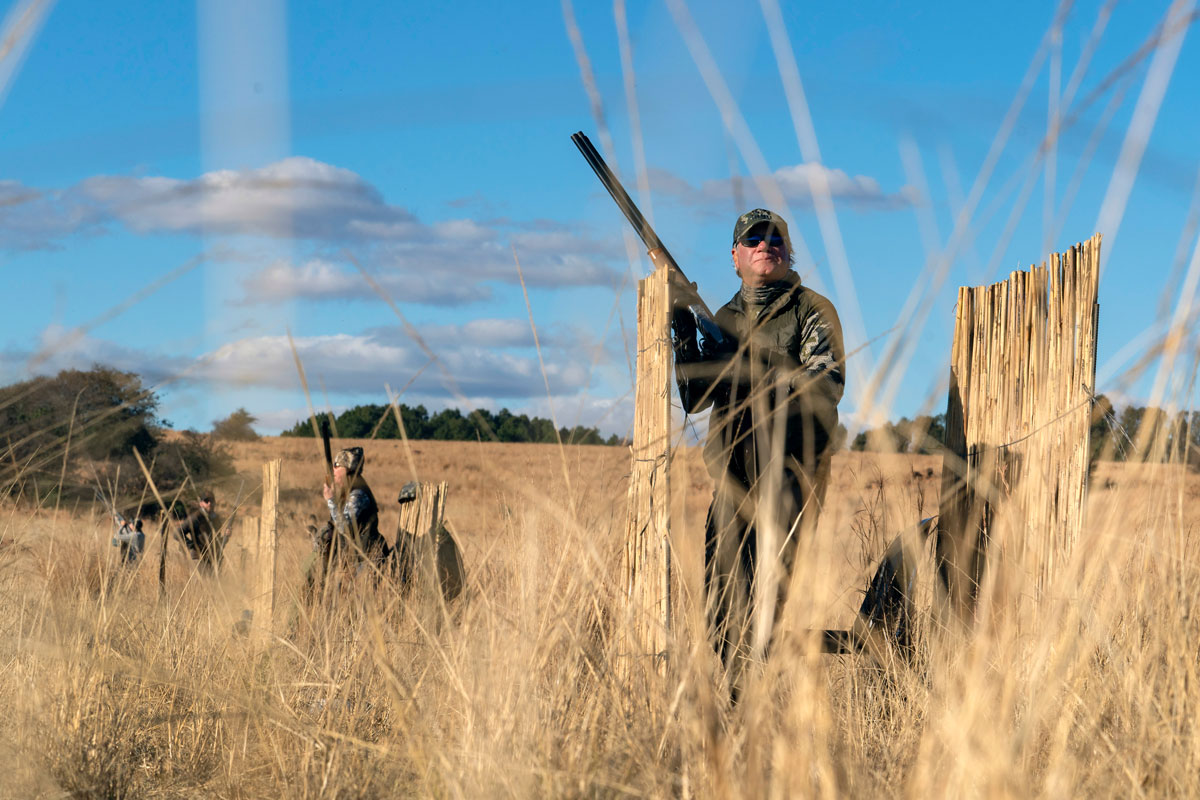
Brays Island resident Mark Ingram awaits a flight of red-billed teal along the banks of a shallow pond in the Blood River region of South Africa. Several species of puddle ducks and pochards—along with Egyptian and swan-like spurwing geese—are on the waterfowl menu in South Africa.
Yellow-billed ducks—looking and sounding like hen mallards with bright yellow bills—and red-billed teal share the skies with the geese and whistling ducks, diversifying our bag. Bird boys use rowboats to fetch the fallen birds, for the waters teem with crocodiles that have developed a taste for Labs and almost anything else that enters their river.
Comins’ retrieving crew is slow to reach one of the fallen spurwings that is flopping on the water, so the race is on between the small fetch boat and three crocs triangulating toward what amounts to an outsized topwater lure. Hungry crocs make certain that no bird goes to waste. It isn’t clear what you might have done wrong to be drafted for retrieving duty here, but it’s likely a profession that doesn’t come with a pension.
The crocs aren’t alone in the river, however, as the bulbous faces of hippos periodically surface, spraying water and groaning as they rise. At first glance, they are seemingly sublime plant-eaters whose doughboy appearance belies their malevolent nature.
“They might be the most dangerous animal in Africa,” says Comins with a watchful eye and a tone of mistrust in his voice. Which is saying something when you think of the considerable cast of African beasts whose menus have included Homo sapiens.
“Mark right!” shouts Comins, ending our brief conversation the moment he spies a pair of Egyptian geese sailing toward us. The region’s other geese, the Egyptian variety, are roughly the dimensions of a small- to medium-sized honker and readily decoy to the Canada dupes that have been painted rusty brown to match this African species. The pair passes wide of Welker’s blind but swings back overhead. It’s an easy double. It should have been an easy double. I still can’t believe that I didn’t bust a feather.
“Mr. Dorsey, do you need some tissue?” queries Comins with a smirk growing wide across his face owing to the schtick he’s about to perform.
“For what?” I ask, willfully taking the bait.
“So that you can wipe the dirt out of your eyes to see to shoot.”
Laughter erupts from the blinds, and Comins translates the joke to his Zulu staff, who share in the laugh at my expense. Comins is part field general with comedic moments. He’s fluent in Zulu, Afrikaans and English, and speaks enough German to get into a bar fight. He grew up with the Zulus, his father once recruiting them to work in the country’s rich diamond mines. His resume includes a tenure as a game warden who helped found the Itala Nature Reserve in the former Zululand. He and his wife, Colette, are skilled hosts, quickly acclimating their guests to the casual lifestyle of an African wingshooting safari. Of course, never taking any of it too seriously.
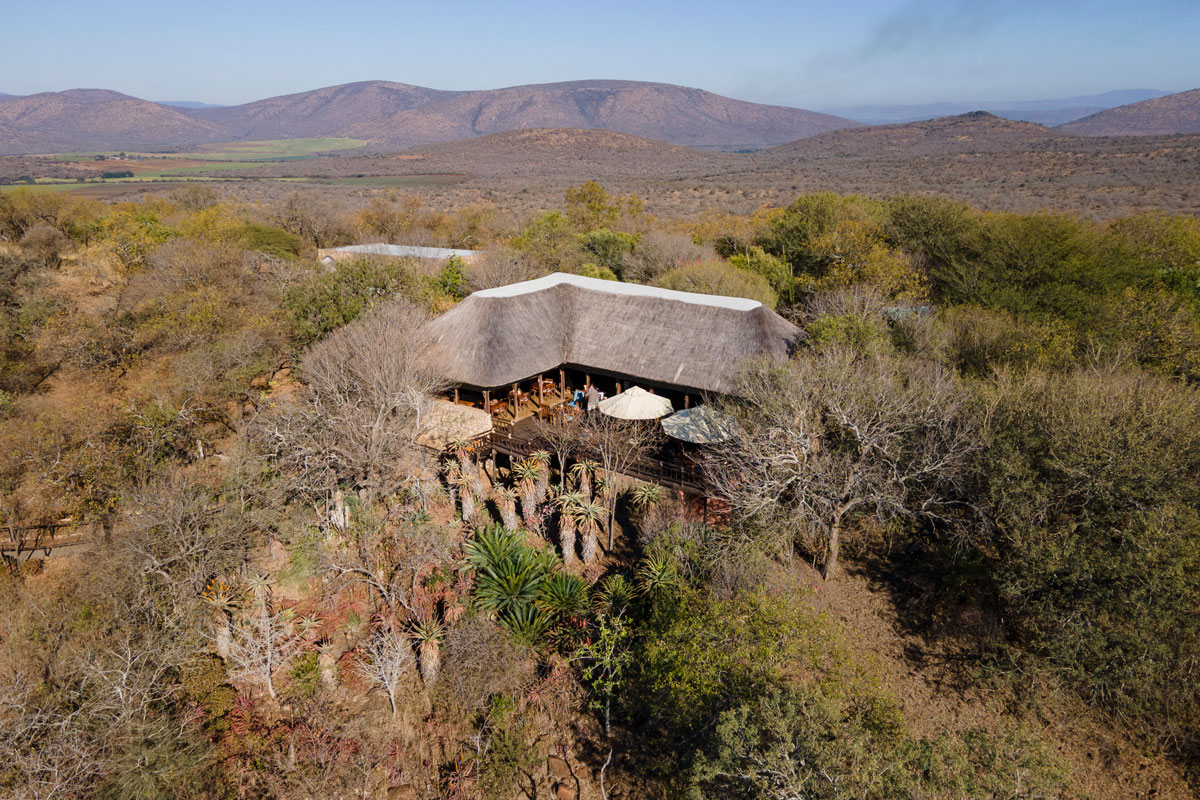
A Wing and a Prayer—Tendele Lodge
Running out of cash and desperate to carve out a life together, Trevor and Collette Comins struggled to find a way to extract a living from the South African landscape. Only after exhausting conventional employment, the couple came upon the idea of opening a bird hunting operation. The notion was received with laughter and no small amount of skepticism from the country’s big game outfitters. Some 30 years later, however, thanks to the success of the Comins’ wingshooting safaris, many of South Africa’s big game outfitters are dovetailing bird hunting with their commercial big game ventures.
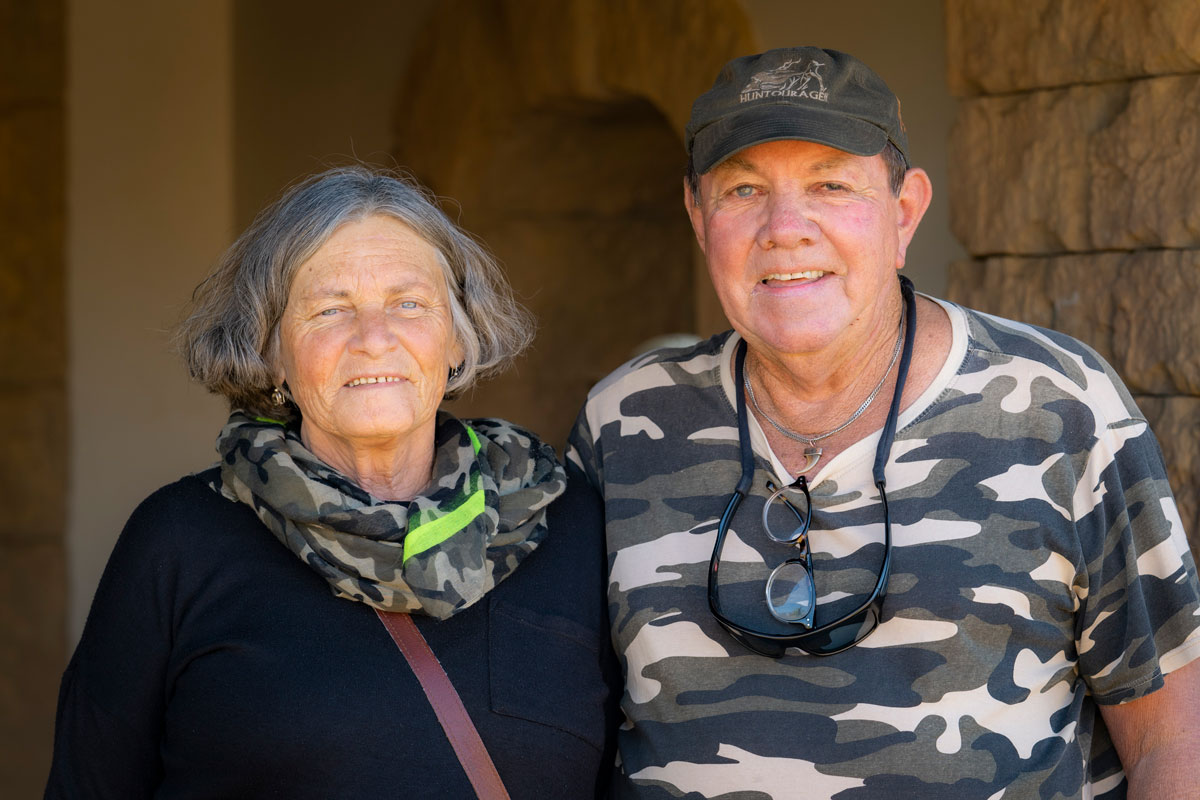
Collette & Trevor Comins
The stone walls and floors of Comins’ Tendele Lodge—Zulu for “partridge—and the many mounts of African gamebirds that adorn the great receiving room are instantly welcoming to wingshooters who follow the rumors of memorable bird hunting emanating from South Africa. Hardwood tables and bookshelves replete with scores of sporting titles add to the atmosphere. A small sign behind the bar sets the tone of the experience: “Relax, you’re on safari.” Underfoot are zebra rugs, from beasts that won’t ever have to worry about lions again, and in the corner sits a piano in case any guest is moved to music by the confidence of bourbon or wine—or both.
Tendele was built in 1948 by former Italian prisoners of war who remained in South Africa after World War II. It’s located near the predominantly Afrikaans community of Vryheid in South Africa’s Natal Province, a region blessed with abundant wingshooting opportunities.
Our introduction to the area’s waterfowling comes the first morning of the sojourn when we arrive at our blinds before dawn. They are sturdy hides with wooden frames and cane sides complete with cushioned seats. They’re situated at the confluence of a small stream that feeds into a 120-acre reservoir, the point of entry for every duck moving upriver looking to rest on the lake.
As Comins will tell it, though, it takes years of experience to get it right, and his education came through trial and error and firsthand exposure to international wingshooters. “It’s got to be right,” he says, “or they just won’t come back.”
It’s that approach to his business that has brought him a steady cadre of repeat clients—the best testimonial for any hunting outfitter. It is the nation’s abundance of birds, coupled with Comin’s careful stewardship of that resource to offer consistently abundant shooting, that have enabled him to grow his list of far-flung guests.
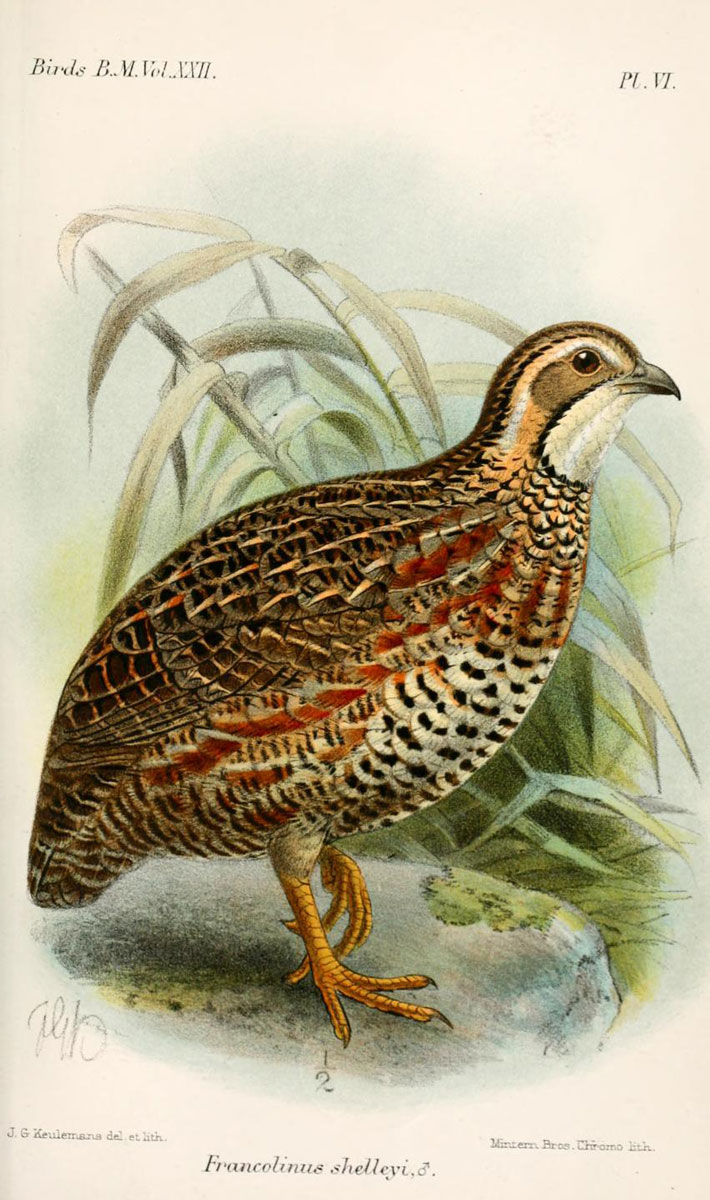
More than a dozen species of partridge-like francolin species inhabit the bushveld of South Africa. Both flushing and pointing breeds are used to hunt the birds and most hold well for a point and fly with the strength and speed similar to pheasants.
His Tendele Lodge sits in the Montana-like countryside of eastern South Africa, an area once dominated by the kingdom of Shaka Zulu, the demonic leader of the Zulu nation. It’s an area where both upland birds (predominantly Swainson’s and Shelly’s francolin) and waterfowl (yellow-billed ducks, red-billed teal and Egyptian geese) are found. The marquee attractions, however, are guineafowl and spurwing geese, black-and-white birds that resemble a hybrid of a Muscovy duck and black swan, with a bit of pterodactyl mixed in. While the guineas are driven, the spurwing decoy like the rest of South Africa’s waterfowl—providing a mixed assortment of ducks and geese on several of Comins’ many hunting venues.
With homemade spurwing silhouettes staked along the edge of a five-acre slough, I await dawn with the expectation that the monstrous birds will be coming soon. As is often the case when hunting with Comins, the birds arrive as if on cue. For such ponderous birds, they utter a remarkably subtle hiss, enough to set the hair on the nape of any waterfowler’s neck on end with anticipation.
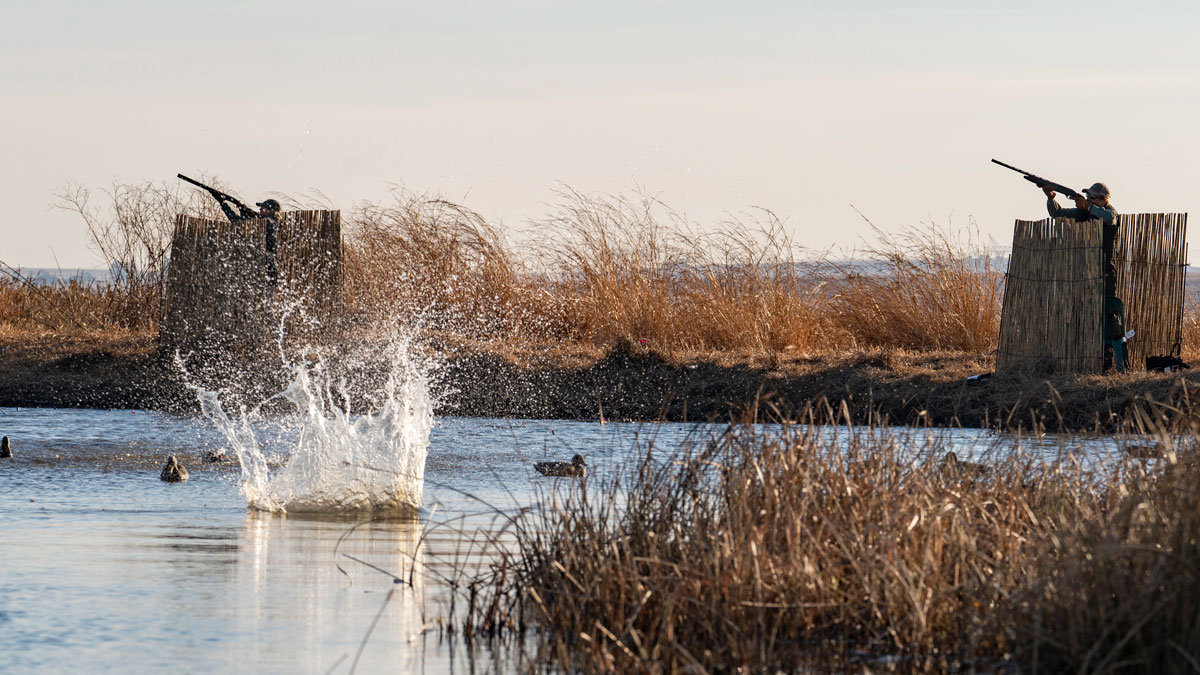
Waterfowling in parts of South Africa rivals the best of the duck hunting found in Argentina. Couple that with the ability to add big game hunting or game viewing to a safari and you have one
of the sporting world’s most unique destinations.
A dozen birds glide through the gray light of a cloud-covered morning, their wingtips tapping the air currents ever so slightly. In the slow motion of the shooting sequence, I swing the gun ahead of the lead bird and merely send the flock into aerial contortions in that awkward moment when the birds first discern that something is dreadfully wrong with their descent. The second barrel betrays me as well—a remarkable phenomenon given the amount of air space above my blind occupied by birds. It wouldn’t have been so humiliating save for the fact that there are witnesses to the travesty…witnesses with long memories.
As fortune has it, there are soon opportunities for redemption as myriad small flocks of whistling ducks, red-billed teal, Egyptian geese and more spurwings arrive from a nearby reservoir. Several catch the ire of my 12 bore, later to become the staple of an equally memorable dinner at Tendele. Comins’ daughter, Camilla, is a chef de partie, which is to say she is something of an alchemist, transforming the treasures of the field into riches on the table.
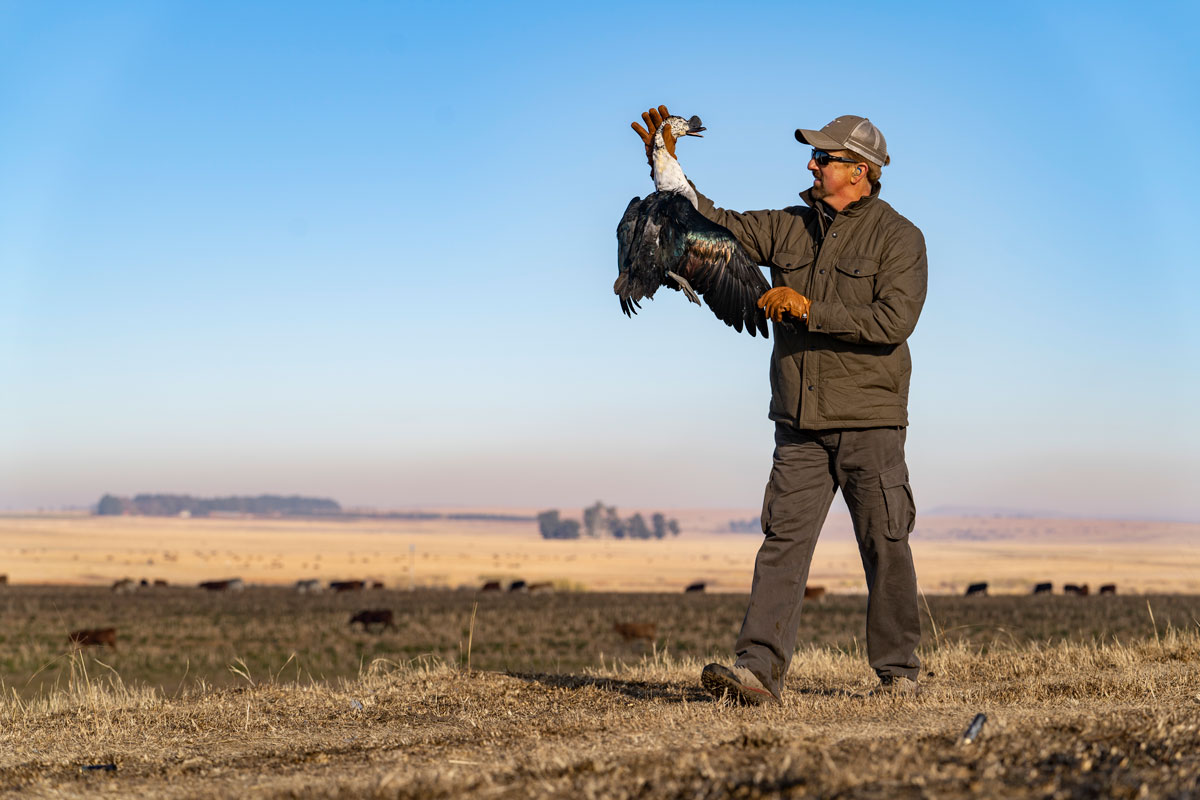
The author hoists a knob-billed, or African comb, duck taken during an afternoon shoot.
The variety of gamebird species in South Africa is perhaps unmatched anywhere in the world. In addition to many kinds of waterfowl, some 12 species of francolin—upland birds ranging in size from partridges to pheasants—and many species of doves, pigeons and quail are also found there.
“The key to maintaining quality waterfowling,” says Comins, “is to provide plenty of rest areas for the ducks. And you mustn’t overshoot your birds.” It’s an axiom that holds true everywhere commercial hunting is offered.
Comins hunts an area some 500,000 acres in size, relying on cooperative arrangements with farmers who sell him shooting rights.
“When the landowners see financial value in the game,” he says, “they begin to manage the land to accommodate more wildlife.” Such is the truth the world over: wildlife that pays, stays.
An Eruption of Guineas
“Driving guinea fowl,” says Comins, “is like to trying to lasso smoke.” Although there is no shortage of the birds on the plains of southern Africa, they seem more akin to roadrunners than gamebirds. In a 100-yard dash between a guinea and a pheasant, good money is on the guinea and don’t worry about spotting the rooster 30 yards. After two frustrating attempts to corral flocks of hundreds of guineas, Comins refuses to concede to the beasts. Having developed something of a love-hate relationship with the birds, he formulates a new strategy to trap them on the slope of a coulee dotted with acacias, the thorn trees that are the signature flora of the African bushveld where even the plants bite.
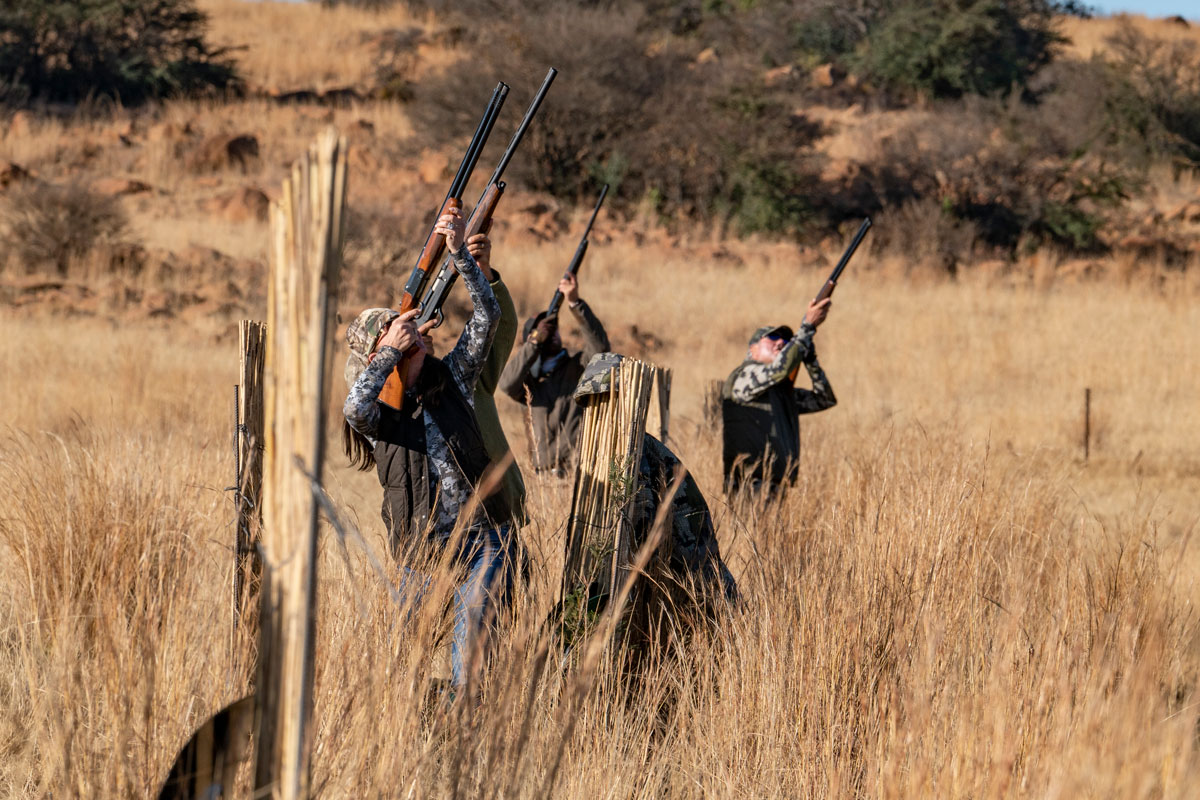
A line of guns greets a flock of mallard-like yellowbill ducks during a morning shoot in South Africa’s KwaZulu-Natal Province. Both 12-gauge and 20-gauge ammo is readily available across South Africa.
With gunners positioned in a line stretching the length of the slope, Comins leads his team of a dozen beaters in a quick march to surround the birds that we watch slip into the grass and acacia cover. In moments, Comins sounds his horn, signaling that the first birds are airborne and heading for the guns. This time the ambush works. Guns pop below the hill as Cooke and Welker drop several of the helmeted guineafowl, the birds’ name derived from the plates on their head, which look like German Pickelhaube helmets worn in World War I.
Comins’ horn soon becomes a serenade as untold numbers of birds take flight like a guinea migration and, in the distance, he conducts his orchestra of beaters to close ranks by waving his flushing stick hither and yon to keep the birds from breaking back through the line of beaters. A flock of 20 guineas swings overhead, intermittently flapping and gliding as they head for distant covers. I pull down one of the birds, tipping it with the first barrel and finishing the job with the second. I quickly reload as more birds approach. This time a double falls to my reports, and in the distance, Cooke and Welker busily intercept birds of their own. This time Comins gets the best of the birds.
“We got the guinea-bastards that time,” he proclaims with a smile as he marches out of the field like a victorious football coach. Guineafowl shooting doesn’t enjoy the esteem of, say, driven grouse on the Scottish moors, but that could simply be because those who have seen the veld come alive with the sight of hundreds of airborne guineas aren’t telling anyone.
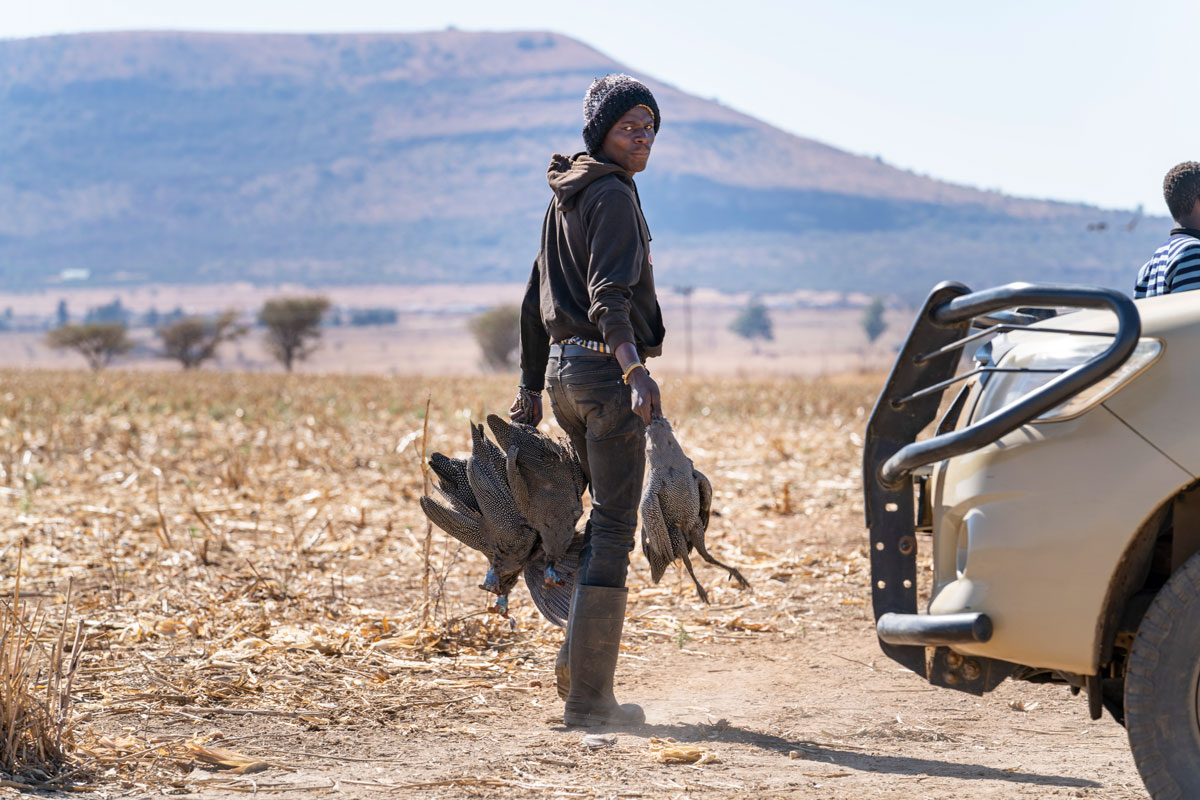
A beater collects the spoils of a driven guinea shoot.
While guinea shooting is one of the world’s great wingshooting endeavors, Comins has also secured many parcels rich in francolin. The Swainson’s, roughly the size of a hen pheasant and equally as presentable as table fare, is the most prevalent in the region. The methodical style of Comins’ pointers make them easy to follow, and in one morning alone they produce nearly 30 birds over point, showcasing yet another form of wingshooting Comins offers on his diverse menu. Each of the party rotates shooting chances, captivated by the mesmerizing dog-work and feathers-in-your-face flushes. Despite offering an abundance of waterfowl, francolin, doves, pigeons and driven guineas, South Africa might still be the wingshooting world’s best kept secret.
And for double-barrel aficionados like me, that’s just fine.
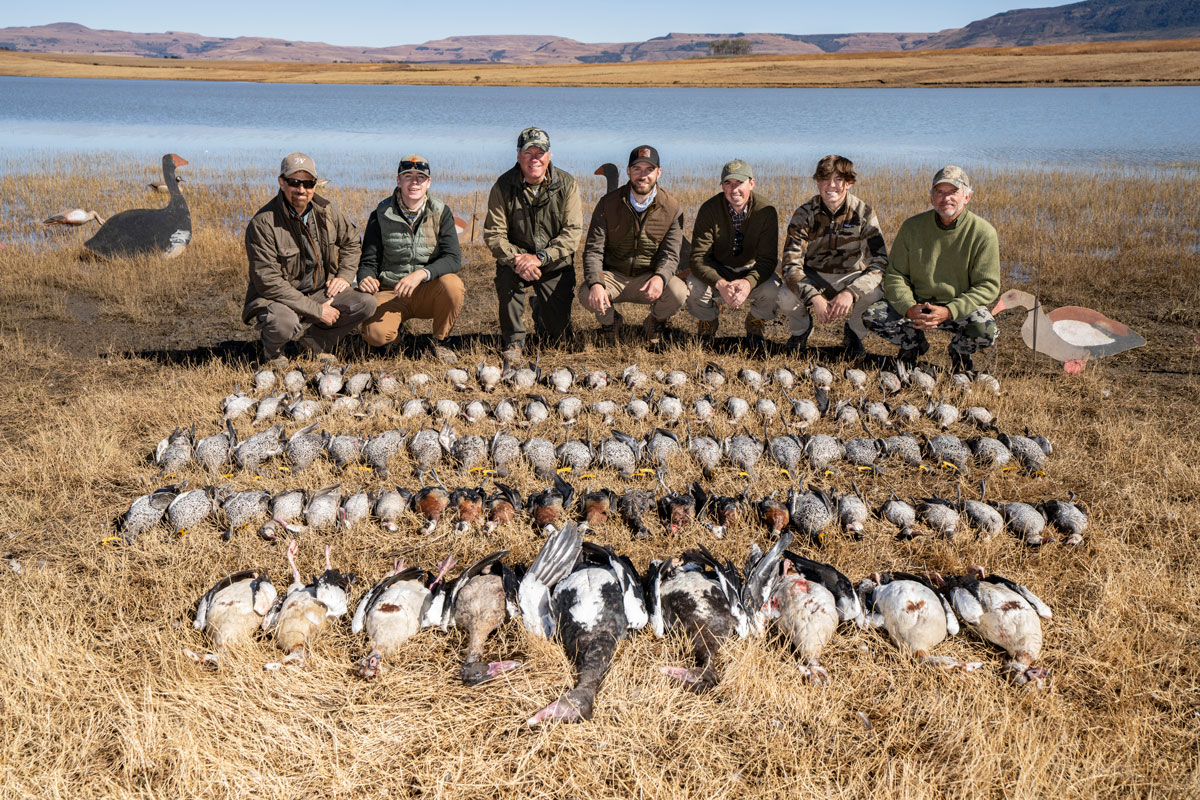
A fruitful morning of hunting with Clayton Comins produced a mixed bag of yellowbills, red-billed teal, white-faced whistling ducks, Egyptian and spurwing geese.
Epilogue
After a more than 20 year absence from South African wingshooting, I returned in 2019 and joined Trevor and Collette and their son, Clayton, who is now running the wingshooting business. It was as if I had returned in time to my inaugural South African wingshooting foray, for I shot several of the same areas Trevor and I prospected two decades earlier. The dogs had changed and so had the shooting—remarkably, it had gotten better.
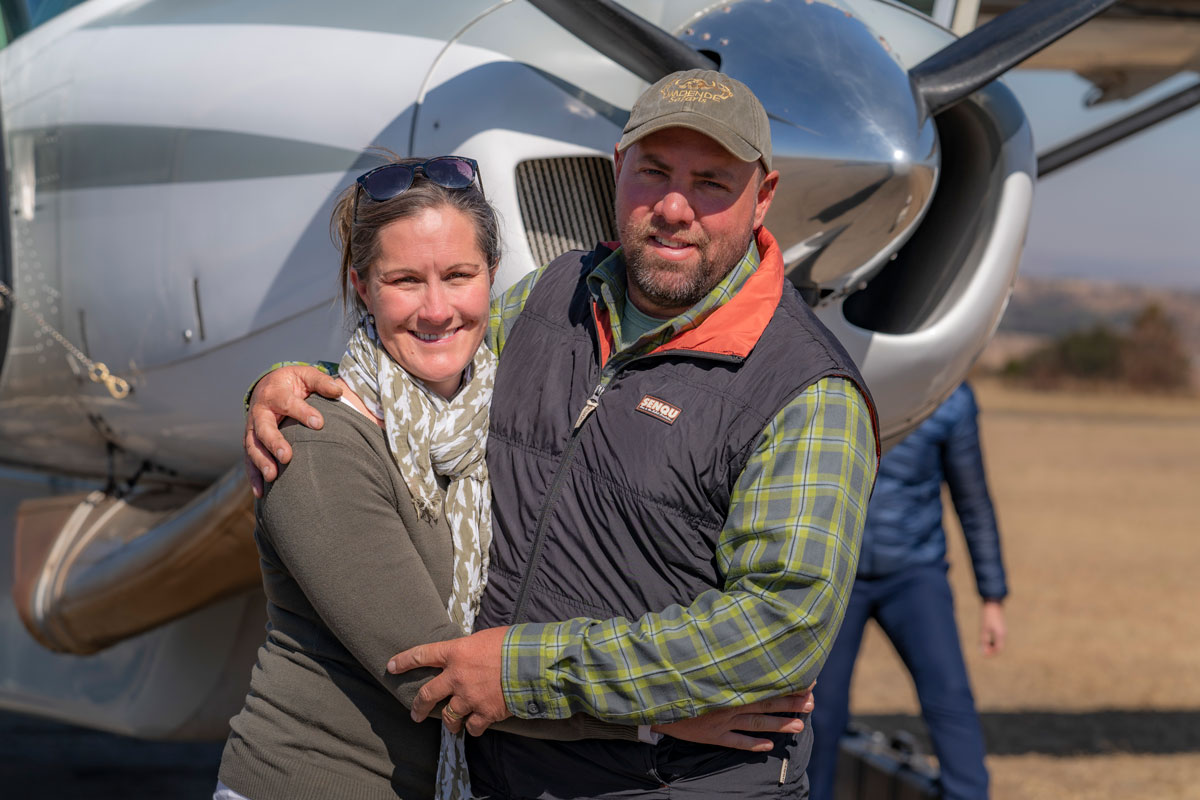
Debbie & Clayton Comins
While Tendele is gone, part of the post-Apartheid redistribution of land ownership, Clayton’s Umdende Safaris operates in some of the best bird areas throughout South Africa, employing a series of beautiful lodges within short driving distance of epic upland bird and waterfowl shoots. No matter where Collette prepares her meals, they remain extraordinary in every sense.
As I sat in a duck blind the last night of my return voyage, it was heartening to see something in the hunting world that had improved, a memory that hadn’t faded but rather brought optimism for a new dawn, one I hope to one day share with my sons as they come to know how special this place—and these people—truly are.
Editor’s Note:
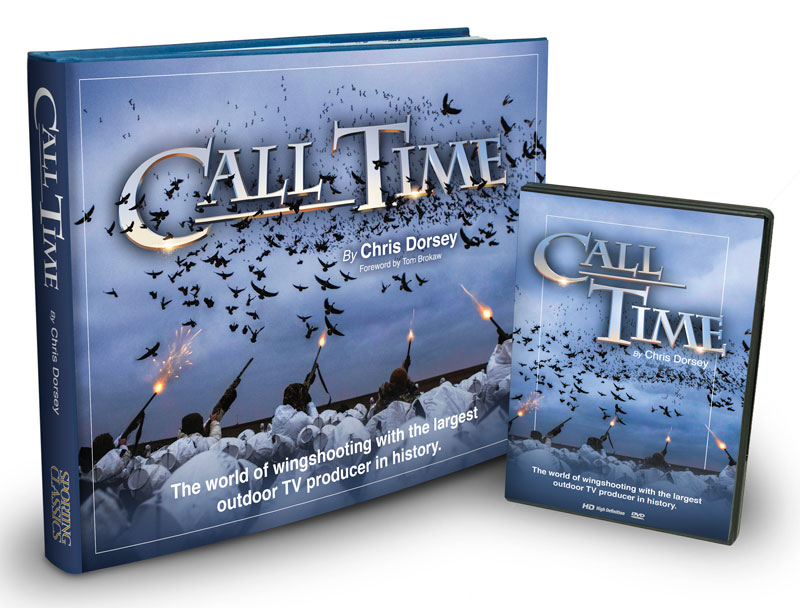
This essay is adapted from Chris Dorsey’s wingshooting book, Call Time. From one of the world’s most widely traveled wingshooters and the largest producer of outdoor television in history comes the first of its kind celebration of the planet’s greatest bird hunting. Dorsey’s book and film combo set takes readers and viewers to unforgettable fields, marshes and mountains from Africa to Canada to South America and many points in between. Visit the Sporting Classics Store at www.SportingClassicsStore.com or call toll-free (800) 849-1004 to order your copy today.