
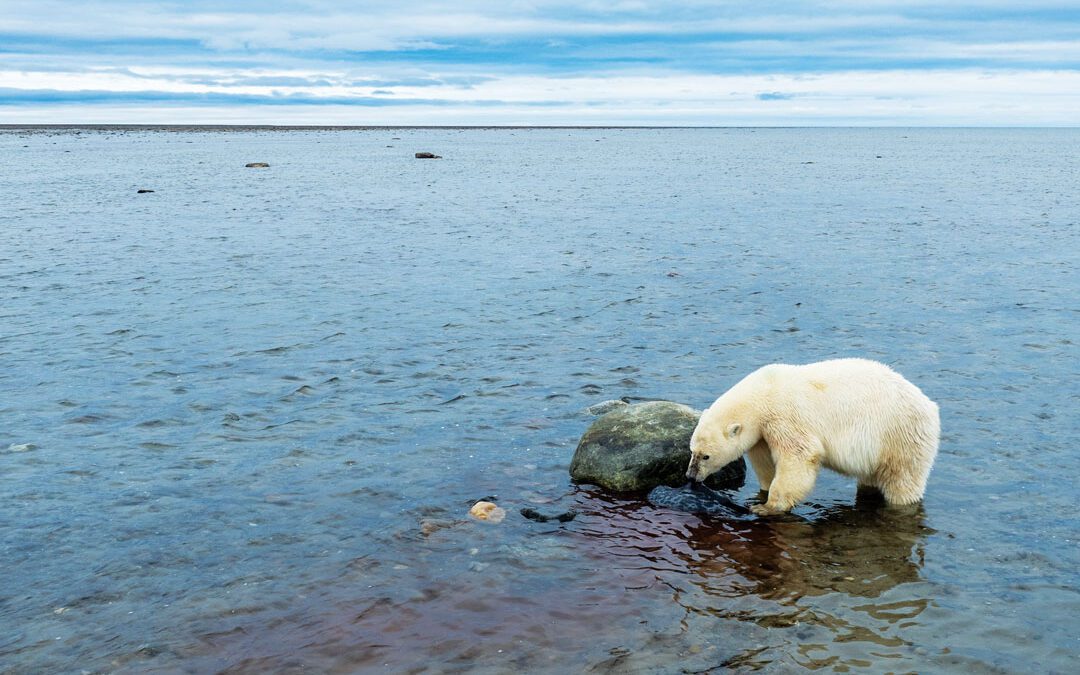
The hunt for the tundra’s legendary white bears.
In the land where the geese, fox, owls, hares and grouse are white, why should the bears be any different? Head to the western shore of Canada’s Hudson Bay and you’ll find yourself amid the richest polar bear territory in the world. It’s why I am making the journey to the Hudson Bay Lowlands—to stalk one of only a handful of predators on the planet that view humans as prey. In other words, it’s their food chain and, when you enter it, you are signing nature’s liability waiver.
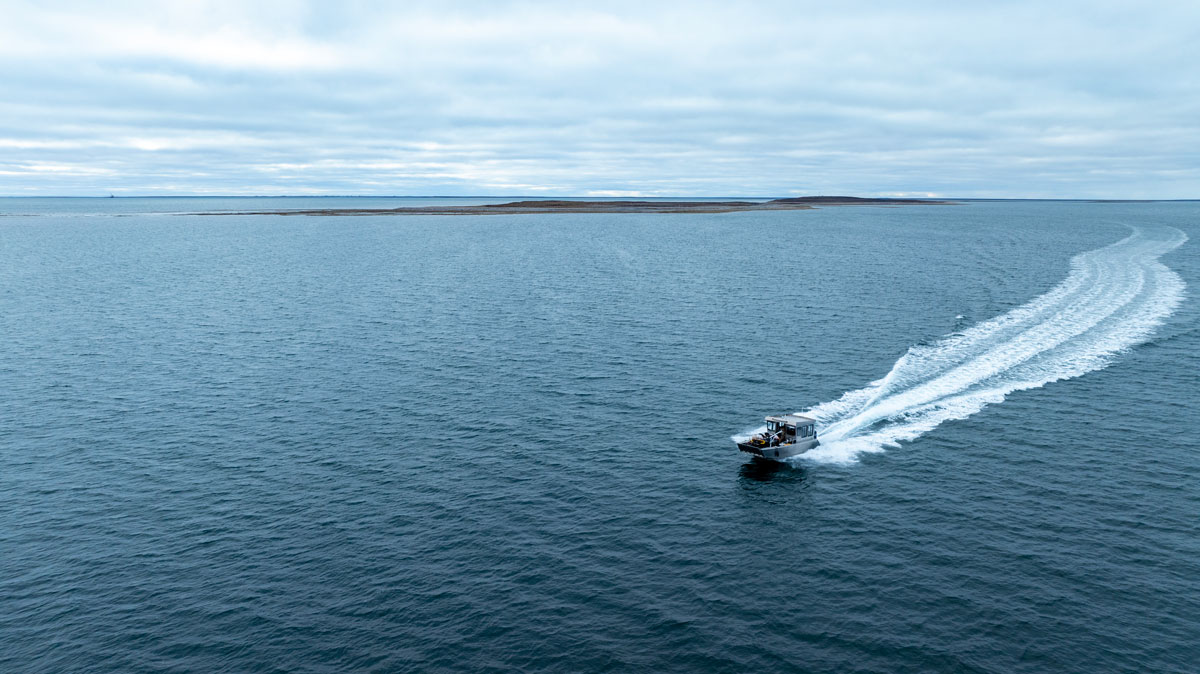
The lowlands along the western shore of Canada’s Hudson Bay are ground zero for the world’s highest densities of polar bears. Come October, the bears concentrate along the shoreline waiting for sea ice to form from which they hunt seals—their favorite meal.
Of all the members of the Ursus clan, only the polar bear is a true carnivore (the rest are technically omnivores) and their ability to kill equally effectively on land and in water speaks to the species’ remarkable adaption and resilience. With a diet that ranges from caribou and muskox to seals and whales, the bears are nothing if not opportunistic.
For hunters who pursue dangerous game, the experience comes with the understanding that everything rides on the effectiveness of the first shot. The difference between hunting and dangerous game hunting is roulette versus Russian roulette.
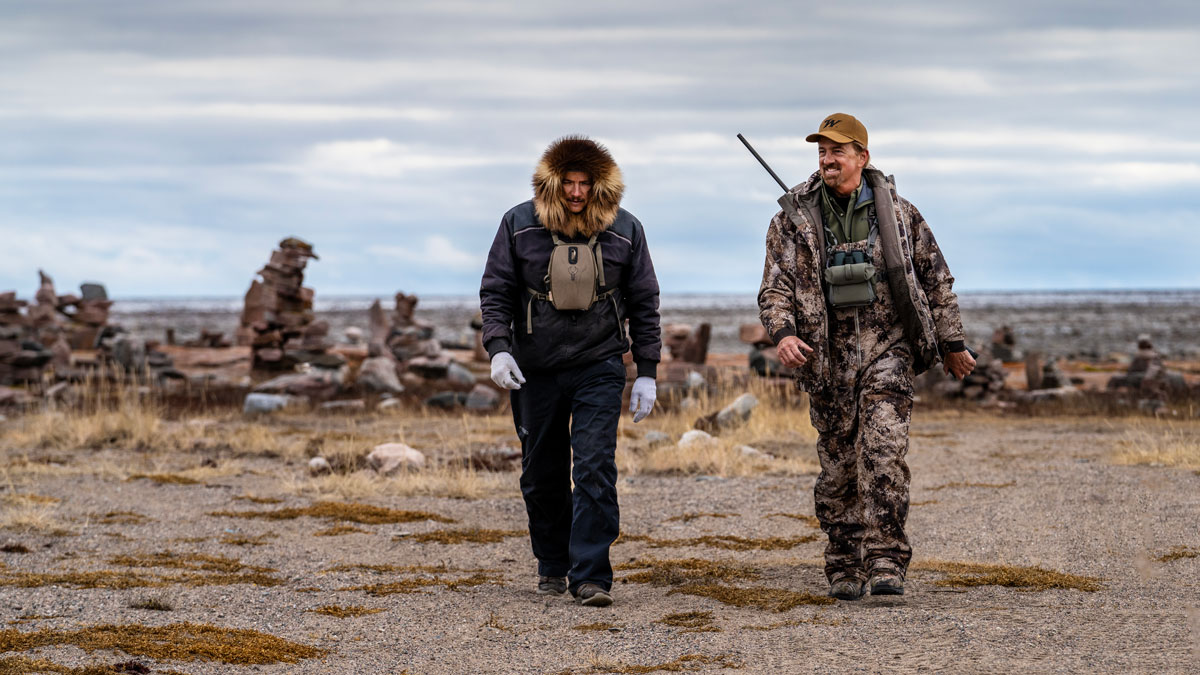
Dorsey walks the tundra in search of bears with outfitter Ryan St. John who has been hunting the region for nearly 40 years.
For Ryan St. John, a 52-year-old Inuit from the village of Arviat—population 3,000—life among the great bears is just part of the existence above the 60th parallel. As hunter-gatherers, the Inuit accept risk as a birth right—whether pursuing whales from seal skin boats or facing a polar bear with a spear. They are the Masai of our continent.
They are also a gentle, kind people whose strength and resilience is derived from the rich tapestry of community that has mostly been lost in the ever-transient modern world.
I join St. John and his family along with their community as a humble observer, an outsider trying to fit into a world that, for the most part, hasn’t widely existed for hundreds of years. As I travel in mid-October through the small hamlet on the edge of civilization, I marvel at what their existence is like come January and February—a time when locals must surely pray for global warming.
I am the student, and St. John is my teacher…call me Weedhopper. I am not here to simply go hunting as much as I am to immerse myself into another time. It feels like we could be hunting woolly mammoths as much as we are polar bears. The difference in the landscape since the last epoch is negligible, for the view on the outskirts of Hudson Bay has not changed appreciably since the Ice Age.
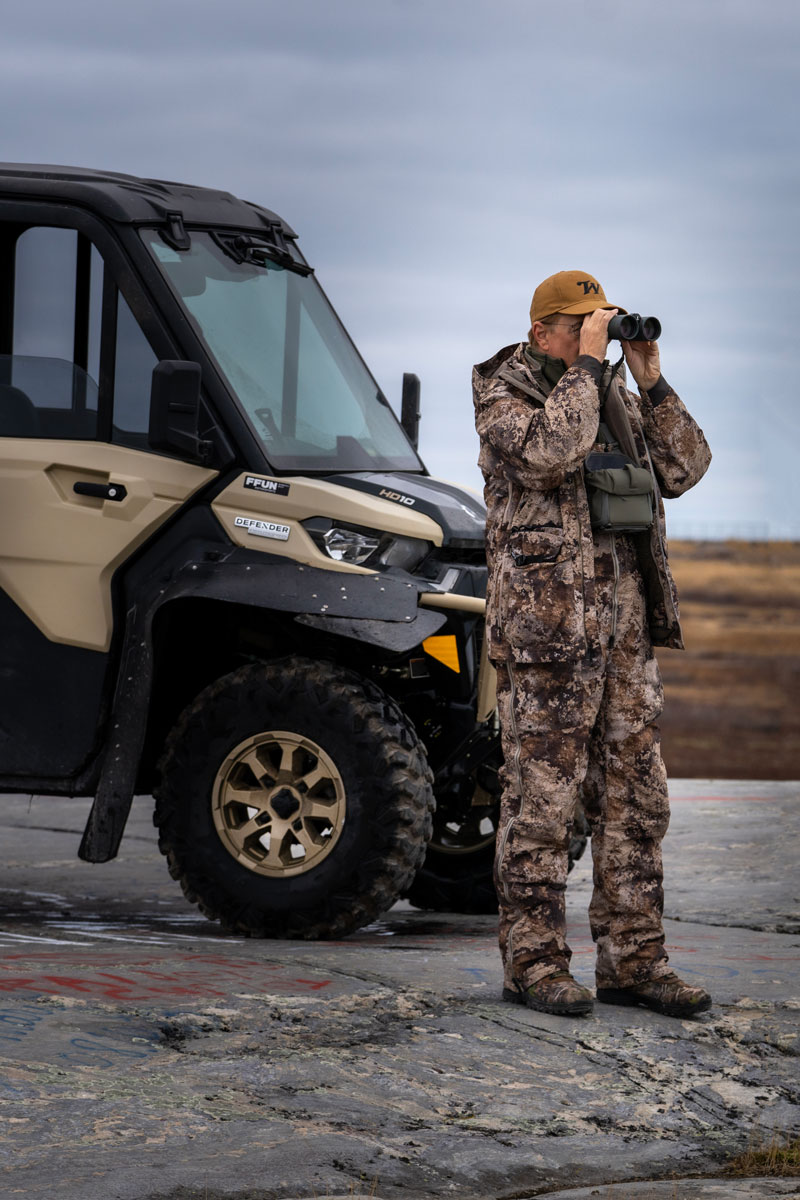
Dorsey glasses the sprawling Hudson Bay Lowlands in search of a suitable bruin—preferably one measuring more than nine feet in length.
After a few minutes of talking with St. John, I get the sense that I am the excuse for him to do what he loves. That he can hunt polar bear for a living seems a gift from the heavens. I’m just glad I can be his reason to strike off onto the vast tundra in search of these 10-foot bears wrapped in ermine coats.
The first morning we load up a side-by-side with a covered cab that is a significant upgrade from the dogsleds of his ancestors. The weather has been unusually mild this season so there is no ice nor snow on the tundra. Last year was a different tale; extreme cold and snow locked the Hudson Bay Lowlands into an early big chill—ideal conditions to find polar bears headed to the Bay.
The bears gravitate to the coast in anticipation of ice forming on the Bay, the preferred platform they use to hunt their favorite meal—the ring seal, a polar bear’s 70-pound blubber-laden snackable.
We strike off down the coastline, stopping to glass the flats below us exposed by a receding tide. Hudson Bay is a relatively shallow 450,000-square-mile body of saltwater that is home to generous populations of rock cod and char that are favorite foods of seals—ring, bearded and ranger.
It isn’t long before I spy my first bear, a young male feeding in the vastness of the exposed flat on a ring seal that he has caught. Think of Hudson Bay more as a saucer than a deep bowl; thus, the shoreline and flats are comprised of a vast territory where bears roam forever in search of seals that didn’t time the tide and are trapped on the flats.
While climate change activists are quick to say that polar bears are threatened because of a decline in sea ice, St. John says the bears are remarkably resilient and have adapted quickly to changing conditions.
“The bears aren’t starving as you often hear from mainstream media advancing the climate change narrative,” he says. “We are seeing more bears now than we ever have.”
Government estimates suggest that there are roughly five times the number of bears today as there were in the 1950s. There are some 30,000 bears across the entire Arctic with more than half residing in Canada. Fewer than 500 bears are taken annually, so hunter harvest is biologically irrelevant.
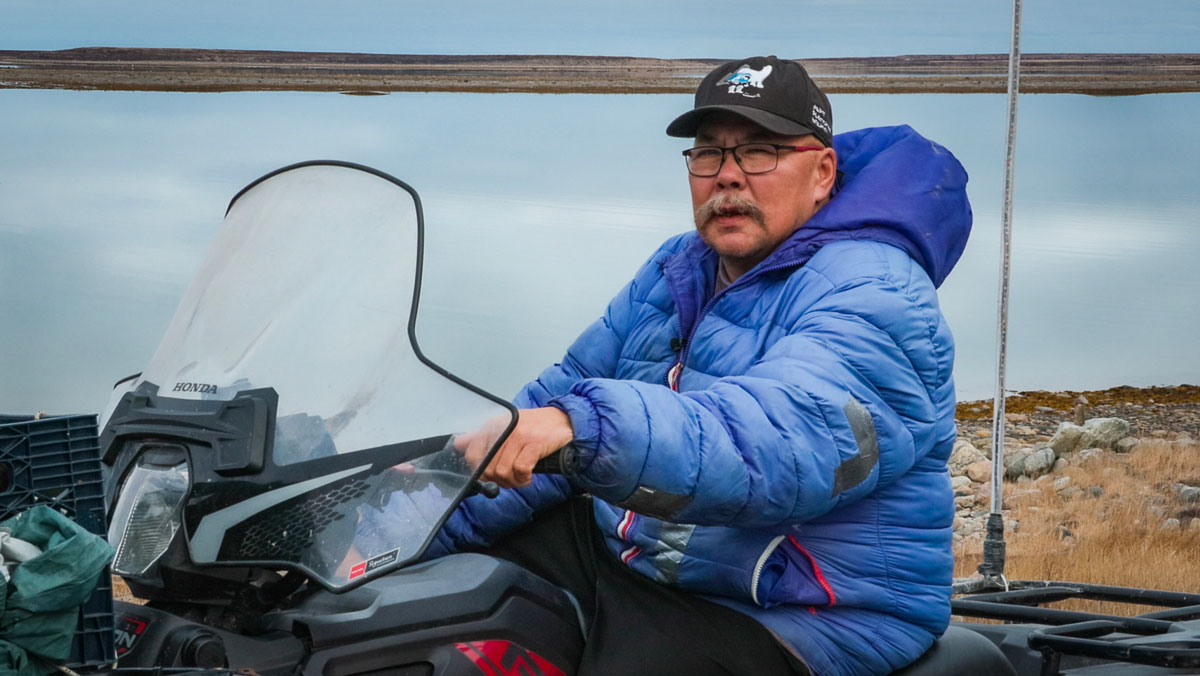
Polar bears make a habit out of visiting the village of Arviat, so guards patrol 24/7 to keep residents safe.
In 2008, however, the U.S. listed the polar bear as an internationally threatened species under the Endangered Species Act, and importation of the bears by hunters was then halted by the U.S. Fish & Wildlife Service. The move was made despite the science of the Canadian Wildlife Service that has carefully monitored polar bear populations for decades and has worked in concert with Inuit communities across the northern Canadian polar bear range to establish very limited and sustainable harvest quotas.
Curiously, the global population of polar bears was estimated at 25,000 animals in 1984—the same total in 2008 when the bears were designated as a protected species.
For St. John, who guides a handful of American hunters for polar bear, muskox and caribou each year, the ban makes no difference in the number of bears that are taken annually. This year, the community received 12 permits to hunt polar bear—they will either be taken by foreign hunters who pay upwards of $60,000 to hunt one of the animals or, if there are no American hunters, the locals will shoot them, a scenario that generates little value to the community.
“The American import ban has devalued the bears and the financial benefits to northern communities,” says St. John. “With an unemployment rate of 70 percent in Arviat, each bear that is hunted by foreigners—mostly Americans—directly generates $20,000 to the village. That’s to say nothing of thousands more dollars that go to pay guides and suppliers and that is spent in local stores, shops, airlines and such. In other words, when the Americans banned polar bear imports, they hurt the communities that needed the income most and the move made no difference to polar bear harvest totals or populations.
“When you take away an animal’s value,” he says, “bad things happen to it. On the other hand, when animals bring revenue to a community they look after them rather than killing them as nuisance bears or as a threat when there is conflict between man and animals.”
That wildlife management reality holds true across the globe—especially in Africa. Without hunters’ dollars benefitting indigenous communities, dangerous animals such as lions, leopards and elephants are seen by locals solely as threats and crop raiders and are removed from the equation—often shot, snared or poisoned.
There are so many polar bears near Arviat that the community employs a 24/7 bear patrol to help keep residents safe. For Leo Ikakhik, the longest serving member of the community’s bear patrol, reducing human-bear conflict through non-lethal means creates a direct financial benefit to the community. Each bear that is killed as a threat reduces the community’s harvest quota and, subsequently, the potential revenue that could be generated by foreign hunters paying a premium to hunt a bear.
For St. John, baptizing visiting hunters into the uniqueness of polar bear hunting and life on the tundra is about sharing the wonders of his world. As we ride along, he is a talking encyclopedia of knowledge of the area and recounts many past hunts and encounters with the great bears. Hunt with him and you’ve stamped your passport to one of the North’s greatest adventures.
We find another bear, a bruin on the tideline feeding on a ring seal that it had killed. The tide is incoming quickly, so the bear picks up the seal and begins to carry it like a Lab totes a bumper.
“He’s maybe eight or eight-and-a-half feet,” says St. John. “We’re looking for something over nine feet. It’s early, we’ve got plenty of time.”
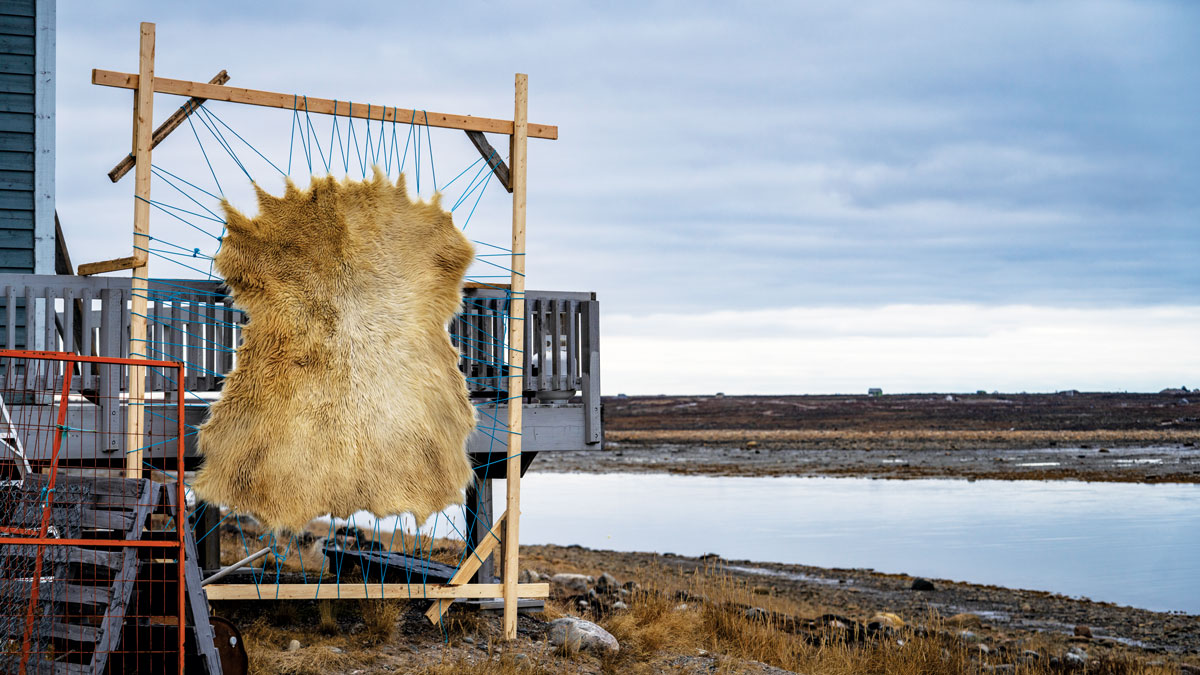
The hide of a previously harvested bear dries and will ultimately become a blanket—traditional use among the local Inuits.
After the 40-mile drive down the coast, we return to Arviat and St. John’s home where we are based for the duration. He has several outpost camps built out of shipping containers located far down the Hudson Bay shoreline, so it’s easy to spend a night or two amid different bear ranges should the need arise.
“Since it’s so mild and calm,” he says, “why don’t we take the boat over to Sentry Island tomorrow—it’s about a half-hour ride and we’ve been seeing bears there.”
The plan is to live aboard the amphibious boat for a couple of days and check out a series of uninhabited islands where the bears sometimes stage to hunt seals and beluga whales.
We load supplies to last several days and strike off across the sound to the island. As we get within a half mile of the four-mile-long island, we spy a bear not far from shore. Soon, we see a second, larger bruin. Seems St. John’s hunch to investigate the island was fortuitous. The bears meandered out of sight over a ridge in the middle of the island, so we had our opportunity to beach the craft and strike off on foot to get a closer look at the beasts.
Despite stretching upwards of nine feet and weighing some 1,200-pounds, they seem to vanish as we climb the island looking for their whereabouts. After about a half-hour of walking and glassing, I see one of the bears—perhaps a mile away—standing in the water along the shoreline. While we couldn’t yet see the second bear, we surmised it was probably near the other bear but just out of sight behind the ridge lining the shore.
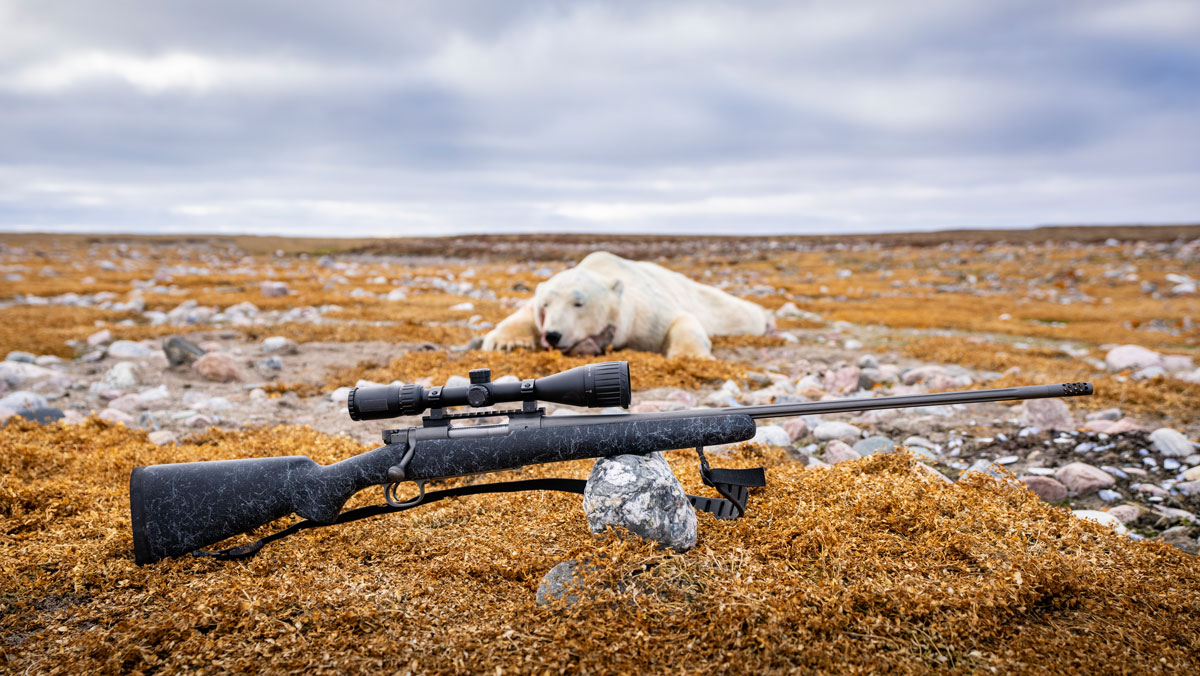
The author used a Winchester Model 70 in 300 Win. Mag. and
190-grain Winchester Nosler Accubond bullets to take the bruin.
Another half hour later and we find ourselves just a few hundred yards from the bears, their enormity and magnificence at closer range becoming captivating. It’s clear the larger of the two is well over 9 feet and now we are in position to set up for a shot.
As we marvel at the giant bears, they begin to spar, standing on their back legs and biting one another the way a pair of stallions might. While they are preoccupied, I sneak to the rim of the ledge we had snuck below to get into position and set up for a shot.
“The darker of the two is the biggest,” whispers St. John. The bear had been rolling in berries and had blue stains on its fur, making it obvious to distinguish from his sparring partner that looked recently washed in Woolite.
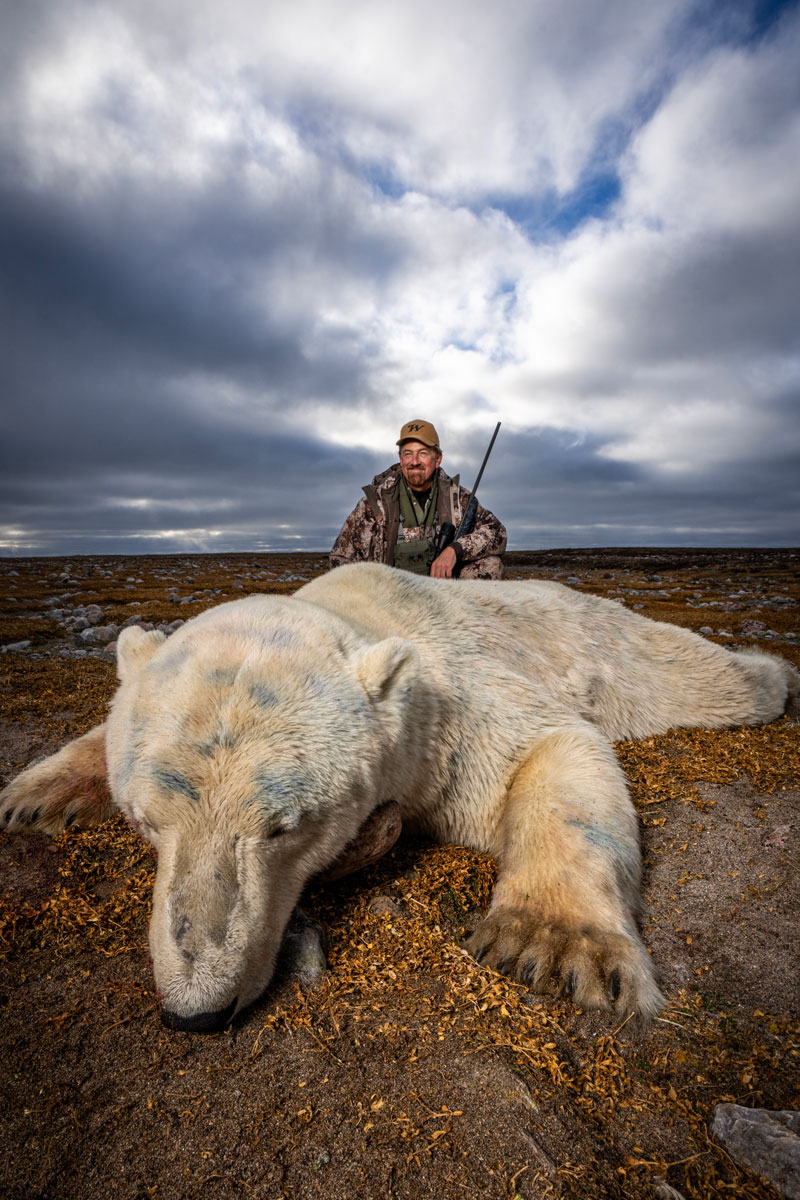
After finding a pair of mature polar bears sparring on an island in Hudson Bay, Dorsey took the largest of the duo—a brute with blue stains from having been feeding on an abundant crop of berries. The hunt will be featured on an upcoming episode of Sporting Classics TV airing on the Outdoor Channel.
I rested the rifle on the sticks and waited for the blue bear to clear, all the while I was transfixed by the great bears and my proximity to them as well as what was about to transpire when I unleashed a round.
At last, the bear cleared the other and provided a quartering shot, so I sent a round smashing through his shoulder into his vitals. The bear rolled and roared, ultimately righting itself to run perpendicular to us when I put two more rounds into his boiler room. It takes a lot of punch to take the steam out of one of the massive bears but, at last, it lay still on the tundra.
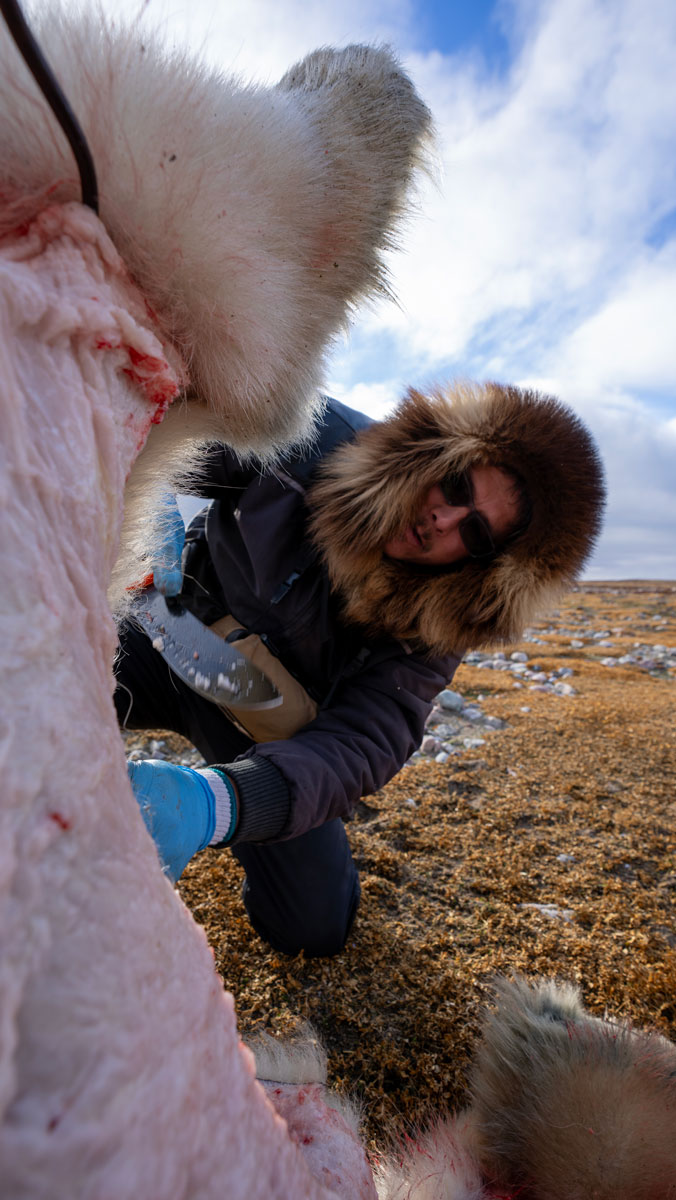
St. John puts the finishing touches on skinning the author’s bear, an animal estimated to weigh some 1,200 pounds.
Walking up to such an iconic, incredible creature is both remarkably satisfying and humbling. Few animals in the world of big game hunting rival the great bears of the north. Put them alongside elephants, lions and brown bears in the pinnacle of dangerous game species.
For me, hunting them on the lonely tundra with a man who grew up among them is just as the experience was meant to be.
Unforgettable.