
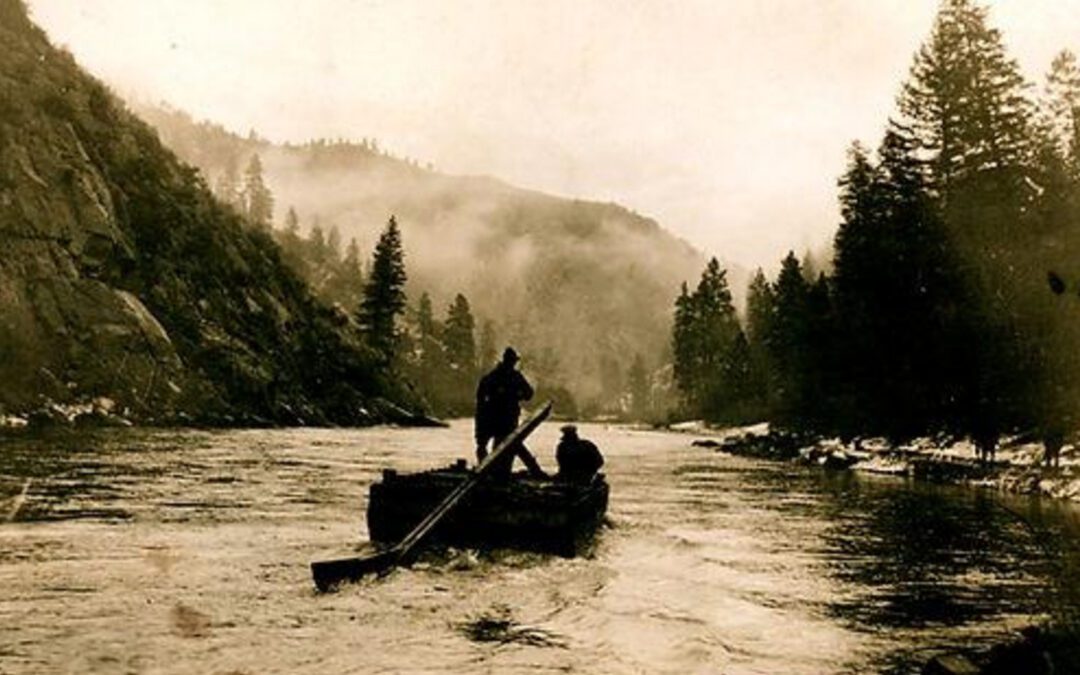
The place was called Boise City, which was something of a joke to anyone who had actually been there. It wasn’t even a town, much less a city—a few cleared fields around a dirt track where trappers and Indians pitched their teepees and caravans of covered wagons could park on their way to the Oregon country. There was only one permanent structure in the place, and it was so ramshackle that its permanence was always a running concern. The locals called it the Boise City Saloon, which was also something of a joke, but that didn’t stop its proprietor from conducting a swift trade among the thirsty wayfarers.
Tonight was the exception. Business was slow. This was on account of the weather. It was a sultry evening in late summer and too nice to be inside for all but the most seriously preoccupied. There were only two people at the bar, an old timer and a newcomer, and they were deep in conversation about the trapping prospects in the high country above the Salmon River, which the locals called the River of No Return.
“Oh there’s fur up there,” the old timer said. “Plenty of it. Beaver the size of bear cubs and stupid, too, on account of the fact that not many men head up that way.”
“Why not?” the newcomer asked.
“Too dangerous, that’s why,” the old timer said, then spat. The spittoon dinged.
“Dangerous how?”
“Well, no one really knows, do they?” the old timer replied, not meaning to be cryptic but having that effect. Seeing the confusion on his companion’s face, he went on, “There are stories, you know. People go up there and never come back. The few who have made it back tell tales of men ripped limb from limb.”
“What’s up there? A grizzly bear?” the newcomer had never seen a grizzly, but he had heard terrible stories of “Old Ephraim,” the terror of the Rocky Mountains.
“It ain’t no bear,” the old timer said. “Can’t be. Grizz don’t rip you limb from limb. He bites ya and shakes ya to death.” He spat again and missed, staining the pine boards with tobacco juice. “Besides, the fellers who’ve seen glimpses of the creature, and glimpses are all anyone gets, they say he walks on two feet like a man.”
The newcomer, who had dark skin and kinky hair, appeared even more perplexed than before.
“What is it then?”
The old timer scratched his Adam’s apple. “Welp, some fellers have a theory that it’s a mutant cross between a bear and a man, but I don’t think so. I just can’t picture how a female bear and a man; or a male bear and woman—well, you know.” He took a drink, washing down the tobacco with the whiskey. “If you ask me, it’s simpler than that. It’s a demon or a goblin or some other evil thing that the good Lord allows to live up there to keep people out. And if that’s the case, the creature does a good job, because it ain’t just Christians who won’t go up there, the Shoshones keep their distance, too.”
At this, the young man, whose name was George Dupris, became very quiet.
George was from New Orleans, a restless youth who had decided at the age of 25 that there must be more to life than unloading bales of cotton and dodging slave catchers. He had heard about gold in California, and decided he’d better get in on the action before it all dried up.
George had taken the longer northern route to avoid being hassled, and made it as far as Boise City before he ran out of money. Now he was stuck, doing odd jobs around the camp, trying to make enough to see him the rest of the way. But the jobs didn’t pay much, barely enough to cover his evening refreshment, and he had been starting to think he might have to spend the winter in this so-called city, when fate intervened in the form of a mean-looking old feller who had bought the down-and-out youngster a drink.
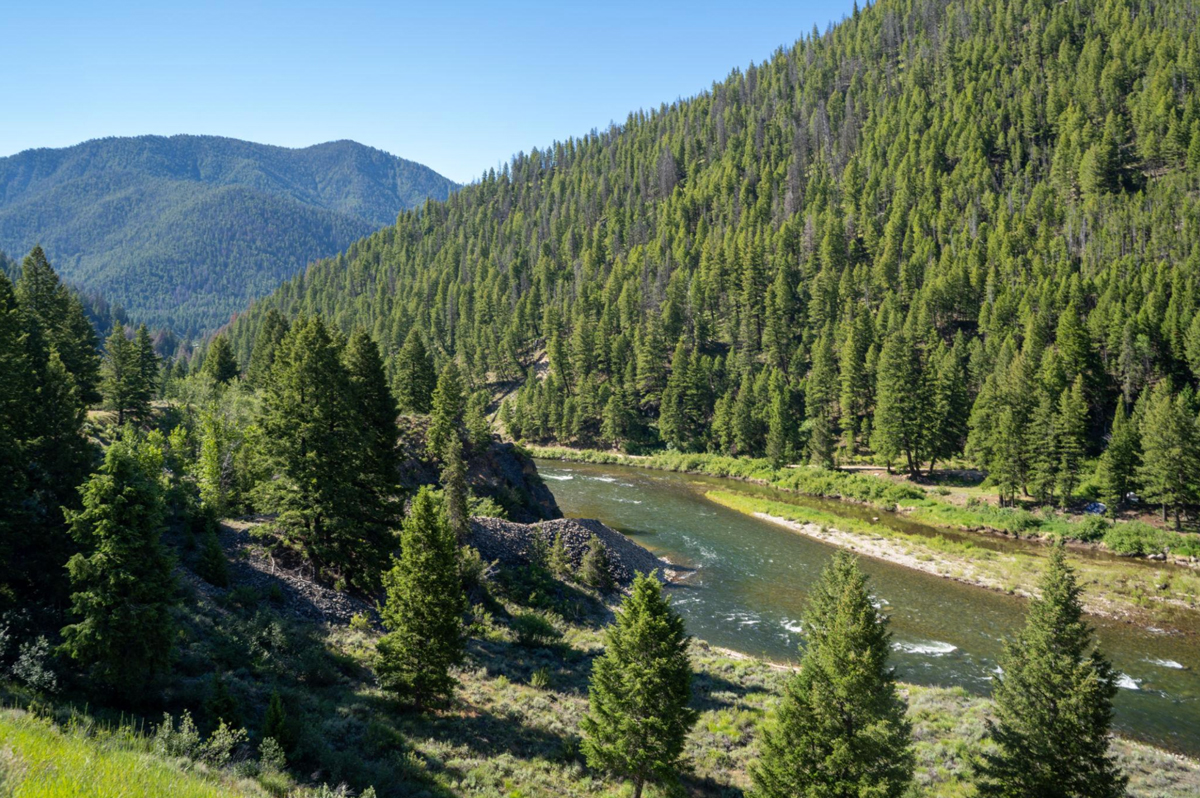
The stranger explained he was planning a trapping expedition to the high country above the Salmon River, and if it went well, George could make all the money he needed to make it to the coast—in one trip. The old guy didn’t care that George didn’t have any experience, he said he just needed the muscle to help haul the traps and supplies up and down the mountains. It sounded too good to be true, but the young man was desperate. Now, a day before they were due to leave, George was finding out some details the mean-looking feller had left out.
The old timer sitting next to George might not have had teeth, but he had intelligent, perceptive eyes—and he seemed to read the problem on his young companion’s face. “I’m guessing you already signed up to head into the No Return,” he said softly. “May I ask who with?”
“I didn’t catch his name,” George said. “He talked sorta funny.”
“That must be Bauman then,” the old timer said. “Henry Bauman. We call him ‘Dutch’ around these parts on account he once told us he comes from a place called Dutch-land. He don’t like that name by the way, so you best just call him Mr. Bauman.”
“Is he good?”
“The best,” the old timer said straightly. Then hooked a contemplative finger through his beard. “But it makes sense that it’d be Dutch going up there. You see, he doesn’t believe in mutants or devils so he’s probably not scared.”
“He doesn’t believe in devils?” George was incredulous.
“Nope,” the old timer said. “Dutch is usually a tight-lipped sort of character, but he explained it all to me once when we were both pretty far gone. His whole philosophy, it all stems from the fact that when he was still a boy, the Emperor of France forced him to fight in a war against the Emperor of Russia. Dutch says after what he saw there, he can’t believe in any creature more evil than man.”
George wondered how any of this was supposed to make him feel better.
The old timer, perhaps thinking along the same lines, finished by saying, “I’ll say this for Dutch, you won’t find a more competent man running these mountains. Listen to him and keep your head about you. You should be okay.”
Bauman picked up George in the morning to begin their trek into the mountains. It was a light outfit. Two men. Two horses. One Hawken rifle, 50 caliber. One flintlock fowler, unspecified bore. Ammunition. Traps and tackle. Two pounds bacon. Five pounds pemmican. Twenty pounds salt. Two blankets.
They spent the whole day riding up dusty switchback trails. George sweated the whole way, partly because of the heat, but mostly because he had been riding a horse. He was frightened of horses and, making matters infinitely worse, some of the trails they had ridden were so narrow that any misstep would have sent man and beast tumbling a thousand feet down a gorge to the river below. George was very glad when dusk came and he slid out of the saddle. They were in a dry meadow a thousand feet above the river.
“We camp here tonight,” Bauman said in his heavily-accented English. “Then go on foot the rest of the way.”
The next morning, they woke when it was still dark. It was cooler up there than it had been in town, and George shivered as they fried bacon in the graying dawn.
When it was light enough to see the trail, they began the steep hike uphill. The day became hot quickly, and to George’s surprise, he found it difficult to keep pace with his much older partner. The air was very dry and when there was a wind, the spruce branches overhead cracked and sent down little showers of debris.
At midday, they stopped by a stream for water and rest. George noticed fish in the stream, darting from shadow to shadow, flashing in between when they caught the sunlight. They reminded him of the speckled trout the Indians used to sell in the French Market back in New Orleans. How he could go for one of those right now, he thought, dredged in cornmeal and fried in lard….
Bauman saw George eyeing the fish. “We don’t have time for that. Eat the pemmican.”
Pemmican was a sort of brown mush, pressed into little bricks that looked like dried mud and tasted pretty much like it, too. But George was too hungry to turn it down. Luckily, he found that after a few handfuls you forgot about the taste.
They hiked further into the peaks following game trails through trees and fields. It was hopper season, and in every field the little insects sawed ceaselessly, jumping on your clothes then flying off. George didn’t mind the hoppers. Better hoppers than mosquitoes, he thought. And better mosquitoes than dragonflies. Dragonflies can steal your soul. His mother had taught him that.
Further on, George saw something he’d never seen before. A black hopper. A little farther and he saw another. Soon all the hoppers were black and so were most of the trees, but the grass in between the trees was green. It was the only green grass in the whole country.
It wasn’t long after they had left the black land that Bauman said they had reached the place where they would trap. It was a long, narrow valley with steep slopes of spruce on either side. The valley was bisected by a small stream. The stream was low and when the men reached the first beaver pond, they saw the water there was low, too, and brown and scummy. George didn’t think anything could live in that water and said so to Bauman.
“You see those white clumps floating on top?” Bauman said, pointing. “That’s beaver scat. And what do you need to make beaver scat?”
“Beavers,” Geroge said.
“Very good. Now cut some alder saplings.”
George cut the saplings and Bauman secured the traps on them with wire. The old trapper then made George wade into the water and drive the sets—there were three—into the mud. The water was warm as a bath.
When George finished, he found Bauman studying the animal tracks printed in the dry mud by the edge of the pond. There were deer tracks, tracks that looked like deer tracks but bigger and some tracks that George didn’t recognize. The mysterious tracks were large, fairly flat and poorly defined around the edges. George wasn’t experienced enough to know that the creature who had made the tracks was soft-footed, and so its prints were not as well preserved.
Bauman, too, seemed interested in the large tracks. He studied them for what seemed like a long time then pronounced his judgment. “Grizzly bear. Keep your eyes peeled.” He looked to all four sides then checked to make sure a percussion cap was in place on his rifle’s nipple. George briefly thought about how the old timer in the saloon had said there were no grizzly bears in this country, then forgot about it and checked the powder in his flintlock. It was dry.
They walked up through the fir trees and made camp in a clearing at the top of one side of the valley. By the time they had a fire going, George was bone tired, but he built himself a crude lean-to shelter on the theory that if there was a grizzly bear up there and he attacked the camp, the time it would take him to tear apart the lean-to might give George enough time to wake up and defend himself. Bauman did not build a shelter, and George asked why not.
“I dislike tents,” the old man said.
George wondered why that was, but didn’t ask.
They each ate another handful of pemmican and went to sleep.
George had been sleeping soundly when he was awakened by a shriek in the night. It was close, very close. The fire had burned down to coals, but in the moonlight George could see Bauman was already awake with his rifle in his lap.
“What is it?” George asked.
Bauman didn’t answer right away. Another shriek rippled through the night, and George tried to see beyond the clearing, but it was no good. Every time he focused on something, it began to move and lose its shape. One more shriek came, but it was farther away and George saw Bauman relax.
“It’s just a female elk,” the old man said. “I forgot that the rut is just around the corner. That was just some elk getting the itch. Go back to sleep.”
George did as he was told, but couldn’t help noticing that Bauman stayed sitting up by the dead fire.
They rose in the gray light of early morning. They didn’t eat breakfast, but made their way down the slope to check the traps. An owl called from high in the trees, but otherwise it was silent. George thought it was eerie to be anywhere so quiet.
They had caught just one beaver—a small one—but Bauman didn’t seem disappointed. “The other traps weren’t set in deep enough water. You can reset them while I liberate this one of its skin.”
After resetting the traps, George watched as Bauman quickly and skillfully “liberated” the beaver’s skin. When he was done, the old trapper told George to cut him one of those skinny willow shoots that were growing next to the water. Bauman scraped the bark off the willow and made it into a circle. Then, using a needle and some sinew, the old man attached the beaver plew on the inside of the willow hoop. It made a perfect circle. Then the old trapper removed four waxy glands from around the beaver’s anus.
“Castor,” he explained, and held one of the glands under George’s nose.
“Smells good,” George said, surprised.
Bauman smiled, a rare gesture. “The castor is worth more than the plews these days.” He sighed. “No one wears beaver hats anymore. They like silk. Do you know what silk is?”
George didn’t.
“Worm vomit,” Bauman said, then wrapped the castor glands in some oilskin paper and put it in one of his vest pockets. He jointed the beaver carcass, taking the back hams. That night they ate roasted beaver hams. George was surprised at the taste. It was better than pemmican, anyway.
They turned in early, but George had trouble falling asleep. He found it difficult to stop listening to every noise around camp. It didn’t help when he looked across the fire-circle and saw Bauman wasn’t sleeping either. The old man was sitting up, staring out at the woods.
Eventually George did manage to slip into a state that was something like sleep, but it didn’t last long. He was awoken by another high-pitched cry and the sound of something striking his lean-to.
“What was that?” George said, jumping awake.
Bauman didn’t answer. He had his Hawken at his shoulder and was scanning the dark spaces between the trees.
“W-what’s going on?” George said, his voice shaking with fear. “What’s out there?”
“Quiet,” Bauman said.
Then came another shriek and a rock the size of a watermelon came hurtling out of the darkness.
George just barely slipped the missile and felt the whoosh of air as it passed by his ear. Bauman aimed his rifle at the point in the darkness where the rock had come from and pulled the trigger. A tongue of flame stabbed into the night. For a brief, terrifying moment, the men caught sight of a pair of gas-blue eyes floating seven feet off the ground. There was a moment of silence, then a screech of pain.
“You got him!” George said exultantly.
Bauman said nothing, but reloaded with the same practiced motion he had learned in the 2nd Jaeger Regiment when he was 16 years old.
There was a groan and footsteps padding off into the night.
“We’re going to leave, right?” George asked, his voice panicky. “We have to leave.”
“We can’t go now,” Bauman said, still loading.
“Why not?”
“Because it’s the middle of the night,” Bauman snapped. “Do you think it would be a clever idea to go feeling our way around in the dark with that, that thing, out there?”
George was silent.
“Exactly,” Bauman said, placing the percussion cap on the nipple of his Hawken. “We’ll leave in the morning.”
George took a deep breath. “Alright.”
“Good,” Bauman said, then sat on a log. “Put some more wood on the fire, then try and get some sleep.”
“Sleep?” George laughed. “I ain’t gonna sleep. Not now. I’ll just stay up and keep watch with you.”
“No,” Bauman said curtly. “I want you to rest. There’s a lot of work to be done tomorrow morning and you’re going to be doing most of it. It’ll go a lot faster if you’ve rested.”
“But I don’t think I can sleep,” George said.
“That’s fine,” Bauman said. “If you can’t sleep, just lie down and close your eyes. You can rest your body at least.”
George looked skeptically at Bauman, threw another two logs onto the fire, then lay down under his lean-to.
Bauman tried to keep his eyes on the woods, but as the night wore on and his lids grew heavy, he found himself drawn more and more toward the fire, attracted, moth-like, by the all-consuming violence of it. He had seen many fires in his life, and much violence. He remembered the field at Borodino and the fires that had erupted from the great earthen redoubt. The iron muzzles of the guns had jutted out like dragon’s teeth, belching sulfur and smoke. He remembered the fat little man sitting on a hill, his leg propped on a drumhead, feeding souls into the dragon’s mouth like the men were lumps of coal.
Then there was the field after the battle where the dead were stacked, naked and white like broken dolls. Their skin burning, sizzling, turning black and everywhere was the smoke and a smell, a sickly smell like roasting pork.
Then came the winter. Bauman and the others had been huddled around a burning wagon, when suddenly, from darkness of the forest, a horn sounded—a hunting horn. The Cossacks charged through the snow, their curved sabers flashing in the firelight. The blades struck down on the officers’ tents. The men inside screamed, trapped like rabbits in a net.
Bauman jerked awake. It was morning. There was bluish gray light separating the trunks of the trees. At some point his visions had slid from conscious to unconscious without him knowing. George had fallen asleep, too. Bauman put a hand on the younger man’s shoulder. The brown eyes peeled open.
“We’re leaving,” Bauman said.
George looked about to swoon; he was so relieved.
“I’m going to go pull the traps. You stay here and clean up camp, I’ll be back in a few hours.”
George nodded his eager assent, and Bauman went back into the valley to pull the traps. He paused as he arrived at the pond. There was a smell in the air, one he didn’t recognize. It was a rancid, fecal smell, the kind made by an animal that feeds exclusively on meat. He cocked his rifle and approached slowly to the edge of the water. There were fresh tracks in the mud, and this time there could be no convincing yourself that these were from a grizzly bear. The tracks were like a man’s foot but three times the size. Bauman scanned the pond and saw all his traps had been pulled. He walked around the edge of the pond until he found his traps, the metal twisted as if it had been melted in a furnace. There was a beaver carcass too, a big one, ripped limb from bloody limb.
Bauman noticed the breath going in and out of him fast in a way that it hadn’t in 40 years. Slowly, he backed away from the pond. He retraced his path back up the timbered slope, moving as fast as he dared, always scanning the trees. As he came near the crest, he caught sight of something on the trail that made his stomach drop. There, on the trail leading to camp were the tracks, the same ones he had seen at the pond, pressed into the soft pine needle floor.
Bauman wanted to shout, to call to George, but he mastered his impulse. Slowly, rifle glued to his shoulder, he climbed the last few yards into camp. The scene that met him was as grotesque as any he had ever witnessed. George, or the parts of him, were scattered in a 20-yard diameter. The camp was utterly destroyed. The lean-to knocked over, the food supplies ransacked.
Bauman walked carefully around the charnel scene, always keeping one eye on the trees. He found George’s musket, with his hand still tightly gripped around the trigger guard. The gun had been discharged and the smell of burnt powder was still hanging in the air. This had all happened just a few minutes before he arrived, Bauman thought, which meant….
A low growl erupted from the trees. Bauman froze, finger on the trigger, scanning for any movement. Taut as the spring on his rifle, he held that position for several minutes, but the only other sound was the wind sighing through the treetops. At last, Bauman allowed himself to start moving, slowly at first, then faster. Soon he was running, dashing through the trees as fast as his old legs would carry him, heading for the meadow, heading away from this accursed canyon.
Bauman put a few hundred yards between himself and the ruined camp, and he began to feel safe. But then he heard padded feet thumping the earth behind him. The beast was chasing him! He’d never outrun it. The only thing was to kill it before it killed him. Bauman stopped behind a tree. He could see the dark shape growing larger behind him. Bracing the Hawken on the tree, the old trapper resolved to take one shot. When the beast broke cover 20 yards away, Bauman pressed the trigger. He never heard the shot. There was a cloud of white smoke and a blood-chilling shriek. Bauman tossed the rifle away—it was useless now, nothing but extra weight—and ran.
He never knew what damage had been done with the shot. Perhaps he had killed the beast that had killed George. Perhaps it was still up there guarding who knew what. Bauman never returned to check. The experience had utterly cured him of all greed-born curiosity. He spent the rest of his days warning anyone who would listen to stay away. There was something unholy up there over the River of No Return.