
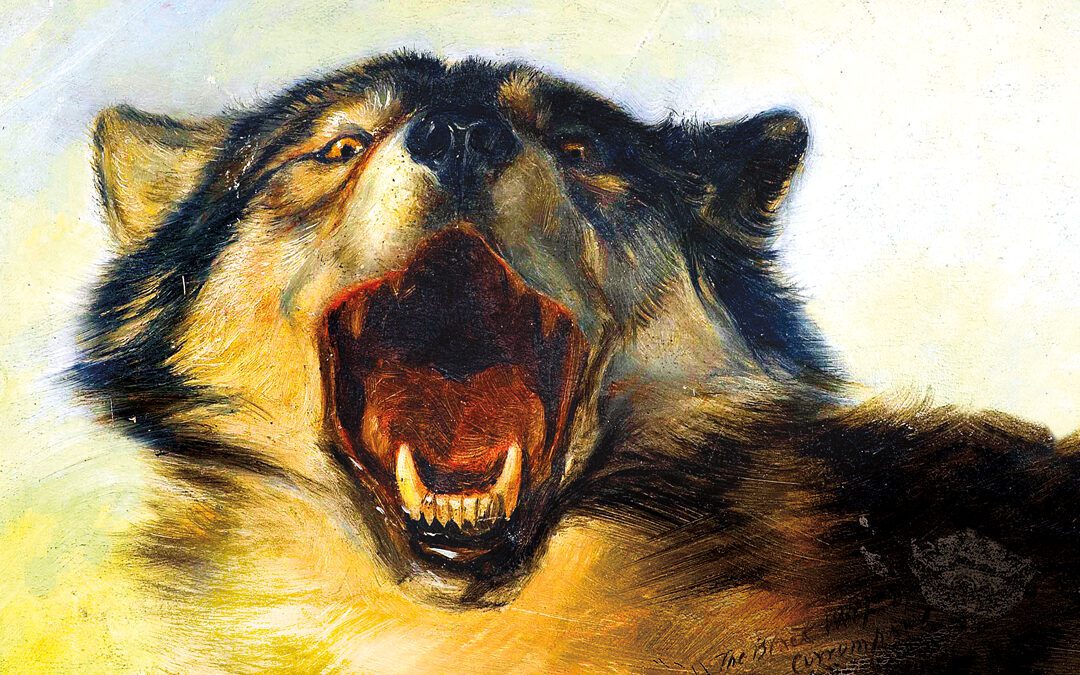
The half-breed, Peter Bellise, beached the canoe, stepped out, and pulled it up on the shore. He was a stocky man, barrel-chested and muscled like a bull, but graceful; his swarthy, pleasant face was a little thin because he had just returned from a hard month in the back country laying out a new trapline. He started up the hill toward the log buildings of the Hudson’s Bay Company with the woodsman’s short, quick stride, and the pack of wolfish dogs belonging to the Indians camped about rushed down to snarl at him. He stooped for a stone and threw it without breaking his stride; there was a yelp, and the pack, recognizing an experienced man, promptly lost interest in him.
In the fragrant dimness of the store, the factor, Duncan MacDonald, was patiently waiting on an indecisive squaw. Bellise leaned against the opposite counter and drew a deep breath to savor the smells of the place: the smoke-tanned leather; the black rope tobacco; sweetgrass from the muskegs made into baskets; bacon, coffee; the freshness of new ash canoe paddles and the faint fragrance of maple sugar. These things were good to him; he closed his eyes, took another deep breath and held it, and when he opened his eyes again, the squaw had made her decision and was going out the door.
MacDonald came across the store, tall and rangy in the gloom. “Hello, Bellise,” he said. His words had a faint burr to them, for he was a Highland man. “You got my message, I take it. It means a trip, and you’d be wanting a few days’ rest first.”
“Sure,” Bellise said. “I rest four-five days, mebbe. I have long trip, I eat little. Game, she is ver’ scarce.”
“Ay,” MacDonald said. “It will be a bad winter, I reckon, with the rabbits low.” He was silent for a moment and looked at Bellise with a faint smile, for Bellise was a good and trustworthy man. “It’s a letter from Morton, in the States. Morton wants his gyrfalcons. He’s come back from the war.”
“So,” Bellise said. He had forgotten Andrew Morton and the airplane Morton had sent for him on MacDonald’s recommendation four years before. In that airplane he had flown high above the earth for uncounted miles, into a fabulous world that was like a strange dream even now. He had spent a month in a place called Long Island, with a man who trained hawks for Morton. Under this man’s instruction he had learned to handle hawks himself – to catch them, take care of them, fly them at game. It had been an interesting thing, even more strange than the world in which he found himself for a time. Morton’s peregrine falcons had captured his hunter’s imagination with their terrible and breathtaking plunges from the upper air upon their quarry; their look of wild freedom, even when they were on their blocks, leashed and earth-bound, had found an echo in his freedom-loving spirit. “I want you to learn this,” Morton had said, “because you are to go up around Hudson Bay and bring some of these out.” He showed Bellise a mounted gyrfalcon; it was larger than a peregrine, the largest of the falcons. “They’re better fliers than the peregrines, Bellise; they’re big enough to handle anything. Nobody’s had any gyrfalcons for a long time. They’ll never make it alive if you don’t learn all you can here.”
Bellise had learned well; he would have gone north two weeks after the plane had brought him home, if the war hadn’t broken out. Thinking back on it, he still couldn’t understand why Morton had gone into such an elaborate affair, why Morton would spend more money on hawks in a year than would have maintained him, Bellise, in great splendor for a lifetime.
“Me, I do not know why he does this,” he said to MacDonald, bringing his thoughts back to the present again. “The hawks, they have the great beauty when they fly, yes. But he does not need meat, and a gun kills more.”
“Havers!” MacDonald said. “It’s a sport. They don’t trap foxes; they get horses and a great pack of dogs and chase them all over creation.” They looked at each other for a moment, a little bemused by the outlandish vagaries of rich men, and more than a little scandalized by the enormous expense of these vagaries. “You’ll go?” MacDonald asked finally.
“I go, me,” Bellise said. “I take dog team, hein?”
“Ay,” MacDonald said. “I’ll send an Injun to the telegraph. He said to do that. He’s going to send a bush flier here to pick you up and take you north.”
“Bien,” Bellise said. He was silent for a moment; the recollection came to him of the fenced fields, the multitude of No Trespass signs and the lack of freedom, the two men he had knocked down because they tried to tell him where he couldn’t walk. He rubbed his cheek and glanced at MacDonald. “Me, I do not think they will live with M’sieu Morton, these hawks.”
“Eh?” MacDonald said. He had caught a faint note of regret in Bellise’s tone, and it puzzled him. No breed or Indian, in his experience, had ever indicated sympathy for any bird or beast before. “Don’t you want to do it?”
“Is ver’ warm there,” Bellise said, avoiding a direct answer. He shrugged. “The hawks,” he said, “they have the great beauty when they fly.” He looked at MacDonald as though he were a little ashamed of himself.
The last few hours of the trip they flew above snowstorms, and the bleak shore was snow-covered when the pilot, Burnside, made his landing and brought the plane into a little flat beach. They got the dogs off first, and then the three boxes of pigeons and the sled.
“So pigeons was what they have in those boxes,” Burnside said. “Well, now I’ve seen everything, even a man taking pigeons to the North Pole. Maybe you’ll be sending one of them with a message to MacDonald when you want to come home.”
“No,” Bellise said. “Two weeks you come back. I meet you here.”
“Okay,” Burnside said. “You and the pigeons meet me here. You be here, though. The weather won’t get any better from now on. It’ll probably be so bad I won’t be able to stick around.”
Bellise nodded; they finished unloading the plane, and Burnside started the motor. He let the plane drift out a little way, waved, turned into the wind, and gunned the motor. The plane went down the bay in a cloud of flying spray, took off, and quickly vanished toward the south.
When it was out of sight, Bellise pitched the tent, fed the dogs and straightened up the camp. He put the pigeon boxes on the lee side of the tent, to keep most of the wind off them, started the alcohol stove and cooked his supper. The bleak landscape and the bare rocky headlands of the shore darkened rapidly as he ate; it was very dark when he had finished. He smoked a pipe by the light of the gasoline lantern, relaxed, contented and comfortable. It began to snow again, and he knocked out his pipe, extinguished the lantern and crawled into his sleeping bag. For a time the dark and lonely world was held by silence, disturbed only by the whisper of the snow on the sides of the tent. Then, far off, a wolf howled. Another answered it, and was in turn answered by the wailing, melancholy howl of a third. Bellise stirred in his sleeping bag. He grunted at the sounds; they indicated that the wolves, finding the hunting difficult, were drawing together into a pack. Hungry wolves would dare far more in a pack than they would dare singly or in pairs, and the wolves of this place had not had enough experience with man and his firearms to maintain their proper distance.
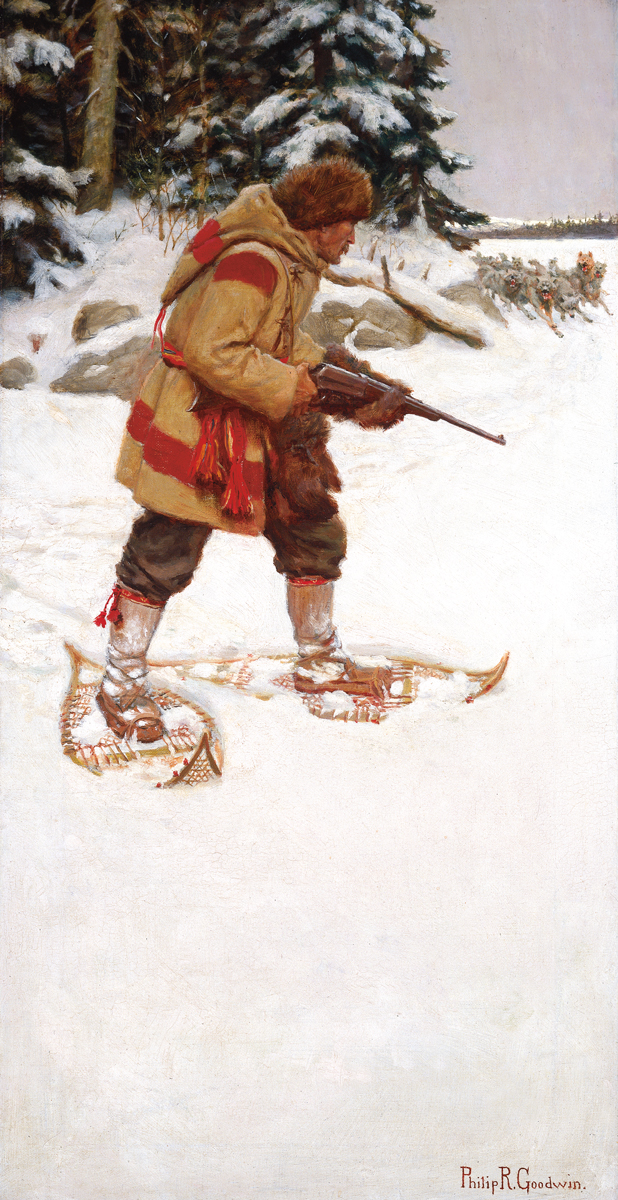
Trapper Attacked By Wolves, Circa 1910 By Philip R. Goodwin – Courtesy Buffalo Bill Historical Center, Cody, Wyoming
The snow had stopped falling by morning, and Bellise began flying his pigeons. He let half of them out, and stood by, waving a shirt to keep them from returning to their box. They flew well, wheeling and darting in their formations against the pale sky; if there had been a gyrfalcon within miles, it would have come and pitched among them like a thunderbolt, but no gyrfalcon appeared. After half an hour, Bellise let the pigeons return, shut them up and fed them. He was a little disappointed, but not too much; most of the ducks and shorebirds had gone, and there was little to hold hawks near the bay.
In the afternoon he hitched up the dog team and took a box of pigeons several miles up the shore, to the highest headland in the vicinity, and let them out. From the height upon which he stood, the world was even more lonely and inimical than from the camp – a world of leaden water, barren, rocky shore, and broken country white with snow and seemingly empty of life. He was used to loneliness, but not of this sort. He could see too much and too far; he liked better the forests where he ran traplines, which were as empty of man, but had a still and somber friendliness.
The pigeons mounted high above him, their wings flashing as they swung between him and the declining sun. They seemed to accentuate the loneliness of the land, and as he watched them the thought came to him that it was a foolish thing to take a hawk, grown in the cold, sweeping vastness of the country, into the soft land of little fields of the south. The leashed peregrines, birds of more settled lands, always seemed to be longing for the wide sky; it would be worse for gyrfalcons. His mind played about this thought for a while, and presently he shrugged, let the pigeons come in, and went back to camp.
That night the wolves came closer. They gathered about a thousand yards away and awoke him with their howling. He got out of the sleeping bag with a curse, picked up the rifle, and went outside. It was cold and clear, the stars glittered frostily; the dogs, growling, had gathered close to the tent, and they crowded around him. He cursed them in the same tone he had used for the wolves, and fired a shot toward the howling. The night swallowed the sound, and the wolves immediately fell silent. He stood listening for a moment to a quiet that seemed to stretch to the ends of the earth, and went back into the tent again.
The next morning he broke camp and started inland. He traveled for three days, flying the pigeons morning and afternoon, without seeing a gyrfalcon. More snow fell; it nearly covered the low scrub now, and because the country was flat, broken only by gullies and occasional high points of land that looked pretty much alike, he began to get the feeling that no matter how long he walked, he was always in the same place.
He was a little disappointed by the scarcity of hawks, and the wolves had begun to irritate him. Ordinarily, he had a great contempt for wolves, or at least for the timber wolves he knew. They kept out of the way or, at most, howled once or twice from a distant vantage point and went on. These, which he decided were white wolves from farther north, driven down by hunger, didn’t go away. They hung on, shadowing him, and every night they seemed to come a bit closer. The dogs were in great fear of them; always underfoot, snarling into the dark. Bellise’s sleep was broken into; he began trying to bushwhack them during the day, staking the dogs out and hiding among the gullies and hummocks, but with no success.
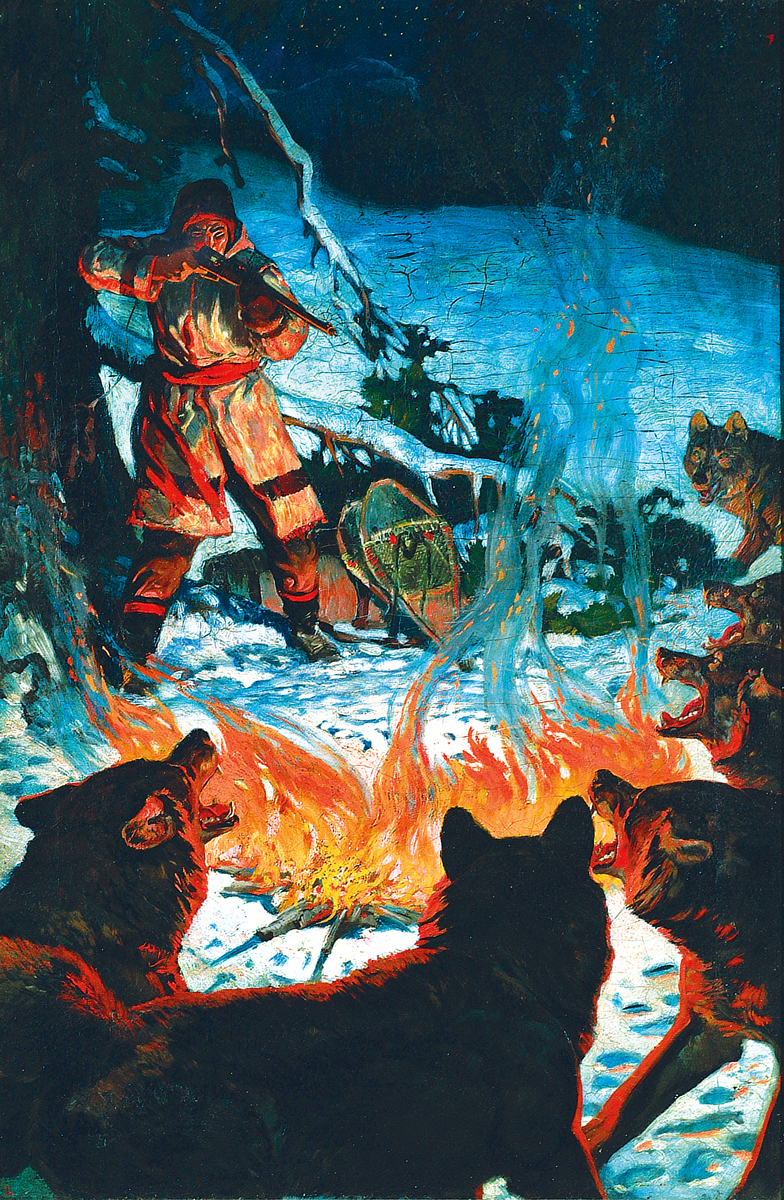
Yukon Trouble by Lynn Bogue Hunt – Courtesy The Remington Collection
In the middle of the fourth night he was awakened by a hysterical and bloodcurdling uproar around the tent. He got out of the sleeping bag, grabbed the rifle and ran out. There was a thin moon; the dogs crowded around him, and stumbling about he saw a great white beast, with its head high, running off with a dog nearly as big as itself in its jaws. It wasn’t more than 15 yards away and rapidly vanishing into the gloom. He shot. The wolf dropped the dog and fell, rolled over, then got up on its forelegs and dragged itself swiftly out of sight. A few seconds later he heard the rest of them finish it.
The next morning he started on a wide circle that would take him back toward the bay. It had been six days since Burnside had left him, and he estimated that it would take him six or seven more to get back. He had lost one dog, and thought it possible that he would lose one or two more, which would slow him down, but he was sure that the killing of the wolf the night before would make the rest of them more cautious for a time.
The day was uneventful until after noon, when three ptarmigan flushed 40 or 50 yards in front of him. He was idly watching them fly off when he chanced to glance above them, into the sky. He stopped in midstride, staring; for high in the blue he saw a tiny dot dropping. It hurtled down with such tremendous speed that he had difficulty following it; its velocity through the air made a sound like tearing silk, and Bellise’s skin crawled as he watched. It hit the leading ptarmigan; there was a crash like the report of a gun and an explosion of feathers. The ptarmigan rolled over and fell; the gyrfalcon swung up, paused for an instant, and swooped. It picked the ptarmigan from the snow and carried it to a rocky knoll about a mile away.
It had been the most spectacular stoop Bellise had ever seen, a terrible thing, much higher and harder than any made by Morton’s peregrines. It had brought his heart into his throat, and he knew now why Morton, as a falconer, wanted a gyrfalcon or two. He let out the breath he had unconsciously been holding, and decided to camp where he stood. He unharnessed the dogs, pitched the tent, and began to straighten out the gear he would use in the morning.
The gyrfalcon had slept on a high shelf running across the precipitous face of the rocky knoll, and awoke with the first faint gleam of light. She was a big, sleek bird with the hooked beak, large dark eyes, and needle-sharp talons of all falcons, immaculately white on her crown and upper back and tail, with a few dark lines on the sides of her head; her wing and upper tail coverts and lower back were barred with arrow-shaped spots of blackish brown.
She had eaten late, and not being hungry, she was still for several hours; her stillness was far from being an inattentive one. She was never inattentive. On that eminence above the plain, with her superlative vision, she would instantly have seen anything that moved within an immense area. She was out of sight of Bellise, having gone over the top of the knoll with the ptarmigan the afternoon before to get out of the wind, and the rock hid him.
The mounting sun warmed her; she stared at it with fierce eyes and spread her wings a little to take in its warmth. Presently she felt the beginning of hunger, not pressing, but pleasant; she shook herself again, walked to the edge of the shelf and jumped into the air. The warmed, rising currents took her, and her long narrow wings beat upon them. They flowed around her like water, firm and sustaining, but shifty enough to make the managing of them a keen wild pleasure. She went straight away from the knoll for several miles, rising slowly higher, until she found a great updraft. She swung into this; it took her up several thousand feet without effort. The earth sank away and curved off to the far horizons, white and empty, and she hung with her wings still and her head to the wind.
It was then that she saw, far away, the pigeons wheeling about. Hunger stabbed her, and she started for them at tremendous speed. As she crossed high above the knoll, the pigeons caught sight of her and hesitated in their swinging. She was above them a few seconds later; she selected one, rolled over, and giving a few swift wingbeats, started straight down like a meteor. The pigeons were fleeing when she started her stoop. They flashed down to their box sitting in the snow; the last one managed to hurl itself through the door three feet in front of the hawk, which swooped up to hang above the box, puzzled.
As she hung there, another pigeon appeared from beneath a mound of snow, struggling as though it were being pulled by a cord across the ground. The gyrfalcon dropped on it; it moved another two or three feet, and then the bow net banged over them. The gyrfalcon screamed with rage, rolled over on her back, and took the net in her talons, but it was thin and bodiless, and she could not hurt it. She was caught.
Fifty yards away, Bellise threw up the white canvas under which he had been hiding, and stood up. He held tightly the cord attached to the pigeon and the cord attached to the net, and ran up. Working quickly, he disentangled the gyrfalcon, slipped a leather hood over her head, and put her into a woolen sock. She was blinded and bound, and so shocked that she didn’t struggle any more. Her freedom was ended.
As soon as Bellise got back to the tent, he put leather straps – jesses – on the gyrfalcon’s legs and began to man her. This was a procedure as old as falconry, and had been standardized for centuries. It consisted of carrying her, hooded, on his fist for hours at a time, keeping her awake, stroking her with a short stick and talking to her; in this way her wildness was slowly overcome and she was made accustomed to man. She didn’t take kindly to it. Although she couldn’t see, she wanted her freedom desperately; she jumped off innumerable times, flapped about and hung head down; and innumerable times he replaced her gently and patiently. He made supper and fed the dogs, carrying her, then decided to carry her all night. He pulled the sleeping bag to the door of the tent, laid the rifle handy, and wrapped himself up.
It wasn’t so bad for the first four or five hours; the gyrfalcon jumped off his fist frequently and kept him occupied. After midnight, however, although she was still ready to hiss and bite at the stroking stick, she began to tire. The gyrfalcon’s head fell forward occasionally, and Bellise rolled his fist to wake her, but that was all he had to do. A pale aurora began to play; the long, ghostly beams marched with majestic silence across the sky.
In the immense and brooding silence, Bellise, robbed of sleep by the wolves, began to nod. His arm dropped, and the struggling bird awoke him; he got a block, put her on it, and nodded again. He dreamed of the gyrfalcon: the hooked beak no more cruel than the land that nourished it, the dark, hooded stare and the fierce will that flung it a thousand feet down through the cold and empty air. In his dream the bird screamed defiance at him, the screaming grew louder, and he awoke to find the wolves in camp again.
The snarling confusion swirled close around him in the aurora’s pale light, almost across his feet. The gyrfalcon was flapping wildly at the end of its leash, and his plight seemed so desperate to his startled and half-awake senses that he didn’t act coolly. He caught up the rifle and emptied it among the great leaping white forms; the shots crashed against the night. Almost instantly the dogs were about him and the wolves gone. A dead dog and a dead wolf were lying in the torn snow, and Bellise ran into the tent for the cartridge box.
He couldn’t find it. He switched on the hanging flashlight and frantically turned everything upside down in his search, but it wasn’t there. He enforced deliberateness on himself and searched again, panting. But it was gone; he had lost it somewhere, in packing or unpacking, or on the trail. He knew that he would never find it, and cold sweat came out all over him.
He straightened up slowly and walked to the entrance of the tent. The aurora was dying out, and as he watched darkness cover the land again, calmness came to him. He estimated his chances, and knew them to be poor, but far from hopeless; he had got out of situations before that had seemed as desperate. All he had to do was get to the shore of the bay and hold on until Burnside came – and Burnside would be early rather than late.
He looked at the dogs. There were three left instead of the four he expected; the wolves had apparently carried one off; and of the three, one was going to be dead by morning. He brought them all into the tent, unhooded the gyrfalcon in the dark and left it on its block, and got into his sleeping bag. Before he went to sleep he made what plans he could.
He awoke before it was light. The gyrfalcon hissed at him and fought him, but he hooded her, and after carrying her for a time, finally got her to eat a little. He knew he should use the time spent on her to better advantage, but the time he spent on her was partly for Morton, who had paid his money to have her brought out in good shape, and partly a gesture, a defiance, belonging to the exhilaration he had felt the night before; he was determined to take her out, cost what it might. Then he carefully selected the things he intended to leave – things that added to his comfort, but were not necessary, such as the tent. He killed most of the pigeons, and so got rid of one of the boxes; dead pigeons were easier to carry and would keep as well frozen.
The injured dog had died during the night, and because the two that were left could make little progress, he pulled with them. It was awkward work on snowshoes, and to complicate it, he carried the gyrfalcon on his fist most of the time. This cut into his traveling badly, for she continued to jump off despite the hood, to try, although unable to see, to regain her freedom. He knew exactly how much time and effort it would cost him to continue to carry her, but kept on with it. After he had camped and eaten, he carried her long after dark; she struggled as much as on the first evening. There should have been a slight indication that she was resigning herself, but there was none.
The wolves left him alone that night, but early in the afternoon of the next day, for the first time, he saw two of them. They came out from behind a hill at their deceptive, sliding gait, paused and stood watching him, just within rifle range. It was as though they suspected he couldn’t shoot at them and were trying him out. He stopped and waved the useless rifle at them, but they didn’t move.
After watching them for a time, he put the rifle back on the sled, and for the rest of the afternoon stopped frequently to dig stunted trees and bushes out of the snow and chop them up. He piled the sled with firewood, until he had enough to keep a fire going all night. He camped early that night, and built a small fire as soon as it began to grow dark. A thin sickle moon climbed the sky; he ate and fed the dogs and carried the gyrfalcon, but she still showed no signs of growing calmer.
The night wore on; he was awakened to replenish the fire by the gyrfalcon jumping from his fist or an increased snarling from the dogs as the wolves drew in a little closer. When he threw on more wood, he could see their eyes shifting and vanishing as they drew back, then gleam faintly farther away. He didn’t get much sleep and was not much rested in the morning.
That day the wolves didn’t bother to conceal themselves as they followed him. They had grown much bolder. They trailed him openly, following 200 yards or so behind the sled. There were nine of them left, great powerful brutes so thin that they looked like perambulating skeletons covered with fur, and he was a little dismayed when he first counted them. He would have felt confident of being able to cope with two or three with the ax if they rushed him during the night; he could do nothing against nine.
He built two fires that night and stayed between them. The wolves came closer; they were no longer vague shapes in the dim light of the crescent moon, but close at hand, dreadfully thin and patient creatures regarding him wistfully, outlined by the glow of the fire. He hardly slept at all.
By noon the next day even his great strength began to break. There were moments when he fell asleep pulling on the sled, and awoke to the gyrfalcon’s flapping wings and the snarls of the dogs, standing still, confused and with the faceless white land heaving around him and the wolves moving in. Everything became detached and a little distant, like events in a grim and improbable dream. He lost track of time; he moved like an automaton; he cut more wood and built more fires. He surrounded himself with fires; at one time he thrust a flaming branch into the muzzle of a wolf that had got to within arm’s length of him, and laughed at the smell of burning hair and the animal’s yelp as it plunged about, cooling its mouth in the snow.
Then, suddenly, he was rational again. It was day; fire surrounded him, and wolves surrounded the fire. He was on a height of land, and far off he could see the dull waters of the bay. It seemed an impossible distance, a mirage on the horizon. He stood up, and the circle about him stirred; the wolves stood up, yawned and stretched. He stepped over the fire; the nearest wolf slashed at him; the circle surged forward. He dodged back of the fire again, and with flailing arms threw embers and blazing brands among them until he forced them back.
One dog had vanished, and he had not even seen it go; it had been forced beyond the fire, torn to pieces and devoured in the moment his back was turned. He built up the fire again with desperate haste, and knew that he would never get beyond it and that soon the wood would be gone. He would never get to the bay. He turned and saw the gyrfalcon on its block close behind him, and picked it up. It hissed and struck at him, and jumped from his fist. It was as wild as it had always been; the carrying and handling he had given it, which would have manned any other falcon he had ever known, had made no impression on it whatever. It wasn’t stupidity that made the bird continue to batter itself hopelessly about, but the complete and essential wildness of its spirit, its unyielding determination to be free.
He wondered for a moment whether he could ever have tamed it, and it pleased him to know that he wouldn’t have the chance. For he had tried his best to take Morton the bird he had paid for, and his honor was satisfied; it could be free now, as he realized he had always wanted it to be free. He cut off the jesses, took off the hood and threw it into the air. The long wings beat strongly and took it away from him into the sky.
He watched it diminish and fade from sight. Then he replenished the fire and stared for a time at the waiting wolves. Presently he began to nod. He was too deeply asleep to hear the airplane that roared over him and landed on its skis not far away, too deeply asleep to hear the shots or see the wolves go off or recognize Burnside and the other man. He swayed between them as they held him up, gaunt, singed and smelling strongly of smoke, half awake and mumbling.
“Just as well we didn’t wait for my motor to get fixed,” Burnside said, and grunted as he got a tighter hold on Bellise. “Come on, sport, wake up. This man came all the way here just to see your pigeons. Where are all the hawks?”
“The hawk,” Bellise mumbled. “The hawk, she fly away.”
Editor’s Note: This article originally appeared in Robert Murphy’s The Phantom Setter & Other Stories, Copyright © 1966 by Robert Murphy. Reprinted by permission of Harold Ober Associates Incorporated.