
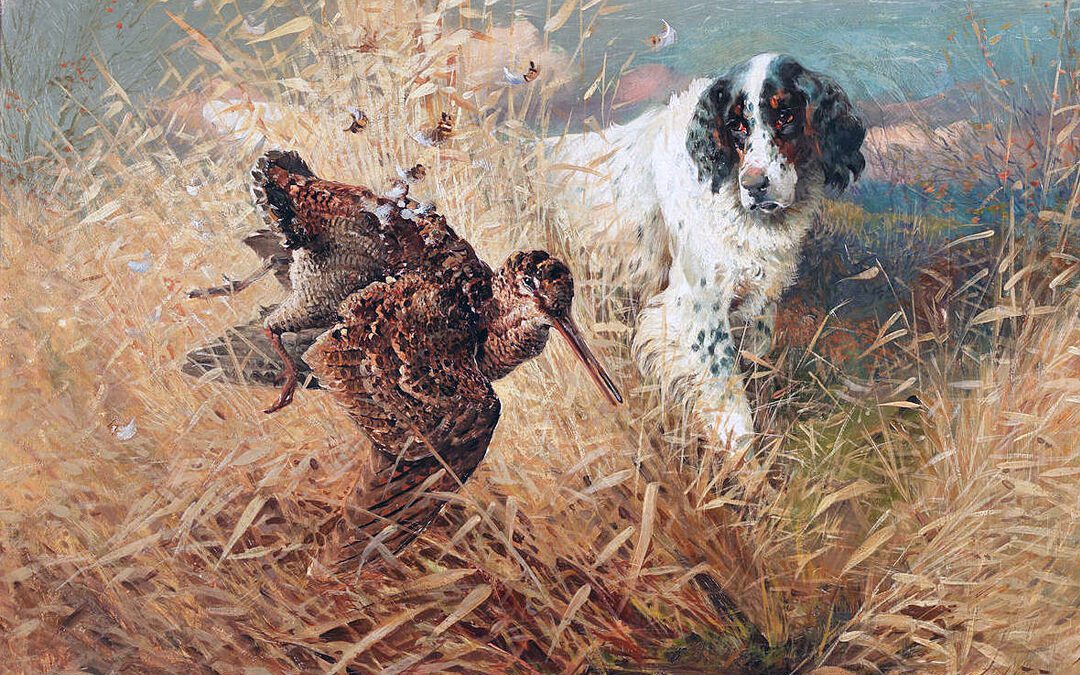
In few places has there ever been woodcock shooting that for certainty of finding the birds and ease in following them equaled the sport of the bottom lands of the upper Mississippi River 20 years ago. Scarcely any of the resident sportsmen then troubled this charming bird, the estimation of game at that time depending entirely upon the number of pounds avoirdupois that reached the ground after the report of the gun. The market shooter was then unknown upon those grounds and I enjoyed a practical monopoly of the woodcock shooting for miles below the foot of Lake Pepin. The bottoms were then very different from what they now are, when much of the timber is gone and the sloughs of once clear water are muddy and full of sawdust instead of fish.
Then when the light canoe left the river it entered a new world, as the cedar paddle sent it gliding swiftly among fallen trees, driftwood and sandbars, around sharp elbows and through swirling eddies. The soft, warm air, the strange fragrance wafted by the light breeze, the hum of bees and a thousand other insects, the banks of deep, dark soil, densely covered with long grass, the heavy masses of climbing vines that festooned with showers of green and white the tangled brush or fallen tree-tops, the immense growth of flowers of a thousand kinds, reminded one of the tropics.
Yet the wide, waving arms of the elm along the banks, and the maple’s head, broad with silvery green, brightly pictured in the smooth water, quickly broke the illusion. Above the dense undergrowth of soft maple, swamp-oak and poplar the ash reared its dark green form, trim and stately the bass wood stood on every side while aged cottonwoods, still proud in death, raised their ragged, storm-scarred limbs skyward as in defiance of the elements.
In the openings the flag stood in serried ranks along the edges of little ponds, and from the water rose the luxuriant wild rice. Outstretched on many a limb lay the gray squirrel with bushy tail outspread, taking his midday rest, and on many a tree sat the wild pigeon, nodding with curiosity, while others, like arrows feathered with white and gray, hissed with speed through the openings in the timber.
Dark, shining turtles slipped with soft splash from the logs of driftwood or waddled off the sandbars, while the kingfisher sprung his noisy rattle from the dead limbs that overhung the stream. Blackbirds with burnished necks of bluish green and others with red-barred wings rose in roaring flocks from the reeds, and the wood duck with her dolorous “wee, wee, wee, wee,” winged her way up the stream while the little brood paddled the reeds for safety.
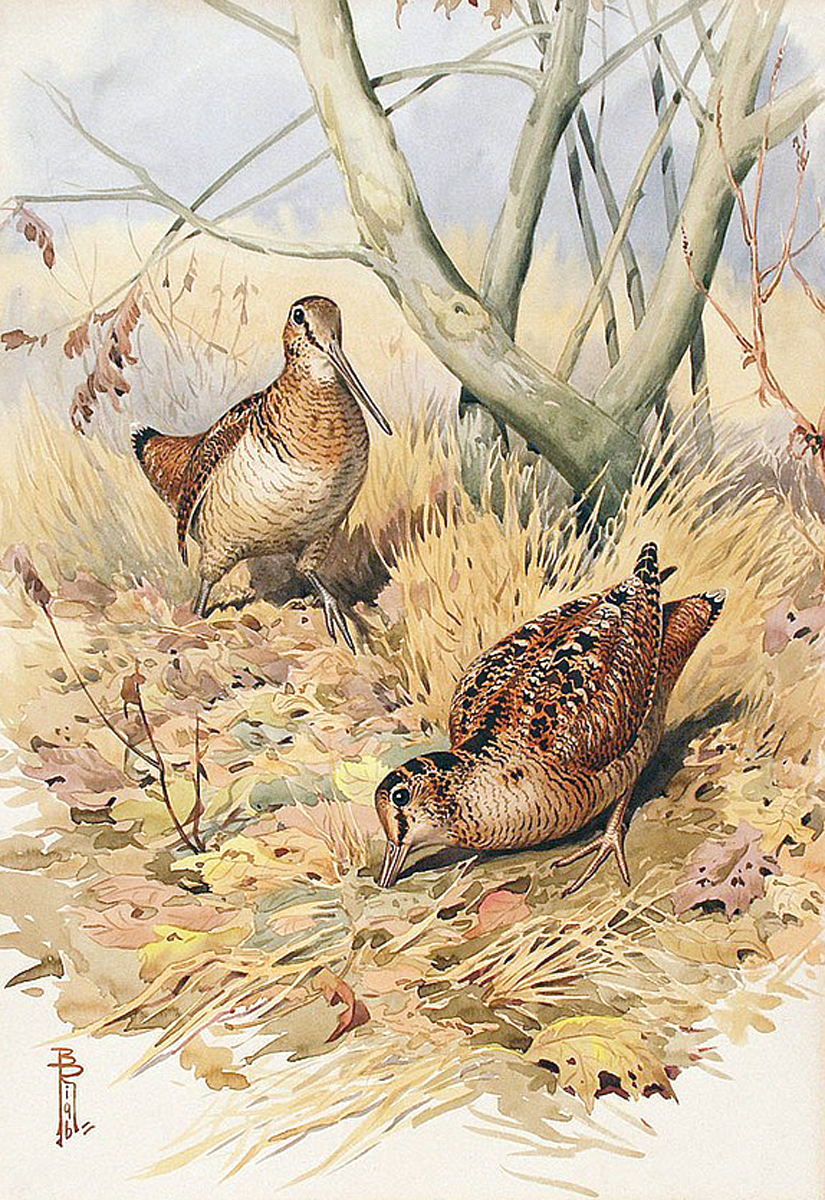
Woodcock, Boris Riab (Russian, 1898-1975), watercolor.
My first trial of those grounds was with a friend from the East. On the edge of the little side slough in which we first landed we found the soft mud by the water’s edge riddled with small holes. The dog had not yet smelt a woodcock in Minnesota, and while coming up the slough had looked intensely disgusted, for since he had been in the country he had hunted only on the prairie. But now he looked happy at once, and with cautious trot and gently swaying tail keeping time to the motion of his legs he plunged gayly into the reeds.
Scarcely had he vanished when the reeds and grass stopped waving above him and the sound of his feet in the mud ceased. We soon found him standing perfectly still with head projecting from a strip of reeds partly covering a point of muddy shore. His nostrils twitched faintly at the corners and his eyes were staring confidently at the muddy shore ahead of him. But a yard from his nose, in the shade of some waterlilies left by the receding water, sat a full-grown woodcock. Numerous small holes were in the ground around him, fresh mud was on his bill and he had evidently been breakfasting late and paused to inspect the party. His strangely shaped head was drawn well back until its rich colors blended with the rosewood tints of his back, and his large, dark, liquid eye was quizzing us with sublime indifference to the dog.
With whistling wing the bird whirled upward in a spiral line over our heads before we were fairly out of the mud and vanished through the tree-tops with two charges of shot scattering ruin among caterpillars’ nests and leaves in his rear. My friend and I looked at one another in blank amazement, each chuckling internally with satisfaction at the other’s missing.
By the time we had reloaded our guns, all was again quiet and the little birds that had been scared by the noise were soon as busy as ever. The rustling of the dog in the reeds soon ceased again and we found him in a clump of saplings standing calm and solid as the Sphinx, with one forefoot on a fallen log which he was evidently about to cross as he had caught the scent of the bird.
With soft twittering of brown wings, a woodcock rose a few feet ahead of him as we came up, making, as we raised our guns, so sudden a turn downward that neither of us fired. Scarcely 30 feet from where it rose it alighted upon the ground then, with drooping wings and tail erect and outspread like that of a turkey gobbler, it strutted along for several yards with the dog pacing solemnly behind it at a safe distance, watching the bird intently and evidently much surprised at this peculiar action, which many dogs and many sportsmen have never seen.
Suddenly the bird ran into a little bunch of thin grass and squatted along its edge as unconcerned as if hidden in a jungle, while the dog as suddenly stopped and looked around at us a moment as though amazed at the bird’s coolness and then settled to a rigid point. We came up to within 15 feet of it when, with a flash of brown and a whistle of swift wings, the game was lost to sight in an instant in the dense cover of the leaves above. Almost as quickly, two loads of shot rent the foliage from two different directions across the path of the bird and amid a small shower of leaves and twigs it came tumbling down with a small cloud of fine feathers floating slowly after it.
A few yards beyond, the brush opened into a shallow slough full of wild rice, into which the dog plunged, while out of the edge of it came two woodcock wheeling over the timber above us. As we fired, both the birds pitched downward in succession and in a moment more the dog came out of the reeds bearing in his mouth, alive and unharmed, a young wood duck nearly full grown.
The scamp seemed quite unconscious of having flushed any woodcock in his eager hunt for the ducks, which at this stage of growth run into cover instead of flying and set the best-broken dogs half crazy. He seemed quite astonished when we took him to retrieve the two fallen woodcock, but quickly recovered from his surprise and galloped away to the reeds again and brought out another duck.
Along the shady sides of strips of timber, with open grassy slopes merging into the reeds that fringed the edges of little ponds, our sport continued, the dog trotting cautiously with upraised nose along the outer edge of the reeds, occasionally poking in his nose for a closer inspection. Suddenly his body disappeared within the reeds, leaving only his tail visible along the outer edge. And so long and so rigidly did this remain in one position that we hastened to see what it meant. We found it quivering with its owner’s attempts to hold it still; and as we came near him, out from almost beneath the dog’s nose came a large woodcock, wheeling so close to my head that neither I nor my friend was able to shoot at it until it swept over the tree-tops behind us. And then nothing came down at the report of the guns but some leaves and twigs. Yet we fancied that something brown settled softly down into the timber beyond.
We went to look; the dog quickly drew and walked slowly up to a wing-tipped bird that was making off toward a clump of dense grass along the outer edge. As we went from the timber to the ponds again, two more woodcock rose from under the top of a fallen tree around which was a heavy growth of grass and weeds. If anything can excel the brilliancy of cutting down on the right and on the left, one with each barrel, two birds that spring together, it is the dexterity with which two barrels can often be emptied at a single bird without ruffling a feather. And no one could help admiring the grace and speed with which my friend executed a flank movement of smoke and flame on the tail feathers of the first bird before it was a yard from the tree-top, and then, wheeling halfway around, emptied his second barrel at the other before I had fairly caught sight of either.
What the writer did is none of the reader’s business. With birds rising in this way, a very short time on pleasant days used to afford all the shooting a reasonable mortal could want. It always grew better toward evening, and then the homeward trip was ever a pleasure.
Swiftly the little boat glided down the slough to the great river in the falling of the twilight. The muskrat clove the dark water ahead of the boat, leaving a rippling wake as he passed; the night heron flapped his solemn way in the air above, and the deep “too hoo” of the great owl resounded far and wide through the darkening green. The smooth face of the great river glimmered with crimson and gold mirrored from the fleecy clouds above; and far up and down the Minnesota side the long line of bluffs lay darkly blue, while on the Wisconsin side they retained a last lingering trace of pink, as if unwilling to let go of day.
Long pickerel shone for an instant as they threw themselves in air and sank back with a splash into the water; night hawks by the score pitched here and there over the water; little bands of ducks went whizzing by and from both shores in every direction rolled across the waters the rich but mournful monotone of the whip-poor-will.
He who has never seen woodcock shooting on these bottom lands at high water has missed the rarest of all sport with the shotgun. It is something rarely, if ever, seen on the Atlantic coast and rarely in the Western states, except on streams such as the Upper Mississippi. And even there it could be seen only in occasional years. In most sections where this bird is found, heavy rains scatter it over the whole country instead of concentrating it. But on the Upper Mississippi, the woodcock are always confined to the bottoms of the river, and never go in any numbers to the bluffs or the low benches of land between the bluffs and the river.
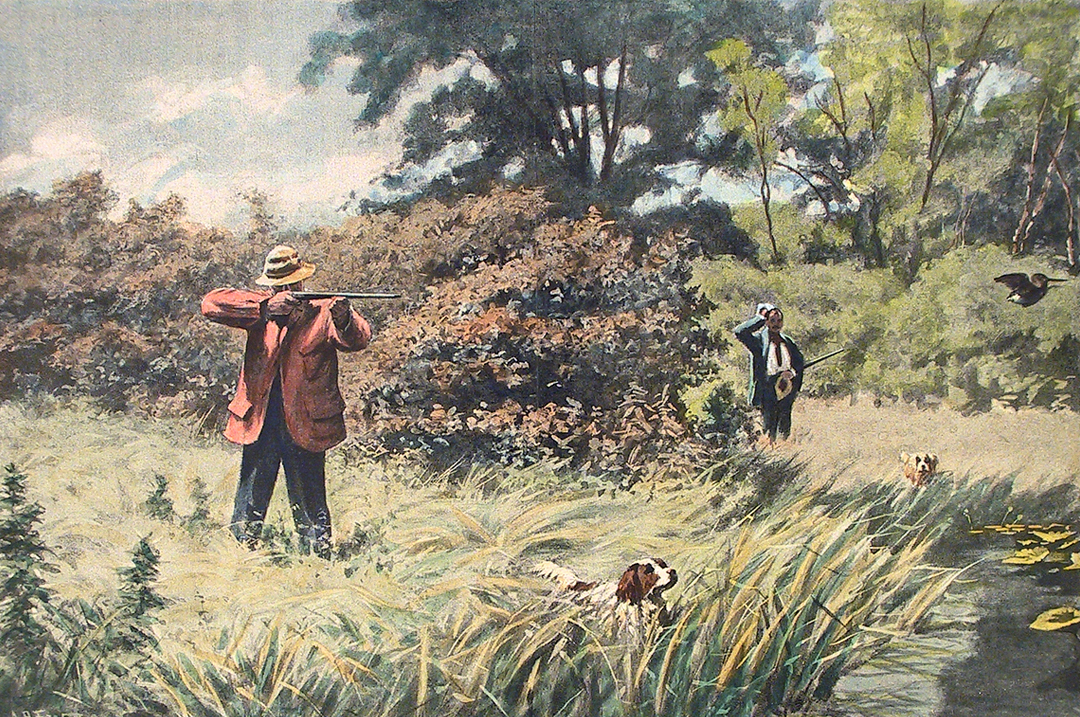
Woodcock Shooting, 1892, A.B. Frost (hand-colored by William Kurtz).
Suppose, now, that when they were numerous throughout the bottoms generally, the river should rise just high enough to cover about four-fifths or nine-tenths of the bottoms, leaving the whole a network of islands and peninsulas, among which, in a little boat, you may paddle anywhere. Does it need much stretch of fancy to picture the intensity of the shooting that may be had at such times? And when it is one of the noblest of game birds—the one of all others with which the soul of the sportsman is most deeply and quickly charmed—what can equal it?
You have, perhaps, seen a dog point from a wagon on the prairie. But have you ever seen him refuse to get out of a boat when it touched the shore; or, if he did step out, remain standing in the water beside it? Such was a common sight on the Upper Mississippi in days of high water. As you step from the boat a woodcock rises a few feet from the shore with that mellow whistle of wing so enchanting to the soul of the sportsman. A puff of feathers comes from it at the report of the gun as it is wheeling over the tree-tops and it falls through the dense green beyond.
As the dog goes to retrieve it, he stops halfway and stands with upraised forefoot and rigid tail. As you go up to the dog a bird springs from the ground a few feet ahead of him and vanishes in a spiral line through the green canopy above. Over the tops of the trees it wheels and away it scuds across an open piece of water for the next island beyond. But, as the dim line of brown and buff fades through the dense foliage, a charge of shot flies across its path and down it goes into the open water.
Make no more such shots as that today. Too much time will be lost in retrieving the game, for the dog cannot see it fall. As you will now have your choice of shots, it is best to take such birds only as will fall where they may be quickly found. The dog soon finds the first bird that fell, and as you take him to retrieve the second one, he refuses to go faster than on a slow walk. This gait settles at once to a crawl and, just as he is about to stop, three woodcock whiz out of a bunch of grapevines along the water’s edge. One falls almost beside the bird you are going to retrieve and the other two disappear in the brush over the next piece of water.
Crossing with the boat to the next piece of dry land, which is much larger than the last one, you pick up the fallen birds as you go and let the dog swim across. He soon reaches the opposite shore, shakes the water from his sides and walks with cautious sniff of upraised nose toward the first projecting bush. He stops a moment for a longer sniff of the air, which not proving entirely satisfactory, he swings cautiously around to the leeward side where his tail, which has been wavering in a manner expressive of considerable doubt, becomes suddenly as stiff as an icicle.
Before you have the boat moored, four woodcock spring from the driftwood and grass ahead of the dog and start for the four points of the compass. Out of a shower of fine feathers one falls in a twinkling into the brush, while another making rapid time across the open water descends with a splash into it. Entering the timber, the dog comes to a sudden stop and two twittering brown lines dart away from in front of him amid the roar of two successive barrels, which send both of them whirling downward.
But scarcely a step does the dog take toward them when he again stops and turns his nose, first to the right, then to the left, then to the right again. Before you can take another step ahead, away goes a ’cock on the right, then another on the left, with three or four more rising out of a clump of grass-grown driftwood ahead. And before you or the dog can reach the first one that falls, half a dozen more are twisting with whistling wing in every direction. And so you may go on from island to island with the dog not even walking, but half the time merely crawling about with thievish stealth and every minute or two stiffening into a rigid point.
During high water on these bottom lands the woodcock are generally much wilder than usual. Many rise far ahead of the dog, many lie in the edge of the timber and wheel away upward on the outside while you are inside or dart away across the water to the next island. Some twist upward among the tree-tops and then spin away on a straight line. Some whisk away so close to the ground that the brown line of their flight is hard to distinguish from it, while others bustle out of sight in a twinkling through some dense thicket.
You do some missing, as who will not?
Here goes a bird whizzing across an open place only 25 yards away. Clearly along the iron rib of the gun you see the rich brown robes of this prince of game birds and the gun (as you think) pointing just a foot ahead of him. You see so plainly his rich colors and his long bill that you feel a sublime confidence. What a perfect aim! How exactly in line! How nicely calculated at the proper distance ahead of the game! How cool you feel, and what an immensity of confident expectation is crowded into one short instant! You pull the trigger and the brown line whistles on without wavering or shedding a feather on the air, leaving you so engulfed in amazement at the fact, that you forget to shoot at two other birds that rise at the report of your first barrel.
The most hardened nerves may become fluttered by such fast rising of birds as was often seen on these bottoms at such stages of the water at the right time of the season. To have a fresh bird bustling up as you go to pick up a dead one, and killing the fresh one, to see your dog pointing another before he or you can reach either of the two that have fallen, and then to have a couple more spring right and left before you can reach your dog, will turn into a shuttle the heart of the most experienced shot. It is then almost impossible to preserve that coolness indispensable for steady shooting, The finger will sometimes betray one and pull the trigger when the eye plainly sees that the gun is not pointed at the right spot, and sometimes it will tremble and balk upon the trigger and disobey one’s will to pull it at the right instant.
Sometimes, when a quick shot is necessary, the gun fails to come to the right place as you raise it and it cannot be shifted before the bird is out of range. Sometimes when thrown up at a crossing bird it comes directly upon the mark and the temptation to pull the trigger at once instead of shifting the gun ahead to the proper place is irresistible. And often, in coming up, it strikes an unnoticed branch or twig; and frequently when wheeling suddenly with heavy pockets swinging around, one is thrown out of balance and cannot recover it in time. These and a dozen other causes—above all, that mysterious “bad spell” which at times attacks the best of shots—make it impossible for anyone to shoot without an occasional miss.
Thanks to human infirmity that it is so! Were it otherwise, most of the pleasure of the field would be gone.
This article originally appeared in the July 1892 issue of Outing.