
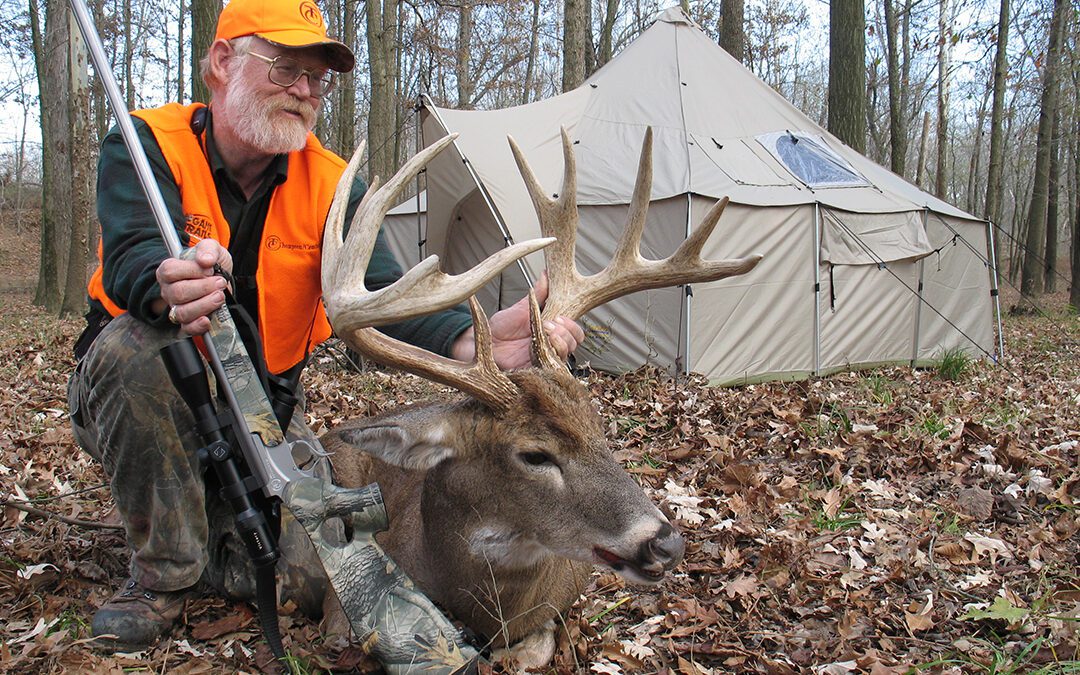
“It was him!” said Charlie as he strode into our Game Trails Kentucky camp kitchen. “He was at least five miles from where you saw him last November. He was with two other bucks near the end of Bell Road close to the river. No doubt it was him! Same antler style, but this year both his back tines are split.”
“At least I now know he’s still alive,” I responded as my thoughts returned to memories of my previous year’s encounter with same buck. His Boone and Crockett rack could have, should have been, on my wall.
The previous fall, I had spent many hours looking for the large ten point with a split back tine. Like Charlie, I had found him in late summer, not far from where the Tradewater River flowed into the Ohio River. When the rut approached, he left his late-summer home and took up residence near the Sturgis Highway Bridge about a mile from our camp. I saw him walk into the river bottom the week before Kentucky’s rifle season opener.
Late winter, after the deer season had closed, I scouted the brushy draws alongside the Tradewater. I found rubs on big trees as well as numerous scrapes. I also found an ancient fallen tree where I could hide and watch a well-used deer trail. I knew that was where I wanted to be on opening morning.
I was tempted to go into that area before opening morning to check for fresh tracks, rubs and scrapes, but did not. I thought it best to avoid the area until opening morning.
Well, before the slightest hint of the coming daylight, a cameraman followed me to “my log” in the Tradewater bottom. I positioned him where he could film both the deer trails and me.
At that time, I was doing public relations/media/marketing work for Thompson/Center Arms. As such, I had contracted with Tom Miranda to provide cameramen and produce our T/C Game Trails television show. Tom and I had been friends for years and had hunted together in the southern part of Texas.
After black turned gray to full light, three does followed by two young bucks cautiously walked the trail. Minutes later, the low-angle sun shone through bare oak limbs, much appreciated due to the single-digit temperature. I sat secreted behind the fallen tree’s big trunk looking toward the east.
I heard the slightest scraping sound to my left. I turned in that direction to watch a buck with a monstrous body and heavy antlers walking south on the trail. Steam wafting off of his backlit body; he was truly a breathtaking sight.
The buck’s rack had ten very long and heavy primary points and massive main beams. His onside back tine was split, making him an 11-point. He stopped, then warily stepped forward, offering me a clear shot less than 50 yards away.
I had seen and scored many great whitetail racks in the past, both as professional wildlife biologist and hunter. No doubt, his rack would easily score in the mid-180s B&C as a typical, if not higher.
I gripped my T/C Encore chambered in .270 Win. with the hammer cocked and ready to send a 130-grain Hornady his way. Hidden behind the thigh-high log, rifle firmly rested, all I had to do was pull the trigger. I took a deep breath, let it all out and was putting pressure on the trigger.
“DON’T SHOOT!” came a loud whisper from the cameraman. Then in a lower voice, “I’m NOT on him. Wait!” Had the buck of a lifetime, several lifetimes, not been standing there looking like a fire-breathing dragon with monster antlers, I would have screamed obscenities at the cameraman after pulling the trigger.
“Wait, don’t shoot, I’m not on him!” again came the cameraman’s warning caution. I backed off the trigger. The buck took two steps forward, still providing a perfect broadside shot. I shifted my rifle a bit to the right. The buck took two more steps and again stopped broadside. “I’m not on him. Don’t shoot!”
All the while, I was wondering how a cameraman with both wide and telephoto capabilities could not be filming this monstrous buck. Much as I wanted to turn to look his way, I dared not doing so in fear the buck would see my movement and spook.
What was likely 30 seconds seemed like 30 minutes or more as I waited for the cameraman to utter one simple, single word, “Shoot!” But it did not come!
Then, as suddenly as he had arrived, the big buck was gone. I sat, not saying a word, dumbfounded. I had just let a “dream buck” walk away unscathed, waiting for the cameraman to tell me he had sufficient pre-roll and for me to shoot.
An hour later, after waiting and hoping the buck might return or at least chase a doe by us, I walked over to where the cameraman sat. He did not say anything, other than, “You ready to try someplace else?”
Two weeks after my encounter with the monstrous buck, I received a call from Tom Miranda. “Larry what the world is wrong with you? Why didn’t you shoot that buck?”
“Tom, what are you talking about? What buck?”
“That big buck two weeks ago in Kentucky! He was an absolute monster, easily Boone and Crockett. The footage is tremendous, backlit by the sun, steam coming off his back and out his nostrils, like a fire-breathing dragon. Why didn’t you shoot? The cameraman got over thirty seconds of him! You should have shot!”
In a way, upon hearing what I just had, Tom without realizing it, was indeed reading my mind. I did want to shoot him . . . the cameraman. After hearing what Tom had said, I was quiet for nearly a minute. Then, I explained why I had not pulled the trigger. I did tell Tom if he intended to send that same cameraman with me on upcoming hunts, he definitely should reconsider. I did not want to work with him again!
Even now, more than 25 years later, and I can still close my eyes and see that buck!
Fast forward to the following year. Charlie told me he had seen “the don’t shoot buck” five miles from where I had encountered him the year previous. I was not surprised. As the rut approached, I felt assured the big ten-point, now with split back-tines that make him a 12-point, would return to where I had seen him the previous year. I had seen that kind of thing happen numerous times.
The day before opening day, I drove to near where the buck had been the year before. Low and behold, I spotted him walking toward the river bottom where he had been a year ago. There was no doubt it was him.
That night, I decided that I wanted to hunt alone on opening morning. I was not about to have a cameraman tell me not to or wait to shoot, should I see the monstrous buck.
Well before daylight, I was back behind my log where I remained until eleven. I saw several bucks, two of which had I not been hunting my specific buck, I would have taken. Both were mature ten-points that would easily score in the 160s.
Just before noon, I walked out of the woods toward a ten-acre island of woods in the middle of a broad, open field planted in soybeans. Off to my right, against the field’s opposite wood line, I spotted a big bodied deer. Its head was hidden as it fed on knee-high soybeans. I took a couple of steps in the direction of the animals, which was at least 500 yards away. The deer raised its head. A buck! Peering through 10x binoculars, I could hardly believe what I saw. It was the buck I was hunting.
I hurried toward the tree island to use it for cover to cut the distance between us. Once behind the trees, I ran in the buck’s direction. I cautiously approached the tree-line and peered out the other side. The buck had by then walked toward a power-line.
I was setting up my shooting sticks when I heard what sounded like a helicopter. The sound was coming from behind where my buck stood about 250 yards away and coming closer. That’s when I saw a helicopter flying just above the treetops, checking the transmission lines and coming my way. Before I could get a solid rest, the helicopter turned my way and spooked the buck. He ran to his right just inside the tree-line. I could hardly believe what happened. The first time I had been foiled by a lying cameraman and now by a helicopter.
I sat down where I had stood, trying to determine what to do next. Five minutes into sitting there, wallowing in my bad luck, I again spotted the buck. He was walking briskly toward the island of trees.
A slight, noon-time breeze was blowing essentially from me toward him. I needed to get to the far side of the trees where I had come in downwind of him, then hug the edge while heading in his direction. Hopefully, I could then cut back into the trees and come in behind where he might be.
Ten minutes later, I was moving at a snail’s pace, heading toward where I hoped the buck might have stopped or was bedded. I knew there was an old homestead in the southwest sector of the woods. Having scouted the wooded island the previous winter, after the hunting season had closed, I found where a big bodied deer had often bedded amongst the fallen-in remnants of an ancient barn and home buildings. I suspected it had been the buck I was after.
Closer to the old homestead, I carefully glassed the tall grass and weeds, and, immediately spotted the outline of the massive, tall rack of a bedded buck. I set up my shooting sticks, then rested my .280 Remington T/C Encore rifle loaded with a single 140-grain Hornady Interlock round. I waited for him to move or stand up, so I could have a clear shot at his vitals. I knew he might stay bedded for hours or stand up in the next few minutes.
Five minutes later, he stood up. But before I could take a shot, he stepped behind a dense patch of brush. He stood there for at least a full minute before stepping clear. My crosshairs were locked on his vitals as I pulled the trigger. At the shot, he humped up a bit, then turned to walk away. By then, I had loaded a fresh round. I shot a second time, determined to put him down on the spot, but he managed to stumble behind some underbrush.
I knew my shots had hit him hard. I walked to where I had last seen him and, just shy of getting there, I spotted a broad blood trail. He had not gone far.
Later, while field-dressing him, I learned my first bullet had gone squarely through both lungs. My second going-away shot had severed his femoral artery.
After a prayer of thanks, I knelt beside my buck and grabbed his magnificent antlers. He had broken off one of his front tines very recently. Had that tine been present, his rack would have grossed close to 190 B&C points. I also opened his mouth to look at his lower jaw teeth and determine his age. His tooth-wear suggested he was at least seven years old.
My quest that had started a year earlier had come to an end. I was tremendously pleased, but also sad.
Next morning, guiding one of the writers in camp, at a very long distance I spotted a buck. He was extremely massive, at least 6-inch bases and 12 very long tines. He appeared to be no more than a three or four-year old. Come on next year!