
“For extended trips, where time is no object and cross country work is intended, the ox-wagon is the best means of conveyance, especially if a bulk of heads and skins is to be collected, and carried about. The hire of a wagon, with a full span of oxen native driver, leader, etc., is about £1 per day.”
So wrote Captain H.F. Varian M.C. about Angola. He had arrived there in 1898 and, interrupted only by World War I, hunted for a couple of decades through the “chain of countries south of the Equator from the Indian to the Atlantic Ocean.” In roadless places, he added, native carriers trumped wagons. Each man was to carry a load of 50 to 80 pounds 15 miles a day for “six pence to about eight pence.”
Trackers fared better. Safaris needed fewer trackers than porters. But despite any competition for the job and its status, early hunters often had trouble finding enough trackers.
“The natives of this sparsely populated country, the Luimbe, are a poor lot,” wrote Varian. “They are principally beekeepers [and] every tree of any size holds one of their hives. The sable [we hunt] seem accustomed to seeing them about the bush and apparently have no fear of them.” Capt. G. Blaine thought much the same: “[They] cultivate scarcely at all, and at the time of our visit were subsisting mainly upon wild fruits and honey. They had no cattle and very few sheep and goats….”
European hunters found early on that the best trackers came from herding tribes, perhaps because their youth grew up tracking livestock on unfenced range. Locals of other background often disappointed.
For help on one of his Angola hunts, Varian hired “a likely-looking local native, who volunteered to show where the sable were to be found, [but] after wandering about with him in an aimless fashion for several hours, it dawned on me he was taking a walk for his own purposes of hive inspection.” This man was dismissed; but with stand-in trackers the hunt continued. Mid-morning of the last day, Varian’s party came upon fresh spoor from a big sable. “At that very dry time of the year, when the ground is hard, it is difficult to distinguish sable from roan, so there was a doubt about it.” But after the tracks joined those of a herd, “there was no more doubt.”
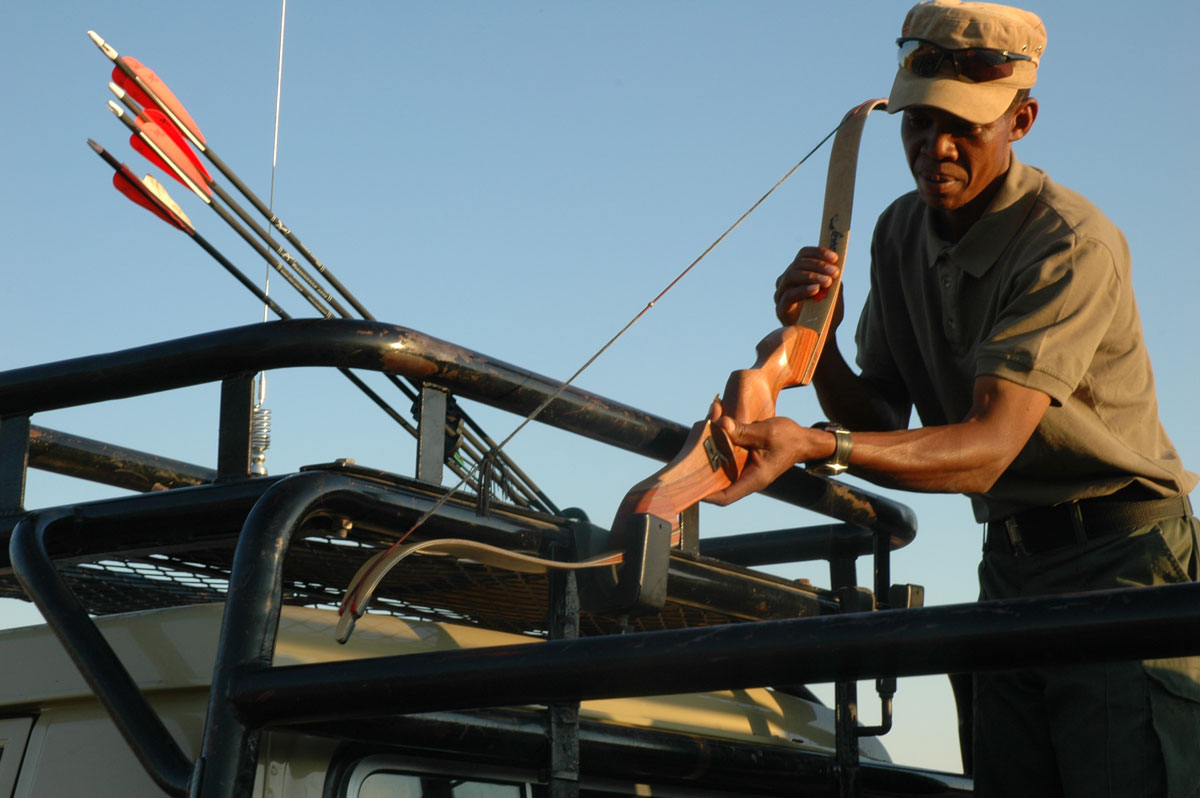
Not so primitive! This multi-lingual tracker uses sunglasses, a watch, a cell phone and a Land Cruiser.
“About ten o’clock a bad patch of bush was struck, with the wind all wrong,” so the hunters cast “forward in more open country. Near the end of the cast there was apparently no sign of the herd, and, as one native expressed it, ‘they have flown up into the air.’ [But] they were just then close by [and] took the wind, so the chase continued until one o’clock, when they were found resting in more open bush….”
A “circuitous crawl on bare knees, through burnt stubble [in] the heat of an approaching storm and [swarms of] mopani bees” brought Varian close. Behind an ant-hill, he pushed his 400/360 double ahead of him to its top. Alas, “it was impossible to avoid resting part of the barrel, [so] the bullet struck high…. The bull went down with all four feet spread out, but recovered himself immediately and made off.”
Blood spoor soon vanished, but the trackers persevered. “After several hours, when it was nearly dark,” they found and finished the sable. “The head, with flesh and horns, is in itself a heavy burden, but with a wet skin attached, it made a very awkward load…especially at night going through bush.” There were only two natives and myself to carry it….” They reached camp after a hunt that had taken 15 hours.
Some noteworthy details surface in this tale: On hard ground, Varian’s stand-ins found promising spoor mid-morning and followed it for at least an hour. They determined from herd prints it was a sable’s track, not a roan’s (in silhouette many people couldn’t tell these animals apart, much less their tracks). After the bedded animals winded the men and left, the trackers gamely took up the trail again, and for most of three hours in the heat of the day stayed on it until they found their quarry. The errant shot put them back on the faint prints, blood only temporary help…. In all, a fine effort for second-string trackers—and a reflection of the standards of the day!
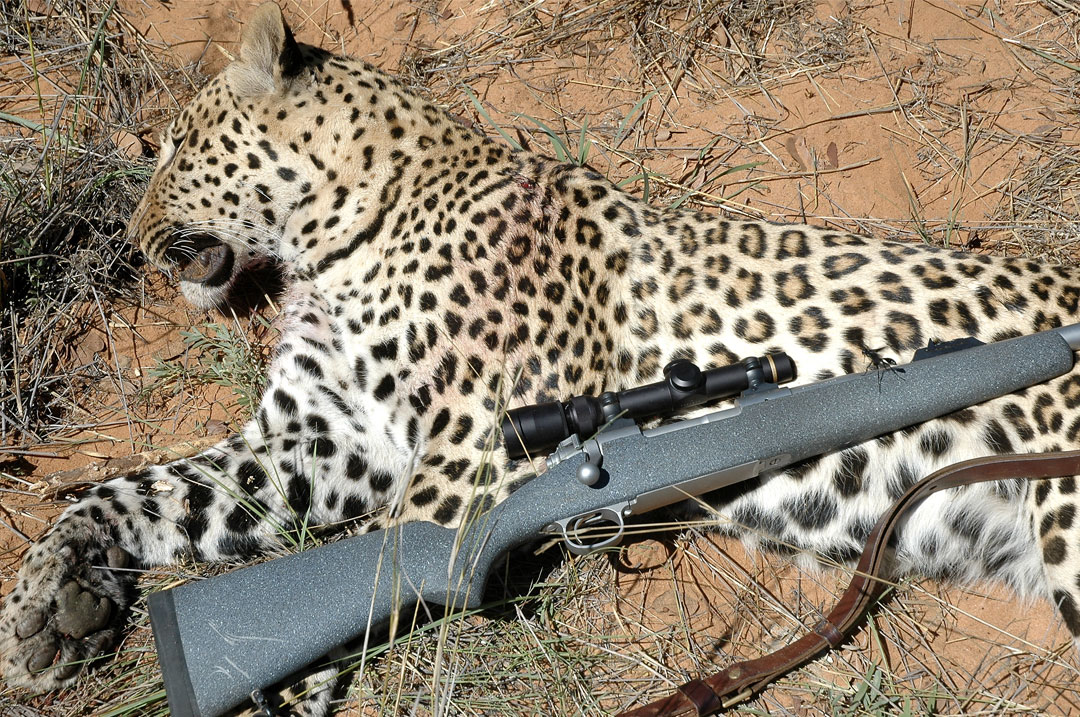
Stock-killing cats are easier to track after re-visiting kills if a small un-staked leg-hold trap gets a foot.
When I first hunted in Africa 38 years ago, I had tracked game only in snow. A good tracker in Michigan was one who’d carry on through swamps or could stay with one set of prints joining a snarl in a corn field. Nobody I knew dogged deer through autumn leaves or on hard earth under long grass. I laid to myth tales of African savants who could trail leopards across rock and sift one set of dimples from myriad pocks in loose sand.
Then one morning, still-hunting solo in northern Zimbabwe, I spied a big sable bull. Heavy bush swallowed him during my approach. Camp was an easy mile away, so off I trotted to fetch a tracker. By the time we returned, all moisture had left the prints. They were shapeless, too, in a carpet of craters much like a beach after a volleyball tournament. Still, Amos bent to the task, stepping carefully as he cast about. At last, as if magnetically drawn, he settled on a direction. For an hour I followed him on a tortuous path through head-high thorn edging a broad vlei.
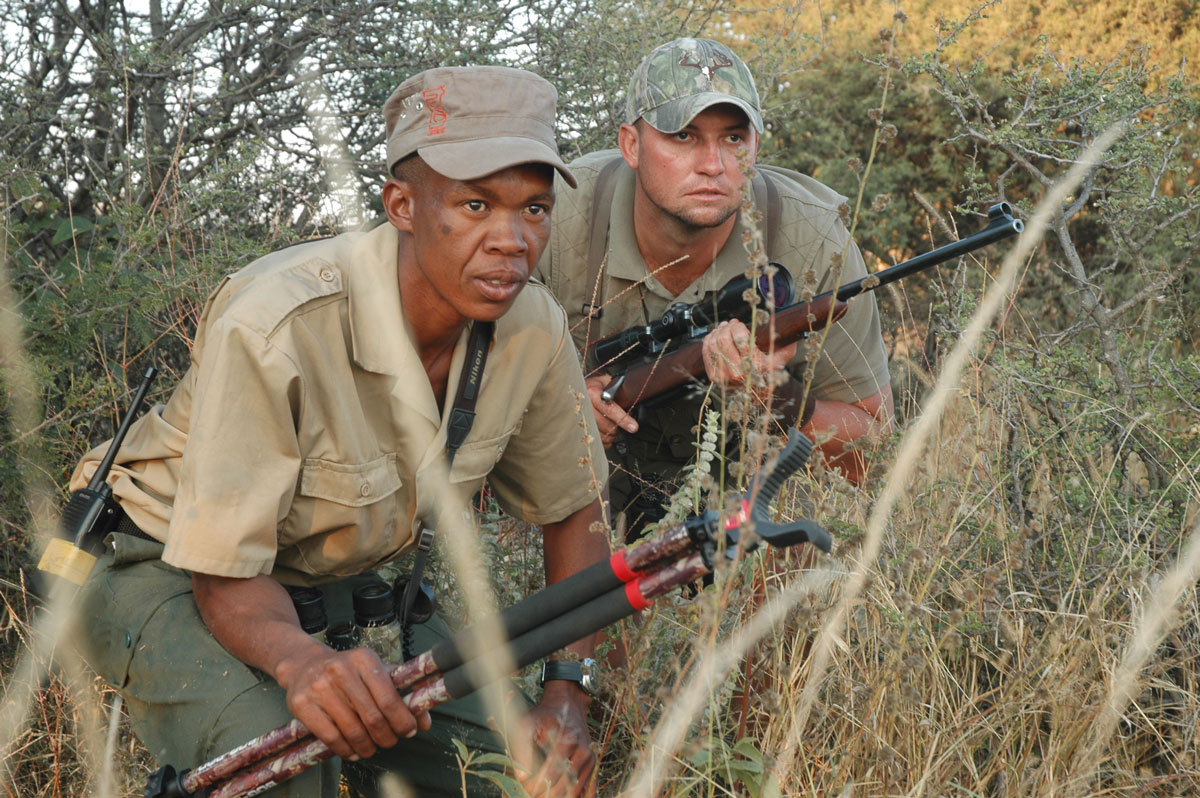
Finding game is the first step. Close approach, a shot for the client in the offing, can be more difficult.
Impatience at last got the best of me. He can’t tell where this sable went. Perhaps he’s never had the track. If he’s on prints, they could have been made this morning, yesterday or last week. He obviously enjoys hunting more than he does camp chores. This interlude was his morning break! The sun was now high, the day half spent. Time to end this charade.
As I reached out to touch his arm, the man became, suddenly, a statue. Slowly he eased a hand up tight to his ribs, extending a finger forward. I saw only thorn. Perhaps a minute passed. A breeze wriggled up from behind—a puff, cool on sweat.
The tall, black, scimitar-winged rocket burst from the wait-a-bit 17 steps away. Two great leaps, a rattle of thorn and the sable was gone. I gaped.
Amos turned, quizzically, as if to say. “Didn’t you like him?”
I have not since doubted a native tracker. Questioned? Yes. But to learn. To see what he sees, and interpret. To make something of nothing. So I’m not such an oaf.
“Is he a Bushman?” It was all I could think to ask when, a decade later, I saw a tracker of striking proportions. Roughly a head shy of my 75 inches, he was hardly stunted. And his bulk must have brought him near my weight. But his light complexion and prominent buttocks contrasted with the hue and shape of others I’d watched on the trail.
“He’s from Bushmanland,” said my PH. Evidently explanation enough.
Historically, trackers there learned their craft early. The welfare of the clan could depend on their success reading their surroundings. An ancient race, the Bushmen (or San) comprised many nations using three distinct language groups in southern Africa. They get due credit for their tracking acumen.
Their ancestors were short people with tight, lobeless ears bracketing flat faces and broad noses under peppercorn hair. Their skin was loose and wrinkled, even in youth. They camped in the shade, but knew nothing of roofs. They ate roots, grubs and wild fruit, supplemented by game killed with bows and poisoned arrows. They stored fat in their buttocks and thighs. When food got scarce, they could survive weeks without it. Small family groups recognized no higher political structure.
Despite a simple life, early Bushmen used a complex language punctuated by clicks, clucks and croaks. Their rock art shows a high level of sophistication. They knew music.
Probably more than 1,000 years ago, a new race migrated down the Atlantic coast and around the continent’s southern tip. Taller than Bushmen, the Hottentots had similar hair and skin, but relied more heavily on spears than on bows. They raised crops and owned cattle. Local chiefs inherited their station. Because the best land for both also supported the local game, Bushman and Hottentot cultures clashed. Hottentots pushed Bushmen to the fringes of their range—but were themselves displaced and persecuted by Dutch settlers (Boers) spreading north from the Cape.
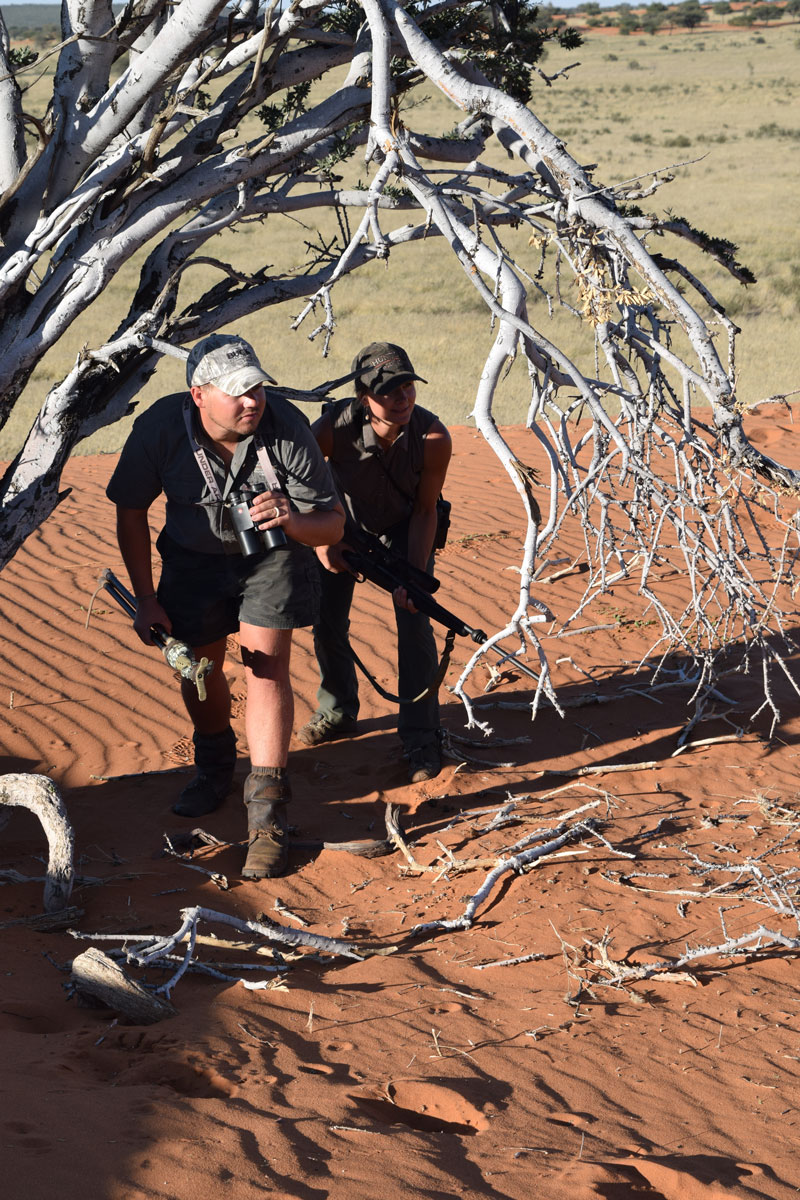
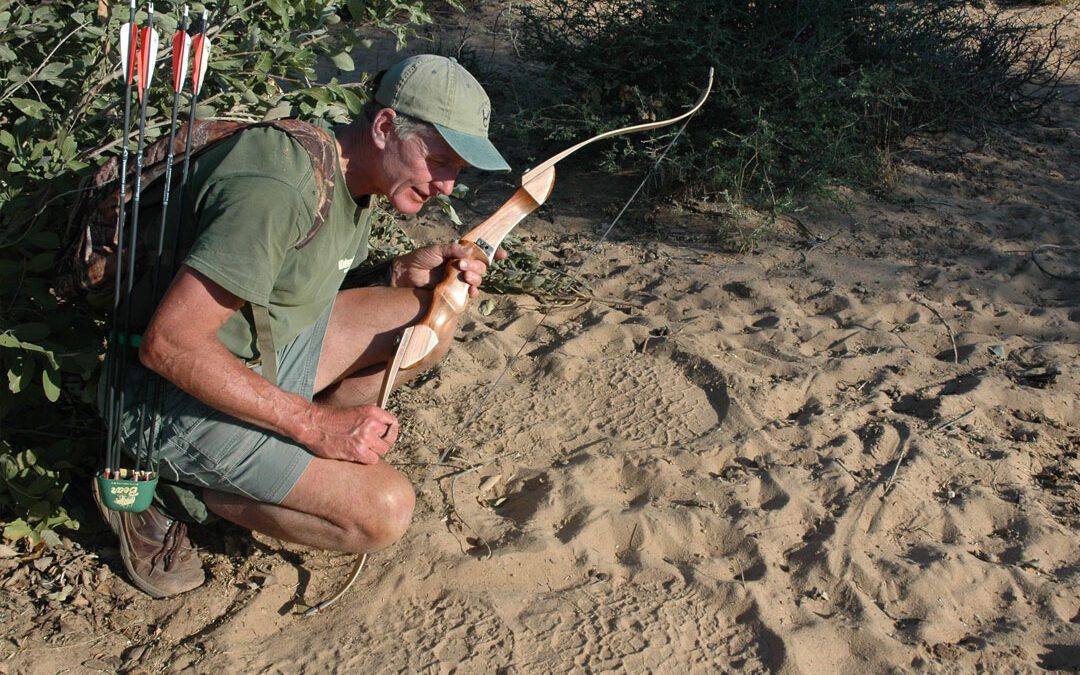
Closing in, hunters in open country make use of sparse cover, even if it takes them off the prints.
Meanwhile, other Africans were completing a migration begun in the Fertile Crescent thousands of years earlier. The Bantu (abaNu for “people,” umuNtu for “man”) were tall, strong hunters and herders who counted livestock as wealth and followed good grazing. But they also cultivated land, living on fruit, vegetables and milk as well as meat. By the 14th century, the Bantu had crossed the Zambezi and pushed Hottentots toward the coasts. On the Great Fish River, the Xhosa people met the Boers. Had they arrived at the Fish before Table Bay’s colony took root, they might have driven off these ill-provisioned pioneers.
The Zulu War, the Boer Wars, slave trade and inter-tribal conflict in the south were triggered by increasing competition for diminishing space and resources. In colonial East Africa, Great Britain cast its net over farms and game fields in what would become Kenya, Uganda, Tanganyika, Rhodesia. Arguably, WW I shifted control of the continent more than it changed its character. Then came the motor-car.
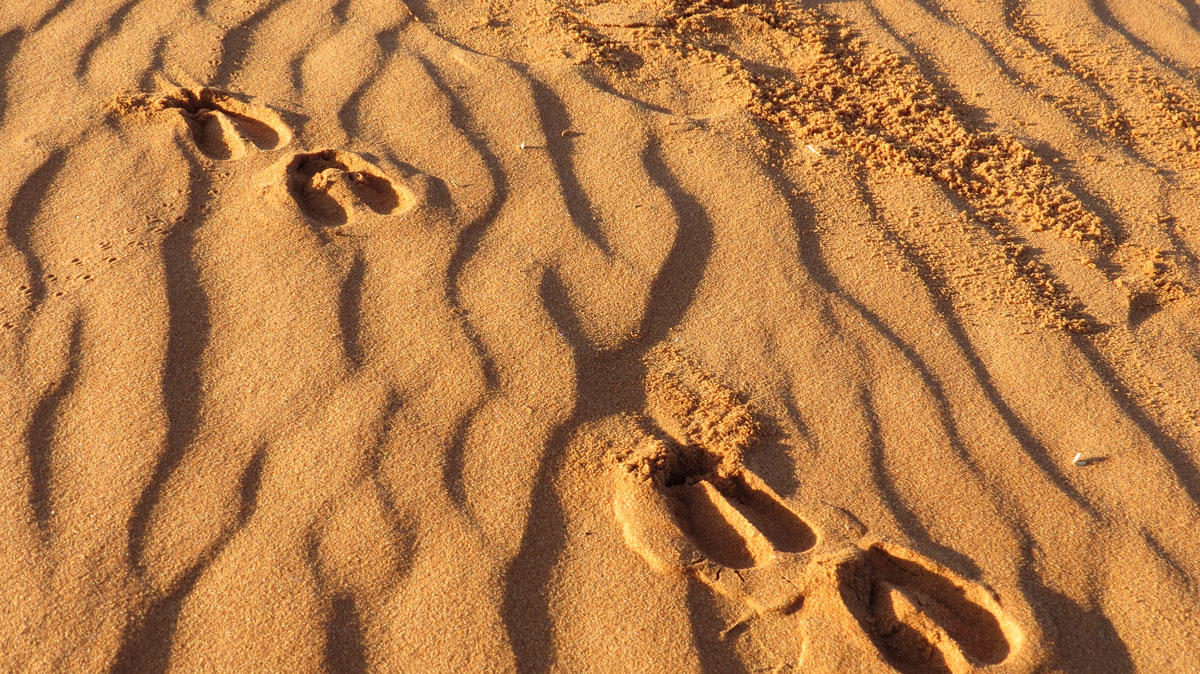
Which animal made these sharp prints in wet sand? Age? Sex? When did it pass? Where did it go?
Nature or nurture? Are great trackers born or developed? Explorers and early professional hunters admired and hired as trackers men of certain places and races. But the eyes of any newborn are much like those of the next. (The ranks of accomplished trackers include Europeans!) Tracking fundamentals can be learned beginning at a young age, as can reading, a similar skill. Spotting and interpreting details in hoof-prints is akin to distinguishing the letters c, e and o on a page. To most of us, the track is the greater puzzle, as we read print more frequently than we track game. Imagine looking at details on the ground as often as you scan newspapers or read texts on a shaking cell phone as you hurry through crowds.
Print in Chinese characters would be alien to most of us; why not the subtleties of animal tracks?
We recognize what we’ve seen before. With practice, we instantly distinguish one letter from the next. We form words with letters, sentences with words. A story emerges without thought of the process.
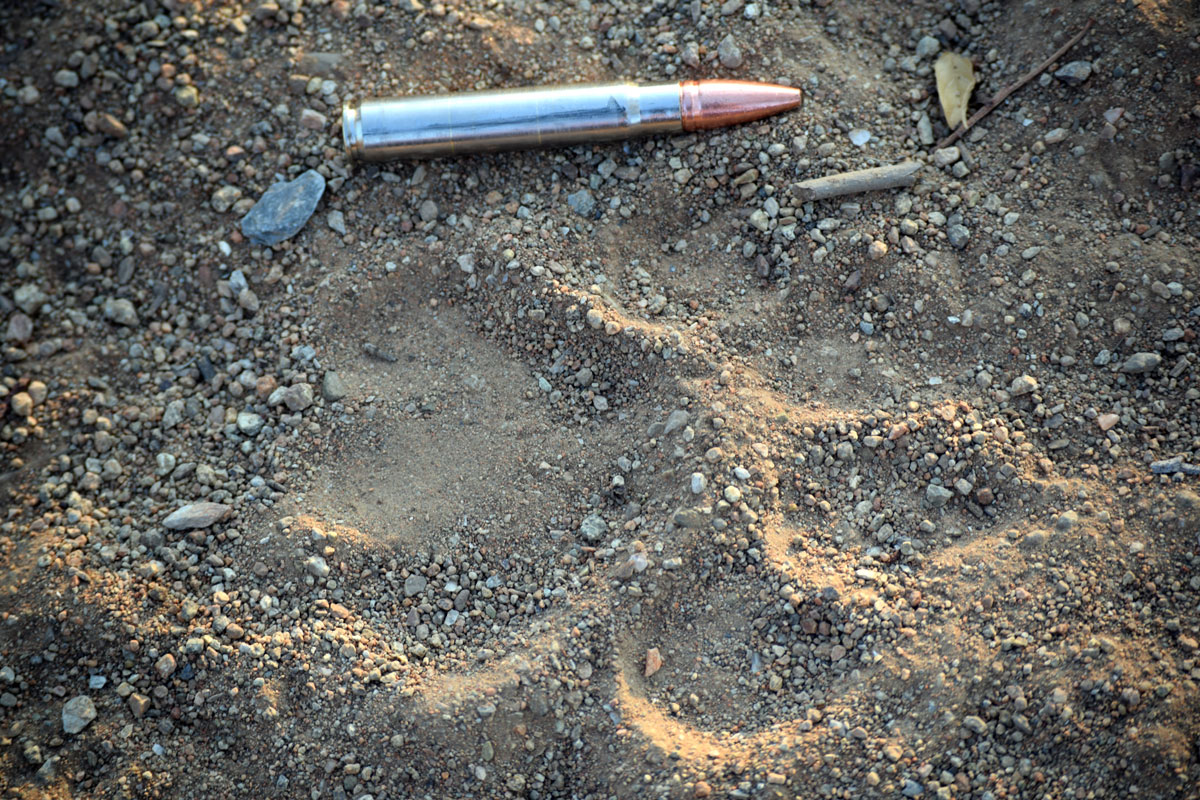
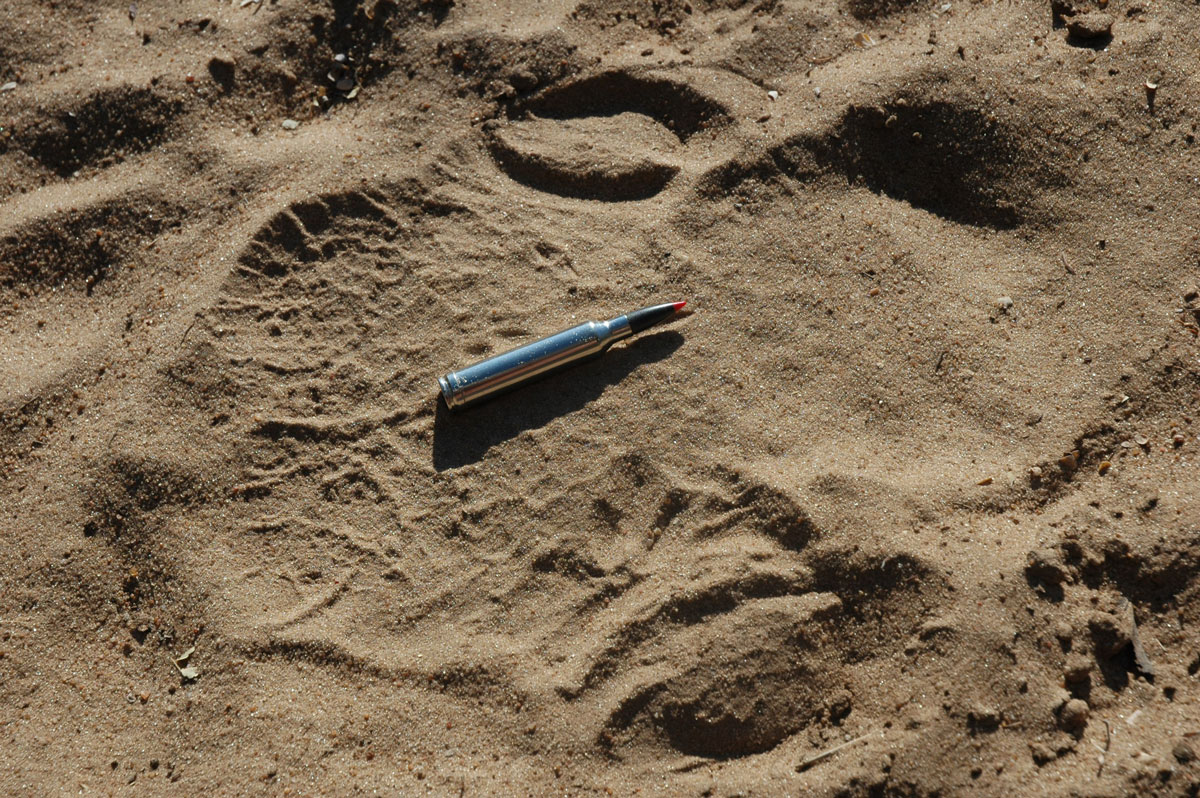
This lion print dwarfs a 9.3x62mm cartridge. Tracking lions can be one of Africa’s most thrilling hunts!
Professional hunter J.A. Hunter once remarked on the ability of ex-poachers in his employ to trail soft-footed rhinos across hard, stony ground. “My eyes became dizzy with strain,” he wrote, while “my scouts were following the spoor as though it were a well-marked road. One scout would go ahead [until] he grew tired of tracking…and another scout would take his place.”
Trackers must sift the important from the incidental—the displaced twig from myriad twigs that register as tapestry, one track from another that appears the same save for the blunted left hind toe-print. Next, interpretation: Why did that kudu turn from the group? Did injury cause the lean to one shoulder?
Given this short section of trail, where is the animal headed? When will it bed?
Besides an early introduction to the bush, ace trackers seem eager learners. I’ve hunted with men who could not only read Nature; they’d filed key words in several languages. One fluent in English and Afrikaans could also converse in Spanish and three native dialects! Such paragons retain what they learn, and recall it. No matter how quickly grasped, wisdom that slips memory or comes to mind late in a brief window of opportunity is useless!
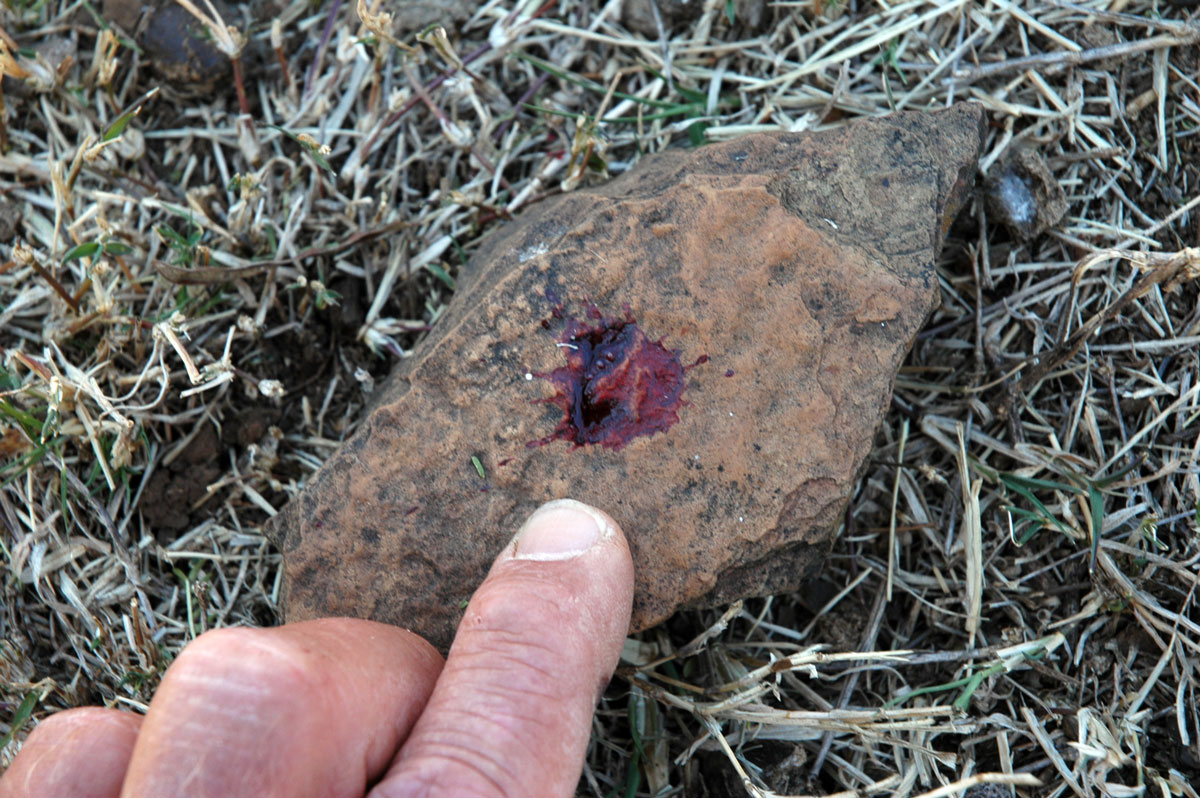
Before sun blackens it, blood on rocks is easy to see. Sand absorbs it. Wounded game may not leak.
To save time and energy, veteran trackers reel in distance with short-cuts. Jonah had an uncanny sense of where a trail would lead, how to skip loops and jinks without over-shooting the beast or missing a crucial turn. Once I followed as he trailed a gemsbok shot poorly by a client. Hands clasped behind his back to free his peripheral vision, Jonah advanced slowly along a faint cleft in the grass. He looked briefly at small spots of blood—to learn, he told me, not only where the leak was, but where the bullet had gone inside and what it had done. Then the grass thinned. The cleft and the blood vanished. The bull had taken to a stony, thorny hill that nixed impressions. I saw nothing and said so. “Never invisible,” Jonah replied. He pointed to a small stone freshly turned. Then he walked faster. As with the sable years earlier, I could hardly believe he was still on the trail.
He wasn’t. Cresting a ridge, he eased through dense thorn across-slope, looking more ahead now. We caught a game trail. It pulled us into a thicket of tall acacia. Jonah stopped and stared. Believe! I still saw nothing. The rifle wasn’t quite to cheek when the gemsbok broke cover. My bullet caught it in stride.
The trail of a crippled animal may be short. But not all are; and not all wounds continue to leak. Finding a beast that will otherwise die slowly, wasted, is an imperative that keeps trackers on faint trails.
One in memory began mid-morning when a client wounded a wildebeest, one of a trio. The strike was audible. The bulls ran off. Hoof-gouges in the plain led to a rocky slope that all but erased the prints.
Blood spots were smaller now, and widely spaced. What puzzled us was their placement, one on the right, then one on the left, alternating. A pass-through. But they were far from the track without froth from an injured lung, whose function would have propelled them.
The hill’s crest was all rock. We fanned out, went to hands and knees. After some time, by great good luck, I found a blood spot the diameter of a finishing nail. It told the trackers the animal had crossed the hump. They picked up the track below. It took us to another slope. Climbing, a tracker spied a flicker of movement ahead. The wind had changed.
“Following is pointless if the animal knows you come,” he shrugged.
We left. Near day’s end, we returned to glass the area from afar. All three bulls were grazing on the plain. A sneak and a well-placed shot collected the injured animal. Hair on its dewlap was matted with blood. The first hit had been too far forward. The ground-gobbling trot that had taken the bull from us had swung the dewlap back and forth, sending blood droplets in rhythmic time to either side.
Following game, the tracker sets the pace—and can call a halt. Kamati, a muscular, dark-skinned Namibian, knew when to pause, and for how long. He could trail at speed, then, uncannily, brake just shy of bumping it. Once, client in tow, we tracked a kudu into dense thorn. Silently, Kamati stopped and set the shooting sticks, then motioned the huntress behind them, nudging the rifle toward a featureless wall of brush. We stood for an hour in that apparently empty thicket. Then Kamati stared. I saw a shadow wink. The bull’s chevron appeared at 15 steps, in an invisible alley right in front of the rifle.
At the blast the kudu whirled and crashed off. Kamati pointed to a shattered limb, shook his head.
But that bullet scar was short feet from where the animal had stood. Searching beyond, I found a stained twig. Blood. As night was coming on, the client agreed to sit, so we could follow fast. In dusk’s shadow, with little spotting from the wound, Kamati trailed that kudu at hiking speed. Light was almost gone when the animal sun-fished from cover. Gone at my rifle’s blast, it lunged just a few yards before its shredded lungs failed. The client’s deflected bullet had nicked a ham.
Peter is another accomplished tracker with no evidence of Bushman heritage. The paunched eland he followed after a hunter’s errant mid-day shot bled little before fat and clotting sealed the entry wound. The hunter had another poke as the bull paused, but muffed it. Hours later, nightfall caught us on braided trails. I could no longer tell fresh prints from old, let alone distinguish the stricken animal’s.
At dawn we returned to the last blood, essentially starting over. Our prospects diminished. In late morning we gathered again, Peter debating options with two other trackers. Shortly, the argument became a plan. Within the hour, a speck on a log caught Peter’s eye. It dissolved under his wet finger. A hundred yards on, we spied the tawny arc of the dead bull’s ribs.
Savvy trackers listen as they look. Following a lion through Kalahari sand, Peter stopped, held his breath and turned his head. “He fights!” Barely audible, the sound was like a burp of thunder many miles off. Peter left the track to lope across the desert toward the battle. We were too late to catch the action; but the losing male broke the horizon far away. In the binocular, he was a magnificent, dark-maned cat—the one we had followed.
The most impressive trackers are Renaissance men of the bush. Not just skilled in finding game, they have a keen, abiding fascination for all around them. They’re interesting people. In their company, I’ve felt blessed, regardless of how the hunt itself spools out.
“What’s that?” I pointed to an eight-inch scuff in the sand. Beyond a short gap there was another, at roughly right angles to the first. The pattern repeated into the grass. Peter looked. “Cape cobra.” Not, “a snake.” While I had yet to meet a Cape cobra on this plain, puff adders had crossed my path. Their heavy torsos moved in a relatively straight line. I said so. He gave an approving nod—a bit too graciously, as if I’d just declared that water flows downhill.
John Hunter told often of his trackers’ many skills, and the acuity of their senses. He seldom left on elephant hunts without Mulumbe, a gifted and fearless tracker whose quick thinking in tight spots was invaluable near these formidable beasts. While elephant feet have ridged patterns unique as finger-prints, they can be hard to follow across baked pans, in thick grass or on bush litter that limits foot impressions. A tracker intent on one bull in a herd must throttle back, lest he miss a split in the group. The job becomes more difficult when the target animal is near the front of a herd.
So a lone bull can be an easier mark.
Called to kill such an animal destroying native shambas, Hunter put Mulumbe on the trail. It was easy to follow in the soft earth, but in the bush led straight-on, portending a long trek. Great piles of dung appeared. Mulumbe minded its temperature and consistency, and the intervals between droppings. Hunter wrote that soft dung often indicates the beast is alarmed, alert. Undigested forage can mean it is nervous.
A naked, rocky ridge erased the trail. Retreating to the bush, the men cast about until they spied faint prints. “Mulumbe would [belly] under the scrub and find marks that I never would have suspected could be there…. We struggled through a clump of sansevieria, [its] spines so tough and sharp, they are often used as phonograph needles.” White pulp beyond the clump showed the elephant had gathered these devilish leaves, chewed them to get at the moist pith inside, then spit out the remains.
At last the bull’s spoor appeared plainly on a game trail. It led through a gap in the bush, beyond which Hunter “could hear the old fellow’s belly rumbling….” But as he started toward the gap, Mulumbe gave his jumper a tug. “I stopped…. [He] was holding his head sideways…. Sound carries better through the earth than through the air…. He was sticking his tongue in and out rapidly, the bush alarm signal.”
Rhinos make distinct tracks, toes either side and ahead of the ridged heel. Easy tracking in sand.
Suddenly a rhino came through the gap toward them, avoiding the elephant. “[But for] Mulumbe, I would have met the rhino head-on….” Now, though, Hunter faced a dilemma. If he fired, the elephant would bolt. Yet he couldn’t let her get too close. Mulumbe “was magnificent. He never moved a muscle as the rhino came on. I decided to shoot her when she got to [a wisp of grass] within five yards of us.” A step from the grass, the rhino turned and walked into the bush.
As Hunter moved forward to get his long-denied shot, the feeding sounds stopped. Time was up! He dashed ahead as the beast spun to retreat and fired both barrels into its body a hands-width back of the ear tip. A path to the heart. The bull crashed away, but fell a few yards on.
Africa’s trackers are investigators. They find and interpret evidence using skills there called bush-craft. Stateside, it’s woodsmanship. After 20-odd trips to Africa over 35 years, I’m still a novice, awed by trackers who stride where I stall, who pick from a sea of dimples in sand the thread of one beast’s passing. To them, the trail is never invisible.