
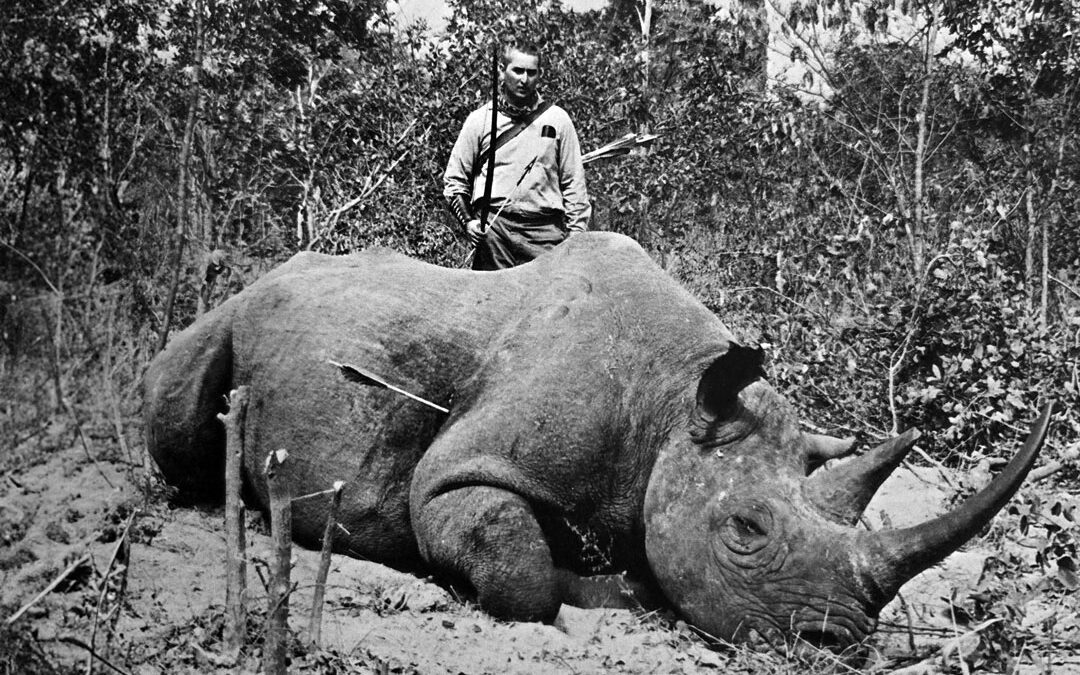
It may sound strange to talk on the subject of hunting an African rhinoceros with a bow and arrow. In fact some folks thought the idea insane, and to attempt the feat sheer suicide. Despite such a negative attitude, I believed a seasoned bowhunter could do it. But I’d have to prove it. No white archer had ever killed a rhino.
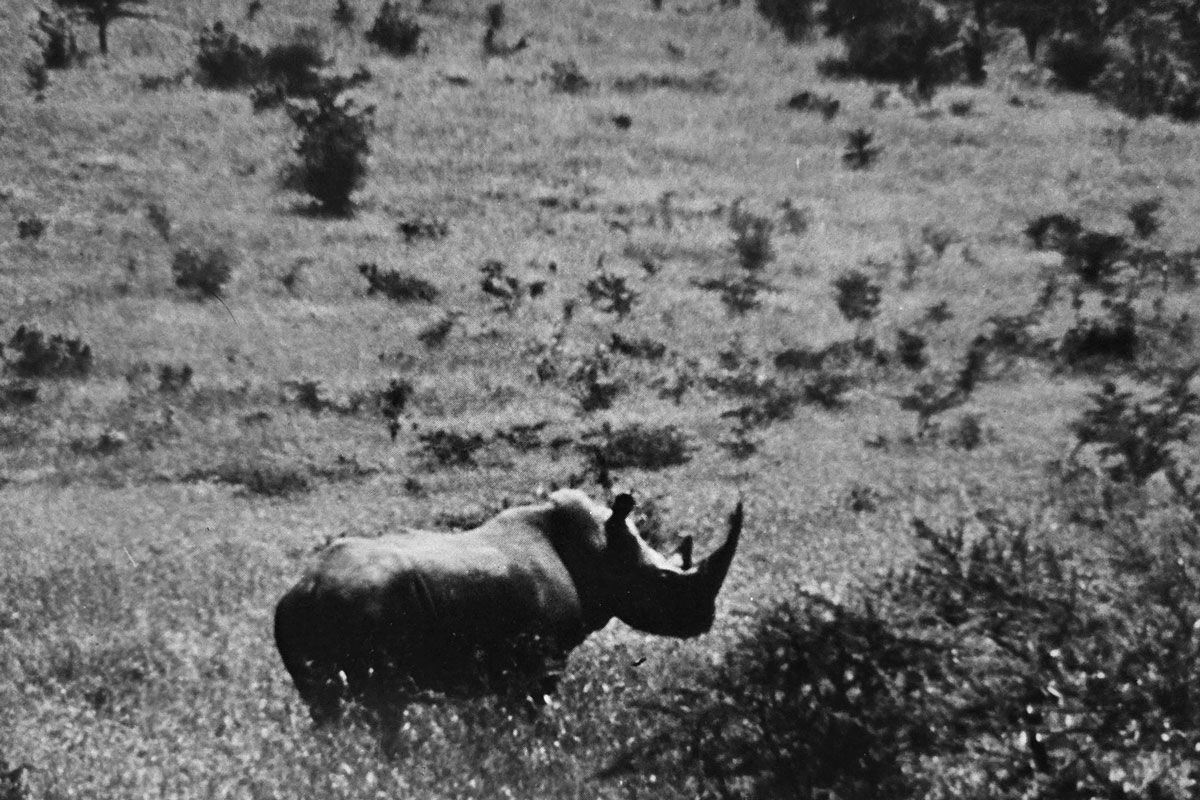
The rhinoceros is an impressive animal and has gained the reputation of being nearly invincible, sometimes demolishing safari vehicles and their occupants. This large pachyderm may weigh one tonne, sport a hide over 3 cm thick, with a lethal horn up to a metre long.
Well, how then is it possible to subdue such a monster with a mere bow and arrow?
“Why, an arrow won’t even penetrate the skin!” exclaimed my friends.
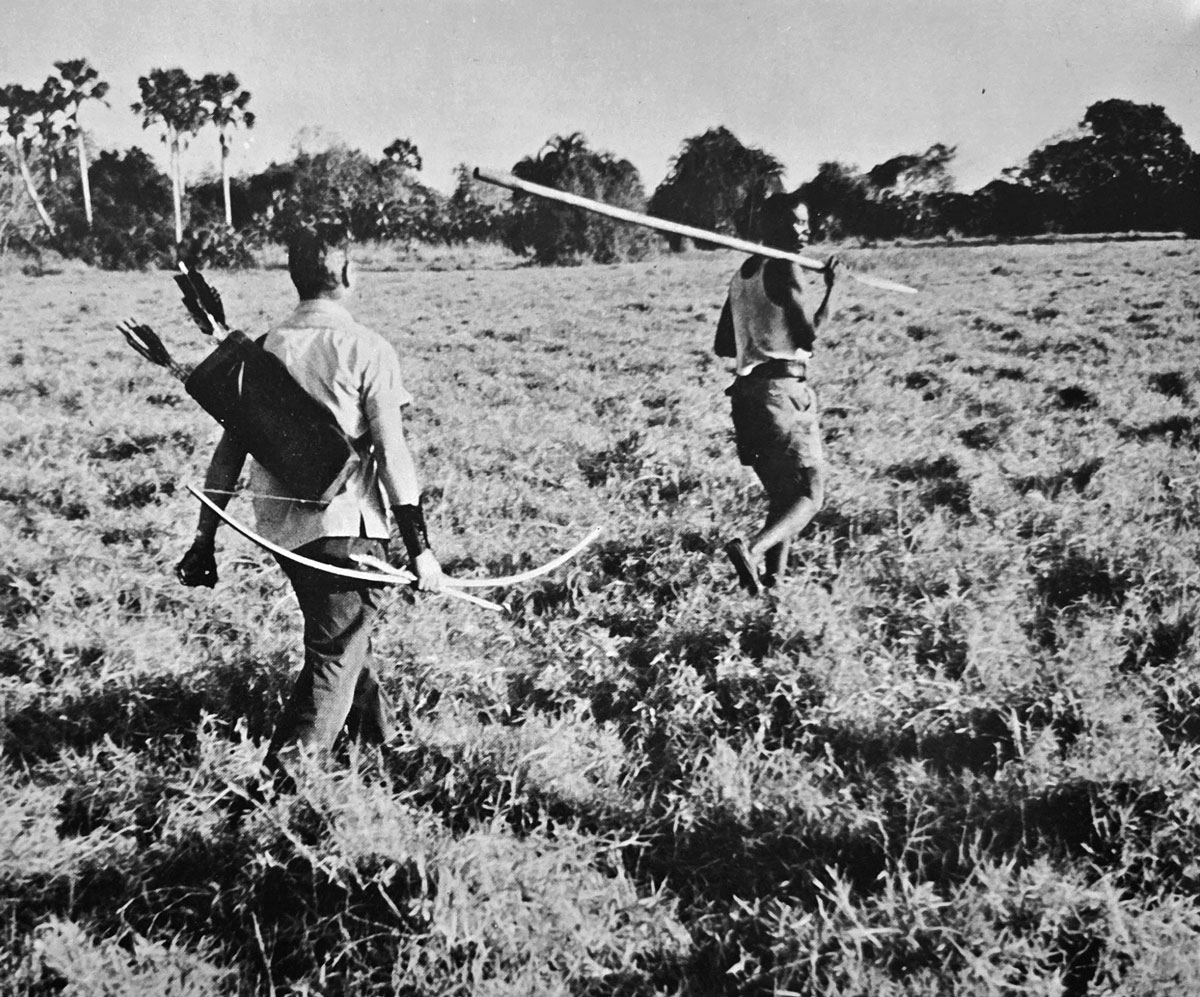
No, ordinary archery tackle could not do the task, I agreed. Bows pulling up to 50 lb (23 kg) would not even draw blood. But a bow pulling 90 lb (41 kg) or 100 lb (45 kg) could do the job, if an extremely heavy arrow were used, tipped with a razor-sharp two-bladed steel broadhead. The force from such a heavy bow would drive the arrow through the 3 cm to 4 cm thick hide into the vitals – the heart or lungs. Once the shaft had knifed through, the animal couldn’t survive. Big as it might be, a rhino would quickly bleed to death.
That was my belief, anyway. Aside from proper equipment, a lot of bowhunting experience helped immeasurably. One cannot afford to make mistakes at close range with dangerous game, and expect to live to talk about them. Equally essential as know-how and an adequate weapon for such hunting is keeping one’s wits when at close quarters with the quarry. Any wrong move, misjudgement or display of fear could be fatal to the hunter.
Although the law requires a bowhunter to be backed-up by a licensed “white hunter” in case of emergency, effective bowhunting range is usually so close (often only 15 or 20 m) that the situation can be exceptionally critical for both client and backer should the animal decide to charge. There seldom is time for more than one shot. A bullet would negate the bow-kill, but if it is well placed – in the brain – at least both men can walk away from the scene to try another day.
Any assistance by the hunter automatically voids claim to a bow-kill. A credited bowhunter kill means downing the animal by arrow only, without other aid.
My initial encounter with rhino was in southeast Angola in 1964 on my first African safari, and the episode was pretty much of a disaster from several aspects. First, the one I sought charged after the arrow struck and had to be stopped by bullets, so I could not claim a bowkill. Second, I still had to pay the $750 licence fee. Third, the enormous beast got to within five paces of me before falling dead.
It was an awesome sight, the long horn and large hulk bearing down, spitting blood, trying to crush me. It was on an open plain, no climbable trees nearby, so I felt rather helpless – especially knowing my weapon was useless against the frontal mass of any large animal. An arrow cannot penetrate the dense skull of animals such as rhino. The animal must be broadside to the bowhunter. The arrow I released drove deeply into the rhino’s chest, and would have been fatal, but knowing that was little consolation for me considering the three aspects already mentioned.
Naturally, there is relief in surviving such a charge, but I was dejected after that episode, wondering if ever again I would have an opportunity of challenging another rhino with bow and arrow. At that time it was felt the rhinoceros within a year or two would be placed on the protected list in Angola, the last country in Africa or India which still permitted bowhunting that throw-back to prehistoric ages.
Even if a person had the financial resources to hunt two rhinos in the same season, the Angola Government did not permit it. One rhino to one client a year.
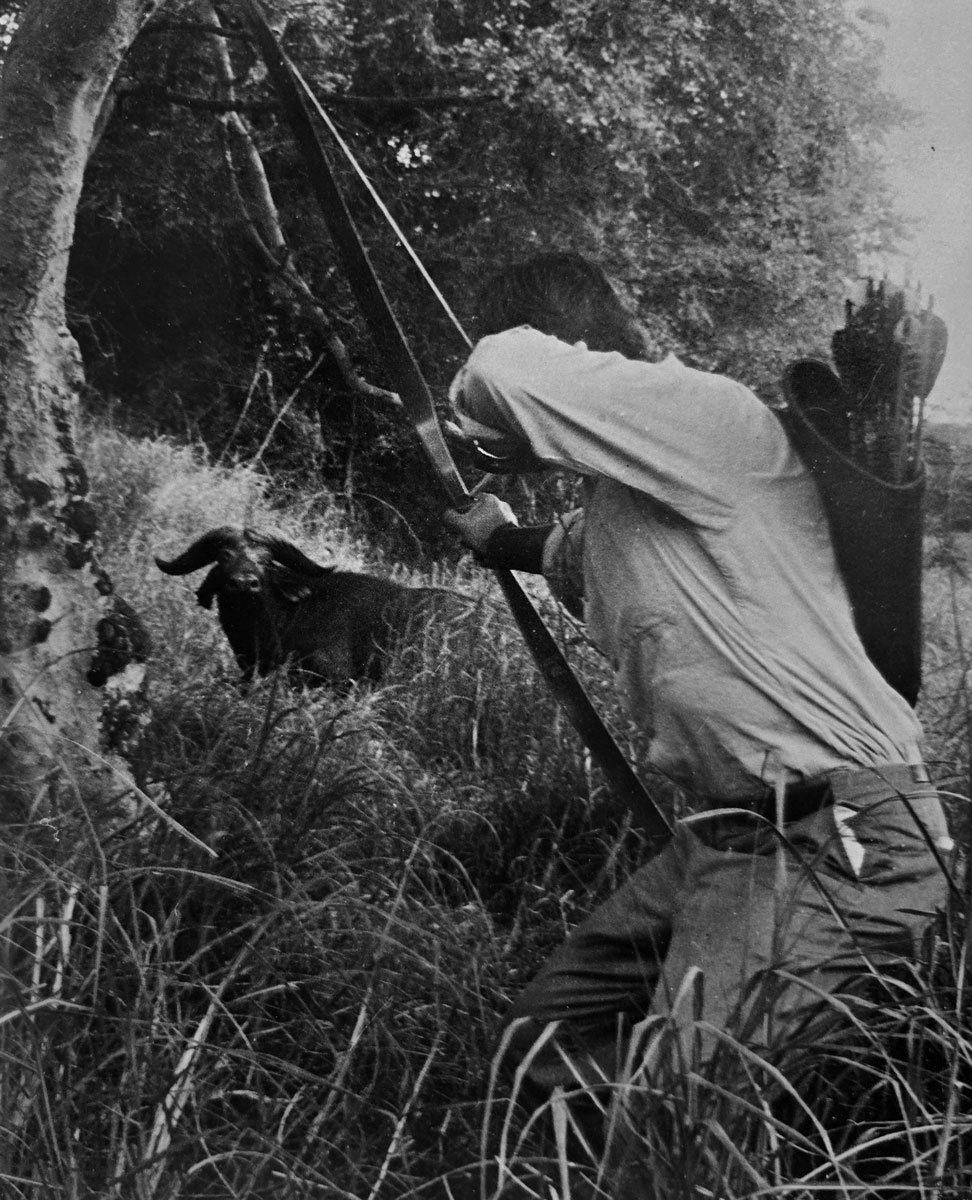
A Cape Buffalo about to go down to an arrow from the massive bow of veteran bowhunter Bob Swinehart of Pennsylvania.
Meanwhile, I bowhunted other species of game in Angola and then Mozambique, and was fortunate in downing three of the Big Five – buffalo, leopard and elephant – and other unusual heads of game such as sable, zebra, reedbuck, wart hog, and eland. Later African safaris resulted in a jackal, wildebeest, bushbuck, kongoni, roan antelope, a record-class waterbuck, and a coveted kudu with 52 inch (132 cm) spiralling horns.
The last animal to fall, on my fourth safari, was the proverbial “King of the Jungle,” the lion. He’s not really the master; the elephant is, but nonetheless the lion is jungle royalty and can be quite an adversary. That was the kill which finally rounded off the grand slam of five for me.
In June of 1966, having managed a permit, I again found myself in Africa – in southeast Angola in the Mucusso region, for one final try on rhino. This trophy animal was to be on the totally protected list at the end of the ’66 season.
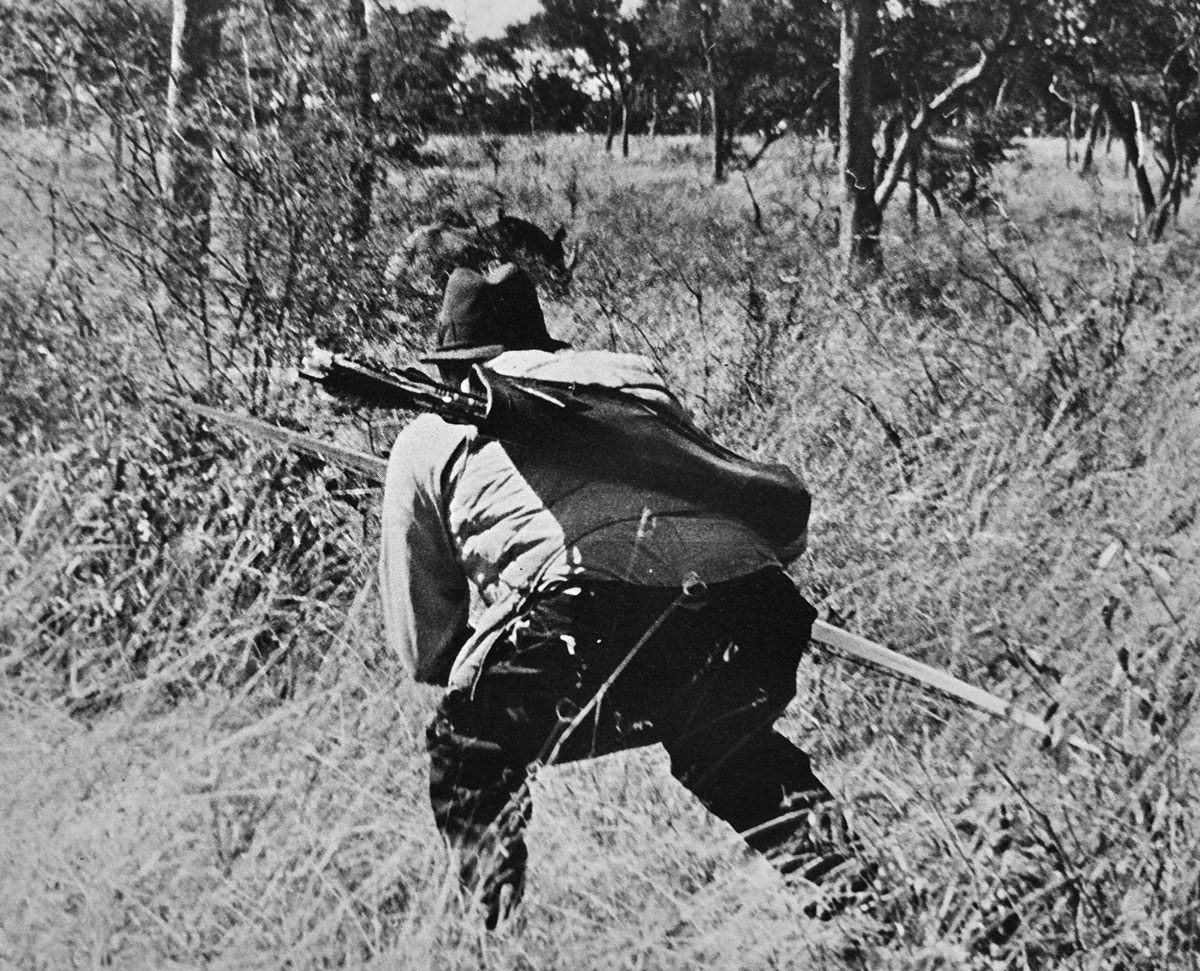
The grass was high, as the natives’ annual grass fires had not yet begun, and it was advantageous for stalking.
Having stalked a cantankerous rhino two years before, I was well aware of the problems which could confront a bowhunter. I did not want a repeat performance of the 1964 encounter, but I almost had it.
Excitement ruled from the start. On the second day of the return engagement, as I crawled in high grass armed with a 41 kg bamboo bow and nocked arrow (a 1200 grain fiberglass shaft) to within 25 m of “a big gray boulder”, it charged!
Some fast and fancy footwork enabled me to get behind a large tree a few steps to the rear, so there was no collision – no blood drawn by either party as the huge animal whizzed by about 56 km/h. The rhino trotted arrogandy away while my Portuguese guide and I considered our luck. As Angola was still then a province of Portugal, nearly all licensed professional guides were Portuguese.
For archers who may be wondering about the extreme weight of my arrows, I used the largest Micro-flite available, Ben Pearson’s number 10, and shaved down a solid fiberglass fish-arrow and slid it inside. Then a machinist friend made metal-nocks to my design for me. The broadhead was the conventional two-bladed Howard Hill, available from any archery retail shop.
There are many tribes in Africa – around 400 as I recall – and many, many more languages and dialects. Consequently, I did not make much of an effort to learn Chilose, the tongue of the Mucusso in lower Angola. My Portuguese guide spoke English, French, Spanish and various native dialects. There was no communication problem. But just in case of emergency, or being only with natives, I learned the essential words such as meat, water, fruit, and similar, and the names of the dangerous animals. The one most on my mind was “chimbanda” meaning rhino.
The crucial test of facing Mister Chimbanda came sooner than expected – the day after the encounter with the speedster. Fresh rhino spoor was located at daybreak along a river’s edge only 10 miles (16 km) from base camp. As the sun rose on the horizon we began tracking. The sector was densely covered with small thorn-trees and waitabits which restricted visibility from five to 15 metres.
Native trackers trail like bloodhounds and just as fast. Tracking several hours, a distance around 10 kilometres, we caught up to the rhino. The tick-birds which ride the backs of all rhino and usually warn them of danger revealed the location of this one. First we heard the birds, then saw them flutter above a bush 20 m away. The “invisible” rhino was there. And had heard us.
A loud crashing ensued as trees were knocked to the ground. It sounded as though a bulldozer were in action in front of us. For a tense second it was difficult to tell exactly in which direction the rhino was headed.
Alerted, it was more difficult to stalk. Again and again we circled, careful of wind direction. And each time the hectic snorting and crashing came from close range. Each time we wondered if he were bluffing, retreating – or charging.
Not all rhino will charge, of course. Each is an individual of varying moods, but the mood can change as rapidly as tick-birds on its back. Why did that rhino tolerate our continued pesky pursuit? Probably because the notoriously poorly-visioned animal never saw us – only heard us. The vegetation was thick, too, so thick it took our “boys” nearly 30 minutes to cut and drag away the thorn-bushes to take photos.
The rhino might also have thought that pursuing him was another rhino looking for a fight, or a pack of prowling lions. Old male lions do occasionally gang-kill a fully grown rhinoceros. Whatever we may have seemed to him, his instincts apparently sensed danger, and he preferred avoiding trouble rather than fighting, content not to remain still long enough to see the pursuer. It was frustrating to us, but preferable to a charge.
The chase continued many more kilometres. Still I hadn’t seen the rhino because I was third in line, the native tracker being first, and the Portuguese guide – our insurance policy – second.
The situation appeared hopeless: the bush too thick, the animal too keen of hearing. If Rui, the guide, had not caught a glimpse of the big horn, I’m sure he’d have asked me to call off the hunt. It was a hot 100 deg. F (39 deg. C) under a piercing sun, past midday. Our feet were blistered, and we were getting awfully far from the vehicle. It might take a half-day to walk back. We stopped to discuss the situation.
“Look,” I pointed out, “this third-man stuff is no good with bow and arrow. I’ve got to be up front.”
“Too dangerous,” Rui said.
“Maybe so, but necessary if I’m to get an arrow into this rhino.” There was a brief pause.
“Okay,” he said reluctandy, “we’ll give it one more try.” We were off again among the low, outstretched thorn-tree limbs.
Finally I saw the rhino, broadside in a relatively open gap among the thorn-bushes. He was big. And so was the front horn. His head was slighdy turned, with one beady eye glaring at me. Now he recognised what had been annoying him. Quickly I drew an arrow on my 90-pound bow.
In the instant of release the dark mass of muscle whirled with such amazing agility that he was coming face on when the arrow got there! It merely glanced off the chin into the shoulder bone, doing no damage. But the end of the shaft alongside his face was bothersome enough to distract him.
He jerked to a stop, jabbed his horn at the arrow, and began to trot away, about 18 paces distant.
The delay was long enough to get off another arrow, which buried deep behind the foreleg just as the rhino disappeared behind some thick growth.
More loud snorting and crashing was heard and small trees snapped to the ground. Then all was deathly still.
Slowly trailing, we soon spied his massive form crumpled to earth like a pile of gray boulders. The rhino was dead. A single arrow – the second shaft – had brought down this tough one-tonne brute. It had penetrated 51 cm, piercing the lungs. The front horn measured over 61 cm. Now I could relax a little—my bow had sunk a battlewagon.
This story is from the book The Trophy Hunters by Col Allison. Here, in their own words, some of the best known Trophy Hunters of today and yesterday recapture the essence of the chase, a pursuit as old as time.