
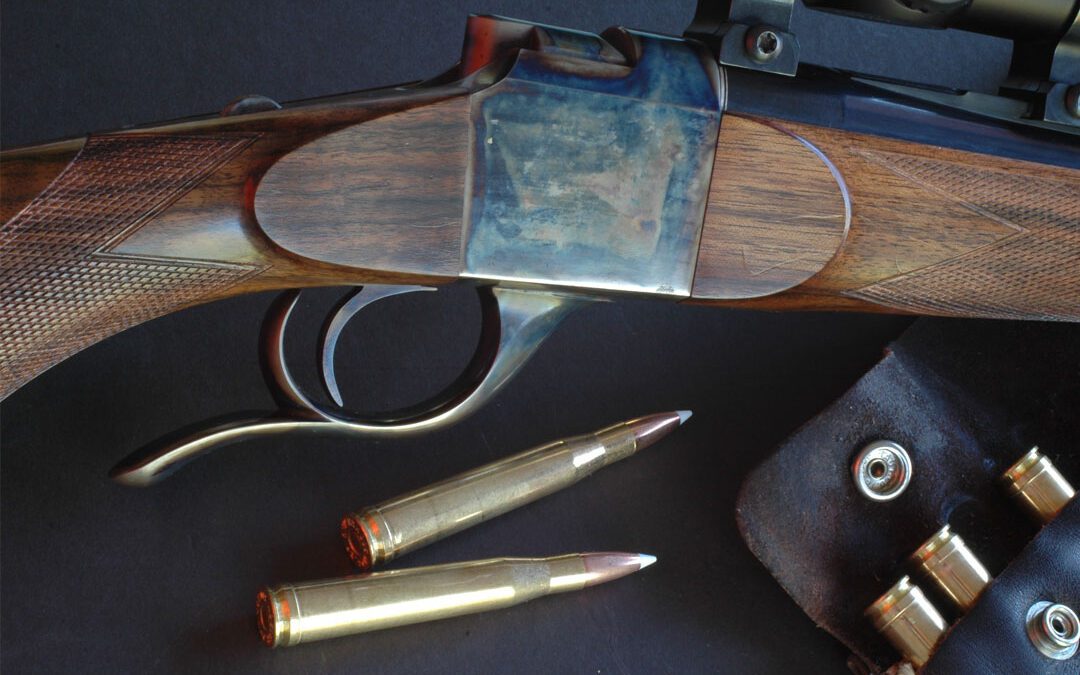
What place, after a century, does a British cartridge have in the booming chorus of American 30-caliber magnums?
Dawn’s hard snow was loud underfoot but the elk were noisy, too. Wind strumming the pines covered the crunch of our steps till both of us, surprised, met at slingshot range. The elk turned to leave. I fired too soon and missed. They galloped off. Despairing, I followed to the side of the gashed snow. An opening ahead was empty. The herd had crossed. But an elk might look back at that slot. Still deep in the trees, I glassed the colorless timber beyond. A russet swatch vanished at my magnum’s blast.
That bull was undeserved, as was another downed by the 300 H&H—my first elk ever. That bull had eased along forest’s edge in dusk so far gone it erased the Lee dot in my scope. Revived as a shadow in bleached grass, it blinked out as I jerked it back to the elk and fired.
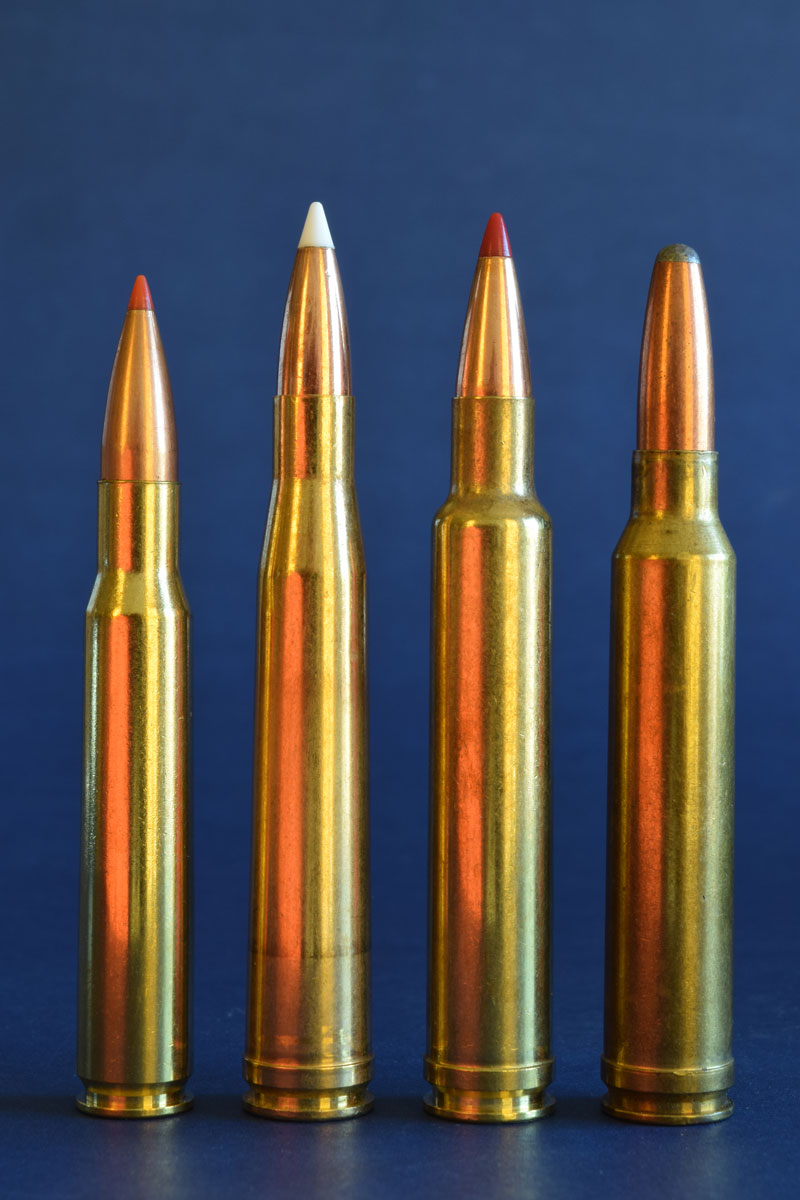
L-R: 30-06 (1906), 300 H&H (1925), 300 Weatherby (1945) and – with 300 H&H punch – 308 Norma (1960).
The 300 Holland & Holland Magnum entered my life in honey-hued French walnut at a gun show. The standard-length Mauser action had been re-barreled, and its feed ramp shaved to accept the leggy British cartridge. In those days, many a ’98’s lower lug abutment endured that surgery. It absolved the hunter of a second mortgage for a Magnum Mauser action.
Sometime after the 375 H&H appeared in 1912, the idea of a 30-caliber magnum on that case took form in the Holland shop. Left full-length, the 375’s 12 3/4-degree shoulder angle was reduced to 8 1/2 degrees on the “Super Thirty.” Perhaps the Great War slowed development; reportedly the first rifle so barreled by Holland & Holland sold in October, 1926. Stateside, Western Cartridge began loading the cartridge in 1925. Known widely thereafter as the 300 H&H Magnum, it sent 180-grain bullets at a listed 3,060 fps, 220-grain bullets at 2,730 from a 26-inch barrel. The earlier 30 Newton has been claimed to ballistically match the 300 H&H. But the 1941 Shooter’s Bible shows Western’s 180-grain 30 Newton load clocking 2,830 fps from a 26-inch barrel. The Newton’s shorter case has less body taper, a sharper shoulder and no belt, and would likely have fared better with powders available now. It was well ahead of its time. Only Charles Newton’s rifles were then barreled for it, and the brilliant inventor repeatedly failed to launch a rifle company. Western Cartridge dropped the 30 Newton from the roster in 1938.
Unsurprisingly, commercial loads gave the 300 H&H a 350-fps edge on the 30-06. Everything about it was bigger—from the hull’s .532-inch rim to its 2.85-inch base-to-mouth length. The 30-06 case has a .473-inch rim. It’s 2.49 inches long. For a decade, hunters paid the 300 H&H little attention. With a loaded span of 3.60 inches, it required longer actions than were common for the 30-06. The 1917 Enfield had a bigger maw and a longer bolt throw than the ’03 Springfield and Winchester’s Model 54. But the ungainly Enfield begged lots of milling to become Cinderella. Whittling a new stock added cost.
Early 300 H&H loads were far from frothy. Their pale orange cordite propellant had enough nitroglycerine to boost pressures considerably in the tropical heat of India and Africa where many British sportsmen frolicked. Loads throttled with that in mind sent 150-, 180- and 220-grain bullets out the muzzle at 3,000, 2,700 and 2,400 fps, respectively. We get as much from a 30-06 today. Subsequent loads from U.S. ammunition firms would hike those speeds by 300 fps. Bullets from current loads fly 15 percent flatter than if fired from a 30-06 rifle and boast a 10 percent advantage in wind.
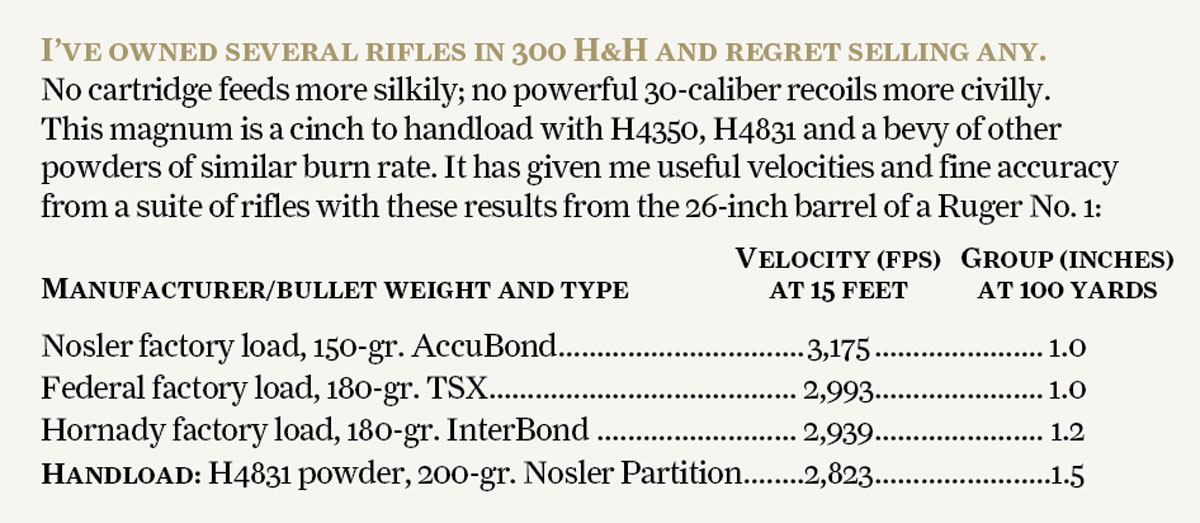
Oddly enough, the 300 H&H got a splash of publicity as a target cartridge when, in 1935, Ben Comfort won the 1,000-yard Wimbledon Match at Camp Perry. His Griffin & Howe rifle on a Remington Model 30 action had a heavy 30-inch Winchester barrel in 300 H&H, a prone stock by G&H’s Ernest Kerner. It weighed 13 1/4 pounds. Comfort used a 10x Lyman Super Targetspot scope and Western loads to punch out a score of 100-14V. By 1940 Western listed match ammunition with a 180-grain boattail bullet at 3,030 fps. A box of 300 H&H cartridges then retailed for $2.57.
When Winchester replaced its Model 54 in 1937, the 375 and 300 H&H Magnums were offered as charter chamberings in the new Model 70. The 300’s barrel wore metallic sights with a forged ramp and an “egg-lump” for the rear sight dovetail. With an elegant barrel 26 inches long, it was stamped simply “.300 Magnum,” as at that time no other commercial .300 magnums were available. Heavy-barreled Model 70s in 300 H&H served bullseye competitors.
The 300 H&H thrives in long barrels. Remington followed Winchester’s lead in that regard, installing a 26-inch 300 H&H barrel on its Model 721 in 1948. Later rifles of various makes would feature both 24- and 26-inch barrels. In the early 1940s, California wildcatter Roy Weatherby trimmed the 300 H&H case to 2.50 inches to suit 30-06-length actions, reduced case taper and formed what would become his signature “venturi” shoulder to produce the 257, 270 and 7mm Weatherby Magnums. In 1945 he announced a 300 magnum on a full-length case. The 300 Weatherby Magnum has considerably more capacity than its tapered parent and leaves the gate about 200 fps faster. But it, too, faced a market headwind, as it was initially offered only in costly Weatherby rifles.
I rue the current dearth of heavy-bullet loads in cartridges stout enough to send them at more than 2,400 fps. At 2,600, the 220-grain round-nose missiles from old 300 H&H loads matched the killing punch of its same-length rival, Rigby’s 350 Rimless Magnum, released in 1908. The Rigby’s .525-inch rim is a close match to the .532-inch rim of the 300 H&H. A 225-grain .350-inch bullet—.367-inch in diameter, not .358, per the U.S. standard—clocks 2,625 fps and carries more than 3,400 ft.-lbs. Among the most lethal 300 H&H factory loads now are from Nosler, which lists 200-grain Partitions and AccuBonds at 2,700 fps. The AccuBond brings a ton of smash past 400 yards!
The 1950s delivered the first short belted magnums of popular acclaim. They had the head of the 375 and 300 H&H. But like the 275 H&H Magnum pre-dating WW I, and Weatherby’s early magnums, the cases were 2.50 inches long. Per the Weatherby clan, they had minimal case taper, so they held about as much powder as the 300 H&H. Oddly, Winchester put its 458 Magnum on the ground first. Essentially useless for North American game, it earned some street cred in Africa. The 338 Magnum followed in 1958, the 264 Magnum in ’59. Meanwhile, Norma of Sweden was developing the cartridge hunters were waiting for: a short 300 Magnum.
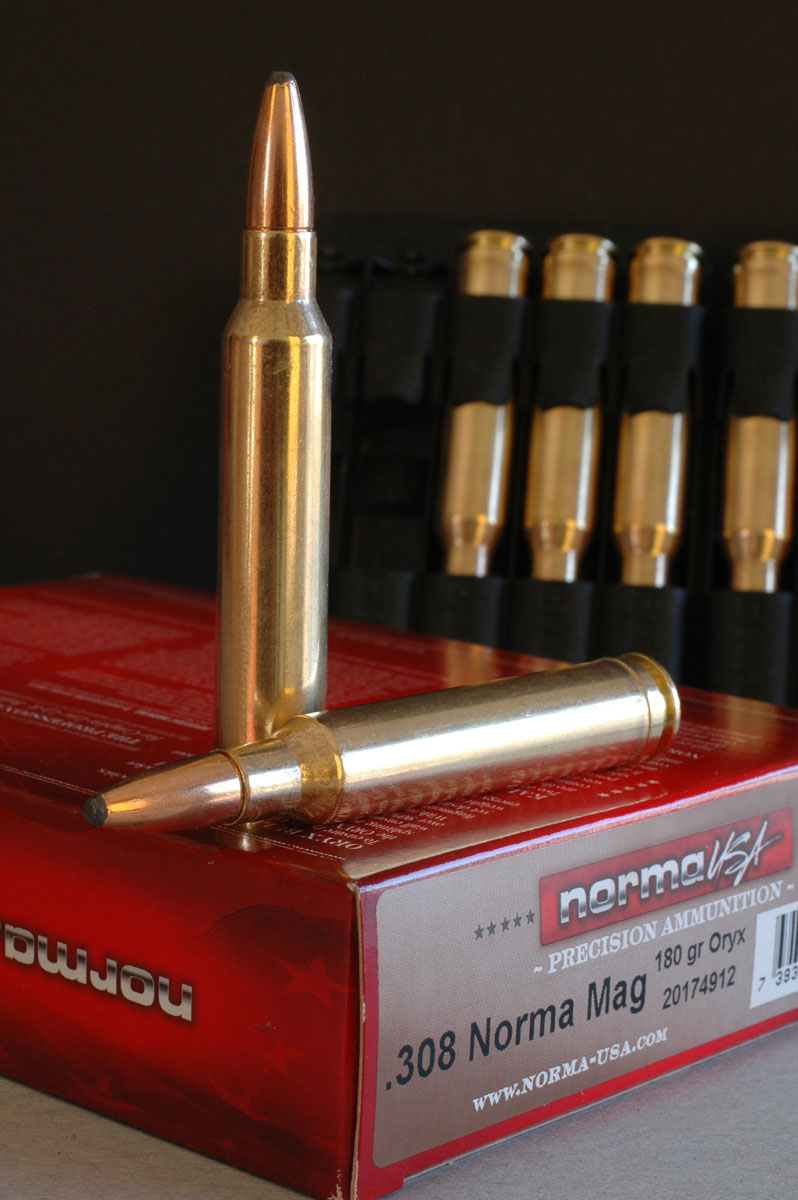
Norma beat Winchester to a 30 magnum for 30-06-length actions. Its 308 is a ballistic twin to the 300 H&H.
At 2.56 inches, the 308 Norma Magnum case is a tad longer than the 338 Winchester’s, so it won’t enter a barrel bored to 30-338, fashioned by wildcatters tired of the wait. Alas, Norma bungled its 1960 debut in the U.S. market by selling only 308 Norma brass. Ammunition arrived months later, “re” on headstamps noting reloadable Boxer-primed brass. If memory serves, only Browning among U.S.-based companies peddled rifles in 308 Norma Magnum. (Ditto the powerful 358 Norma, introduced in 1959.) Built on FN Mauser actions, the lovely High Power series was cataloged from 1960 to 1974.
The 300 Winchester Magnum appeared a year after Remington’s 1962 introduction of its wildly successful 7mm Magnum. Not a necked-down 338, it had a 2.62-inch case with a stubby neck. Deep bullet seating held it to the overall lengths of other short magnums and largely erased any capacity edge it had on the 308 Norma. The 300 Winchester has become a top-seller. My elk hunter surveys have shown it gaining on Remington’s 7mm Magnum.
In the late 1980s and early ’90s, Dakota Arms founder Don Allen designed his own short magnums on 404 Jeffery brass. The 2.55-inch cases are of greater diameter and capacity than the 375 H&H’s. A spate of other belt-free cartridges, short and long, have followed, pleasing shooters who claim the belt has out-lived its utility.
Perhaps it has. But the elegant 300 Holland & Holland need not bow to efficient or more potent 30-calibers. It still glides into chambers, shoots chalk-line flat and lands a blow to deck all but thick-skinned African game. It minds its manners in recoil. If a long bolt throw puts you off, well, some of life’s treasures just take time to appreciate.
Why belted?
The 375 H&H wasn’t the first belted cartridge; the 400/375 Belted Nitro Express preceded it in 1905. The belt establishes headspace on rimless cartridges without definite shoulders. Headspace is the measure from the bolt face to the cartridge’s “stop” in the chamber. The term came about when most cartridges had rims, so the measure was taken at the case head. But straight rimless pistol cartridges headspace at the mouth. Belted cases are halted by the leading edge of the belt (typically .220- to .224-inch from the bolt face) while rimless bottleneck cases at a “datum line” on the shoulder. To limit brass stretch and extend case life, handloaders may neck-size only. Without setting shoulders back in a die, they enable belted cases to headspace on the shoulder in the same rifle.