The federal government has once again fired up its most reliable engine of public policy: if it ain’t broke, form a working group to figure out whether it can be broken more equitably.
This time it’s the U.S. Fish and Wildlife Service, which has opened a remarkably short public-comment window to revisit how it calculates drain-tile setbacks near federally protected wetland easements in the Prairie Pothole Region.
To be fair, the agency hasn’t actually proposed changing anything yet. It’s only asking whether a rule finalized in 2024 — built on roughly six decades of settled policy — is “working as intended.” Comments close August 7, a full 14 days after the notice went up, because nothing screams thoughtful stewardship of a continentally important ecosystem quite like running it as a weekend flash sale.
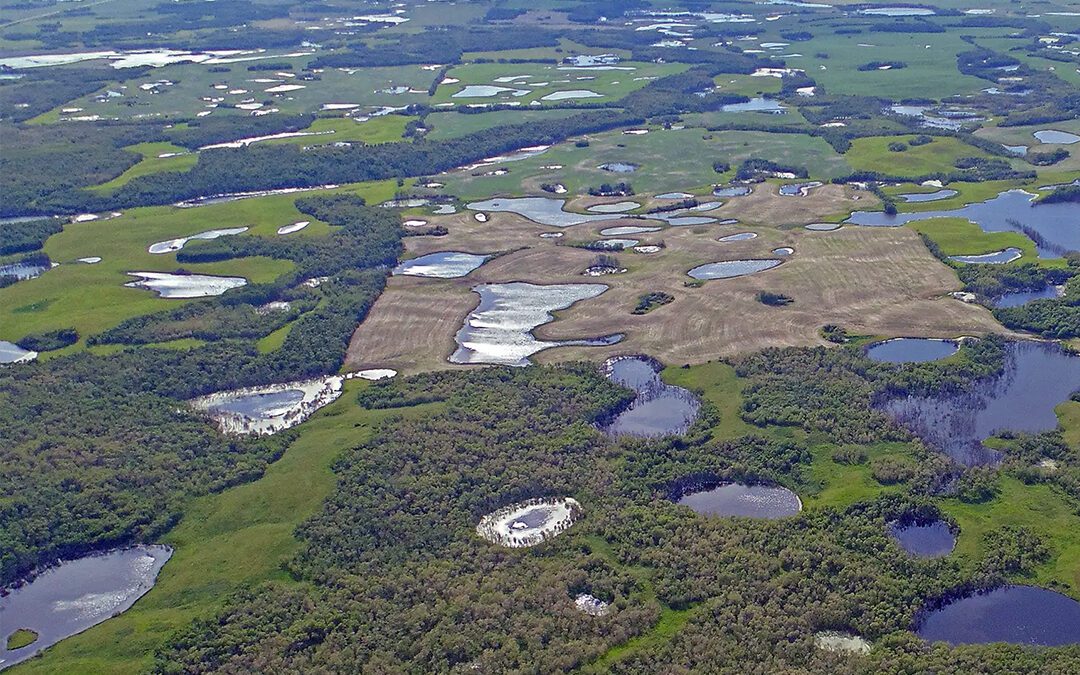
The Prairie Pothole Region runs through Iowa, Minnesota, Montana, North Dakota and South Dakota before spilling into Canada. Duck hunters call it the Duck Factory, and in a good year it produces more than half of North America’s breeding ducks.
Even that undersells the place. It’s a flood-control system, a groundwater recharge network, a water-filtration plant, a wildlife nursery, a soil bank and a carbon-storage facility, all running without a single strategic-planning retreat. The potholes store runoff, filter out pollutants, retain nutrients, recharge aquifers, and lock carbon in the soil. About the only service they don’t provide is a campaign contribution — which might explain why their legal protections are suddenly up for discussion.
Here’s the part that keeps getting lost: these easements weren’t handed down by decree. Landowners sold them, on purpose, for money. The government paid for specific, defined property rights; the deals were recorded at the county courthouse; and the sellers agreed that the mapped wetlands wouldn’t be drained, filled, leveled, or burned.
The easements run with the land forever, the same way a mortgage or a mineral reservation or a utility right-of-way does — which is to say, exactly the way property law is supposed to work when two parties actually mean it. Owners keep the land, keep it on the tax rolls, and can crop, hay, or graze the wetland whenever it dries out on its own. The only thing they gave up was the right to deliberately drain it.
Some current landowners are unhappy because Grandpa signed the deal decades ago. Understandable — a lot of us have inherited things from grandparents we’d love to renegotiate, including farms, furniture, and a genuinely alarming number of ceramic ducks. But Grandpa had options. He could’ve sold outright, subdivided, donated the ground, or left the place to a different grandkid entirely. Instead, he took the check and kept the land working. That transaction doesn’t become a federal taking just because it’s rained since closing.
The complaint usually surfaces in wet years, when a pothole spreads out and eats into tillable acres. Interestingly, nobody objects in dry years, when the same wetland shrinks, and the exposed dirt goes right back into production. So nature’s fluctuations belong to the landowner when they’re profitable and become a federal outrage when they’re inconvenient — a legal theory we might call Heads I Win, Tails the Duck Stamp Buyer Loses.
Drain tile complicates all of this because pipe laid outside the mapped wetland boundary can still redirect the water feeding it. That’s exactly why the Service calculates individualized setbacks using soil type, slope, tile depth and pipe diameter, and why the 2024 rule includes a safe harbor: follow the approved plan and you’re generally protected from legal action even if the wetland is affected anyway, so long as you don’t later modify the system. It’s a rule with both science and common sense baked in — which, on Washington’s endangered-species list, makes it nearly extinct.
Cramer’s Long Campaign
None of this is new territory for North Dakota Senator Kevin Cramer, who has spent the better part of a decade treating FWS wetland enforcement as public enemy number one — even though every acre in question was sold to the government voluntarily. Back in 2019, Cramer told trade press that the Service “doesn’t just take [wetlands]; they restrict farming around it and close to it,” adding that his office had fielded “hundreds of complaints.”
He and Senator John Hoeven pushed the Interior Department into a series of director’s orders — mapping fixes, an appeals process, a “good neighbor” pledge — following a 2019 roundtable near Hope, North Dakota, and a follow-up in Devils Lake in 2020. When Cramer felt the changes weren’t sticking, he took his complaints straight to the nominee overseeing the program, then in 2022 introduced the Landowner Easement Rights Act with Senators Mike Rounds and John Hoeven — legislation that would have barred FWS from writing any new conservation easement longer than 50 years and let existing easement holders renegotiate, renew or simply buy their way out.
He later voted against confirming FWS Director Martha Williams, citing the agency’s refusal to bend on the issue.
It’s worth sitting with that bill for a second. A “landowner rights” measure whose actual effect is to tell a private citizen he isn’t allowed to sell his own land under a permanent restriction is a curious way to defend property rights — a bit like passing a law that protects your right to sign a 30-year mortgage, so long as it’s actually only good for 29.
Who Actually Cashes In on the Duck Factory
If the argument is that wetland easements are some kind of drag on North Dakota’s economy, the numbers tell a different story about who’s really cashing checks out there. Hunting and fishing generate roughly $1.48 billion a year for the state, according to the most recent NDSU expenditure survey — real spending on gear, gas, guides, motel rooms and diner breakfasts, much of it in small towns that don’t have a lot else going on in November.
Waterfowl hunting alone supports hundreds of jobs and tens of millions in wages and tax revenue, built almost entirely on habitat nobody would still have if the government hadn’t bought and locked it up decades ago.
To be clear-eyed about it: agriculture is still the far bigger machine, contributing something like $41.3 billion to North Dakota’s economy in the most recent comprehensive assessment — a quarter of the entire state’s output. Nobody sane is arguing ducks outweigh wheat. But it’s worth noticing which side of this fight is actually flush with federal cash at the moment.
Direct government payments to North Dakota farmers are projected to hit roughly $3 billion in 2025, up from about $627 million the year before — a jump driven almost entirely by Washington stepping in to prop up commodity prices. So the same interests grumbling that a permanent, voluntarily sold wetland restriction is an intolerable federal intrusion are, in the very same fiscal year, collecting a multibillion-dollar increase in direct federal support. If overreach is the concern, it seems to be running in a very specific direction.
Meanwhile, the money that built and supports the Duck Factory in the first place has never been secret. Since 1934, Federal Duck Stamp sales have raised more than $1.3 billion and helped conserve over six million acres, with roughly 98 percent of every dollar required by law to go toward habitat acquisition.
Ducks Unlimited alone just closed a seven-year, $4.06 billion continental fundraising campaign, with North Dakota’s prairie pothole country ranked among its top conservation priorities anywhere on the map — real corporate money, including a Tractor Supply-funded project covering 30,000 private acres in the state, is flowing in specifically because the habitat is still intact. Delta Waterfowl, headquartered just down the road in Bismarck, runs its own suite of production and hunter-access programs across the same landscape. None of that money shows up if the wetlands get drained out from under it.
A Question Worth Asking
Once Washington accepts the principle that a permanent conservation easement can be functionally unwound because a later owner finds it inconvenient, where does that logic stop? Does a grandson get his mineral rights back because oil prices went up? Does a developer erase a recorded sidewalk easement because he’s tired of pedestrians? These aren’t predictions — they’re exactly the questions a serious government ought to work through before it starts treating “permanent” as a suggestion.
The current rule isn’t perfect, because nothing touching hydrology, farming, and federal paperwork ever is. But it protects wetlands Americans already paid for, respects the landowners who chose to sell them, and keeps a functioning safe harbor in place for everyone who plays by it. The Fish and Wildlife Service itself called the 2024 rule a source of “consistency, clarity plus openness.” Two years on, apparently consistency needs a second look, clarity needs reconsidering, and openness means a two-week comment window dropped in the middle of summer.
There’s a simple answer to the question the Service is asking: yes, it works. It protects habitat people already bought and paid for. It respects the deal Grandpa made. It keeps the ducks coming, the water clean, and the hunters spending money in small-town North Dakota every fall. Mostly, it preserves the idea that when a citizen signs a contract with his government — and hands over real money in reliance on it — the government doesn’t get to come back later and reinterpret the bargain because a persistent few have decided permanence is inconvenient.
Keep the rule. Honor the easements. Protect the Duck Factory. And maybe, just this once, let the federal government experience the rare and unfamiliar sensation of finding something that works — and leaving it alone.