
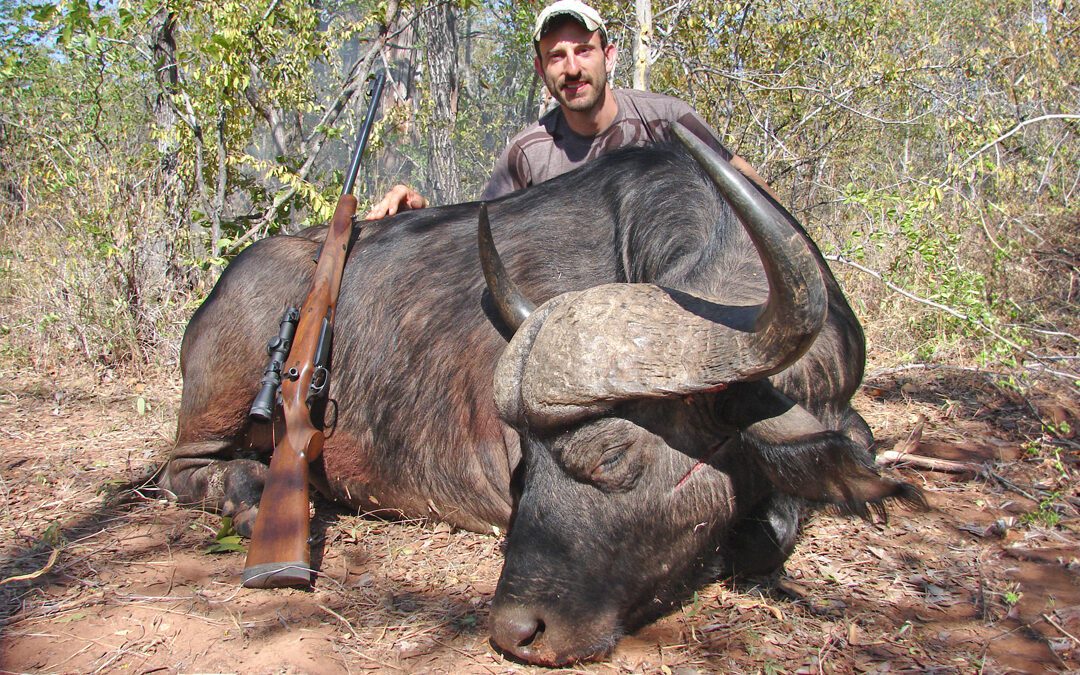
The author fulfills a life-long dream of hunting Cape buffalo in old Africa. When things do not go as planned, he finds himself following a wounded bull — and reconsiders his reasons for pursuing dangerous game.
At the shot, the Cape buffalo bull whirled from his bed and disappeared into the thick brush in only a few steps, taking his herd with him and leaving a cloud of dust in his wake. Soon the sound of the fleeing herd fizzled to nothing and the dust settled back to the earth in the windless air. The silence became deafening with each passing moment. Cape buffalo were well-known to let out a death bellow in their last breath. We heard nothing.
It was a terrible silence.
I put another cartridge in my 375 H&H Mag. bolt action, this one a 300-grain solid to replace the soft point that I had shot the buffalo with. I looked up at the hunting party. No one was smiling.
We found blood and began following it.
After 300 yards of blood but no dead buffalo, my professional hunter, Dalton Tink, motioned for us to stop on the blood trail. He pulled a pack of cigarettes out of his shirt pocket and took one out. He placed the skinny, tobacco-filled cylinder in his mouth, lit it, took a long drag and exhaled.
“This just got serious,” he said.
As a kid, I dreamt of hunting dangerous game in Africa, and the dream only ripened with age. Pursuing a job in public education was not conducive to the eventual fulfillment of that dream, however, but that is where I found myself as an adult. I started a side business, saved for years, and then decided I would hunt Cape buffalo.
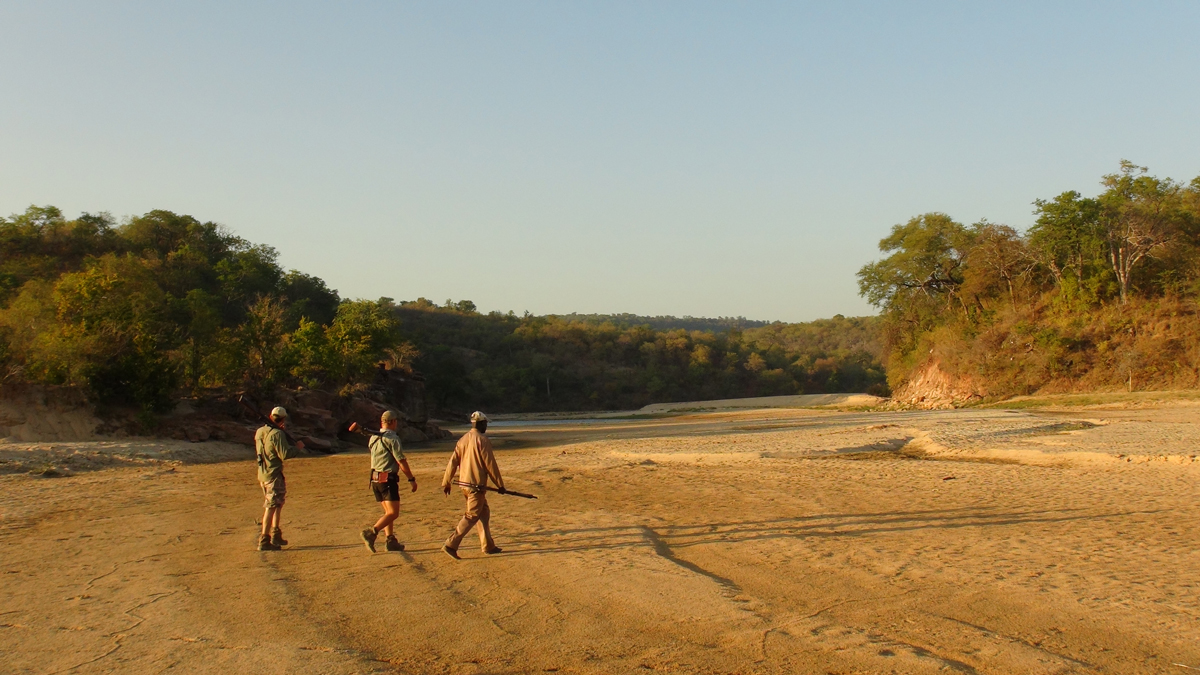
Tongai, Tink and Muckerman tracking buffalo in the morning sun in Zimbabwe’s Zambezi Valley.
It was important to me to hunt a free-range area where tracking was the method of pursuit. Although fair chase is possible on fenced game ranches and the buffalo are no less dangerous there once they get a bullet in the wrong spot, my dream was to hunt in a completely wild dangerous game area. I wanted to hunt the Africa time hadn’t touched where lions still roared, elephants roamed free and leopards stalked in the darkness. I wanted to hunt the old Africa.
I chose Martin Pieter’s Safaris and their 2.2-million-acre Omay CAMPFIRE concession in Zimbabwe’s Zambezi Valley. In the CAMPFIRE areas, trophy fees go directly to the community, incentivizing local support in conserving game numbers by giving game once seen as a serious nuisance to agriculture and livestock direct value to the community. Rural citizens of the Omay have schools, medical clinics and wells, among other things, because of hunters’ dollars.
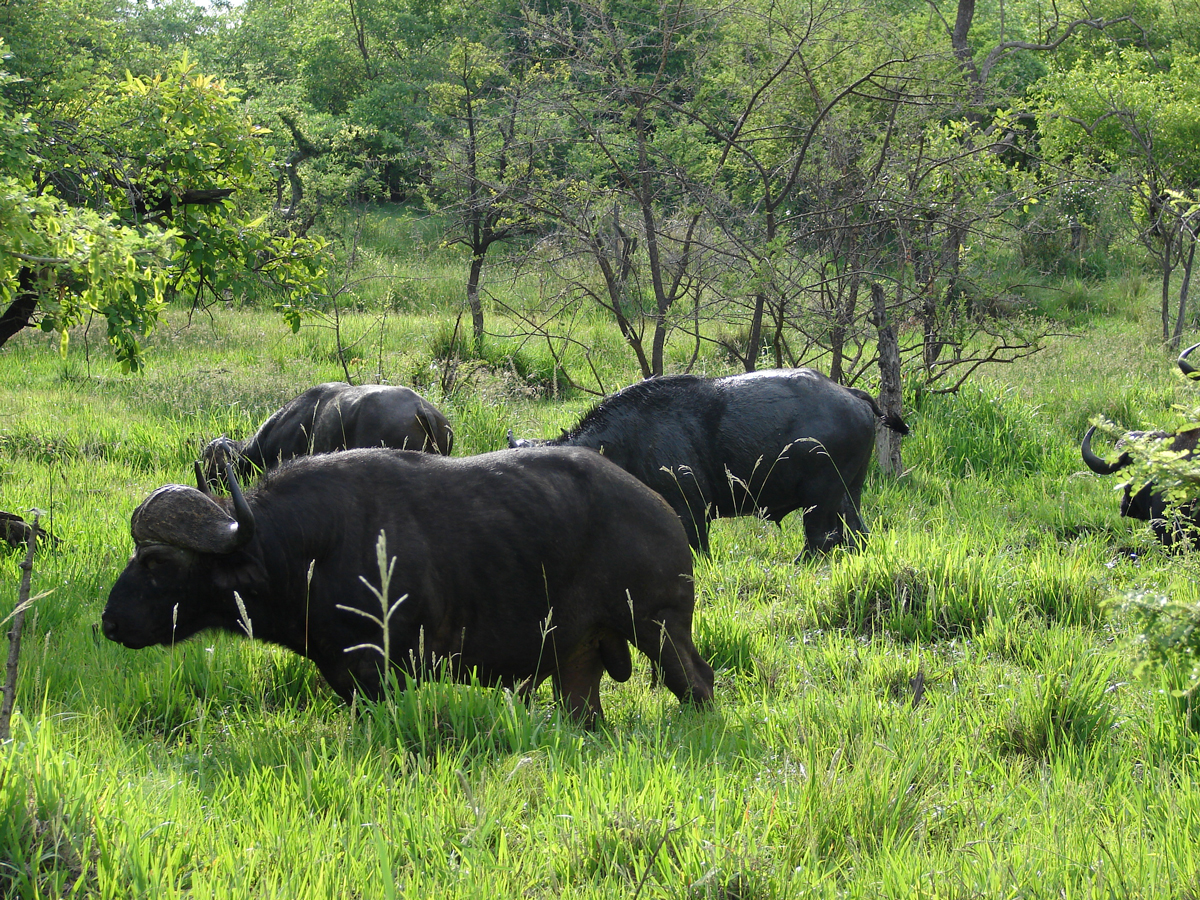
Years of fascination with Africa and her dangerous game had culminated into a thrilling moment.
The Zambezi Valley is not the quintessential African land seen in the nature shows on TV. Having spent a fair bit of time in East Africa’s wild places where many of those shows are filmed, I knew one could see game for miles, speckled dots of moving color against vast grasslands that stretched to the horizon with the occasional picturesque acacia tree mixed in. In the Zambezi Valley, you pretty much see whatever brush is in front of you and the tracks of game at your feet.
Despite not seeing buffalo around every corner, their tracks were there, and at the end of the tracks I knew there were Cape buffalo somewhere. This is where Tongai our tracker came in.
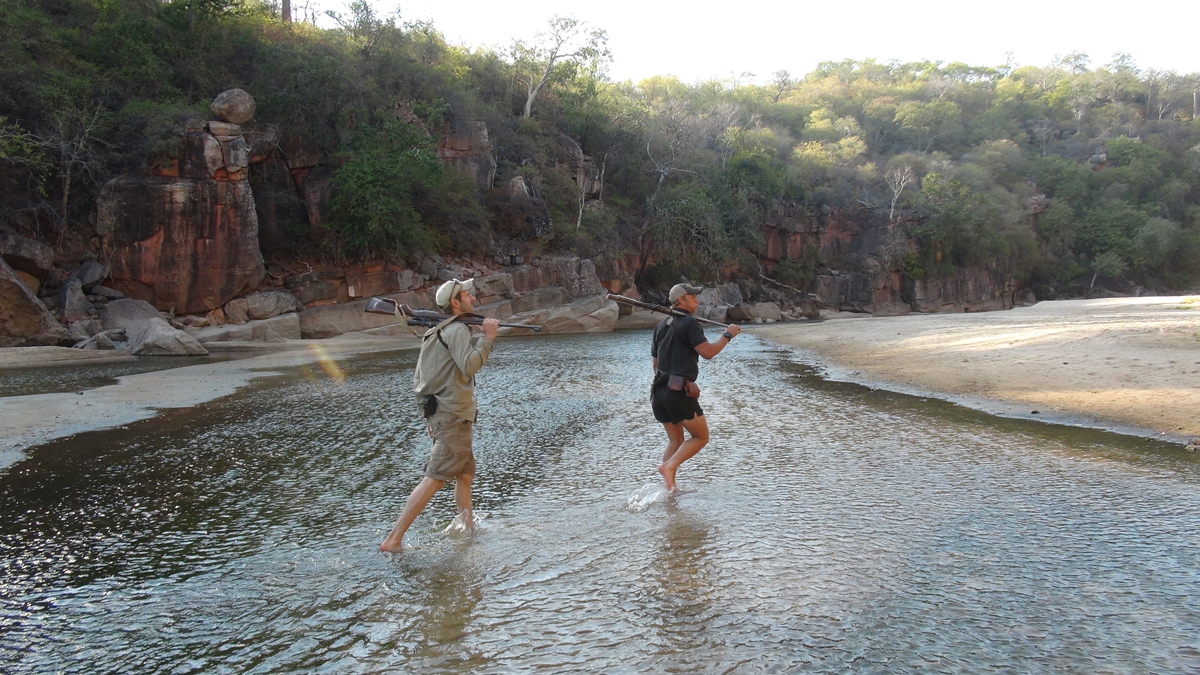
Lamech, Tonagi, Tink and Muckerman work through a creek bottom searching for buffalo tracks.
Tongai was in his late 20s and a few years younger than me. He grew up in rural Zimbabwe and could track a gnat through a rock-covered moonscape. He had a smile that would be the envy of any model who has ever been featured in a dentist office’s advertisement and, according to Dalton, he was a pretty handy sidekick while fighting and manhandling unruly poachers deep in the bush when the idea of “calling for back-up” is not an option.
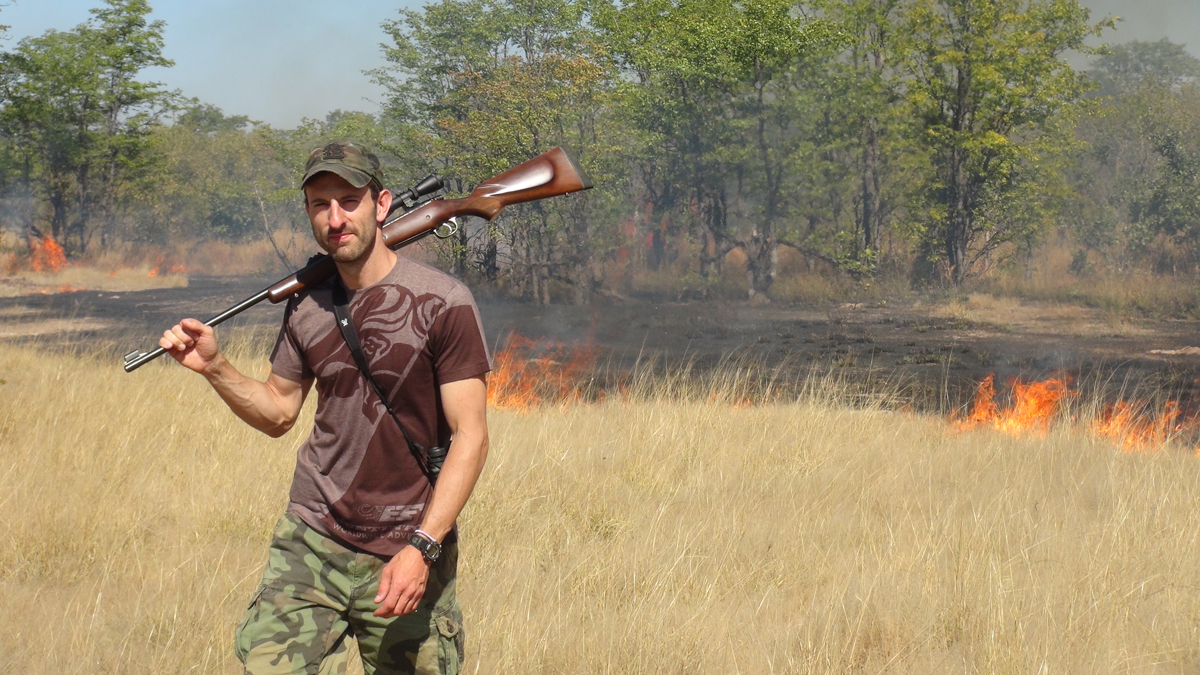
Knowing the benefits of fire to wildlife, Muckerman joined the fun and helped with the job of burning the excess undergrowth in an entire valley.
After five days of hunting and tracking and finally getting a shot at a hard-bossed, mature Cape buffalo bull, I knew how unbelievable his tracking skills were. However, on my first morning of the safari, after driving a couple hours in the dark to one of the remote corners of the Omay called the Dela Valley, I knew none of this.
Soon after it became light enough to shoot, I heard a tap on the roof. Our Land Cruiser slowed to a stop. As I got out, Tongai climbed down from his seat in the back of the truck and walked about 15 feet from the two-track we’d been driving and stared at the ground.
He and Dalton conferred in Shona. I didn’t understand a word, but I inferred the news must be good when Dalton told me to grab my rifle.
I fetched the rifle out of the truck, walked over and stood next to Tongai and stared at the ground curiously. It looked like grass and dirt to me. Tongai pointed and I looked where he pointed. It was still just grass and dirt, so I got down on my knees. He knelt and made a circle with the thumb and index finger of both hands and placed them over the ground. I looked in the circle but all I saw was more grass and dirt. He smiled and put his finger in the dirt. I finally saw it. The mark was maybe an inch by an inch, half-covered by a dead leaf, and it was where a Cape buffalo had lifted his foot walking forward and had left a slight indentation in the hard earth of where the pointed tips of his hooves came together.
He had somehow seen this from 15 feet away from the back of vehicle bouncing down a dirt two-track. I wondered how rare this skill set, or gift, really was.
Dalton explained the situation. “It is a single bull, and he’s big. Following a single bull is tough because there is only one track, but they are usually old bulls.”
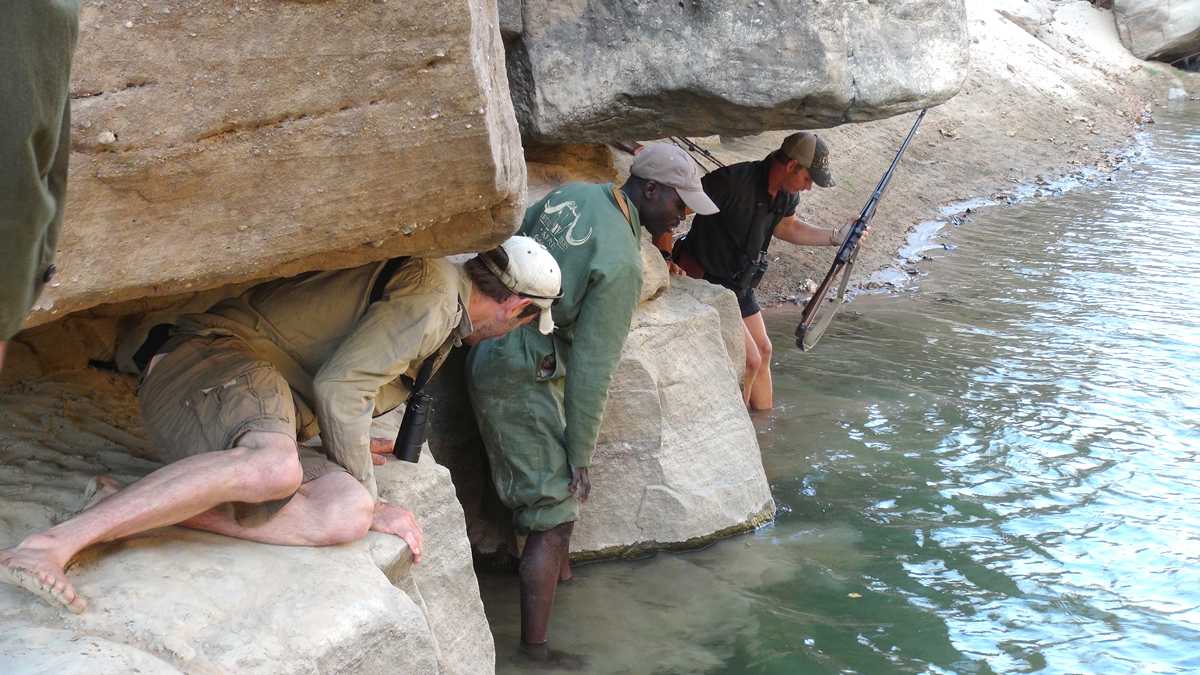
Hunting in old Africa presents unique challenges. Here, the team tries to move along a riverbank without getting eaten by a crocodile or crunched by a hippo from the depths below.
I spent the next nine hours following Tongai around. A couple of times I knew what he was looking at, like when a big clump of black buffalo hair was stuck to a thorn, or when he crossed a riverbed of soft mud where the tracks were so obvious a three-year-old could have deduced that a buffalo had been there.
We stopped when the wind was bad, or occasionally to drink or eat. Other than that, we walked all day until about an hour before shooting light ended, when Dalton radioed our driver our location, and he met us with the truck at the nearest two-track right at dark.
Once we reached camp, I was jetlagged and exhausted, but I smiled as I fell asleep to the sounds of hippos splashing in the river and the sadistic whoops of hyenas on the prowl.
We hunted the Dela Valley again the next day. We drove for a few hours looking for tracks, and after finding none we took off on foot through the heart of the roadless part of the valley searching for tracks. By midafternoon, we had made our way to the bottom of the valley and were surrounded by high yellow grass, but we had no buffalo tracks to follow.
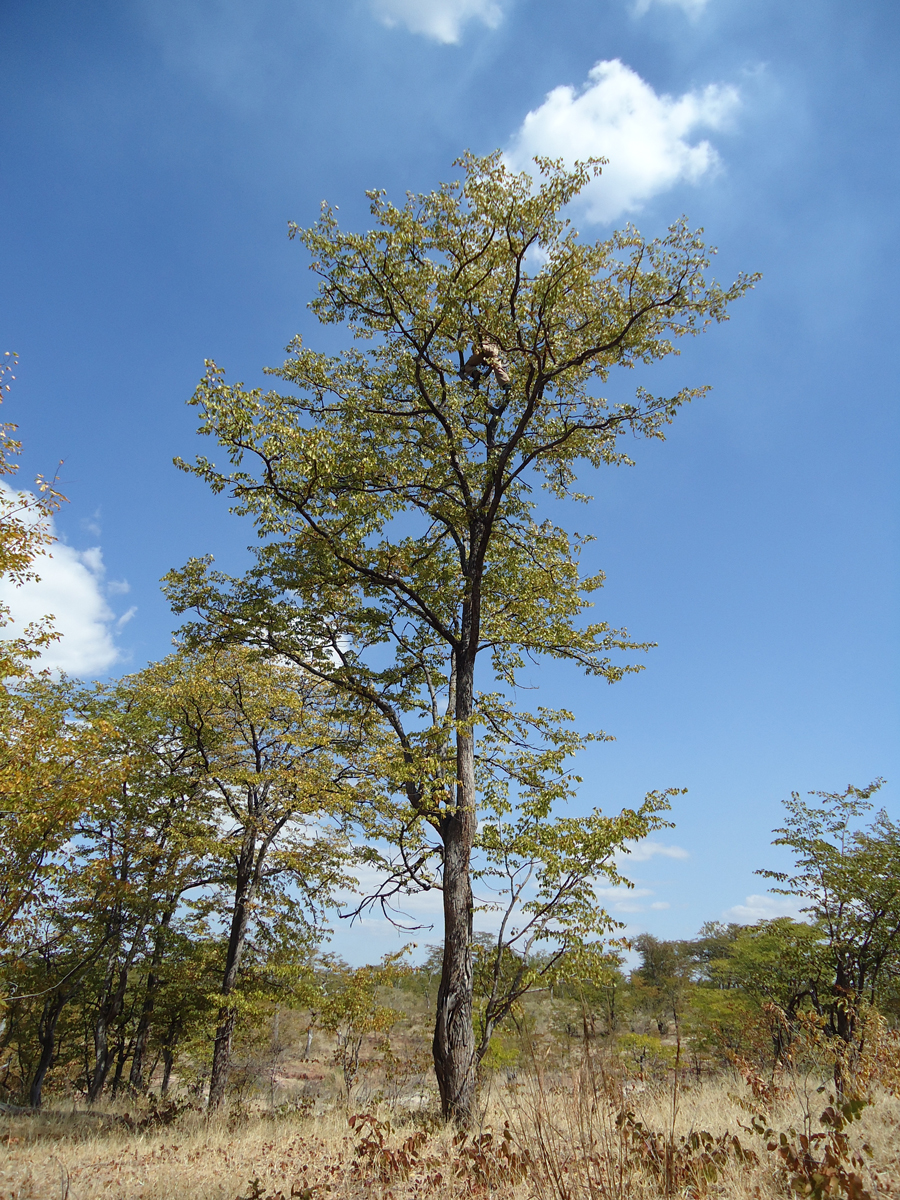
Tongai, the team’s tracker, searches for Cape buffalo from a lofty perch.
“This grass is really thick from the wet spring we had. We’ll burn it and hunt somewhere else tomorrow,” Dalton said. Then he and Tongai got out lighters, lit long chunks of dried grass in their hands, and used those to start lighting the valley on fire. Part of the allure of hunting far-away places is the surprises of just how different another place on Earth can be. Residing in the American West, I live in a state of constant vigilance of wildfire prevention, but in Africa, fires in wild places are viewed differently. Fires are used in Africa to promote new plant growth and enhance the potential of the land to support wildlife by preventing grassy areas from being taken over by less desirable plant species. Fires, natural and man-made, have always been a part of the African landscape. Dalton explained that in just a couple of weeks, new green and nutritious shoots of grass would appear through the ashes.
As an added bonus, making fires also happens to be very fun. I think all boys from a young age have some level of pyromaniac tendencies deep in their DNA.
I ripped a chunk of dried grass from the ground, lit it on fire from Dalton’s makeshift torch, and started helping. We lit the immediate area, walked a few hundred yards and then lit that area. Rinse and repeat for another hour and the whole valley was roaring. Then we left and drove to camp, arriving after dark.
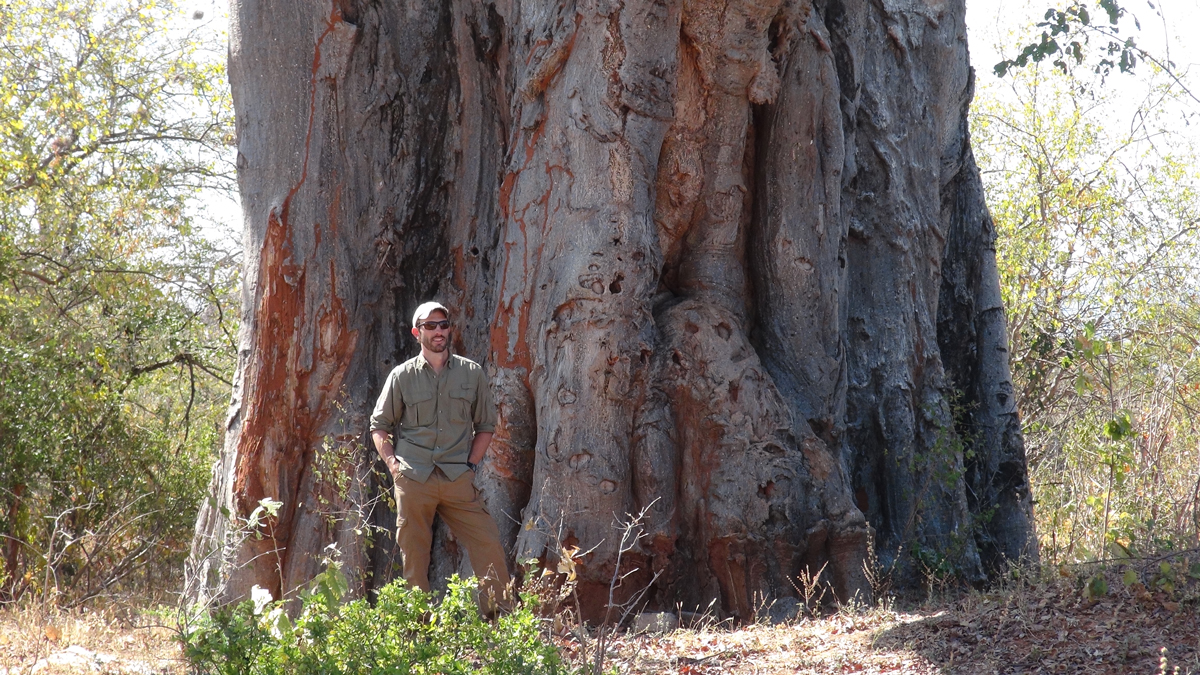
The author poses for a picture in front of an ancient baobab tree.
By the fifth day of hunting, I had yet to see camp in the daylight. We left before light, hunted all day, then came back after dark. I was savoring every moment, aware that when the challenge is great, so is the reward. The morning I shot my buffalo we were again looking for tracks when the truck slowed down. Dalton had to navigate through some rocks in the road, and when the sound of the truck was reduced from slowing down, I heard muted but intense whispers coming from the three guys sitting in the back of the truck. I couldn’t tell what the subject was, but the tracker, game scout and apprentice PH were all arguing about something and neither side was giving an inch.
We continued on and within a few more miles we stopped somewhere in the middle of nowhere that Dalton had decided would be a good place to walk in hopes of finding buffalo tracks to follow.
The guys in the back of the truck were still arguing. I stepped out and asked what the debate was. I was again hit by one of those surprises from hunting in a different culture.
Thomas, Dalton’s apprentice PH, started to say something but was interrupted by Lamech, the Zimbabwean game scout. “Deez crazy man here, Toemaz, he theenkz a man haz flown to de moon in an earpleen, den walk on de moon, and den fly home.”
“It has happened a few times, actually. It wasn’t a plane, either, it was a space shuttle,” Thomas said.
Lamech looked at Thomas and shook his finger side-to-side in front of his face and said, “No, no, no, no! No man een some spaze sheep haz flown to de moon!”
I had somehow stumbled between two worlds.
The three men looked at me to weigh in. Thomas just wanted the debate to end, pleading with his eyes for me to share the good news that mankind had indeed sent a few representatives to the moon. Tongai was more reserved and did not let his thoughts known. Lamech was sure of his position that there was no way on God’s green earth that some guy had flown to the moon and walked around. Somehow I had become the grand arbiter of all things space travel.
I looked up at the moon, a white circle cut in half in the sky above. I took a deep breath, squinted and cocked my head slightly sideways contemplatively, as if I was trying to pick out footprints on the moon from where I stood. “I don’t know guys,” I said, “it sure looks really far away.” Thomas shook his head while Lamech climbed out of the truck smiling in victory. Behind me, I heard Dalton chuckle at my antics as he pushed cartridges into the magazine of his 458 Lott.
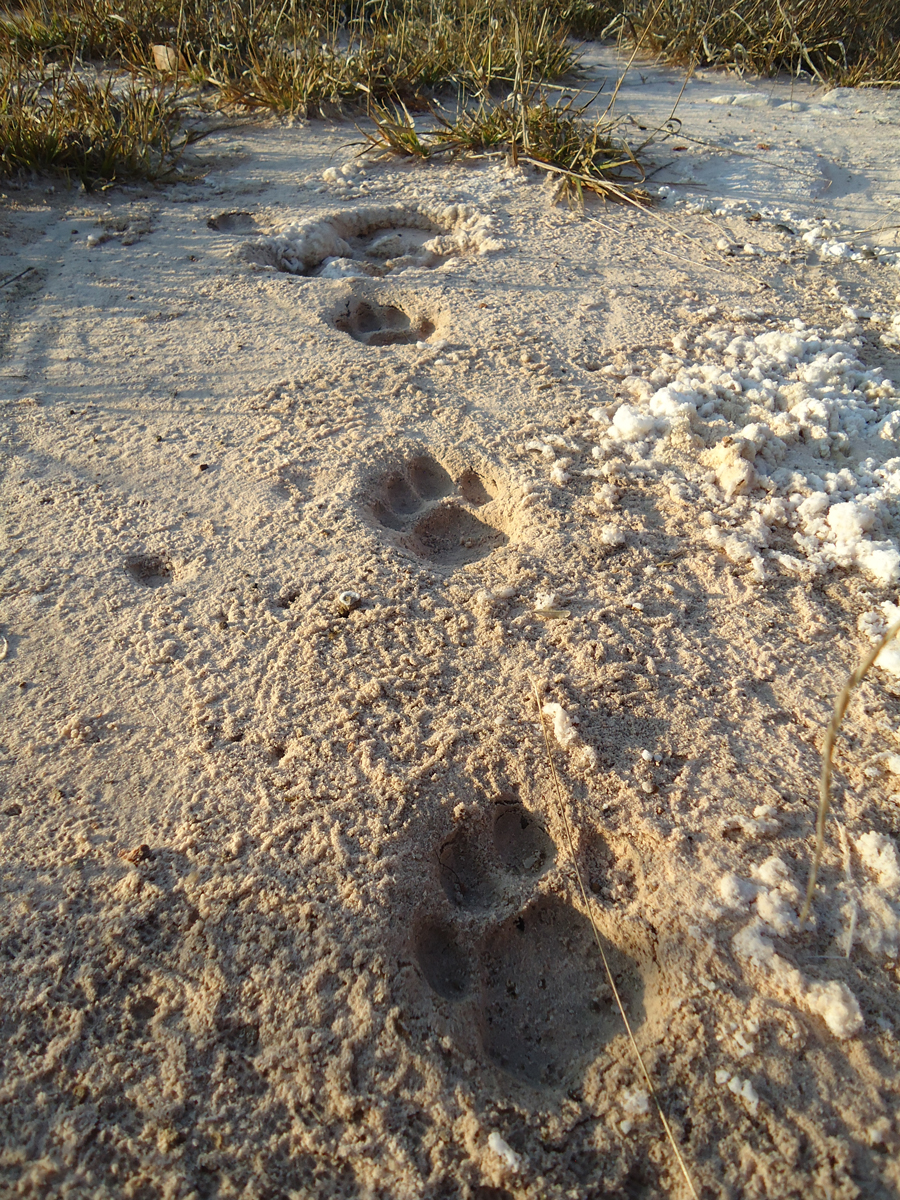
Here, a leopard has crossed through the soft sand of a riverbed.
The moon landing was likely not a topic of conversation under thatched-roof huts with mud walls, and I am pretty sure Lamech wouldn’t have believed me anyways had I told him the truth. Knowledge and skills are relative. I knew plenty of people well-aware of the history of space travel. I knew very few men who had followed up gut-shot leopards in the darkness with nothing but a flashlight in their hand. I also did not know many men who had stood by while an angry elephant or buffalo charged their group hoping the PH in front of them could brain it before it turned everyone to mush. Lamech, a government game scout and former tracker, and Tongai, however, were on that short list, so I had more respect for them than the vast majority of people I have met despite their lack of knowledge of space travel, a subject that meant nothing to them and had zero influence on their lives.
We left the truck and soon we found night-old tracks of a herd of buffalo. Like the days before, we tracked slowly through the mopane forests, ever vigilant for Cape buffalo to be bedded somewhere ahead. Hours passed, and I knew we had to be getting close. I could feel the intensity from Dalton and Tongai, and the dung looked like it had hit the ground just a few minutes prior. Then, for reasons unbeknownst to me, Tongai picked up an old, dried piece of elephant dung and everybody stopped and sat down.
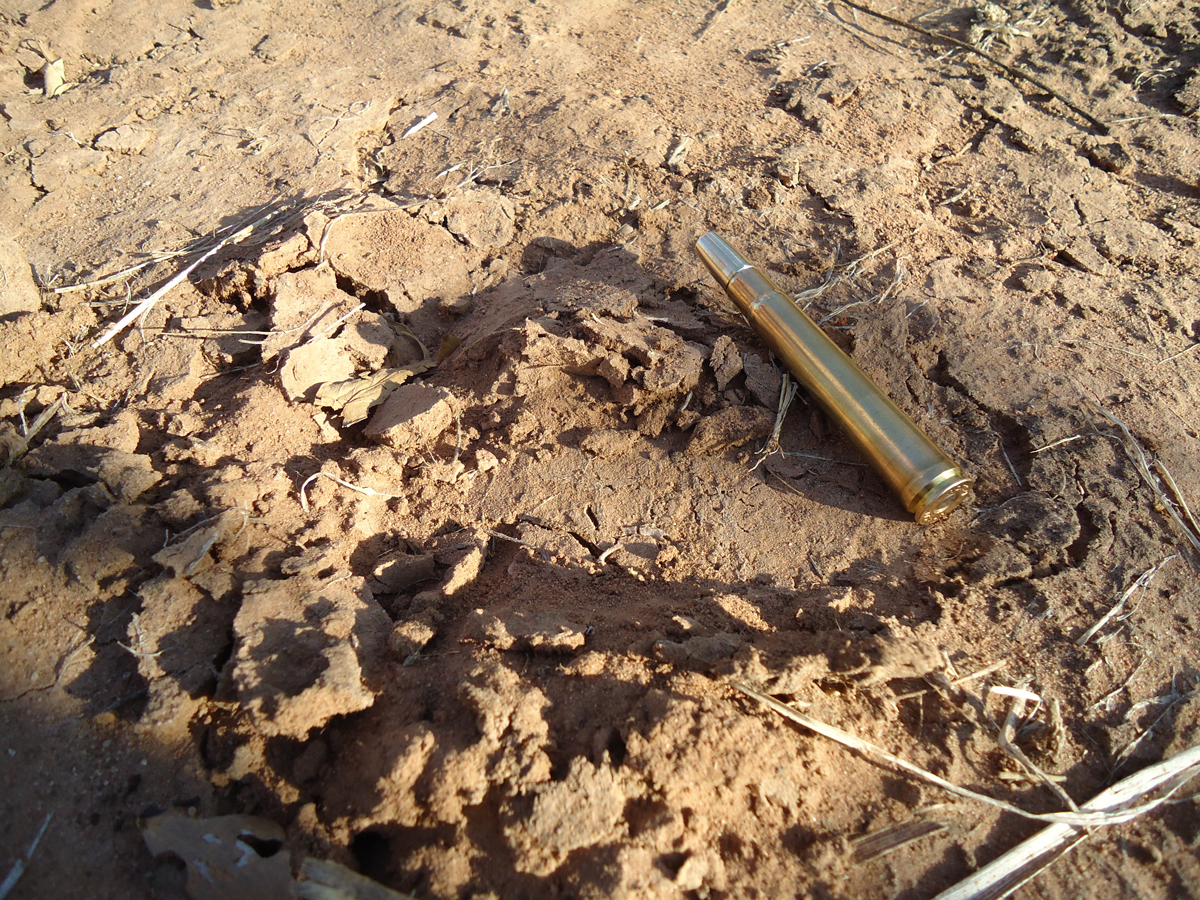
A 375 H&H Mag. 300-grain solid in a Cape buffalo track. The other 99 percent of the tracks weren’t so obvious.
I wasn’t sure what was happening and became a lot more confused when Dalton took the dried feces and lit it on fire. Apparently, Zimbabweans are really keen on lighting fires, and I figured it was some esoteric religious ceremony that I had never read about. I just sat cross-legged and watched respectfully as it played out thinking that perhaps the timing of whatever was happening was inopportune considering that we seemed to be closing in on the herd.
Once the elephant biscuit was thoroughly cooked and nothing but black ashes. Tongai picked up a pinch and put it on a rock while Dalton took another rock and ground it down to a fine powder.
Then Tongai scooped it into the little plastic bottle he had been using to check the wind, puffed some of the concoction into the air and it slowly blew behind us letting us know the wind was still in our favor. It wasn’t a sacred ceremony. He was just making wind powder on the fly.
“He likes the mopane ashes from camp, but he ran out so this will have to do,” Dalton said while picking up his rifle. We kept tracking.
Only a few hundred yards later I spotted a clump of black 30 yards ahead at the same time as Dalton and Tongai. We all went down to a knee in unison.
Dalton put his binoculars up.
“He’s a hard-bossed bull,” he said. “Smoke him.”
The bull was in some thick brush and slightly quartering away. Through the vegetation, I could make out his shoulder crease just as he started to turn his head toward us, aware something was up. The recoil jolted me back, then there was a cloud of dust and that terrible silence, followed by tracking a small amount of frothy lung blood long enough to know that the buffalo was still alive.
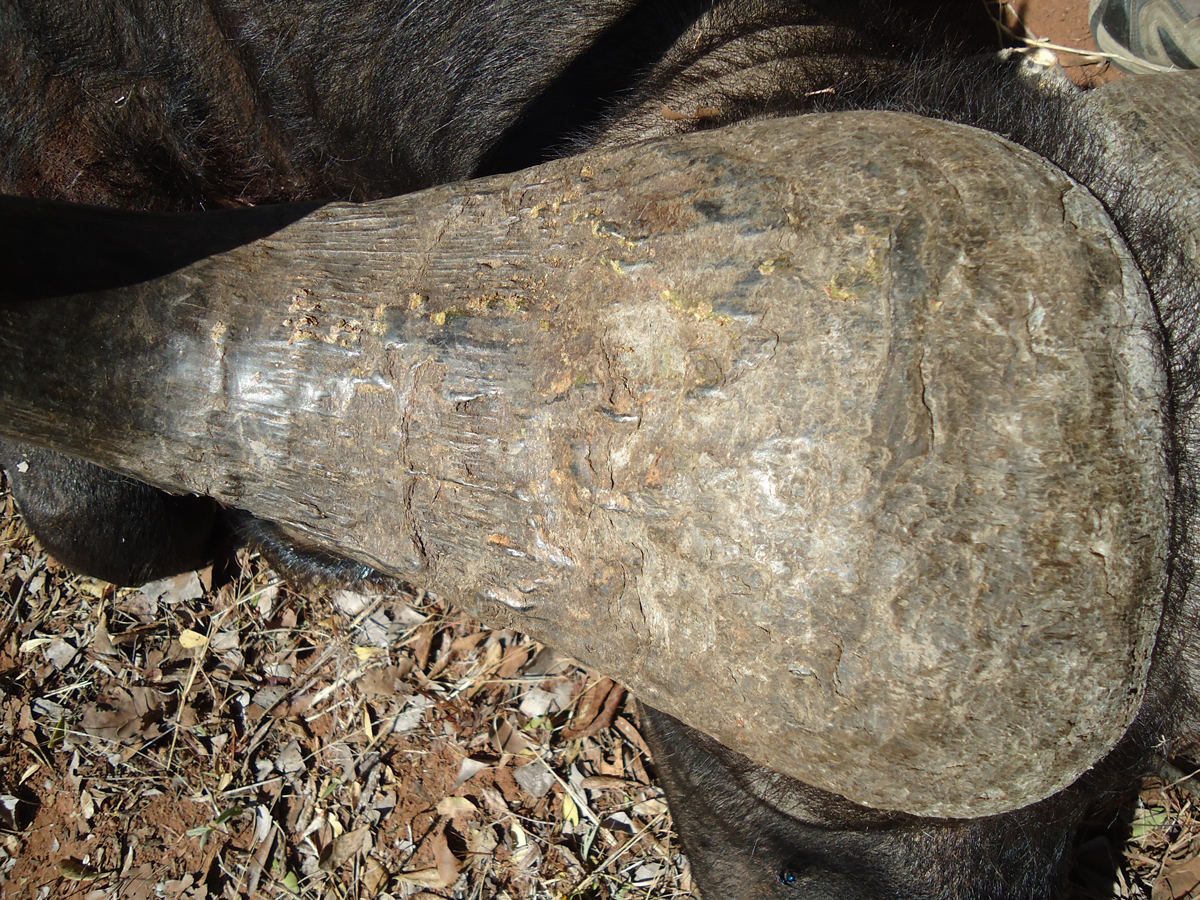
When Dalton told me things had gotten serious, I was more than aware of the fact.
We pushed on and kept tracking.
The physical part of tracking was not a challenge, but the mental strain and fatigue of constantly being ready to shoot something that might try to kill us was something that my adrenaline was trying to fight off.
It seemed the bull had moved through the thickest vegetation it could find, and it was evident that Dalton and I would only have an opportunity for one shot in most places if he decided to charge, and that was if we were lucky.
After a mile of tracking, I began thinking of what had happened. I thought of the angle, and wondered if it was too sharp, or if a deflection had occurred. I cut the thoughts short, and my entire mind frame changed. None of it mattered. It did not change the facts nor what we had to do. The buffalo was alive and out there somewhere.
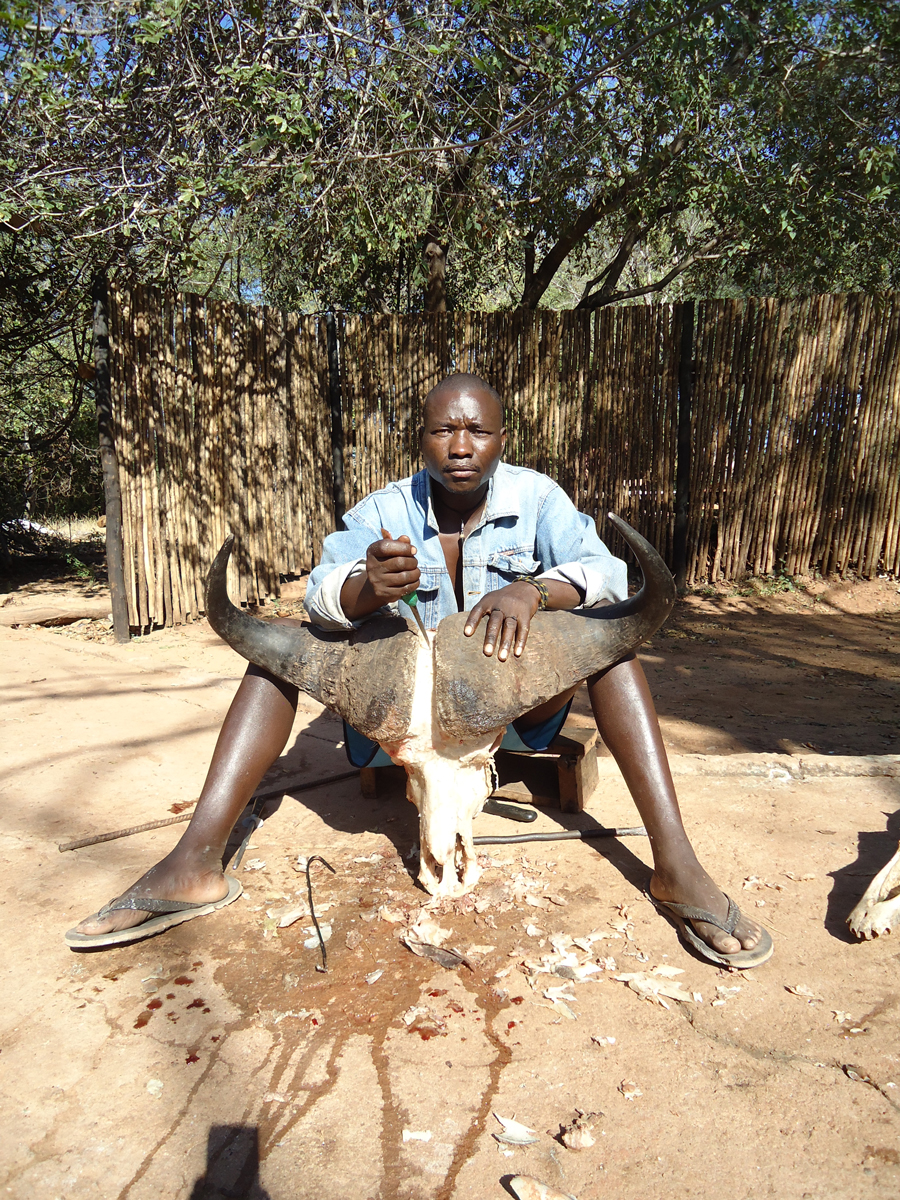
Thoughts bounced around in my head as I put one foot in front of the other, slowly, and scanned the area ahead of me, fearful and tense, wondering what I had gotten myself into. What was the point of hunting dangerous game without the possibility of danger? Wasn’t it this situation that had intrigued me to hunt Cape buffalo in the first place? Did I grow up fascinated with the stories of guys shooting buffalo, watching them drop dead and then getting a picture? No. It was the other stories. The ones where things didn’t go as planned. The ones when that sliver of potential danger became real danger, when the buffalo showed they weren’t the forgiving type.
No hunter wishes for anything other than a quick and clean kill, but that didn’t change anything. I was living my dream and decided to ride the rush of the unknown danger, a 1,500-pound piece of black fur, muscle and horn somewhere ahead, knowing there were very few precious moments in life where I had felt so alive.
I smiled a stupid grin.
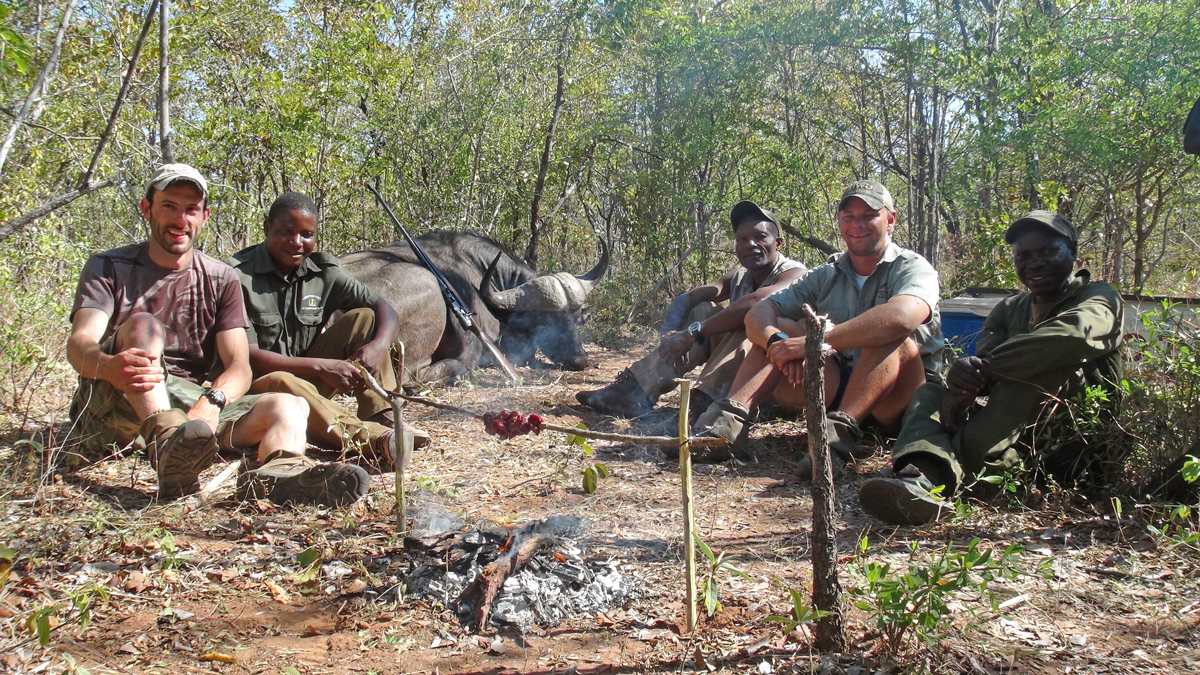
The author brought spices from home to enjoy some fresh buffalo meat at the kill site. Success never tasted so good.
I thought of a million things leading up to what had brought me here. I remembered being a little kid with a globe in my hand and a dream in my heart of crossing the vast blue to the giant and mysterious continent of Africa to hunt the iconic game species. What others saw as grim; I saw as inviting. While others dreamt of the perfect job and a big house, I just wanted to be sweaty, dirty and tired somewhere deep in wild Africa with a rifle in my hand.
Years of fascination with Africa and her dangerous game had culminated into a thrilling moment that was cloaked in a savage and beautiful simplicity: We get him, or he gets us.
I took another step and the brush exploded with black 10 yards ahead of me. My gun went to my shoulder instinctively as my mind computed that the black mass was fleeing rather than coming. At 20 yards, the bull stopped, turned broadside and peered down his blood-soaked nose at me. My front sight found shoulder and my .375 barked. A half a second later, to my left, Dalton’s .458 went off and dust flew off the bull’s shoulder as he stumbled for footing and then righted himself. Then I aimed for his brain and my 300-grain Norma solid found it. The bull collapsed.
It was silent again, but it was a good silence.