
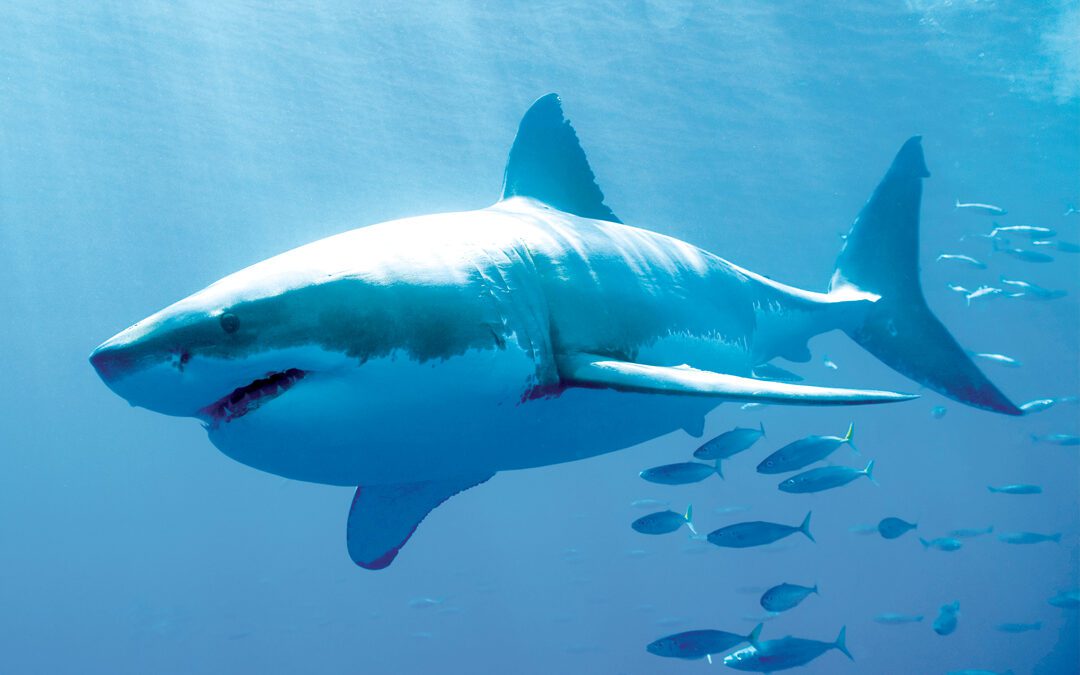
Somewhere off the coast of Florida right now, a mako is doing to a sailfish what a wood chipper does to a Christmas tree, and someone in the boat is filming it in vertical video for maximum emotional impact. This has become a genre unto itself. Scroll for ten minutes and you’ll see a mahi reduced to a lower jaw, a tuna evaporate into a gray blur, a king mackerel become, in the space of one Instagram Reel, simply “head.” The caption is always some version of “got sharked again,” and the comments section underneath functions like a support group for people who just lost their dinner and their tackle budget in the same five seconds.
This is not a fluke of a bad week offshore. It’s not bad luck, or a weird current, or one aggressive shark having a rough month. It is the sound of a conservation program working so well that it has quietly turned into its own emergency, and Congress, bless it, has responded in the way Congress responds to almost everything now — with a task force.
That task force is the SHARKED Act, official title the Supporting the Health of Aquatic systems through Research, Knowledge and Enhanced Dialogue Act, an acronym so clearly built backward from the punchline that you have to admire the commitment. Passed by the House, stalled in the Senate, it would direct NOAA to convene experts to study why sharks keep eating anglers’ catch before the catch ever reaches the boat, and to look into deterrents, habituation patterns, and better coordination between fishery managers and the fishing public.
All of that sounds reasonable enough on paper. Where it falls apart a little is that the bill’s own supporters keep explaining the cause in the very same sentence where they describe the problem: shark depredation, they say, is a growing challenge driven by recovering shark populations, rising angler activity, and sharks learning that fishing boats mean easy meals. Read that sentence again slowly. It is, in essence, an admission dressed up as a discovery.
In other words, we spent fifty years successfully rebuilding shark stocks under federal fishery law, and the reward for that success is a task force to figure out what to do about all the sharks. That’s not a criticism of the rebuilding effort, which by any honest measure worked. It’s a criticism of what came after the success — or rather, of nothing coming after it.
Nobody in the bill text asks the obvious next question, which is: what if the sharks are not confused, and they are not misbehaving, but simply present in the numbers we told them to be present in, doing exactly what apex predators do when there’s an easy meal attached to a fishing line? What if the actual missing ingredient here is not a seminar, but a modern harvest plan?
Six hundred miles northwest, the same play is running with fur instead of fins, and it’s been running longer. The California sea lion population on the West Coast has grown from fewer than 75,000 animals to an estimated 257,000 over the last thirty years. Any wildlife manager would call that an unambiguous recovery. Any Puget Sound steelhead, if it could file paperwork, would call it an eviction notice.
At Seattle’s Ballard Locks, California sea lions spent the 1980s and ’90s picking off Lake Washington’s winter steelhead run despite years of hazing and relocation efforts that, in hindsight, mostly just moved the problem around rather than solving it. Today that run sits at critically low numbers with no realistic expectation of recovery — a fish population wiped out not by a dam, not by pollution, not by decades of overfishing, but by a healthy, thriving population of a fully protected predator doing precisely what healthy predators do when nobody’s allowed to stop them.
Congress has noticed enough, at least occasionally, to act. In 2018, lawmakers amended the Marine Mammal Protection Act to allow more sea lions to be killed in a stretch of the Columbia River, and by the mid-2020s managers had permanently removed roughly 380 California and Steller sea lions there. It was a narrow fix for a narrow stretch of river, and it required an act of Congress to get even that far.
Then a member of Congress from southwest Washington went looking for broader authority, and in the process described the underlying statute about as bluntly as a sitting legislator ever describes anything. The Marine Mammal Protection Act, in this telling, is an outdated law that sets a blanket protection on all marine mammals — meaning that even a species which has fully recovered, and which by any practical definition has become invasive in places, still cannot be taken except under extreme circumstances.
That’s worth sitting with for a second. That is not an activist talking, and it’s not some fringe hunting lobby talking either. That is the government’s own plain-language description of its own statute, applied to a species whose population has more than tripled since the law protecting it took effect. It is, functionally, a confession that the law hasn’t kept up with the animal it was written to protect.
There is no population ceiling written into the Marine Mammal Protection Act. There’s no sunset clause, no built-in moment where “recovered” quietly flips over into “manage it like every other wildlife population in America.” Deer get hunting seasons calibrated to how many deer there are. Elk, turkey, and duck all get the same treatment — seasons that expand and contract with the population count. Sea lions get permanent immunity plus a strongly worded position paper every decade or so.
You don’t actually need a piece of federal legislation to see the same pattern play out at ground level; you can just go look at it yourself. Walk the edge of any decent upland bird field in pheasant or quail country and count the raptors sitting in the fencerows and cottonwoods, patiently watching your dog do the flushing work for them. Red-tails, Cooper’s hawks, great horned owls — sometimes three species stacked in adjoining trees like a hiring committee that’s already made up its mind before the interview starts.
Every one of those birds has been federally protected without interruption since 1918, and nobody has run a population cap on any of them in the century since. That’s because the Migratory Bird Treaty Act, like the Marine Mammal Protection Act, was built to stop extermination, not to manage abundance. Those are two very different jobs, and the law was only ever designed to do the first one.
That was the right call in 1918. It was still the right call in 1972, when a lot of this framework got its modern teeth. It stops being the right call as a permanent, unexamined default once the numbers actually come back — and in a lot of these populations, by the government’s own numbers, they clearly have.
None of this is an argument for open season on sharks, sea lions, or hawks. Actual apex predators do real, measurable ecological work, and nobody sane wants to relitigate the DDT era or pretend that era’s lessons don’t still matter. This isn’t a call to tear the whole framework down.
It’s an argument that “follow the science” has to mean following the science in both directions — including the direction where the population graph points up, not just the direction where it points down and everyone agrees something must be done. We built protections with no expiration date for animals we assumed would always be scarce. Several of those animals stopped being scarce decades ago, and the management framework never got updated to notice, because updating it was never built into the design.
A law that can only ratchet in one direction isn’t science, no matter how much scientific language gets used to defend it. It’s a monument — and monuments, unlike wildlife populations, don’t need managing. They just need to be left alone, which is exactly what’s happening, year after year, while the steelhead run disappears and the mahi keep coming up as heads.