
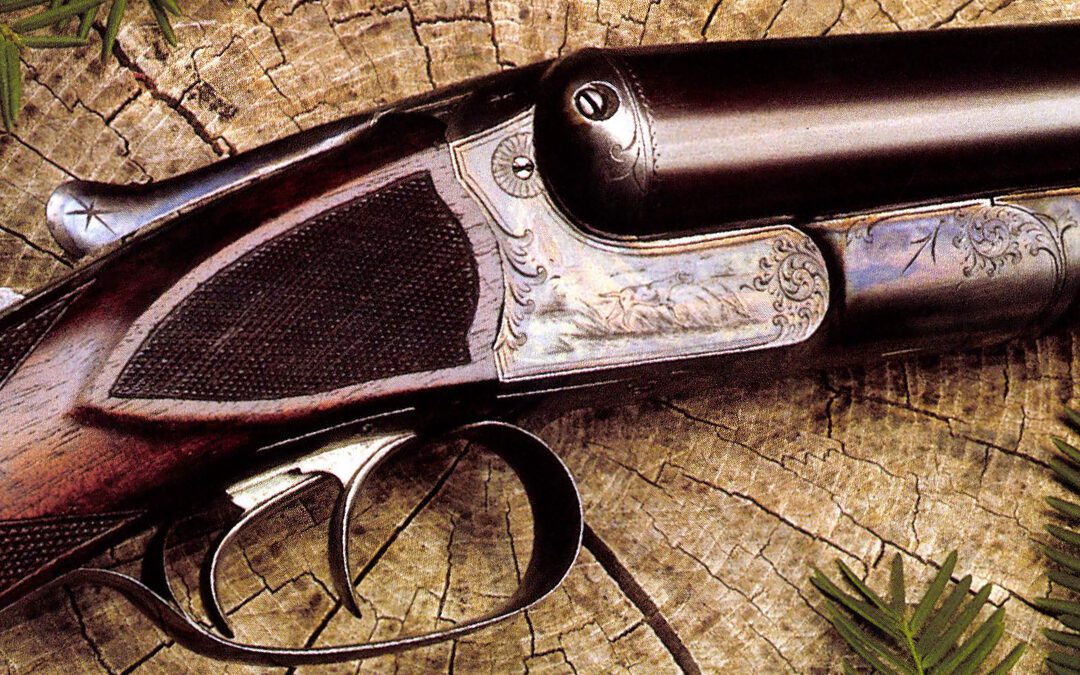
Not many American guns are more thoughtfully designed nor better built than Uncle Dan’s New Lefever.
Dan Lefever had a knack, if you want to call it that, for getting crossways with business partners. In a career that spanned fifty years, he invented some of the cleverest concepts ever applied in American gunmaking and left behind almost as many failed partnerships – with James Ellis, Francis Dangerfield, Lorenzo Barber, Mr. Nichols, the Durstons, the Howletts, and in the end, his own sons.
The Durston and Howlett families were principal investors in Lefever Arms Company, incorporated in June 1884 at Syracuse, New York, to manufacture the Lefever Automatic Hammerless. It was the first truly successful hammerless American gun and the one for which Dan Lefever is best remembered. The partnership was his most enduring as well, but like all the rest, it eventually came apart. Dan Lefever left Lefever Arms in 1901 and with three of his five sons — Charles, Frank and George – started D.M. Lefever & Sons.
They might as well have called it Three Chips & The Block, because they spent the first four months arguing about how the company should be structured and built no guns under the original style. Actual production didn’t get underway until March 1902, when they brought in Samuel Hale as business manager of the newly styled D.M. Lefever, Sons & Company.
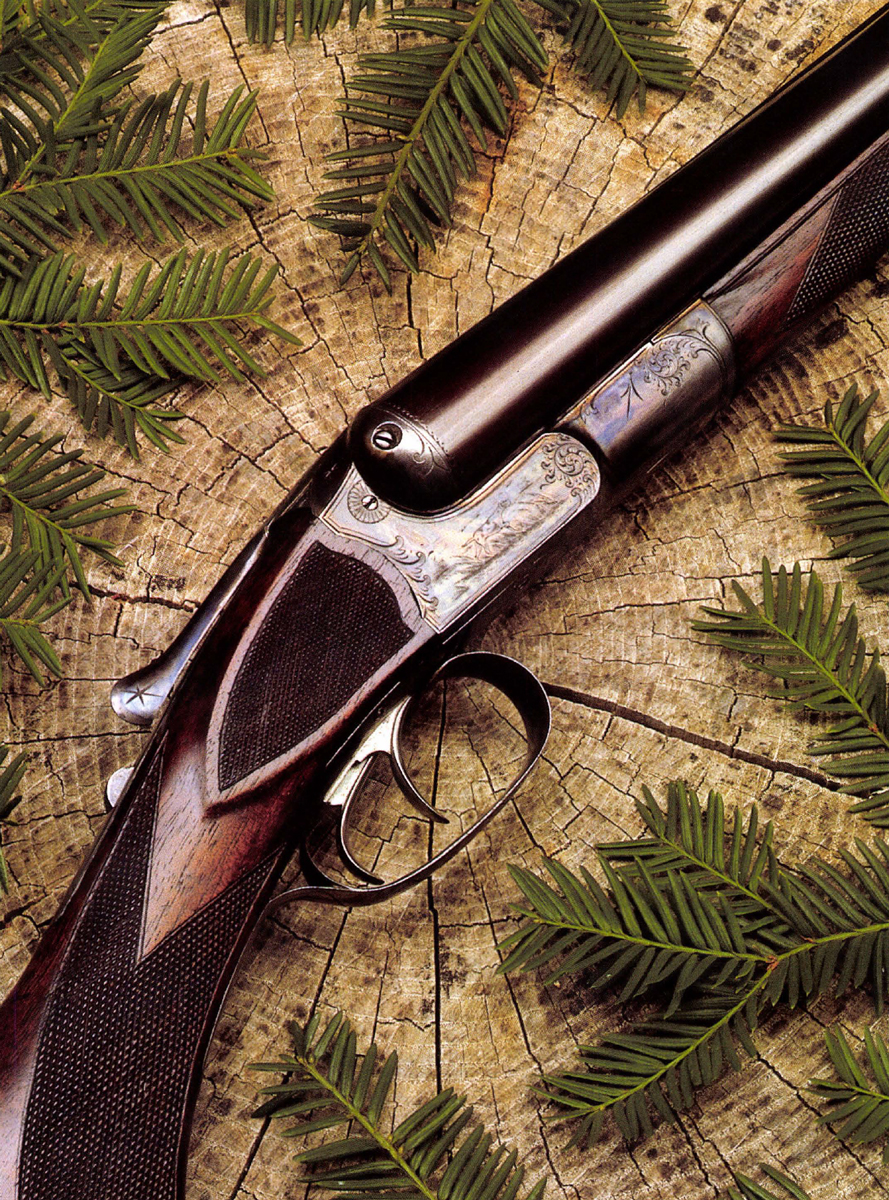
But what a gun they finally built. They called it the New Lefever. Despite a catalogue claim of being “purely an American invention… with no foreign ideas attached,” it’s a boxlock on the Anson & Deeley principle with a Greener-type crossbolt top fastener. Even so, the cocking system is based on the design Lefever invented for the Automatic Hammerless, and he added a second bite to Greener’s rib extension, so while “foreign ideas” are by no means absent, there’s also a lot of pure Dan Lefever in it as well.
The action joint, for instance, which in the New Lefever is the same ball-and-socket arrangement as the Automatic Hammerless. And adjustability: In the Automatic Hammerless, virtually every mechanical sub-system liable to wear is designed to be compensated by the turn of a screw, and this is true of the New Lefever as well. The screw you see in the right-hand fence, for example, regulates the depth to which the crossbolt seats in the rib extension.
The cocking hook performs five separate functions. It cocks the locks and ejectors, serves as a primary extractor and extractor stop, and cushions the action joint. The sears are adjustable for weight of pull down to two pounds. Ejectors can be converted to extractors by turning an adjusting screw. The safety is a roller rather than a conventional sliding thumbpiece.
In 1902 the New Lefever was available in seven grades, from 8E (the one you see here) at $75 to Uncle Dan Grade at $400. It could be 10, 12, 16 or 20 gauge, barreled with Damascus or Knipp fluid steel, and stocked straight, half-hand or pistol-grip. Ejectors were standard, single trigger optional.
Besides the typical Anson & Deeley approach of fastening lockwork to the frame, the Lefevers also built a version with lock parts attached to the trigger plate, like the German Blitz and the Dickson round-action. The gun pictured here is one: note the absence of pivot-pins in the frame. Curiously, the Lefevers apparently made little or no mention of this in their advertising. In 1904 investors in Defiance, Ohio, offered the Lefevers operating capital and a two-story factory building. The company, which by then consisted of Dan Lefever and his son George, moved west and was operating by November. In August 1905 they moved again, to Bowling Green, Ohio, lured by yet another industrial-development pitch. The style became D.M. Lefever Company.
Dan Lefever retired in April 1906, seventy years old and in failing health. He and George moved back to Syracuse, leaving the company in the hands of its investors. Uncle Dan died six months later, on October 29.
Upon the Lefevers’ departure, production came to a virtual standstill, and the company closed down in 1908, despite claims in the press of an intense demand for New Lefever guns. In fact, there was no demand. Uncle Dan’s last gun made few waves when it appeared and left scarcely a ripple when it went under. Although no records remain of production figures, the number of New Lefevers surely didn’t amount to more than 1,200.
And that for certain is a pity, because not many American guns are more thoughtfully designed nor better built than the one that was Uncle Dan’s last hurrah.
Note: This article appeared in the 2000 September/October issue of Sporting Classics magazine and was published in the book Gamefield Classics.