
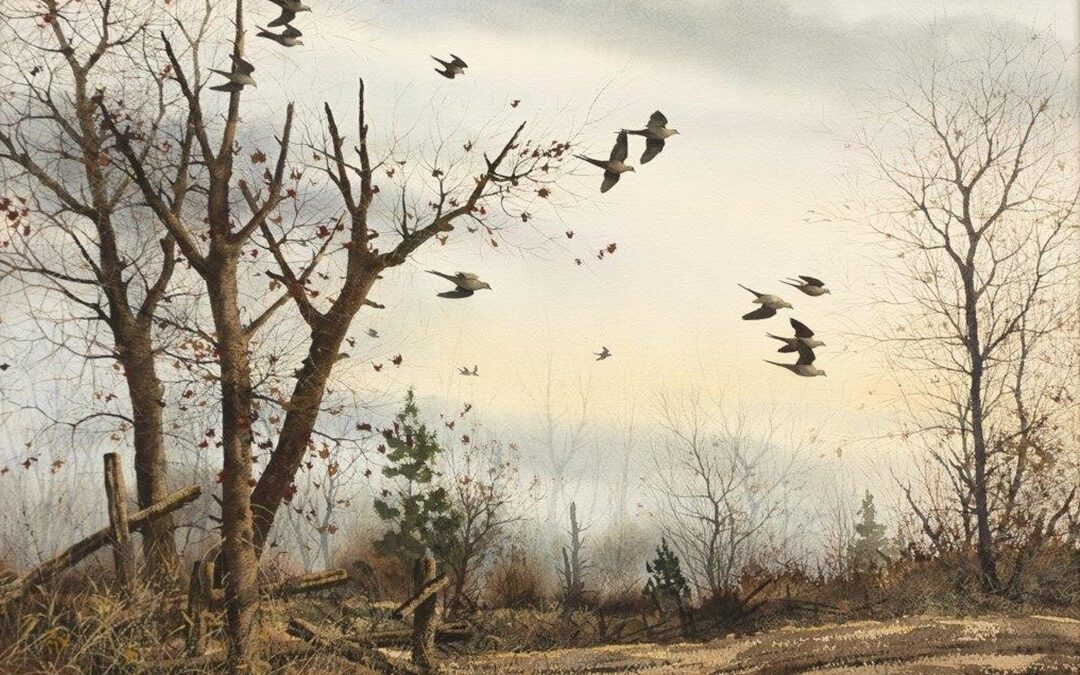
A feral Texas childhood means you never forget a hard-running pack of hounds.
Sitting here listening to music by Guy Clark, almost every song reminds me of my youth. Growing up in Callahan County Texas was not necessarily unique, but it was exciting for a very fortunate young boy. I recall bouncing up and down along a rough pasture road in that old late 1940s, or early ‘50s GMC pickup, but cannot recall the exact year as I was about 4 years old. My uncle William and I were headed to Bill Gaylord’s cabin.
Bill was one of my uncle’s friends who lived alone with his dogs in a cabin on Deep Creek in Callahan County, a few miles up the creek from where my Mother was born in a log cabin in 1913. Bill lived without electricity, as did many folks back then, and cooked on a wood burning stove, while his cabin was lit by smokey kerosine lanterns and lamps There was no fireplace, so the wood stove heated the shack on cold winter nights, and open windows and doors provided usually insignificant cooling during the hot Texas summer. Folks back then said that Texas had four seasons; hot, real hot, damn hot; and deer season.
During the early 1950s, another home my family visited was that of El Mauldin and his wife who lived in a house ten miles north of Baird, which had no electricity. Ironically their house was located a mile or so from the Dyer ranch headquarters, which had electricity. Years later, when I was teaching university classes my students did not believe me when I told them I could recall at least three houses I visited which did not have electricity; it did not reach many rural areas until the late 1950s.
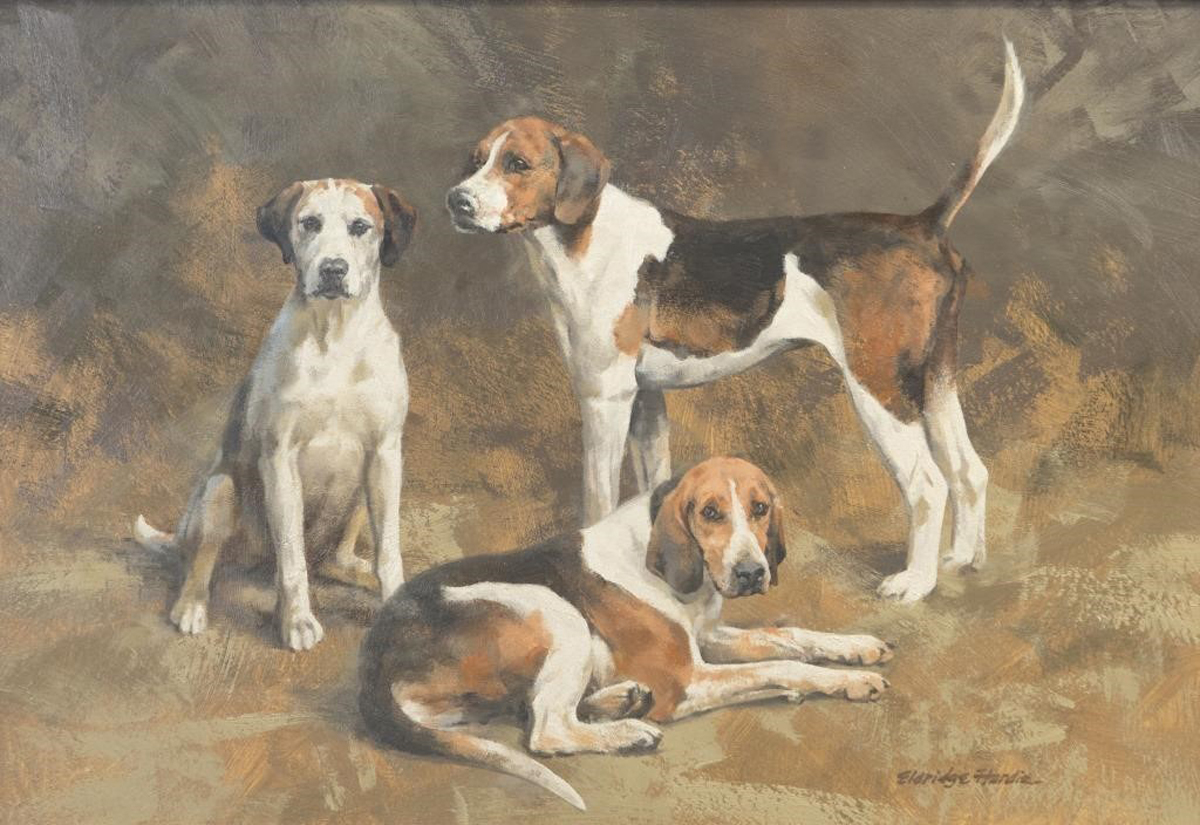
Foxhounds by Eldridge Hardie (1940-2021) Courtesy Copley Art Auctions.
As a very little boy, I recall sitting with the womenfolk as they talked and sewed, next to the lights of those kerosine lamps, listening to the Grand Ole Opry emitting from a battery-powered radio, while the menfolk miles away sat by a campfire listening to a pack of hounds running a wolf, or coyote. My Dad, El Mauldin, and others had packs of hounds which they unleashed to chase wolves, back when there were wolves in Texas. As I grew into my teens I spent many nights sitting around one of those campfires listening to our pack of Walker hounds running wolves, coyotes, or bobcats. One of my favorite movies way back then was “The Voice of Bugle Ann,” starring Lionel Barrymore, made long before I was born. Something of a sad movie. I did not hear the heart-pumping sound of a pack of hounds until I hunted mountain lions near the Grand Canyon in Arizona many years later.
I ate my first bowl of turtle soup in Bill Gaylord’s cabin, along with fried squirrels, cottontail rabbits, dove, quail, frog legs, etc. Although they were plentiful then jackrabbits were too tough to eat and were used for catfish bait on trotlines. The catfish had to chew and pull the tough chunks of rabbit, thus they were more easily hooked. Ole whiskers could not just suck it off like blood bait and some other baits used on a trotline.
My Dad and uncle taught me how to fish, with cane pole, rod & reel, and trotlines. From a cane pole I graduated to an early bait casting reel, which snarled at almost every cast. My Dad and Uncle spent a lot of time unraveling those birdnests until the Zebco 33 appeared. That spin/cast reel became the go-to reel for all of us. I did not shift to expensive bait casting reels until I had graduated from college.
I learned to shoot with my first rifle, a .22 Mossberg which my father bought for $5 and five gallons of gasoline from a transient. The semi-auto rifle, chambered for .22 Long rifle, was reduced to a single-shot because my Dad required me to shoot with .22 shorts, which had to be loaded one at a time. My targets were tin cans and prickly pear pads until I learned to hit. I learned to hunt frogs, rabbits, snakes, etc with my Dad and uncle with that rifle. When I was about twelve I could roam the pastures near town with that rifle, still firing .22 longs and shorts, loaded one at a time. Ironically my Dad would not let me have a BB gun, but trusted me with that .22. When I was 15 I replaced the Mossberg with a Remington 552 “Speedmaster” .22, which I bought from Boydston’s Hardware with money earned from mowing lawns and other odd jobs. The next year I bought a .22 semi-auto pistol, a few years before Federal Regulations prohibited such purchases. I kept the pistol in my first car, a 1955 Ford Fairlane, which I acquired from the proceeds of selling my three cows when my Dad sold our farm.
Summertime found me, when not working or playing baseball, with one of my friends. Both of us clad only in a white T-shirt, baseball cap, cutoff jeans, and old tennis shoes. Thus attired we braved the Texas sun and horseflies to fish and hunt bullfrogs with our .22s in local stock tanks. We did not like gigging the frogs at night, too many snakes! If you went too deep in the water and that T-shirt got wet, the horseflies would bite you through the shirt. If you ever had a red hot ice pick stuck into your back, you have an idea what one of those bites feels like. I have been to Africa several times and I believe those horseflies are equally as voracious as tze-tze flies, although, thank goodness, not as prolific!
In the early 1950s my father and uncle combined their GI benefits to buy that small farm.
It had two stock tanks and two intermittent streams with water gaps which were washed out during heavy rains. They raised cereal grains which brought in lots of doves and quail, as well as a few turkeys. Those grain fields were some of my first memories of many, many dove and quail hunts. My first birddog, a liver-spotted American Pointer, the runt of the litter, I named Smokey. My Dad did not think much of him initially and gave him to me. My mother thought differently because she watched him from the kitchen window pointing grasshoppers and any bird which landed on the ground or fence near him. She said Smokey never missed anything near the dog pen. When he was a puppy he sometimes forgot which leg to raise, sometimes a front leg, sometimes a back. Whatever the case he turned out to be the best birddog my Dad ever trained. My Dad thought so well of him and his infallible nose, that Smokey got to ride in the front seat of the pickup. No other dog ever achieved that honor!
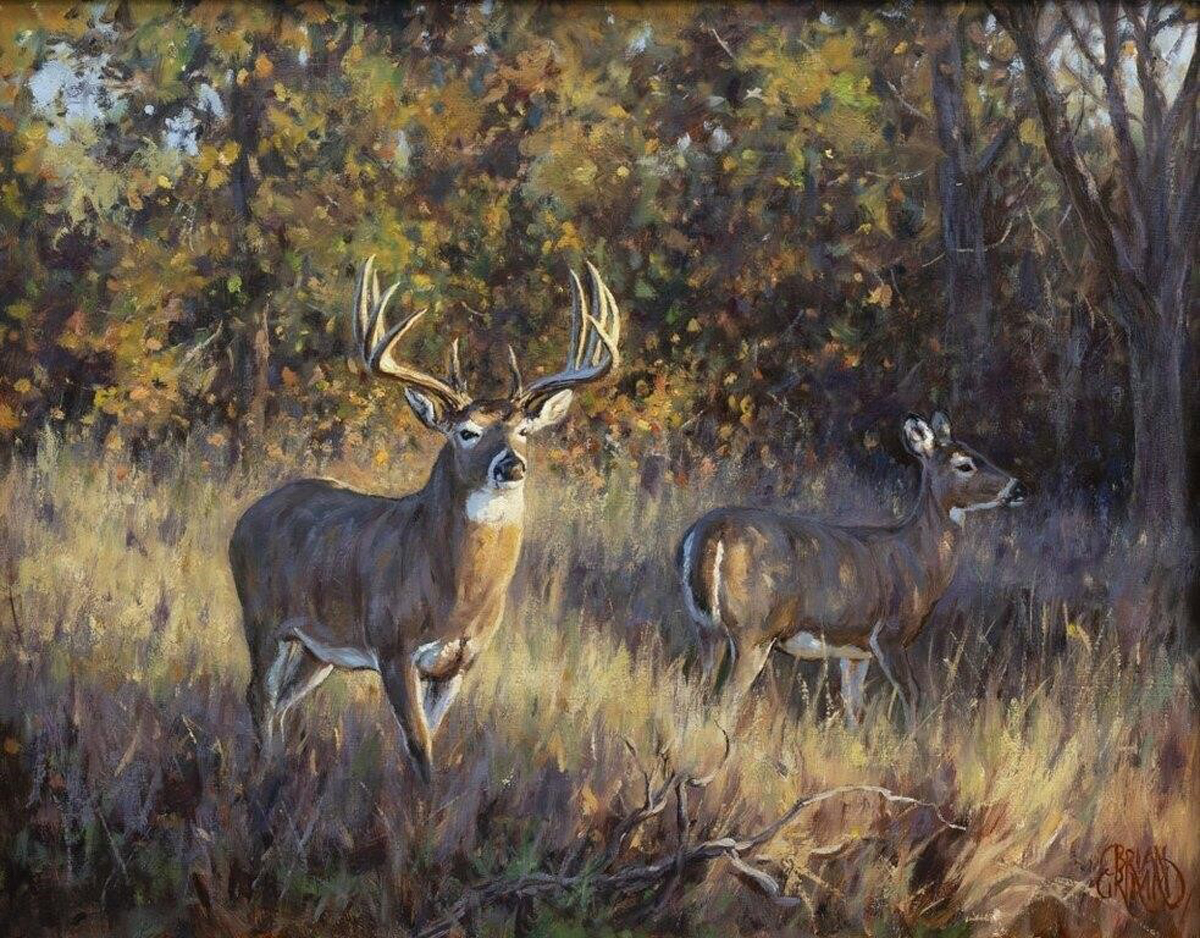
The Rise of Autumn by Brian Grimm Courtesy Copley Art Auctions.
I was ten when I got Smokey and my first shotgun that year as well, a Remington Sportsman 58, 16 gauge, which my son has to this day. No telling how many thousands of rounds have gone through that shotgun. I sold a calf and my Dad used the cash to buy that Remington. Both my son and I wasted lots of shells to learn to shoot, but there was an abundance of doves and bobwhite quail back then which trained me to be a more than adequate shotgunner. I never approached the expertise of my father and his hunting companions. I was fortunate enough to enjoy the plethora of bobwhite quail back then, long before they almost disappeared from the rolling plains of Texas. On one deer hunt in southern Callahan County, I was settled in among a bunch of dead mesquite trees when I saw movement out in front of me. It was not a deer but the largest covey of quail I ever saw. I counted forty-five birds and suspect there may have been sixty birds in that covey. The way they ran around and crisscrossed in the weeds it was impossible to get an accurate count.
Initially I just shot up among the flying birds, hoping to hit one I suppose. I recall one covey that Smokey pointed with his head cocked to the left and nose almost on the ground. When I moved up next to him a covey of bobwhites exploded all around us and, among the whirring of over two dozen wings, I pointed my shotgun up, down, left, and right never settling on a single bird, nor pulling the trigger until all the quail disappeared into the mesquite and oak thickets.
My father laughed out loud and I still remember the grin on his face! Many times when I was learning to shoot, and missed a shot, my Dad would walk up to me and take a shell out of my game bag, shake it, by his ear and comment, “Yep, they’ve got shot in them.” When I missed a shot or two, he smiled and said, “if you keep shooting like that, that dog will bite you!” Finally with my father’s coaching, I learned to pick out one bird and shoot it, then shift to another, and not just bang-bang-bang, empty the Remington.
I vividly recall one covey rise on a chilly winter morning when the sun barely peeked over the treetops, its rays glittering on the thick frost which covered the ground like a thick jeweled blanket. I was hunting with one of my Dad’s friends, Ervin Pruitt, and his pointers Jim and Skeets, who was too old to cast about for coveys, but still looked longingly from the pen to be included in the hunt. We had just crossed the cattleguard into a pasture when a bobwhite ran across the road in front of us. Ervin stomped on the brake and we bailed out of the pickup hauling out our shotguns and hurriedly shoving shells into them. Ervin unloaded Jim from the pickup and pointed him toward where the bird had disappeared.
Jim ran about 20 yards and came to a rock solid point on the opposite side of the road from where we expected the quail. We moved up on either side of the dog and the bobwhites flushed from almost under Jim’s nose. Amid a flurry of wings three shots blasted the morning calm. As the feathers drifted down I realize five birds had hit the ground. I had made my first scotch double, two birds with one shot, and Ervin had done the same on the rise and then crumpled another as they zoomed off toward a mesquite thicket. I still get choked up when I recall Ervin unloading Skeets, who put his nose to the ground, quickly searched about, and brought two of the birds back to Ervin. The old boy wagging his tail and moving like he had for many, many previous seasons.
We seldom saw deer on our farm as screw worms killed most of the fawns until the mid-60s when the parasites were eradicated in Texas. Whitetail deer populations boomed after that. At twelve years old I went on my first deer hunt, on a ranch in West Texas. I hunted with a borrowed Winchester in .25-35, not sure if it was a M92 or 94. Back then the prevailing saying was “if it is brown it is down.” Despite that sentiment I managed to down two decent bucks, an 8 and 6 pointer. That year Santa Claus brought me a Winchester M88 in .243 Win for Christmas. That rifle is now in my son’s possession. During its career it has dropped a large number of deer, both whitetail and mulies, a couple of pronghorns, a blackbuck antelope, a bevy of javelina, some coyotes, and a couple of Rio Grande turkeys.
As youthful years passed I became known for my skill with a rifle. My first mule deer I downed at over 400 yards with that aforementioned .243. My cousin reminded me that I took a crow out of the sky at between 80 and 100 yards on one of our hunting excursions in Callahan County. I also won a county 4H shooting competition and placed first on the rifle range with a M-14 during college ROTC summer camp, all with iron sights.
My mother’s parents had a much larger farm and I had the privilege of roaming over many acres and hunting and fishing their stock tanks as well as ours. Before many of the early morning hunts I recall a huge breakfast of fresh eggs, homemade sausage & gravy, thick sliced bacon, salt cured smoked ham, biscuits, and fresh milk. Both my mother and grandmother loved fresh fish and fried my catches of catfish, black bass, crappie, or perch to perfection. I also learned much about shotgun shooting while dove hunting on my grandad’s farm. In the late 1950s he partially retired and placed many of his fields to lie fallow, in what was then known as the soil bank. He planted sorghums as ground cover, and to provide food for birds and wildlife. These sorghum fields, abetted by sunflowers which cropped up at the edge of the fields attracted thousands of doves. I do not think these fields rivaled what I have read and heard about Argentina, but flocks of thousands of doves swarmed into these fields. There were so many doves that, when they landed on the deteriorated single-wire phone lines, they sometimes broke the wire. Standing at the edge of these fields during dove season I could not keep my Remington loaded, vainly trying to fill my limit of “flying carp,” as one friend called the birds he didn’t like to eat! The birds came in low and fast, or just floated into the fields. I blasted a lot of holes in the sky learning about the many aspects of wing shooting on my grandad’s farm.
Mr. Williams owned a tract of land which included a stretch along Mexia Creek east of Baird, pronounced “mayhair” by locals. A dam on the creek provided a permanent long water hole and a place to camp, while stringing trotlines along the creek. My Uncle William had a worm farm in the backyard, around an old stump in which he poured egg shells, coffee grounds, etc. As a result of this worm farm, we always had large earthworms when going fishing on Mexia Creek, or in the many stock tanks in the county where we were allowed to fish.
When we needed ice for a camping trip, or to make homemade ice cream, we went to the ice house near the T&P railroad depot. Morgan Stokes, an injured Hatchett Ranch cowboy, ran the ice house. Both my Dad and uncle worked on the ranch with Marvin before WW II, where a horse rolled over Marvin, breaking his pelvis, ending his cowboy days. The T&P Railroad delivered large blocks of ice to Morgan and we went there to get block ice for our coolers and crushed ice to make ice cream. We made many trips to get crushed ice to fill the hand-cranked ice cream freezer.
The T&P Railroad provided other things in my life besides ice. During the extreme drought of the middle 1950s the railroad brought in tank cars of water for folks to use at home and for ranchers/farmers to haul water for their livestock. In the late 1880s the railroad built a lake near Baird to provide water for their steam engines, but diesel engines roared over the tracks when I was growing up. However, the lake was still there. The winter weather did not get really cold, but now and again the temperature fell well below freezing, causing the shallow end of the lake to freeze over. When that occurred my friends and I, as did a couple of previous generations, went “skating” on the lake. Actually we just ran and slid on the ice. As far as I know no one ever fell through the ice, but it did crack a few times, warning us to get the hell off the thin ice!
Everything was not always ice cream and lollipops during my youth. I broke my wrist twice during baseball games, was burned in a trash fire, and had the usual bumps and bruises of an active boyhood, requiring a few stitches and multiple bandages. The most serious event almost cost me my life. A friend and our two girlfriends decided to do some night hunting for jackrabbits, skunks, and other varmints. Not thinking of her inexperience in this endeavor, I put my girlfriend, later my wife, behind the wheel while my friend and I rode on the hood as she drove along a pasture road. When she drove up a rise and could not see over the hump, she hit the brakes, causing me to slide toward the front of my car. My friend grabbed a windshield wiper in one hand and me in the other, while he braced his foot on the hood ornament. He saved me from being badly hurt or killed. After the berating I gave my girlfriend she pointed out that I should have never placed her in such a situation, and stayed by my side for over 52 years of marriage. I certainly never again attempted that kind of reckless hunting.
I suppose things work out evenly in life. While my Dad and friends were seining a stock tank for trotline bait, a friend and I were floating around the tank on a truck inner tube. I had no idea he could not swim and when he slid off the tube I did not think much about it. Fortunately the water was very clear and I could see him down under me, reaching up with his hands. I reached down and grabbed him and lifted him back to the tube.
So, I suppose I saved his life, but it did not seem much of an event at the time. He went on to be a teacher, coach, and school superintendent. Much later during my flying career, I pulled another pilot from a burning airplane which had crashed in the woods. So if my friend had not saved my life, many other lives would certainly have been traumatically affected.
Notwithstanding a very few singular events, my boyhood in Callahan County, if not wonderful, was truly educational. I learned about many things city life does not always teach; God, nature, honesty, fair play, integrity and caring for others and the environment. The folks in Callahan County, Texas filled my life with very fond memories, which I would not trade for anything.