
While rummaging through some of my father’s old books, I stumbled across African Game Trails by Theodore Roosevelt. It’s an interesting read regarding the exploits and African journeys of an American hunter and conservationist. One chapter, “Uganda, and the Great Nyanza Lakes,” caught my attention and I couldn’t help but ponder on what our 26th president may have encountered during that period. Other famous hunters such as Walter Dalrymple Maitland Bell, better known as “Karamojo” Bell, also experienced incredible expeditions in the Karamojo sub-region back in the 1900s. Uganda captivated my thoughts and I longed to experience what former British Prime Minister, Sir Winston Churchill referred to as the “pearl” of Africa. In his 1907 book, My African Journey, Churchill stated, “The Kingdom of Uganda is a fairy tale.” I was anxious to see the story unfold.
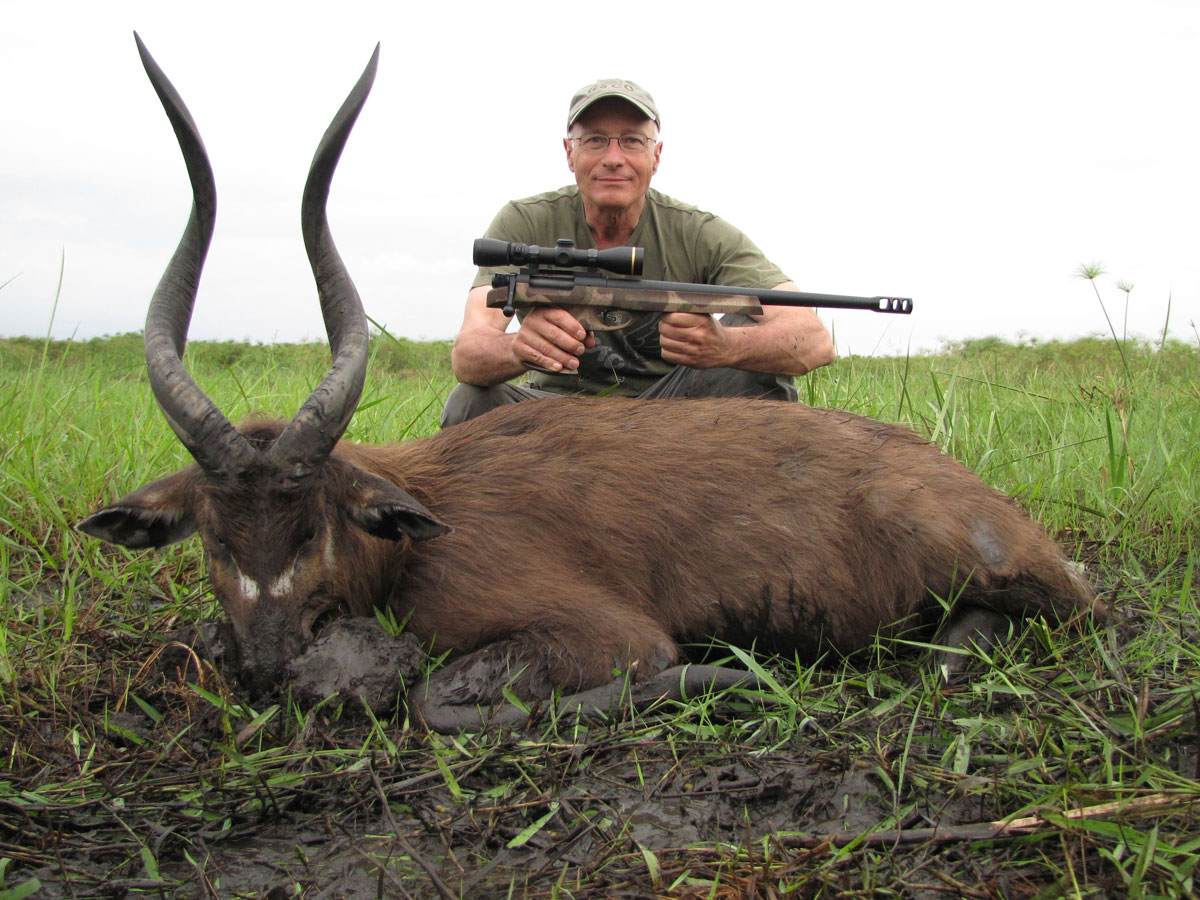
This impressive East African sitatunga is one of Africa’s finest spiral-horned antelope. Mark took this bull with an H-S Precision handgun and Nosler ammunition.
At one time, Uganda was a mecca for adventure-seeking hunters. That was prior to 1971 when, thanks to a military coup, the Dictator Idi Amin’s regime wreaked havoc on humanity including human rights abuses, political repression and persecution of certain ethnic groups. From 1971 through 1979, it was a most tumultuous period for Uganda and its magnificent wildlife as well.
This beautiful country lies within the Nile Basin, bordered by Kenya, Sudan, Congo, Rwanda and Tanzania. Today Uganda’s wildlife flourishes thanks to regulated hunting and sound conservation practices. It was my utmost and deepest personal desire to experience the incredible hunting opportunities just like other adventurers and ardent wildlife conservationists of the past.
When my wife, Karen, and I landed in Kampala, we were greeted by our professional hunter who just arrived from Tanzania. Unfortunately, he just received word his residence was broken into back home and firearms were stolen. This was a major issue in Tanzania and our PH had to immediately catch a return flight back to his home to deal with the incident. We were hunting with Christian Weth of Uganda Wildlife Safaris. With the unfortunate events, Christian drew the short straw and was tasked with being our PH. Christian’s concessions are vast with an abundance of endemic East African game.
When we arrived in camp, traditional East African tents were neatly organized with flush toilets, running water and hot showers. Karen immediately liked the set-up and quickly made friends with the young staff girls who catered well. While enjoying a fine cigar, Christian suggested we start off by looking for an East African sitatunga. Having a weak spot for spiral-horns, it sounded like a great idea.
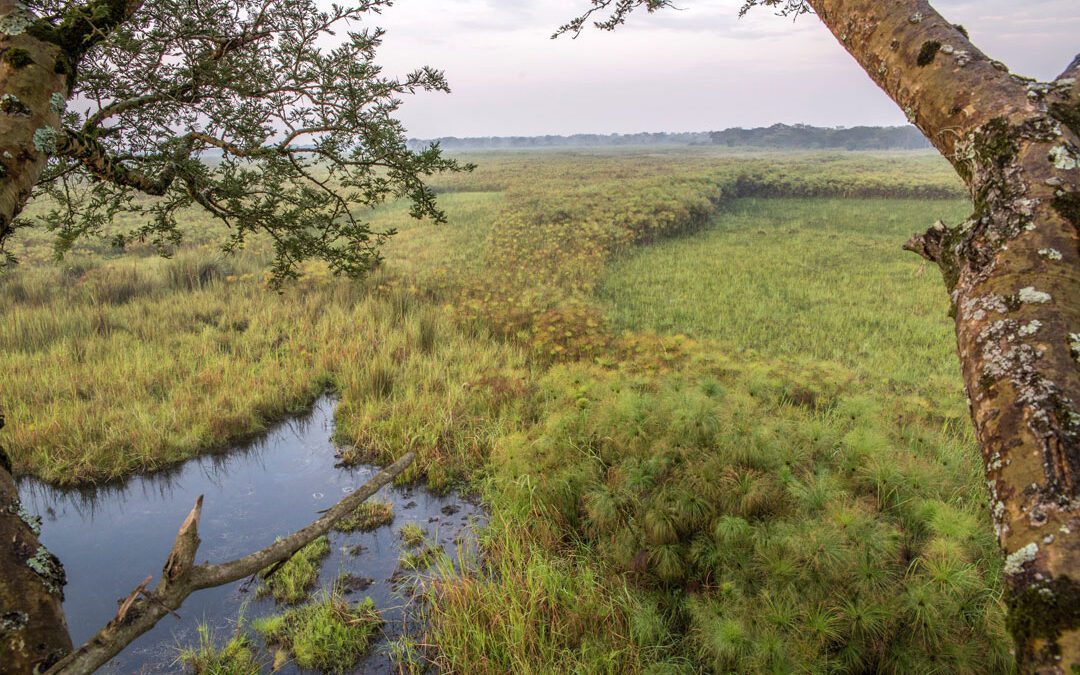
The Mayanja River flows through the Kafu River basin, dissecting a vast sea of very tall papyrus. We would be hunting in elevated blinds they refer to as a machan, hoping to catch a sitatunga stepping out of the gauntlet of papyrus to feed. It’s an early morning, late evening affair with the rest of day spent hunting other game.
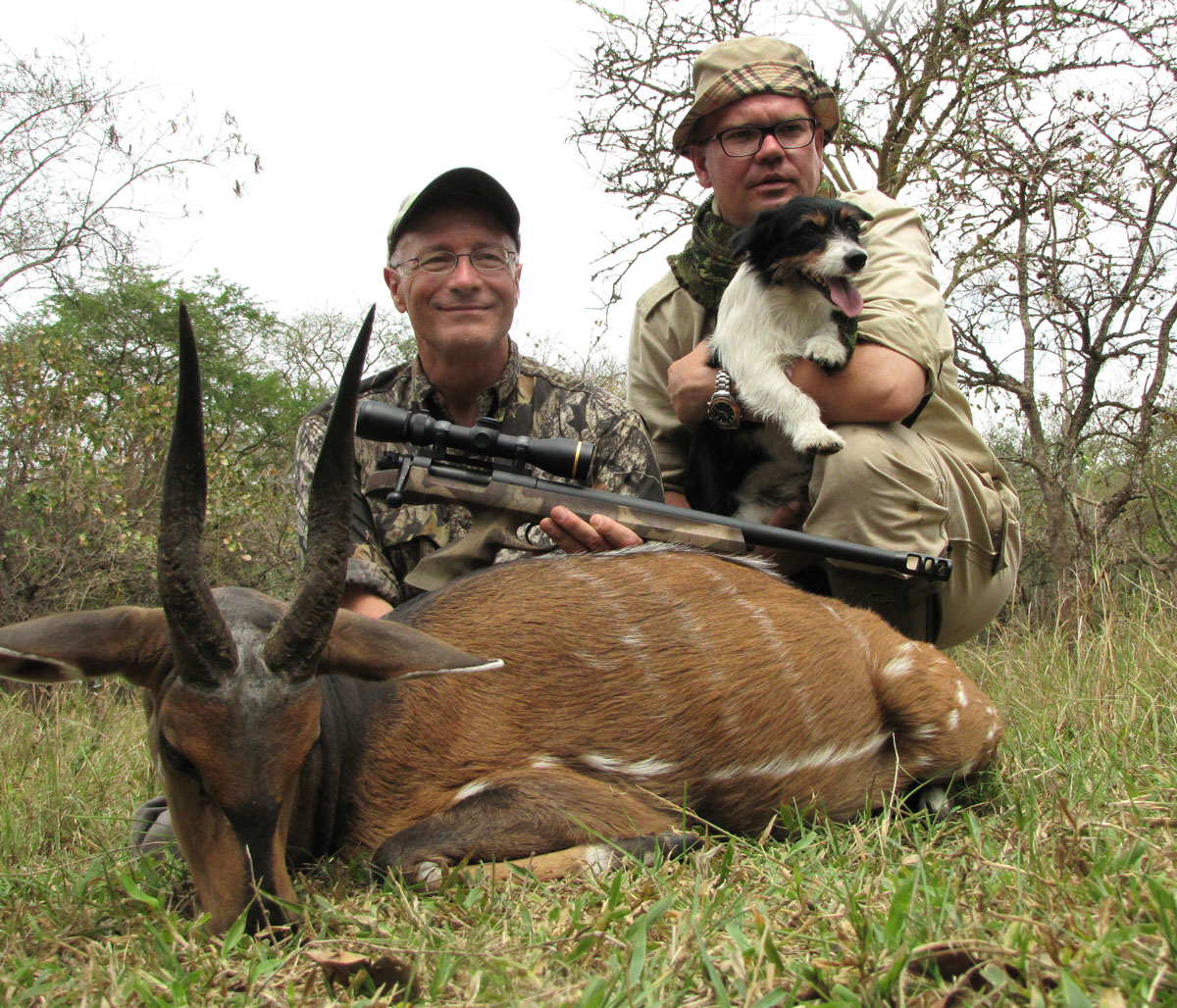
Christian and his faithful companion share Mark’s moment with an impressive Nile bushbuck.
The trackers and staff cut the tall papyrus creating a small clearing. You basically sit in the machan waiting for a sitatunga to step out in the clearing, much like hunting whitetail from a blind. We tried several mornings and evenings to no avail. The sitatunga didn’t cooperate and it’s actually a little boring as there are no other animals to see while waiting. But that’s hunting. Fortunately, between the morning and evening pursuit for sitatunga, other game was abundant.
We saw Nile bushbucks frequently. Hunters are allowed two on quota and with Christian’s insistence; I took two nice males with the H-S Precision handgun. Late one morning after another unsuccessful sitatunga hunt, we took a walk in an open floodplain. We spotted a beautiful, old African bohor reedbuck with massive horns and, being an opportunist, I quickly took a steady rest with the tripod. One shot from the 270 WSM and he was headed for the salt. Later in the day we also scored on an East African bush duiker.
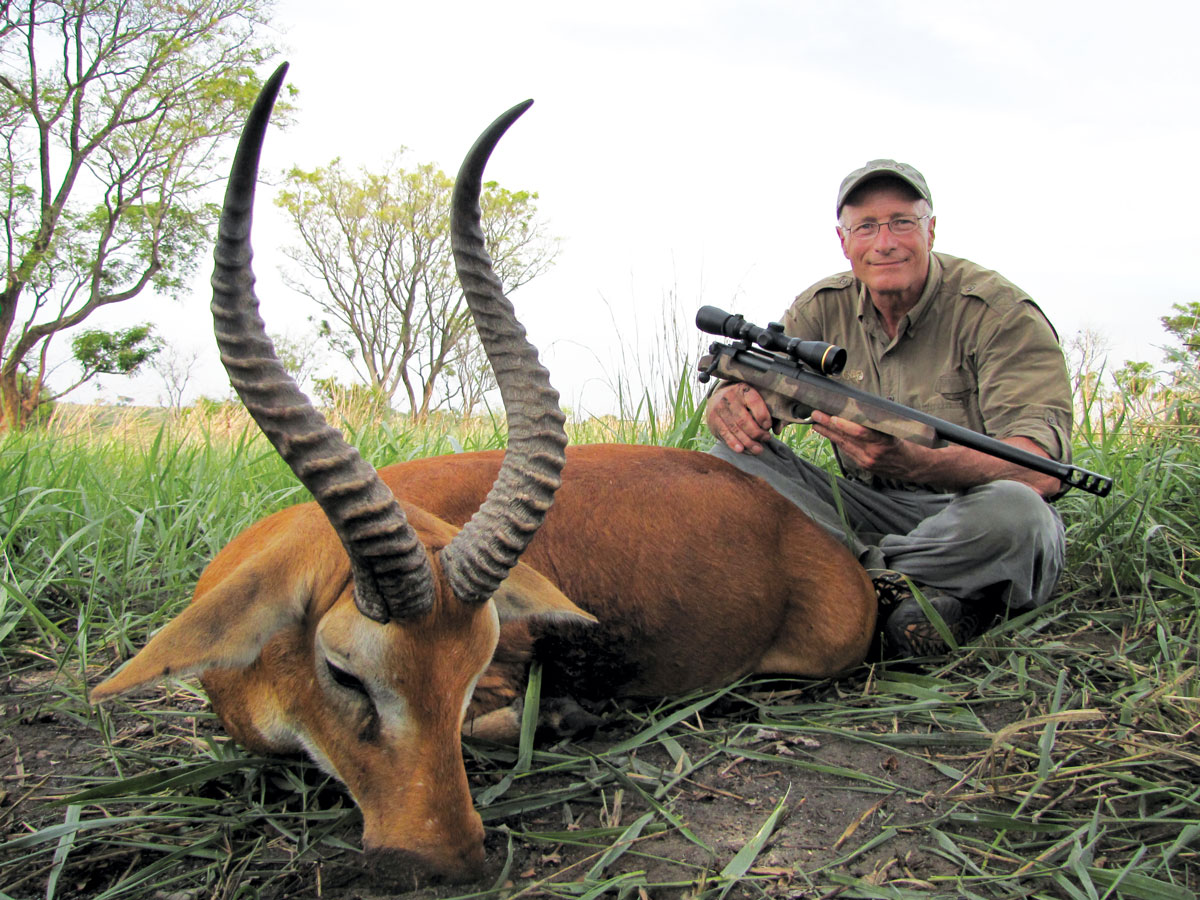
The Uganda kob is the national animal. Their population is thriving and hunters are allowed two on quota.
The sitatunga continued giving us some major heartburn. We tried several different areas that all produced the same result—nothing. Hopefully our persistence would soon pay dividends. One afternoon we were blessed to find a dandy Uganda kob—Uganda’s national animal—and I couldn’t lay off the trigger if I tried. The trackers quickly positioned the Bog-Pod tripod rest and when the crosshairs settled on the shoulder, I gently tugged the trigger and we had our first Uganda kob. The kob appears on the coat of arms of Uganda, representing the abundant wildlife present in the country.
Christian wanted to try a new spot for sitatunga. The machan was located along the banks of the Mayanja River so before daylight, we loaded up in a small wooden canoe and headed downstream. I wasn’t too keen on five grown men aboard a 14-foot wooden canoe. Thankfully the U.S. Coast Guard wouldn’t be dropping by for a compliance check!
The swarm of mosquitos was hungry that morning and I tried to kill as many as possible. Christian was in front of the boat and turned around to whisper, “Do you smell that odor?” I didn’t. “It’s hippo urine.” I was too involved with killing mosquitos to give it much thought.
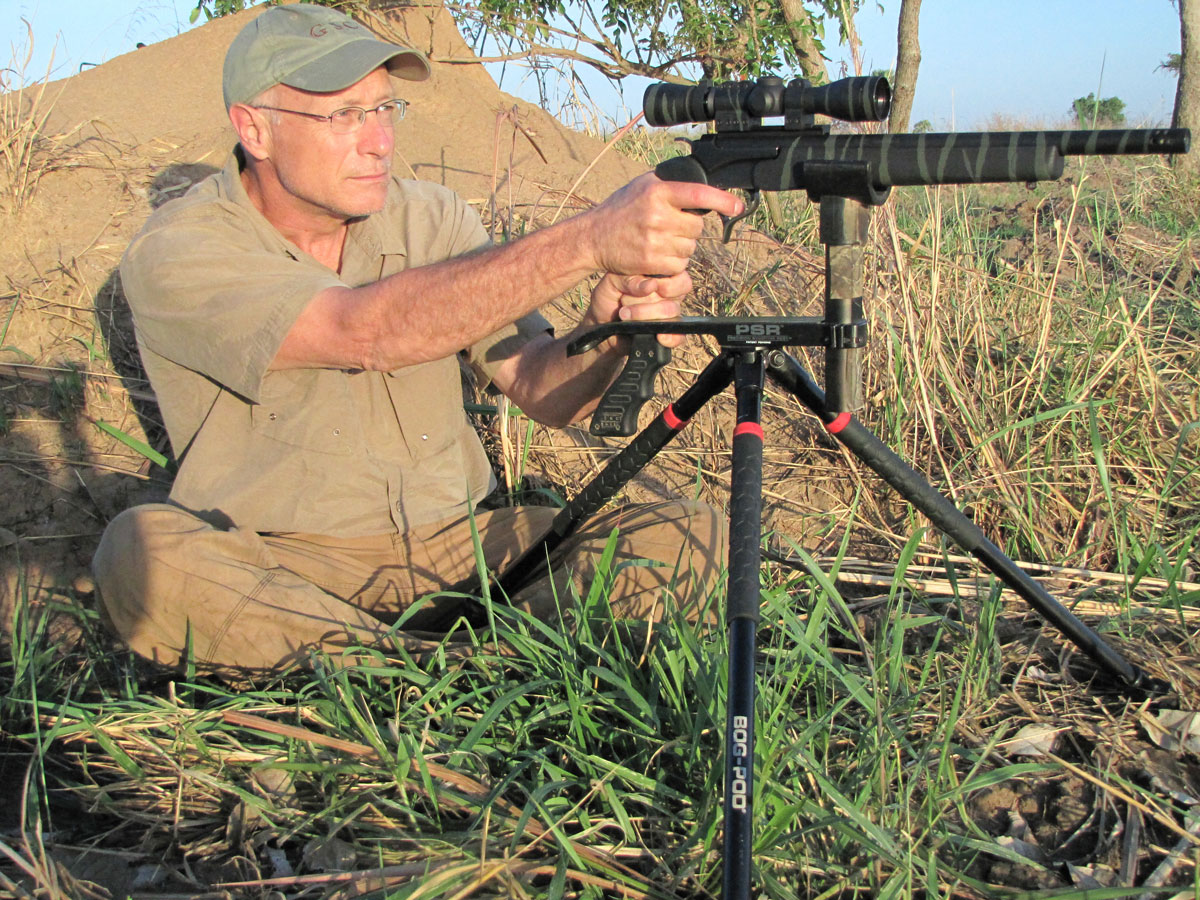
The Bog-Pod tripod shooting rest provided a steady platform for shooting.
Just as it began to get light enough to see, I noticed a large rock protruding from the middle of the river. The obstruction was directly in front of the boat. Then, while the three trackers were paddling toward the object, it suddenly submerged. The trackers yelled, “Hippo!” The big bull popped his head out of the water again, only this time we were so close I could have flipped a coin onto his head! He disappeared momentarily as the canoe was still drifting downstream. The third time he popped up he was facing us and, if body language suggested anything, it was askance and anger. I honestly thought we were in for serious problems!
I told Christian he better get his gun ready. It was a tense, nerve-racking moment! The audacious trackers beat the water frantically with their paddles and begin shouting. My immunity for danger had dissipated. Fortunately for us, the hippo retreated, which was a huge sigh of relief. A close encounter of this kind will certainly confirm things can go south in short order.
We finally made it to the machan shortly after daylight. After the hippo incident, I wasn’t certain my nerves would settle down enough to shoot straight. As I stepped off the Mother Ship, I cherished the moment when my feet touched the ground. We’d been in the machan for more than an hour without seeing anything and with Christian’s lack of patience, I thought it was about time to head back to camp for breakfast.
The wind had picked up by then and was blowing quite hard. I was looking at one portion of the clearing when I noticed the 15-foot-tall papyrus shaking wildly and felt certain that couldn’t possibly be the wind. All of a sudden, a big bull sitatunga stepped out in the open. What an impressive sight! The magnificent bull fed along the edge as I rested the handgun on top of the machan. This is one opportunity I didn’t want to screw up! When the crosshairs finally settled, the 270 WSM broke the morning silence. Abu, one of our trackers, started hugging me as Christian slapped my back so hard it hurt. We were all thrilled and thankful. The big bull was stunning—one of Africa’s impressive spiral-horned trophies—and a celebratory cigar was forthcoming.
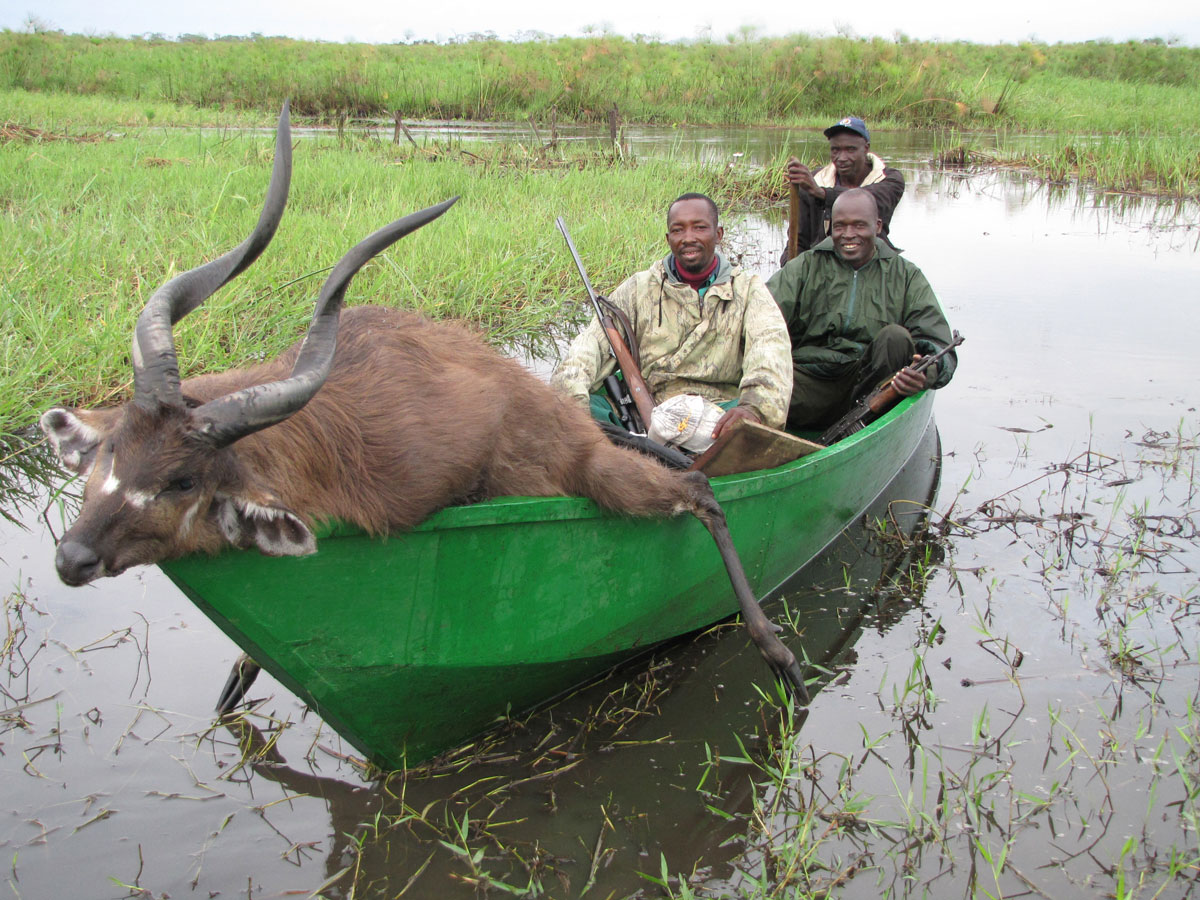
Hauling the sitatunga back to camp, trackers are all smiles after the successful hunt.
At this point, Christian wanted us to see some new territory and target some other endemic game that lived farther north, so we packed our gear and headed to another concession bordering Murchison Falls National Park. Nile buffalo was high on my priority list, so I switched handguns grabbing a T/C Encore chambered in 375 JDJ. The area we were hunting consisted of savannah woods and picturesque green, open grassland. It was an exquisite area abounding with wildlife. Buffalo is one of the most abundant of Africa’s large herbivores. The horns of the Nile buffalo differ from Cape buffalo as they do not curve below the base of the skull along with their length of horn being somewhat smaller.
We started early in the morning searching for buffalo tracks and it wasn’t long before the trackers picked up the spoor of two bulls that had come to water the night before. We followed those two bulls for more than three hours in 100-degree heat. The tracks indicated the bulls were meandering around, probably looking for a place to nap. The trackers did an incredible job of not only following spoor, but also anticipating what the animals were doing.
The tracks led into thick, heavy bush where suddenly one of the trackers pointed to the two bulls. Not only can these trackers follow spoor all day, they have excellent eyes. The bulls were facing us not 40 yards away. They knew something was out of place and vanished quickly into the thick stuff.
We looked around and found fresh sign where the buffalo were about to rest. Christian pointed out a well-shaded false apple tree with many low hanging branches covered with leaves that made a perfect area for the bulls to escape the mid-day heat. The trackers studied the well-worn beds under the tree and stated these bulls were sleeping there frequently. This time, the bulls detected our presence and ran away so we decided to give the place a rest and return a few days later.
Early the next morning while searching for more buffalo tracks, we bumped into a really big Uganda defassa waterbuck. Without hesitation, the Bog-Pod tripod was quickly put in place, the H-S Precision 270 WSM steadied and a Nolser 130-grain AccuBond bullet sent from 120 yards to take care of business. The massive body on this bull was most impressive.
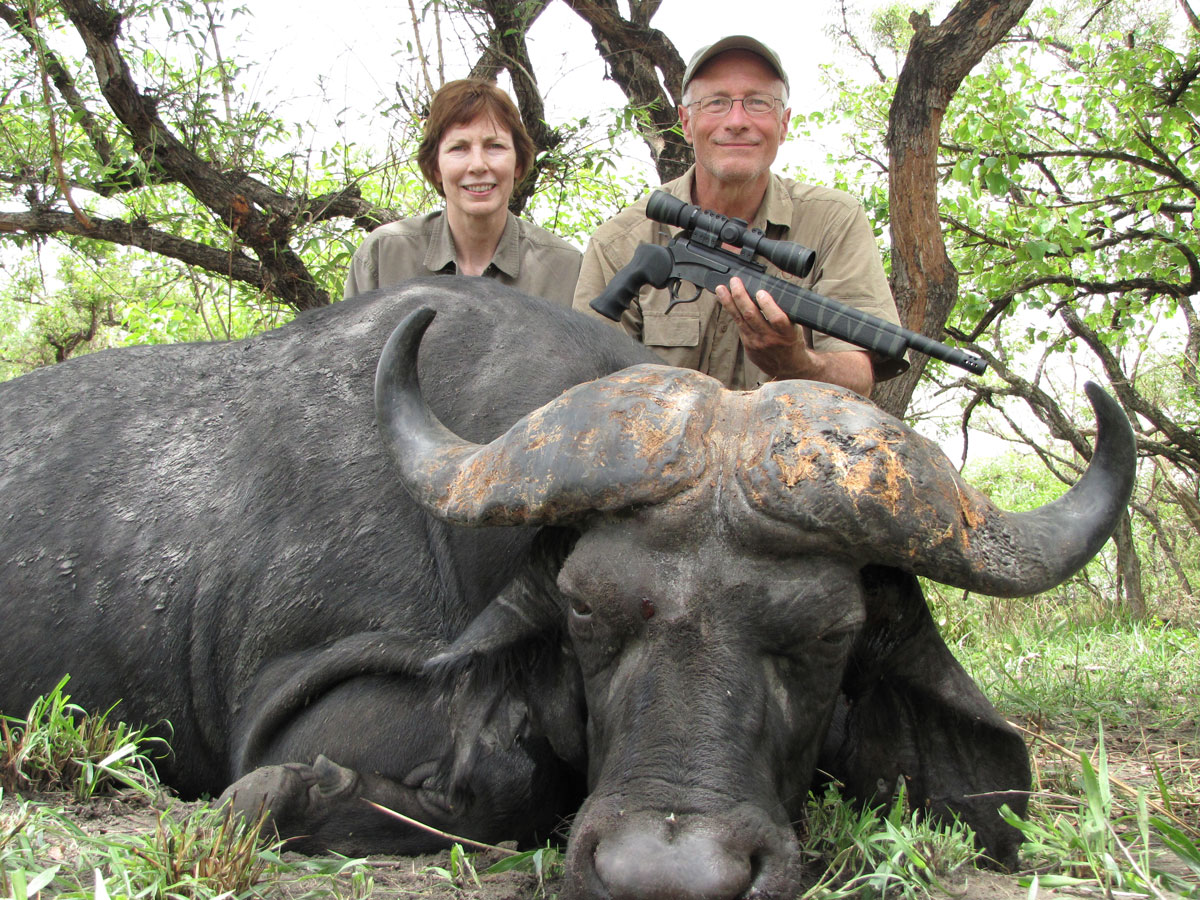
This dandy Nile buffalo was taken on the last day of safari. The 375 JDJ handgun performed flawless under adverse conditions.
Hunting Nile buffalo took up the early morning period but left the rest of day for other game. We saw a lot of Uganda kob and hunters are allowed two thanks to the copious population. Late one morning we spotted a lone bull from afar. A carefully planned stalk yielded a perfect opportunity, and we had our second kob of the hunt, plus, the locals benefited from the meat.
Later in the afternoon, as a major thunderstorm was approaching, we bumped into a herd of Jackson’s hartebeest. There are not a lot of places or opportunity for these odd-looking antelope, and I was hoping to get a crack at one. The rain started and filled my scope. When we got within 75 yards or so of the herd, we had to locate the bull as both males and females support horns. They spotted our movement and ran off a short distance before I could make out which one was the bull.
As the rain continued, our shooting light was fading. It was a stroke of luck, but we managed to find the herd again and spotted the bull. When I finally cleaned the scope lens enough to see through, I found the bull in the crosshairs and placed a bullet in his shoulders. We were all in a state of jubilance even in the downpouring rain.
At this juncture in the safari, I had taken a variety of game—more than I ever dreamed. But the Nile buffalo had eluded us so far. Our last day of hunting found us concentrating on filling this void. Christian wanted to go back to the area where we had previously encountered those two bulls.
The plan called for us going straight to the false apple tree where all the sign of these two bulls were sleeping. It was a long shot and, to be perfectly honest, I didn’t have much faith. Abu slowly eased his way through the thick undergrowth. As we approached the area, I began looking for the particular tree along with the rest of the trackers. Abu borrowed my binos to look under the tree, but the tree he was looking under didn’t seem like the one I remembered.
I looked around and glanced to my left and caught a glimpse of a tail flicker. For a split second I lost my composure, my heart raced out of control as I quickly pulled Abu to my side and pointed toward the movement. Abu had been looking under the wrong tree. Luckily, the bull was facing away from us and hadn’t caught our presence. About that time, the buffalo lay down on the opposite side of the tree, under the canopy of shade—the same place we had earlier detected their beds. There wasn’t any possibility of getting an unobstructed shot from this angle so Christian and I eased forward as slowly and quietly as humanly possible. Christian set-up the shooting sticks but the angle still did not provide a clear opportunity.
We moved slightly to our left and I rested the 375 JDJ, hoping for a shot. At 40 yards, I felt confident we could pull this off even though it wasn’t a perfect situation. I could see two bulls lying down and one was definitely bigger. When the big bull stood up, I squeezed off a round and you can’t believe how fast both of those bulls disappeared. I felt good about the shot, but we were uncertain how far this bull would run.
It was 100 degrees by then as we started following tracks. We followed those two buffalo for more than 200 yards before one of the trackers spotted the smaller bull. Just a few yards to his side stood the bigger bull, facing us. It was a sight I’ll never forget. Christian told me to shoot him between the eyes—before he charges! I didn’t particularly cherish this shot, but it was the only option at this point. When the 375 JDJ smacked the bull in the skull he immediately dropped in his tracks. I cannot convey how relieved and thrilled we all were at this moment! Total exhilaration!
When our hunt was over and the smoke settled, the salt shed was a temporary home for 11 trophies, nine different species, all taken with a handgun. I must confess that, after 34 African safaris in 11 countries, Uganda is among the top of the list—definitely one of the most successful and memorable African adventures. There are many other unique places to visit before, during or after the hunt including 10 national parks, River Nile, gorillas, the equator and beautiful Lake Victoria, the largest freshwater lake in Africa. The country is blessed with natural wonders. I find it difficult to disagree with Churchill’s assessment of Uganda being a fairy tale—this wonderful country is indelibly etched in my soul and could better be defined as “The Real Deal!” I can’t wait to return.