
It’s like someone thumped the middle of your back with their fist, firmly, but not too hard,” Capt. Justin explained. “When you feel that, tighten your line and strike the fish with everything you’ve got.”
But before the “thump” happened, I needed to sling a six-inch, free-lined live croaker 150 feet to the right spot, and do so with as soft a splashdown as possible to avoid disturbing the area and spooking any nearby trout. It sounded quite simple, but anticipating a big spotted seatrout engulfing your bait makes keeping your composure and remembering the simplest instruction seem almost overwhelming.
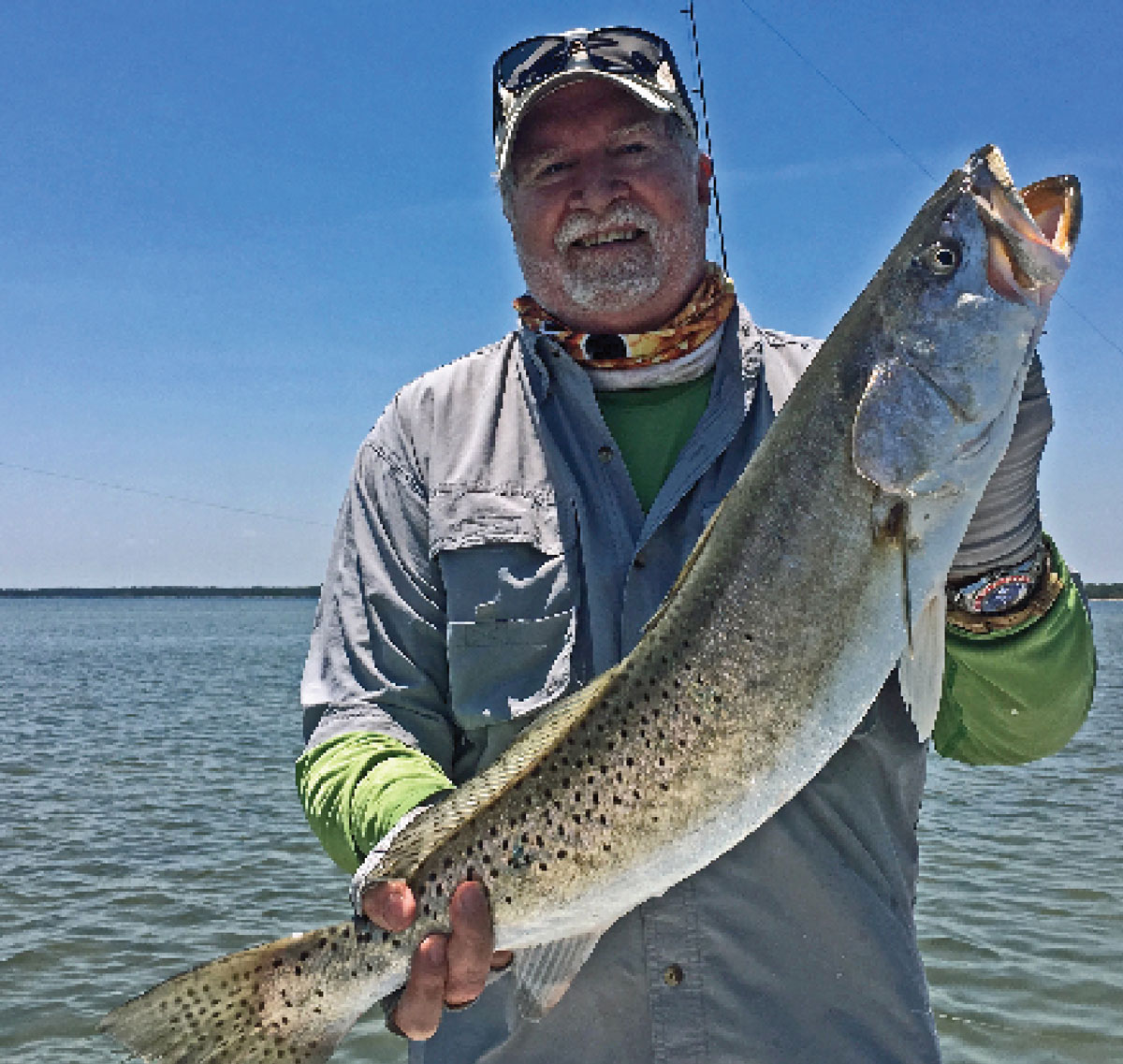
The author holds a Mosquito Lagoon “gator” trout weighing in the neighborhood of eight pounds. A fish this large was formerly called a “button” trout, nicknamed for the award pins that were earned for catching one weighing six pounds or more.
Fellow outdoor writer Jeff Johnston and I were out for a few hours of fishing on the Intracoastal waters of the Indian River Lagoon (IRL) south of New Smyrna Beach, Florida. We were with two certifiable “big trout” specialists—Capt. Bill Fisher and Capt. Justin Spicer of Fisher’s Lagoon Charters who not only target supersize seatrout, but also monster redfish, snook and tarpon. Unless a seatrout approaches 30 inches or better, they hardly raise an eyebrow. Capt. Bill’s largest trout measured close to the current world record at more than 38 inches, but he released her to swim away rather than risk killing the fish to have her officially weighed just for record’s sake.
We were fishing in about three feet of clear water on a wide-open sandy flat at the northern end of the Mosquito Lagoon. It was shallow enough and clear enough to look like you could step out of the boat without getting your knees wet. With the sun nearly overhead and barely a breeze to bother us, our flats skiff held position well while we threw our baits to subtle-looking spots that Capt. Justin and Capt. Bill pointed out.
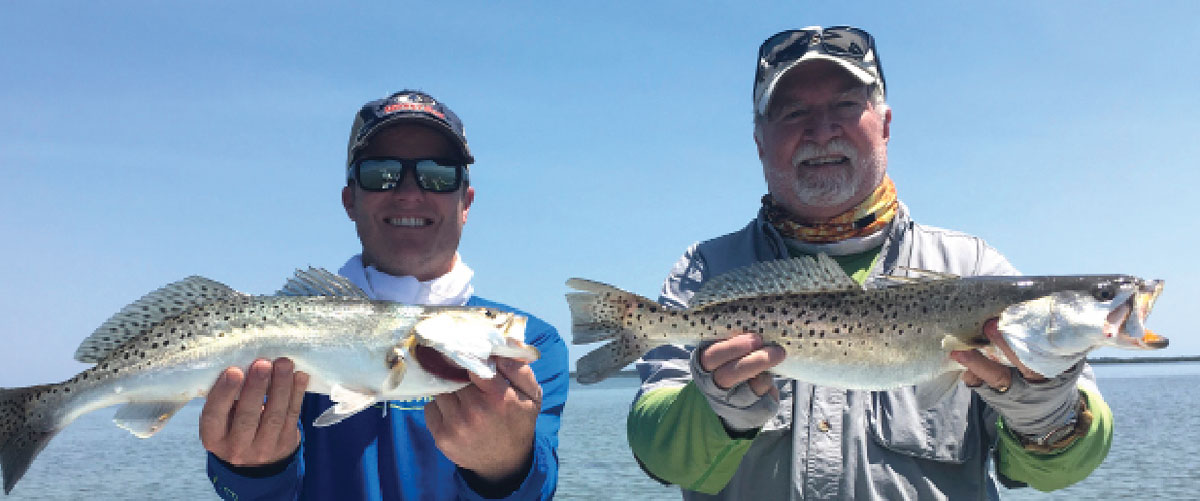
Outdoor writer Jeff Johnston (left) and the author hold keeper trout (more than 15 inches) caught in Mosquito Lagoon north of Cape Canaveral. The daily limit is four, only one of which can exceed 20 inches.
Johnston and I soon enticed a couple of keeper trout in the 15-inch range to take our baits, which kept us clearly focused on the task at hand. Working with medium-weight spinning gear, I aimed a fresh bait at a dark spot at the outer limit of my casting range. It was either a patch of grass or a shell bed—just the kind of place where a lurking trout might ambush an unsuspecting meal.
To my delight, the tail-hooked bait sailed out in a long high arc and came down head-first, knifing into the water with barely a ripple close to the aimed-for dark spot. Trout are opportunistic feeders and when live bait is properly presented close by, they often inhale it quickly and aggressively.
My eyes followed the line as it settled after the cast and, sure enough, quicker than I can describe it, the line jerked just as I felt the “thump” Justin had mentioned. There was no question in my mind that something had just executed a smash-and-grab on my bait, but I hesitated for that nano second or two before remembering to flip the bale, take up slack and strike the fish. Just about the time my scattered thoughts called for action, a loud shout erupted from behind me.
“Hit ‘er now, for God’s sake!” Justin implored. He was watching a classic big trout strike about to be bobbled and he couldn’t contain himself.
I slapped the bale and started reeling like a madman. When the line tightened, I reared back with the rod against something that felt solid and unmovable. Just as suddenly, I felt the throb of the drag giving up line and I knew I’d stuck a big one. I should’ve smacked her again with a second or even third punch, but at that point the best I could muster was just hanging onto the rod.
Keeping the rod tip high, I cranked down when I could, trying to gain back some line, but the fish swam hard and determined, causing the water to boil and ripple in its wake. The huge trout stayed down, shaking its head and fighting angrily, trying to spit the hook. I kept the pressure on, hoping hook and line would hold up in the struggle. The fish swam away from me heading west and actually pulled the boat around in that direction.
The biggest trout are females, and they tell you they’re big the instant you glimpse them. When the line sliced upwards through the water, I knew the fish was about to reveal herself. She breached like big fish do, wallowing and head-shaking with gills flared before plunging back down again. When I realized this was the biggest trout I’d ever hooked, my fish-fight suddenly turned serious. From behind me, I heard Capt. Bill scrambling for a net.
“My word, she’s a good one,” he commented from his seat at the center console. “Don’t lose her!”
I could see she was a good one, and the last thing in the world I wanted was to lose her. She fought furiously, but I finally steered her back toward the boat. Her objection and resistance to being hooked kept my spinning rod bent nearly double as I slowly recovered line.
When a trout reaches 28 inches and exceeds six pounds, it’s certainly noteworthy. But many hold that a true “gator” trout is 30 inches or more in length and will weigh eight pounds
or better.
When I finally maneuvered this large lady trout to the net, she filled it, and whether she qualified as a “gator” made no difference to me—she was plenty big and noteworthy indeed. Previously, I’d caught a couple of trout that pushed the six-pound mark, but this big mama bettered those by a wide margin.
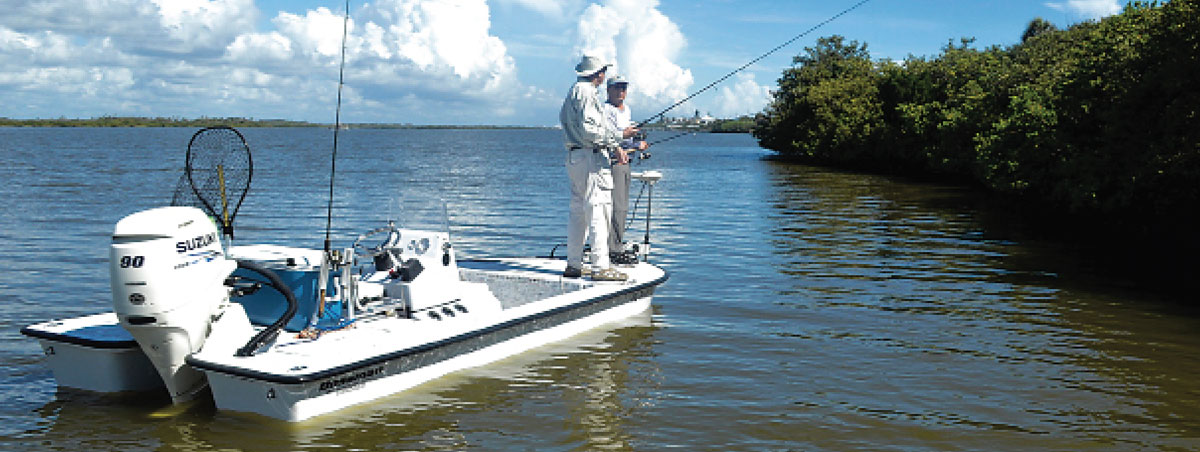
Capt. Bill’s 18-ft. Bossman skiff drafts just seven inches with motor, fuel and gear aboard. Made in Edgewater, Florida, the skiff is specifically designed for local conditions, like running skinny water no deeper than eight inches. Shallow-water manuevering enables Capt. Bill to access hard-to-get-to areas frequented by large trout.
Aggressive ambush feeders, trout can be caught on a myriad of live and artificial baits by shore anglers, by wade fishing or from a boat. Anglers looking for big trout armed with live bait should consider offerings such as large hand-picked shrimp, fingerling mullet, small silver mullet, or a large pin fish, pilchard or croaker. These baits can be free-lined, suspended under a popping cork or rigged with a split-shot, jig head or small egg weight. A long piece of 30-pound test fluorocarbon and a 1/0-3/0 live bait hook complete the terminal tackle.
Specks, as many Florida fishermen call them, are table favorites, averaging one to two pounds, and are common on both Gulf and Atlantic coasts. Gulf coast trout are considered large at five to eight pounds, whereas the largest trout, both in average size and maximum size, come from Florida’s east/central region on the Atlantic side—right where we were fishing. There, trout up to 10 pounds are taken and the potential can be upwards of 15 pounds or more. Florida’s record, which is also the world record, is listed at 17 pounds, 7 ounces—a gigantic trout that was caught in the Indian River near Ft. Pierce back in 1995.
I grew up in 1960’s Cocoa Beach when the original seven astronauts were local residents and missiles were launched from Cape Canaveral, long before it was designated the Kennedy Space Center. The missile “shots,” as they were called, shook the windows of houses located within sight and sound of lift-off.
The nearby Banana River was a healthy saltwater habitat full of fish and waterfowl that was ours to enjoy. My friends and I cruised the waters of the Intracoastal Waterway in skiffs and runabouts like most kids race around their neighborhoods on bicycles.
I was fortunate, indeed, to have learned to fish and hunt in those coastal waters with my dad’s help and encouragement, activities that have had a large influence on my life.
We fished during the summers, then in the cooler months we enjoyed excellent duck hunting among a maze of mangrove islands that attracted flocks of wintering pintails, widgeon and teal as well as resident mottled ducks. On the open water of the Banana River, massive rafts of lesser scaup would stretch for miles and numbered into the thousands. The puddle ducks and divers provided plenty of action, and even back then, we knew how lucky we were to live in such a nature-filled place during such amazing times.
Our home was located on a canal just off the Banana River. It didn’t take my father long after we moved there to discover catchable seatrout in our backyard. He would castnet fingerling mullet and then soak them under a float.
I remember the first time he heaved a fingerling into the middle of the canal behind our house. I kept my eyes glued to the float as it bobbed and darted to the swimming motion of the mullet. When it suddenly slipped below the surface, the excitement of watching dad strike the unseen fish was electric.
I will never forget the bowed rod in that trout tug-of-war, and the thrill of finally seeing the fish as he lifted it splashing from the water. The trout was a brilliant, metallic silver with a white belly and distinctive dark iridescent spots dotting its back, sides, tail and dorsal fins. Its eyes were sharp and clear with wide pupils that seemed all-seeing.
When dad opened the mustard-colored mouth to extract the hook, two fang-looking teeth at the top of the mouth flashed white and foreboding. They would, no doubt, anchor any prey the trout chomped down on. That spotted seatrout impressed me then, and they still do every time I land one of these streamlined predators.
Hunting heavyweight seatrout, like stalking game, takes knowledge, experience, stealth, patience, persistence and timing to have any chance of success. Besides knowing specific honey holes, elements such as tackle type (spinning, baitcasting or fly), bait selection (artificial or live), approach methods (boat, shoreline or wading), season, moon phase, weather, time of day and, of course, water depth, clarity and bottom structure can impact your success, in both good and bad ways.
Landing a trophy-size seatrout, never an easy feat, was recognized as far back as the early 1900s when a national outdoor magazine began publishing the names of fishermen lucky enough to submit a qualifying fish. In 1934, the magazine began awarding bronze and sterling silver badges for meeting minimum weight requirements for each species.
The minimum weight for a spotted seatrout (Cynoscion nebulosus) was six pounds, which needed to be certified at authorized weigh stations. Local Cocoa Beach fishermen working the waters of the Indian and Banana Rivers referred to the badges as “buttons” and hence the term, “button trout” became the nickname describing outsize trout years before the moniker “gator trout” was uttered.
I remember well the respect those “buttons” garnered among local fishermen. Exhibiting more than a couple of trout “buttons” pinned to your hat was a distinction of note that was admired and envied, and with no small amount of jealousy thrown in.
Travel 10 miles west from Cocoa Beach on the Hubert Humphrey Causeway (SR 520) and you’ll cross the Banana River, Merritt Island and then the Indian River before reaching Cocoa, a waterfront town on the western shore of the Indian River that once called itself the “Saltwater Trout Capital of the World.” The area within the Indian River Lagoon (IRL) system, consisting of the Indian River, Banana River and Mosquito Lagoon, holds the greatest potential for producing true heavyweight trout of any place in the world. But there are a couple of other big trout hotspots along the Gulf Coast that also hold potential for producing trophy-size seatrout.
Lake Calcasieu in southwest Louisiana is a big, brackish shallow-water bay that drains into the Gulf of Mexico. It has a surface area of 160 miles and an average depth of less than four feet. Located mostly within Cameron Parish, Calcasieu is well known among Gulf Coast anglers for its redfish, southern flounder and spotted seatrout. It produces many trout weighing seven pounds and even more.
Continuing farther west and south along the Gulf Coast of Texas brings you to Baffin Bay, located on the northern end of Laguna Madre, just south of Corpus Christi Bay. Baffin Bay’s claim to fame is the number of eight- to 12-pound trout it produces each year, and it’s also where the last two state record speckled trout, as Texas anglers prefer to call them, were caught. And it’s no secret what big Baffin Bay trout hang around—it’s rocks, big and small, which Baffin Bay trout truly like. Baffin Bay’s rocks were formed from the calcareous tubes of serpulid worms, which began about 3,000 years ago and ended around 300 years ago.
Baffin is a hyper saline estuary with no direct access to the Gulf and therefore there are no tides—wind being the only influence on water levels. Wading is the ticket to success at Baffin, which is how the current state-record trout was caught and how big numbers of trout, redfish, black drum and flounder are brought to the net each year.
Back in Florida, the IRL is part of the longest barrier island complex in the U.S., stretching for 156 miles from Jupiter inlet in the south all the way to Ponce de Leon inlet in the north. The IRL occupies more than 30 percent of Florida’s east coast, and its most unique and defining feature is its location, putting it in a class all its own. Its unique geographical setting straddles a transition zone between colder temperate and warmer sub tropical biological zones. It is here, and perhaps nowhere else in the United States, that tropical and temperate species coexist and thrive to provide world-class light tackle inshore fishing at its very best.
The IRL is clearly one of the finest inshore back-country fishing flats in the world. It’s in these fish-rich waters that Capt. Bill Fisher and and his brother, Capt. Bob, co-owners of Fisher Lagoon Charters, focus their efforts.
Raised in Satellite Beach and sharing a passion for catching trophy-size fish, the brothers cut their teeth at a young age on the huge seatrout, redfish and snook that swim the nearby Intracoastal waters. Combining their outstanding ability to locate big fish with an intimate knowledge of the local waters paved the way for them to become highly successful commercial fisherman using hook-and-line.
Capt. Bill claims to have personally caught more than 5,000 trout weighing six pounds or better and 91 true monsters that weighed 10 pounds or more. His collection of seatrout “buttons” may be a record in and of itself, filling numerous cigar boxes. Today, the brothers provide the guiding expertise, knowledge and experience that gives visiting anglers an excellent chance of catching quality inshore fish that often end up being their “personal best.”
As our time on Mosquito Lagoon played out, Johnston and I added three more trout to our catch that would’ve won “buttons” back in the day. The challenge of coaxing those big she-trout into biting and then playing them to the net provided not only the thrill of achievement, but was just plain fun. In keeping with Capt. Bill’s philosophy and love of giant trout, all of our big fish were quickly released after snapping a few photos, but we did keep a couple of under-20-inchers that were destined for a frying pan.
The most interesting aspect of our time with Capt. Bill was watching how his methods for locating and catching large trout absolutely fly in the face of conventional trout wisdom. Capt. Bill does not launch his skiff in the dark to be on the water at first light because he believes it’s not necessary if large trout is your aim. He clearly demonstrated this point by putting us on our biggest fish during the middle of the day with the sun almost directly overhead.
“The hotter the weather, the shallower the water, the higher the sun, the bigger the trout,” is his mantra.
“As long as you’re in the right place,” he said, “the big ones bite best at midday.”
And the right place is often marked by the subtlest variations. It might be the presence of an isolated grass patch, rock pile, shell bed or, best of all, a bottom contour that’s different from everything else around it—say a drop-off of only a few inches, if it creates a trough and even though shallow, can be magic.
“Any charateristic that distinguishes a particular spot from its surroundings might be a big trout magnet,” he explained, “and it can produce trophy fish, time and time again.”
Our time on the water with Capt. Bill, a true big-trout aficionado, was a real eye-opener for Johnston and me, and we felt lucky to have been able to tap into his expertise. The time we spent with him was special in a way that initiates a desire to return to do it again. Until that time comes, we will remember a remarkable day of fishing and anticipate feeling the thump of the next “button trout.”
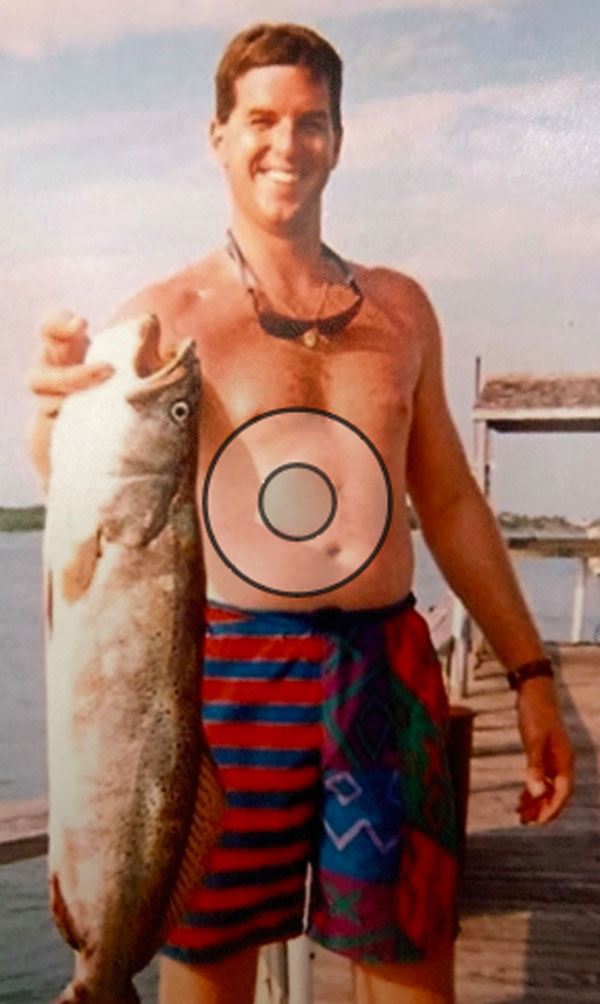 The World Record Spotted Seatrout
In 1995, Craig Carson, fishing with his father near Ft. Pierce, caught the world record spotted seatrout. Unaware of the significance of his catch, Carson threw the monster fish—the largest, ever-known spotted seatrout—into a cooler of ice and took it home to clean and eat. At friends’ urgings, Carson weighed his trout two days after he caught it. The giant trout tipped the scales at 17 pounds, 7 ounces and measured 39 1/2 inches in length. The International Game Fish Association (IGFA) certified Carson’s catch as the All-Tackle World Record spotted seatrout—then Carson and his family ate it. The only evidence that the fish ever existed, other than the top listing in the IGFA record book, is this photograph.