
I’m A.D.D. in the extreme. Have been all my life. If you’ve ever been associated with someone who has attention deficit, it can be a real “trip.” One idea births another idea and that one sprouts two more. Pretty soon, ideas seem to be coming rapid-fire and life becomes a little like a “stream of consciousness” novel. One thing just leads to another. Surely, you’ve noticed.
Anyway, I wrote a column for the March/April issue that recounted all the guns that got away from me in a long career of frenetic gun trading. That, of course, led to a lot of readers’ questions about the ones that didn’t get away and the reasons why they didn’t.
Truthfully, shooting my own guns is quite a luxury for me. I always have a list of guns waiting to be evaluated. And I really do try to give each of them a rigorous workout. Not only that, but I try to give the “field guns” at least a hunt or two to see how they perform under realistic field conditions. Right now, there are five of them propped in my gun safe, patiently awaiting their turn at fame. As you can imagine, there are only so many hunts that a doddering old gentleman can take in a year’s time, and gun evaluations use most of them up.
Most of you know quite well that I’m a dyed in the wool side-by-side man, so it won’t come as much of a surprise that most of my own “using guns” are doubles. You might be surprised to know that the one that I use the most is not. In fact, my most common companion gun is a Remington semiauto, a 12 gauge, the TAC-13 to be exact. It gets far more use than any other shotgun that I have. It accompanies me on many of my off-season jaunts. It stands propped against a tree when I’m camping and rides behind my truck seat when I’m going somewhere. Then it sleeps in the corner next to my bed at night. The TAC-13, which is fairly new, replaced the Remington 11-87 that used to occupy that space because it’s more compact. To this point in time, the 13 has tallied a couple of pigs as well as an equal number of coyotes and a deer, not to mention a basket full of cottonmouths and copperheads that made the mistake of crowding Coco the Wonderdog’s space around my pond. It has also taken a handful of doves and quail that were “targets of opportunity.” It’s a very useful and versatile gun!
Another new gun that I use a lot is the little Dickinson Arms combo gun. It has a set of 28-gauge barrels as well as a set of .410-bore tubes, both 28 inches long, and it’s nearly ideal for quail and woodcock as well as “waterhole” doves. It came in as a sample gun and by pure happenstance, it fit my very average frame perfectly. It swings and points just like a side-by is supposed to, and when the time came for me to send it back, I just couldn’t let it go! After all, where can you find a sweet handling small-bore side-by for an entry level price?
My “big” gun, the one that gets the work on bigger stuff, is my old Trojan grade Parker that I’ve owned for more than 50 years. I call it “the old man.” He’s a big, burly fellow, a husky 7 1/2-pound 12 gauge built on Parker’s #2 frame. Bored modified and extra full, it was a great competitor in the box-bird ring in the days before I got my Purdey pigeon gun. I once referred to it as “the gun beyond price.”
When I purchased the gun in the early 1970s, I had to get a bank loan to float the $350 price. It was my first “nice” gun, and I used it for everything. And I mean that quite literally! For a long time, it was the only gun I owned, and with appropriate loads, I used it for everything from woodcock to geese. After the 2008 recession when times got tough for the Matthews family, the Purdeys had to go, but “the old man” stayed. I’ve made provision for his future in my will!
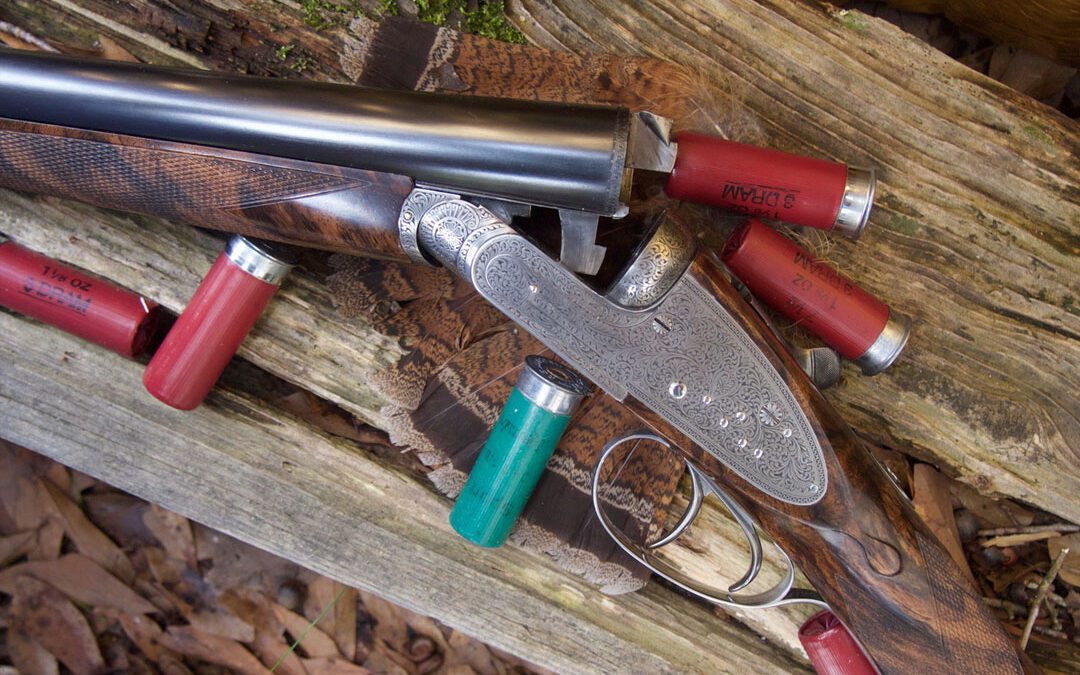
I’ve done the same for my 12-gauge custom built by Todd Ramirez. At 6 1/4 pounds with 30-inch barrels, it is the most satisfying gun that I’ve ever owned. Choked quarter and half, it’s versatile enough to handle almost anything and, when I’m shooting for my own pleasure, it’s the one that I most often grab.
The gun had its genesis in a bull session that Todd and I were having in his shop. I was expounding on “The lesser lights of the English trade.” It’s one of my favorite subjects. There are many makers in the English trade who made guns that range from “exquisite” to “best quality” that never achieved the fame of the Purdeys or Hollands. One of them was the firm of William Evans, and that’s the one we chose when we agreed to prove the theory.
It took me several months to find the right one. Finally, it turned up at Kirby Hoyt’s Vintage Doubles establishment in Oregon and, after a short negotiation, I had it shipped to Todd’s shop in Alba, Texas, where we soon got the project underway.
Since the gun was already sound and the stock solid, we used the existing stock for a dummy. The first step included a couple of days at Todd’s shop where we worked out the stock fit. We took the Evans out to his range and fired a few shots on target, then we went inside and immediately made the required adjustments. We repeated the process a couple of times until the gun shot exactly where I looked, after all, it’s the “holy grail” of shotgunning to have a gun that’s just as much a part of you as your arm, then you just point and shoot. Once the gun fit perfectly, we lightened the stock a little bit at a time until the gun balanced to suit my personal preference.
After I left, Todd rebuilt the gun mechanically to new specs and built a new stock from a gorgeous piece of Turkish walnut to match the dimensions of the original (as modified). In the end, we thoroughly proved our point, and the gun is simply breathtaking! Most of all, it’s MY gun. Totally bespoke. Made for me and me alone. It looks like a million bucks and shoots the same way. And it only cost a fraction of an English “best!”
Do I have other shotguns? You bet, but these are the guns that I shoot on my own time, and they fit the bill just fine.