
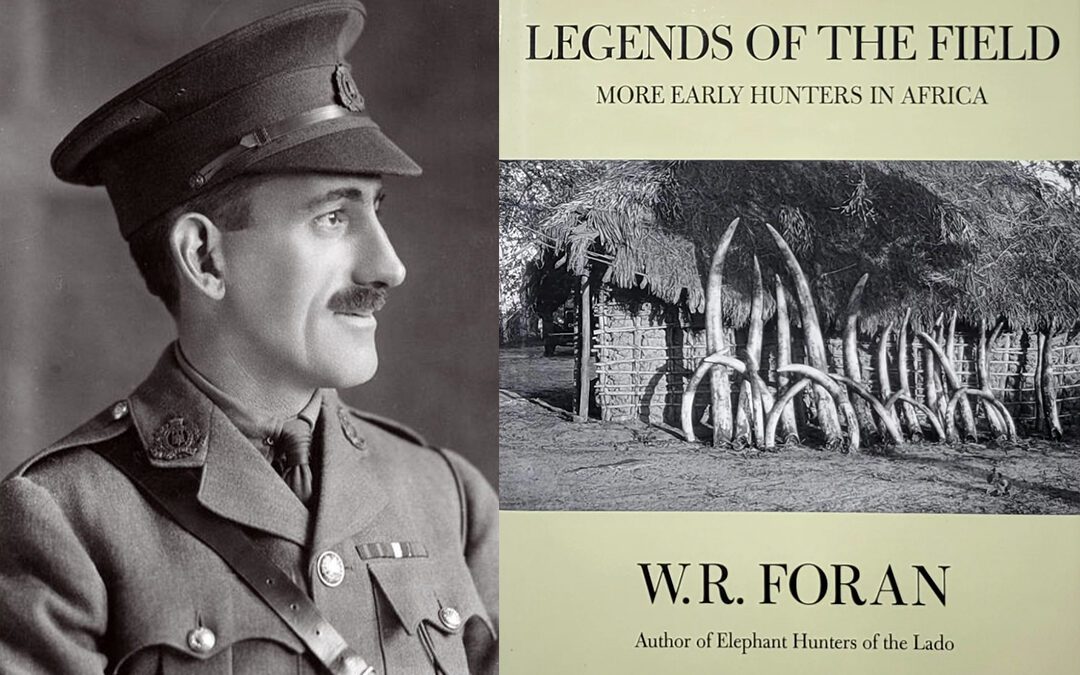
A few months back I received an e-mail from a book collector/dealer asking me a question that immediately raised a question of my own. The essence of his inquiry involved a photocopied collection of a series of syndicated columns written by W. Robert Foran under the general title “With Roosevelt in Africa” and published widely in American newspapers. He wondered whether the columns were ever turned into a book. I am pretty sure the answer is “No,” given that I’ve never seen such a title and cannot find one listed anywhere.
However, a list of Foran’s many publications at the front of his autobiographical A Hunter’s Saga (1961) includes “With Roosevelt in Africa” as one of four works of reminiscence he had previously written, and that is repeated in Legends of the Field. I’m strongly inclined to think this is a ghost title, but if any reader knows of the actual existence of such a book, I would be most appreciative of any relevant information.
The inquiry in turn led me to ask myself: “Why have you never written a column on Foran?” I knew that there were a number of his works on my shelves and that led me to further research and ultimately, this column. He was a prolific writer, did some fine and enduring stuff on great African hunters, dabbled in fiction, wrote the first (and to date only) biography of noted explorer Verney Lovett Cameron and produced several books covering his own hunting adventures. On top of that, he was the most important “on the scene” (part of the time—medical problems kept him away for a time) reporter involved in Theodore Roosevelt’s grand post-presidential safari in Africa.
Over the course of a career characterized by the kind of exploits in far-flung reaches of the British Empire we more commonly associate with the Victorian era than a later period, Foran (1881-1968) visited a great many places, sampled varied sport, experienced brutal military action and wrote a great many words. He was a renowned big game hunter but arguably is better remembered for his acquaintance with the icons of African sport. He knew many of them, wrote about them, and did so in especially meaningful fashion because of his own first-hand experience connected to their exploits.
After training at the “proving ground” for men who saw service in outposts all across the globe where the Union Jack flew, the Royal Military College at Sandhurst, Foran saw active duty in the Second Boer War and achieved the rank of major. Afterwards he moved to Nairobi, ostensibly with the idea of becoming a farmer in the verdant Kenyan highlands, but in short order he became one of the original six officers to take up leadership positions in the British East African Police. Then came involvement in Roosevelt’s grand African adventure. Evidently Foran had, by that time, established a solid reputation, because subsequent blurbs regarding his knowledge quote TR as saying: “Send for Foran.” On the other hand, there is no mention whatsoever of Foran in the former president’s books growing out of the safari, African Game Trails or Life Histories of African Game Animals. It seems fair to indicate, absent any concrete evidence to the contrary, that Foran was in essence part of the press entourage anxious to keep abreast of everything TR did as opposed to someone, such as famed hunter Fred Selous, who figured prominently in plans and preparations for the massive undertaking.
Not long after conclusion of the most spectacular of all TR’s hunting adventures, the European world found itself in the throes of The Great War. According to Tony Dyer, in his Foreword to Foran’s posthumously published Elephant Hunters of the Lado, the soldier was horribly injured in World War I “with half the side of his face shot away.” For the remainder of his life he had difficulty speaking. Apparently a mental breakdown brought on by a combination of factors—seeing his gun bearer killed by a rampaging elephant while they were out after ivory, endless frustration with the sheer madness of dealing with clueless London-based civil servants who understood nothing of on-the-ground realities in the heart of Africa, and dealing daily with extraordinarily stressful circumstances drove him over the edge. According to Peter Capstick, who writes about this aspect of Foran’s career in his biography of Richard Meinertzhagen, Warrior, the upshot of this was abrupt termination of his military endeavors and a return to England for recovery.
Foran never again hunted elephants, but once stability returned to his life he returned to Africa and it was his home for much of the remainder of his years (he died in Nanyuki, Kenya). By the time Roosevelt was planning his grand African adventure, Foran had in effect reinvented himself and launched a new career as a journalist. He would write prolifically, with most of his material dealing with sport or travel, for many decades. He was especially prolific in the 1930s but continued writing to the end of his long, adventurous life. Among Foran’s endeavors was a stint as a travel writer under the auspices of the National Geographic Society, and it seems logical to conclude that his dispatches from TR’s safari, together with the subsequent series for the Newspaper Enterprise Association launched in the mid-1920s, drew the Society’s attention. Also, Foran had found other early outlets for his writings including “With Roosevelt in Africa” in a 1912 issue of Field & Stream magazine. It took a couple of decades for him to hit his full stride as an author, but from the 1930s onward to death and beyond, with several important books appearing posthumously, he was a major contributor to hunting and travel literature. Many of his works comprised material, usually considerably expanded, originally published as magazine or newspaper pieces.
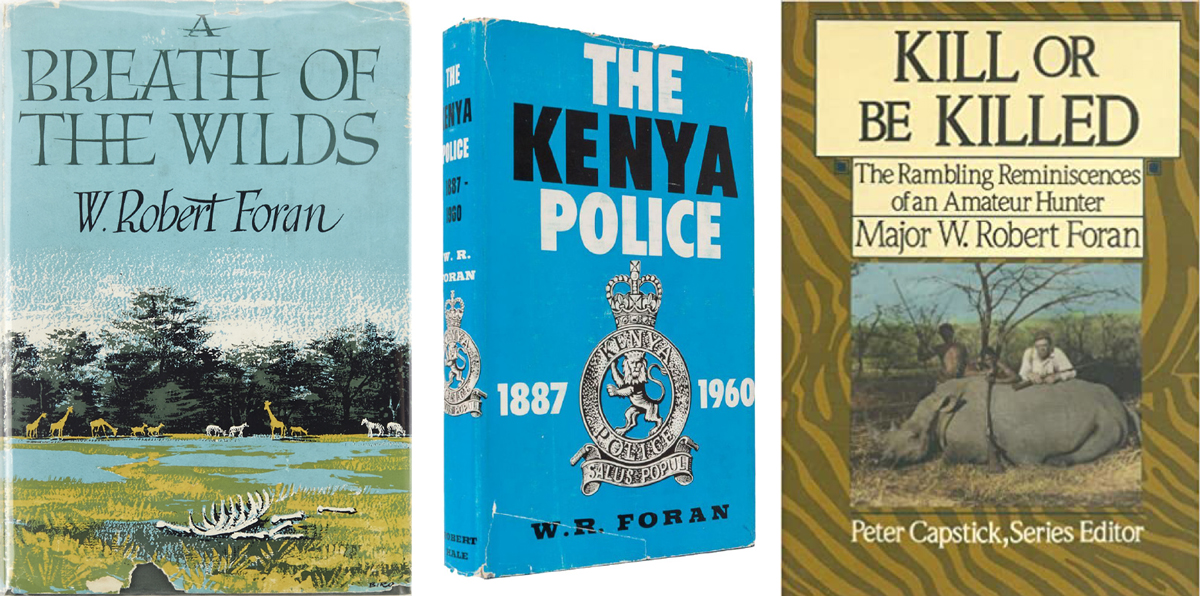
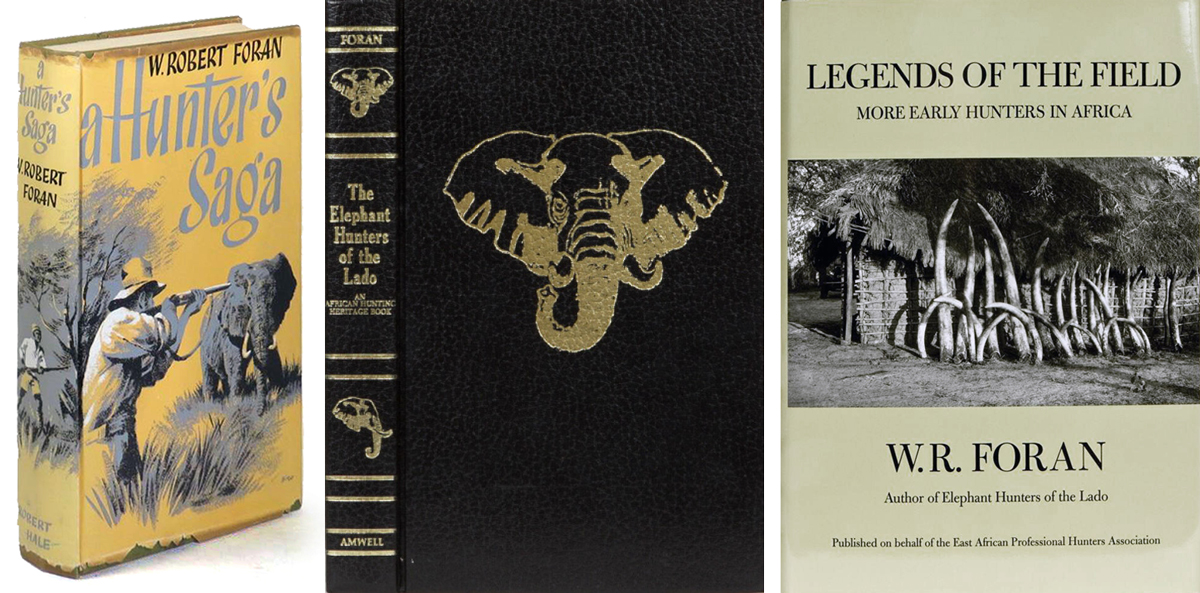
His hunting, adventure and historical books, in the order of their original appearance, include Elephant Hunting—The Classic of Sport (1913—a pamphlet originally published as an article in Outdoor Life), Kill or Be Killed (1933—reprinted as a volume in the Capstick Library, 1988), Malayan Symphony: Being the Impressions Gathered During a Six Months’ Journey Through the Straits Settlements, Federated Malay States, Siam, Sumatra, Java, and Bali (1935), A Cuckoo in Kenya: The Reminiscences of a Pioneer Police Officer in British East Africa (1936), African Odyssey: The Life of Verney Lovett-Cameron (1937), Changing Horizons: Being Pages from My Scrapbook Covering Over Thirty Years’ Wanderings Up and Down the Seven Seas (1937), A Breath of the Wilds (1958), The Kenya Police 1887-1960 (1962), A Hunter’s Saga (1963), The Elephant Hunters of the Lado (1981—limited and numbered edition of 1,000 copies signed by Tony Dyer and Jim Rikhoff; reprinted in 2007 by Safari Press), and Legends of the Field: Famous Early Hunters in Africa (1997—limited, numbered edition of 1,000 copies signed by Anthony Dyer and Tony Archer).
He also wrote a trio of books for a youthful audience, Fifty-two Tales of Wild Life and Adventure (1935), Transport in Many Lands (1939), and Animal Mothers and Babies (1960) along with half a dozen works of fiction. The latter include The Border of Blades: An Anglo-Indian Romance (1916), Roshanara of the Seven Seas (1932), Drums of Sacrifice (1934), The Path of Ivory (1934), Watchers in the Hills (1935), and The Land of Fear (1937).
For the hunter or collector of Africana, Foran’s works dealing with Africa are the ones you particularly want gracing your shelves. That is particularly true of Kill or Be Killed in the original edition and the limited editions prepared from the unpublished manuscripts he left when he died. His coverage of key names in the annals of African hunting—Cotton Oswell, Fred Selous, Sam Baker, Karamoja Bell and others—are of particular note thanks to the fact that his shared experiences gave him rare understanding, even empathy, of the dangers they faced and the exploits that were hallmarks of extraordinary careers.
Long a resident of the Sportsman’s Arms Hotel in Nanyuki where he could enjoy sundowners on the veranda and relive the glories of days gone by, in his 88th year Foran ordered a properly chilled bottle of champagne, toasted his long and fruitful career and died. He left some of his literary remains to Tony and David Archer including unpublished manuscripts that in time became Elephant Hunters of the Lado and Legends of the Field. The Archer brothers in turn eventually donated them to the East African Professional Hunters Association Trust Fund after sport in Kenya went to hell in a handbasket in the late 1970s. Presumably those now form a part of the collection now held by the University of Florida Smathers Libraries, although the contents list notes only a single Foran manuscript, “Things Seen.” It is likely a detailed search of the material, housed in 32 boxes, would reveal appreciably more. One thing is certain, for an enterprising and meticulous researcher, much remains to be learned and shared on the life of W. Robert Foran.