
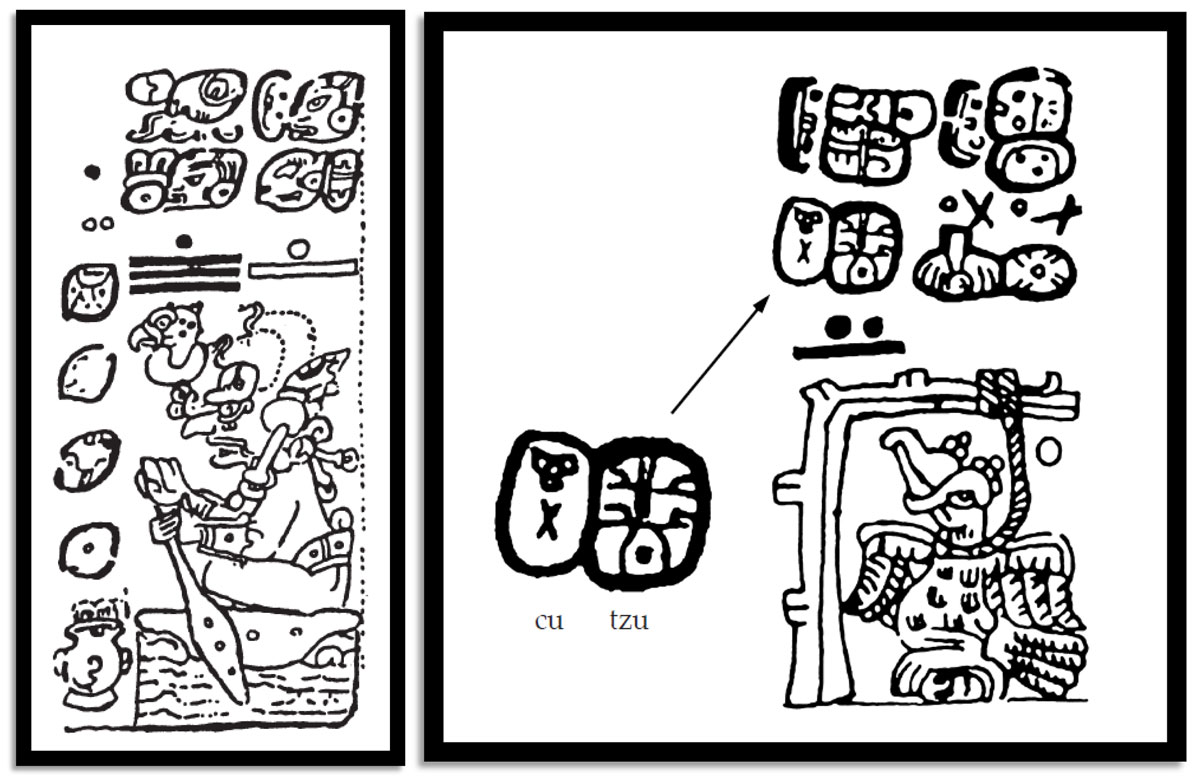
It is said that in the early days of the world, the ocellated turkey (Meleagris ocellata; in Maya, Yuum kuutz) was a bird of pedestrian plumage with a melodious voice while the nightjar (Antrostomus badius; in Maya, Pu’ujuy) was clothed in resplendent finery. So, Kuutz approached the nightjar with a proposal: if Pu’ujuy would give to the turkey his glorious clothes and nominate him to Nohochacym (“Great Ancestor,” the creator-destroyer who will end the world in the last days) to be King of the Birds, then the nightjar would be richly rewarded. The deal was struck and Kuutz wrapped himself in the lustrous, copper-fringed cloak of shimmering cobalt and emerald, the ocelli of his fanned tail gazing out on his avian dominion. But the turkey was selfish, or forgetful, and denied the nightjar his reward. In revenge, Pu’ujuy cursed Kuutz, transforming his lyrical song into a guttural series of rattling thumps.
Not that I could have heard the turkey’s call even if it had been Gabriel’s trumpet sounding the Last Judgment on that Easter Sunday evening. The rain was falling in sheets, water pouring through every seam of the pop-up blind. The tent roof and the portal shields that shrouded the see-thru screens became expansile basins – every few minutes, I would raise my hand against the collapsing ceiling and send the nascent lake hanging above my head cascading down the side.
“No te muevas,” whispered Noe, my long- suffering, Spanish-speaking guide. Of course, I speak Spanish about as well I speak nightjar, so I simply responded with a vacant smile and returned to decompressing the bulging reformed reservoirs.
Fifteen months earlier, and quite a bit drier, my two buddies and I were walking the aisles of SCI Nashville 2025 when we came upon Arturo Malo’s Baja Hunting booth. Arturo has offered upland wingshooting, waterfowl hunts and peninsular blacktail safaris for 35 years on land near his home in Estado Libre y Soberano de Baja California.
Some years back, he expanded to the Yucatán state of Campeche, and one can now pursue ocellated turkey, brown brocket deer, javelina, great curassow and crested guan from his camp situated at the end of a two-track trail where the impenetrable jungle opens into wide, flat fields of milo and maize that would not be out of place in Manitoba or Saskatchewan. Would not be out of place, that is, if the April temperatures and humidity in the Canadian prairies ran north of 35C and 95%, respectively.
Arturo’s Yucatán camp is quite comfortable, if not exactly luxurious. Cabins without walls form the basis of the accommodations: concrete floors support air mattresses, the sleeping spaces enclosed by mosquito-netting and sheltered from rain by tin-covered trusses raised at the corners on wooden posts. There are gravity-fed showers for freshening up at day’s end, hammocks for the obligatory mid-day siesta, and a large, covered communal dining area. The food is exceptional, hearty and filling with a bit more spice than we are accustomed to in British Columbia.
During the week, we dined upon the full menu of our quarry species. Arturo prefers that hunters not try to bring firearms to the Yucatán and provides shotguns to all who require them. He does relay a suggested kit list, one item of which I will highlight. Baja Hunting’s equipment inventory mentions rain gear as “optional,” and says that precipitation is rare. I beg to differ.
On our trip, we had flown from Vancouver via Mexico City. We left Canada (minus 2C) around midnight on Aero Mexico, arrived at 6:00 a.m., and almost cleared Mexican customs without incident. Almost. Ever the agent provocateur, I was the last of the three of us in the security queue.
The kind and officious gentleman on the far side of the baggage scanner politely pantomimed that I should STAY RIGHT WHERE I WAS while he scrutinized the contents of my backpack. No problem. I knew full well that they were probably just having a bit of difficulty scanning through my phone and computer cords, power banks, headlights and rechargeable flashlights. The computer itself was in a separate bin, with my wallet, passport and belt. Nothing else in the backpack but a neck pillow, a BC Lions quarter-zip, a couple notebooks and a history of the battle of Vimy Ridge.
Forty minutes later, my new best friend was still deconstructing my backpack. We had successfully ascertained that neither pens nor pencils nor even Canadian pocket change presented a real and present danger to the safety of my fellow travelers. However, it was clear to the gentleman directly opposite me, and his two colleagues who now attentively stood watch just over both of my shoulders, that I was clearly hiding something . . . something sinister . . . deep in the recesses of my now zip-filleted backpack.
“Los llaves allen?” Without a clue as to what he was saying, I asked him to type it into my phone.
Nope. Although I did have a friend named Allen in grade 3.
And here I learned an important life lesson. It is best NOT to employ the humor of subtle word-play in the security line of a country where you are not a citizen and are not conversant in the national language. Just a safety tip.
Rescanning the empty backpack proved that it was . . . empty. Using methods that may well have been banned by the Geneva Conventions, the security forces cleared Vimy Ridge. The neck pillow posed no threat, nor did the BC Lions. My story notebook was fine, but what might the dark materials be which lay hidden in my reloading notebook?
“Los llaves allen?” Allen wrenches. Oops. In a small Ziplock bag taped to the inside cover of my reloading notebook, I keep a selection of 1 and 2mm Allen wrenches, each shorter than my little finger, so I can adjust red dots and riflescopes at the range.
Yeah . . . I forgot about those.
“Prohibido!” Out came all FIVE (!) of the faceted implements, shedding malevolence from every nefarious facade. Older, wiser and short a handful of hard-to-source tools, I rejoined my buddies – who had applauded the entire Customs burlesque – from a safe distance.
After that, all that was left was the nine-hour layover.
The rest of the trip was great. Arriving in the UNESCO World Heritage city of Campeche, we found our hotel on a shaded square flanked by colonnades of pastel stucco, had a great meal of pulpo intramuros and pámpano en verde, then collapsed into bed to dream of strutting turkeys.
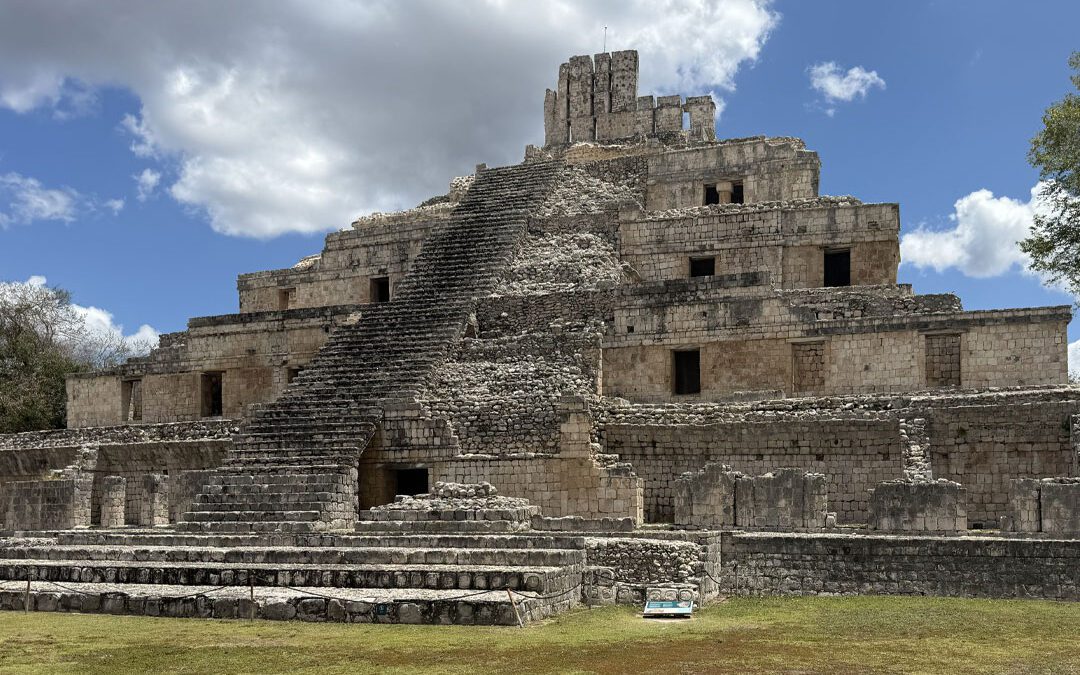
The next day was spent at Edzná, a Mayan city whose bleached limestone glyphs are slowly emerging from half a millennia wrapped in the jungle’s verdant embrace. Beautiful, awe-inspiring – and empty of tourists. A hidden realm, nearly as uncharted as Bingham’s Machu Pichu, and very much an archeological work in progress.
The next day, Easter Sunday, the bells of Nuestra Seňora de la Immaculata Concepción Cathedral rang out to call the faithful to celebrate the season of rebirth. At the crack of dawn. Arturo picked us up about 11:30 and by 2:00, we were in camp. The sky was clear and the humid air temperature a balmy 34C. Time for an evening blind sit, but,\ are those rain clouds off to the north? Not to worry . . .
My quarry that day, as sopping afternoon sluiced into sodden twilight, was none other than the heraldic harbinger of Chaac, the god of rain, lightning and thunder. And, let me tell you, Chaac was giving the region around Pich, Campeche, Mexico his all that day.
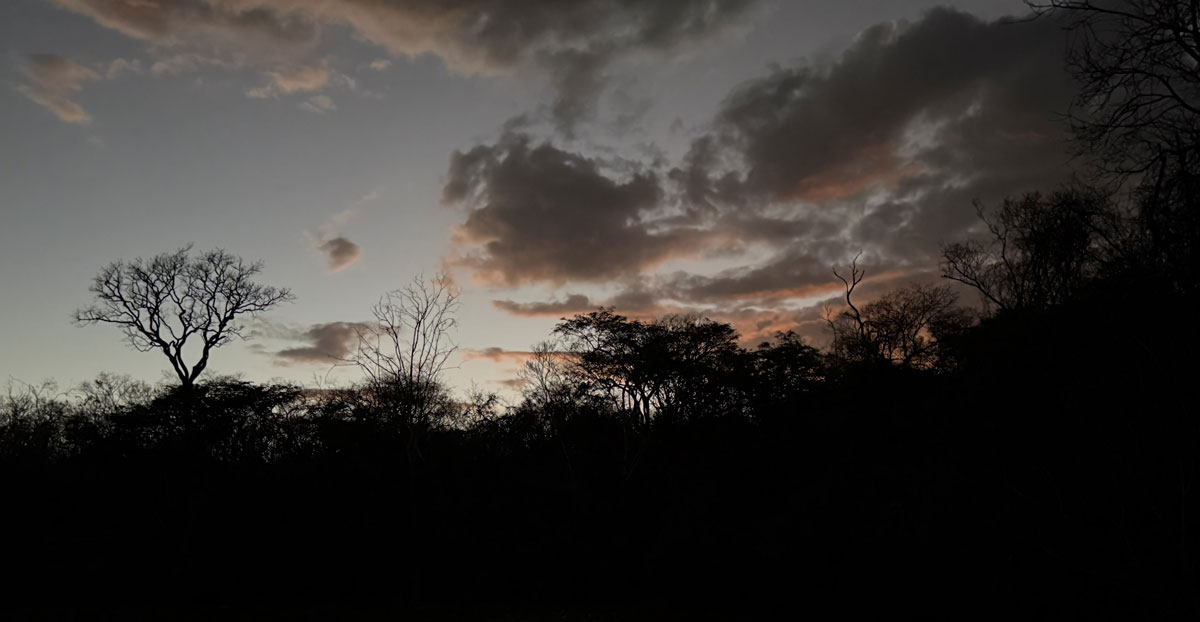
When I was a boy, we were told that if you counted the time between seeing the lightning’s flash and hearing the crash of thunder, you knew that, for each passing second, the bolt strike was at least a mile away. That memory was quite comforting at 4 p.m. when the storm descended from the north and I could reassure myself (“one one-thousand, two one-thousand . . . .”) that it was perfectly sensible to be sitting on a table-flat plain beside a 20-meter Ceiba tree at the edge of a cut-over milo field and huddled under a nylon tarp stretched over an aluminum frame, while holding four feet of Cerakoted steel fire-stick.
By 5:00, my one-thousands had dropped from six to two. Around 6:00, I wasn’t even making it to the “-thousand” part. I tried switching to “Mississippi’s” to see if the unfamiliar geographic reference might distract the Thunder God. No luck. Then, to drive home his point, Chaac brought out his A-game and unleashed the sheet lightning and thunderclaps simultaneously.
Noe, who was a lot braver than me in any language, stiffened visibly – or as visibly as one can stiffen under a shrink-wrapped pergola being buffeted by a twilight tempest, “Pavo!”
Sensing that his blind-mate was an idiot as well as a wimp, Noe translated, “Turkey!”
Since my mother tongue, English, is not given to assigning genders to things like nouns, it didn’t dawn on me that “Pavo” was different than “Pava,” so I queried in my most erudite voice . . . Tom?
“Si, macho.”
I turned my head, very, very slowly. “No te muevas!”
Well, that ain’t gonna work. Turns out it didn’t matter anyway. I would have had more luck trying to spot a turkey scuba diving at the bottom of the river currently known as the Mississippi.
How far? “Setenta.” Back to the vacant smile.
Afraid to pivot and incapable of asking even the simplest question, I returned to trying to squeeze a four-syllable state’s name into the one-syllable interval that Chaac was now trailing between light and sound. That seemed to be working until the floor of Lake Ameristep began to press down on my hat, again.
“Cincuenta!” By now, I had mastered the vacant smile and begun to work on the blank stare.
“Cuarenta y cinco!” Now there was a word I knew – “cinco” – like that “Ocho Cinco” guy, who played wide receiver in Cincinnati. If only I knew what the first part meant or had bothered to download Google Translate.
Maybe I should count shorter rivers? How about “Ohio’s”?….
“Cuarenta! Shoot!”
Huh? I decided it was better to ask forgiveness than permission and turned my head to look out the now-open window. Through the Yucatán atmospheric Niagara, I could just make out a blue blob bobbing in the milo. Looked like a long shot but . . . ”SHOOT!!”
Now, maybe this isn’t the best time for a digression on the challenges of taking firearms through Aeropuerto Internacional Benito Juarez. So, I won’t make one, but I did mention earlier that Arturo had provided the shotgun, a Benelli Super Black Eagle 2 – and, due to ammunition importation restrictions, had supplied me with a total of three shells, 3-inch Winchester XX #5s. Without enough ammo for pattern-checking and, not being facile with the Crio Plus system, I had not been able to figure out how the gun was choked (turns out, it was light modified), or where the shot string might fly when I pulled the trigger.
“SHOOT!”
I slipped the barrel through the open portal. (Cue the lightning.) It was getting dark, or maybe I was momentarily blinded by the flash. Old Yuum Kuutz out in the milo field did not seem to be one bit concerned about the tooth-rattling thunder, nor did he appear uncomfortable in the semi-aquatic environment where he was feeding.
“SHOOT!!!”
Oh well, Chaac hates a coward.
Boom! Down went the tom, flailing a bit in the ongoing deluge. I flicked on the safety and began to pull the Benelli into the blind. My plan had been to lean the gun against the tent wall and turn to shake Noe’s hand. But the best-laid plans don’t always take into account the lived experience of expert guides, or the incompetent communication skills of old Canadian hunters. Before the shotgun was fully back inside, Noe had reached down and grabbed the base of the blind.
With what appeared to be a practiced deftness, he flipped the tent into the air and sprinted toward the weakly splashing bird. In so doing, he fundamentally changed the forces acting on the one hundred liters of water cradled within the sagging tent ceiling. Gravity, which had heretofore been fighting vertically to keep the Mossy Oak aquifer within its plastic borders, now switched sides and drained the sinkhole in an instantaneous inundation. An inundation that released its torrent straight backward, directly onto the tallest thing in the area – the head of the seated grey-beard holding the firestick.
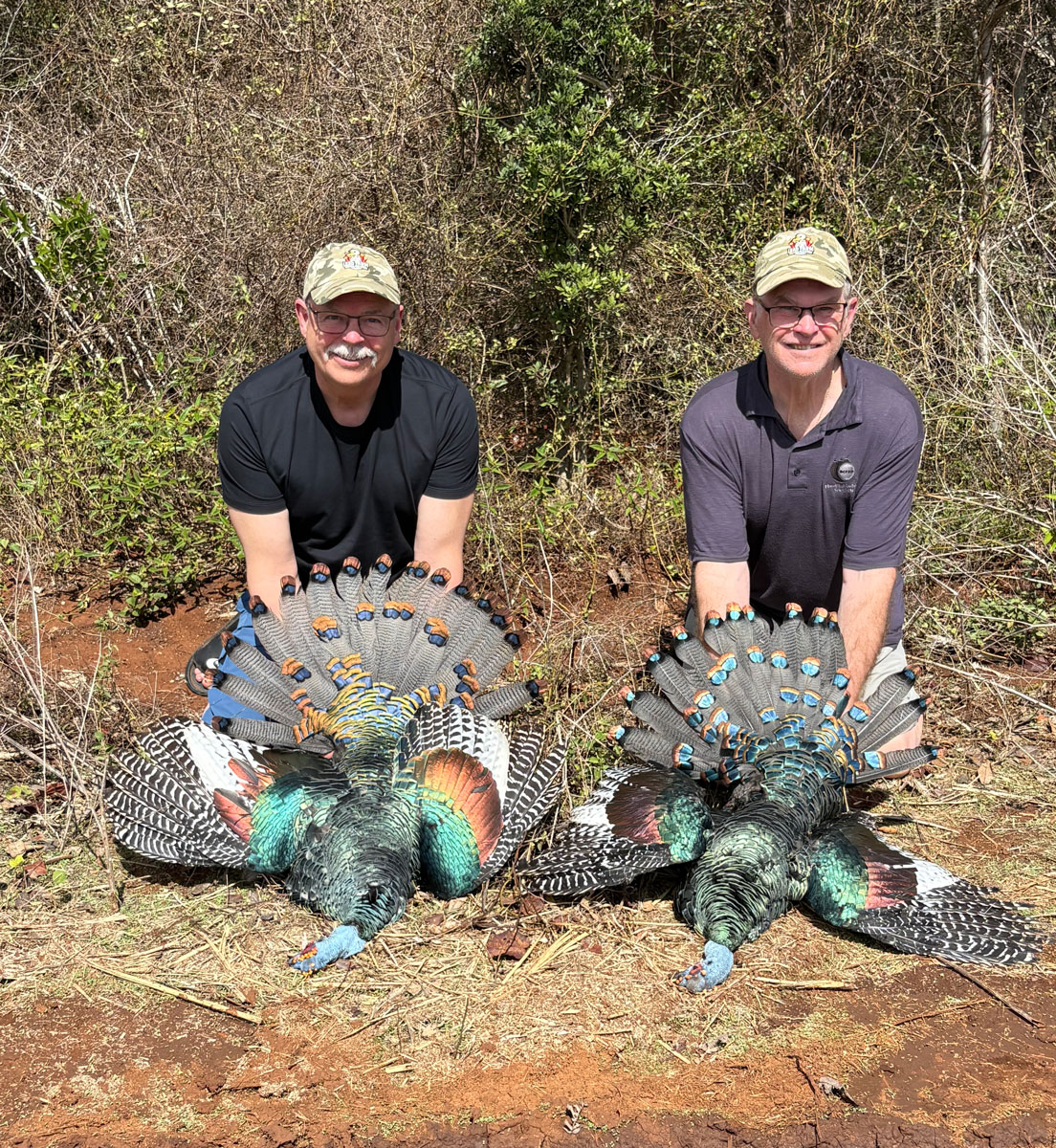
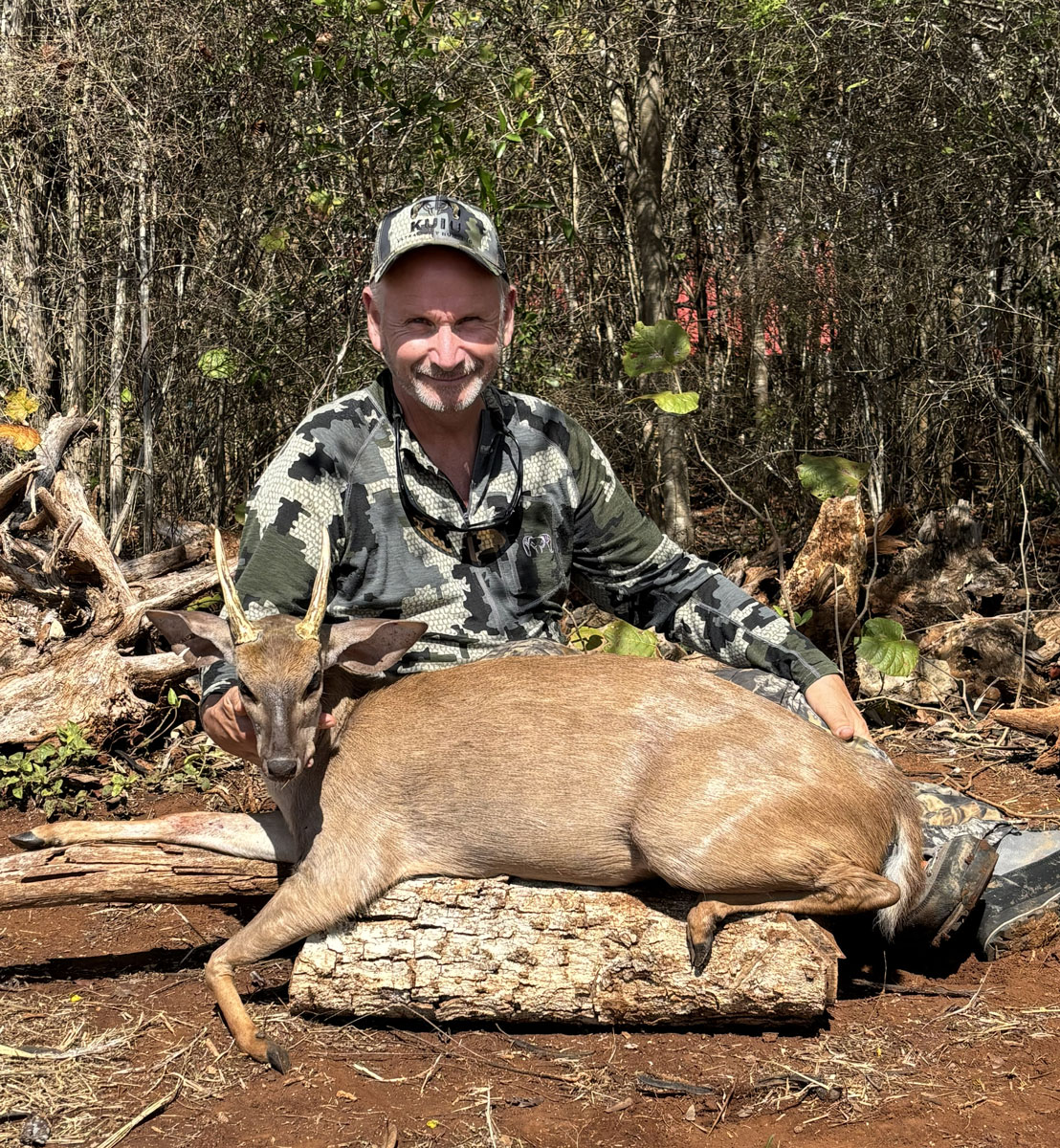
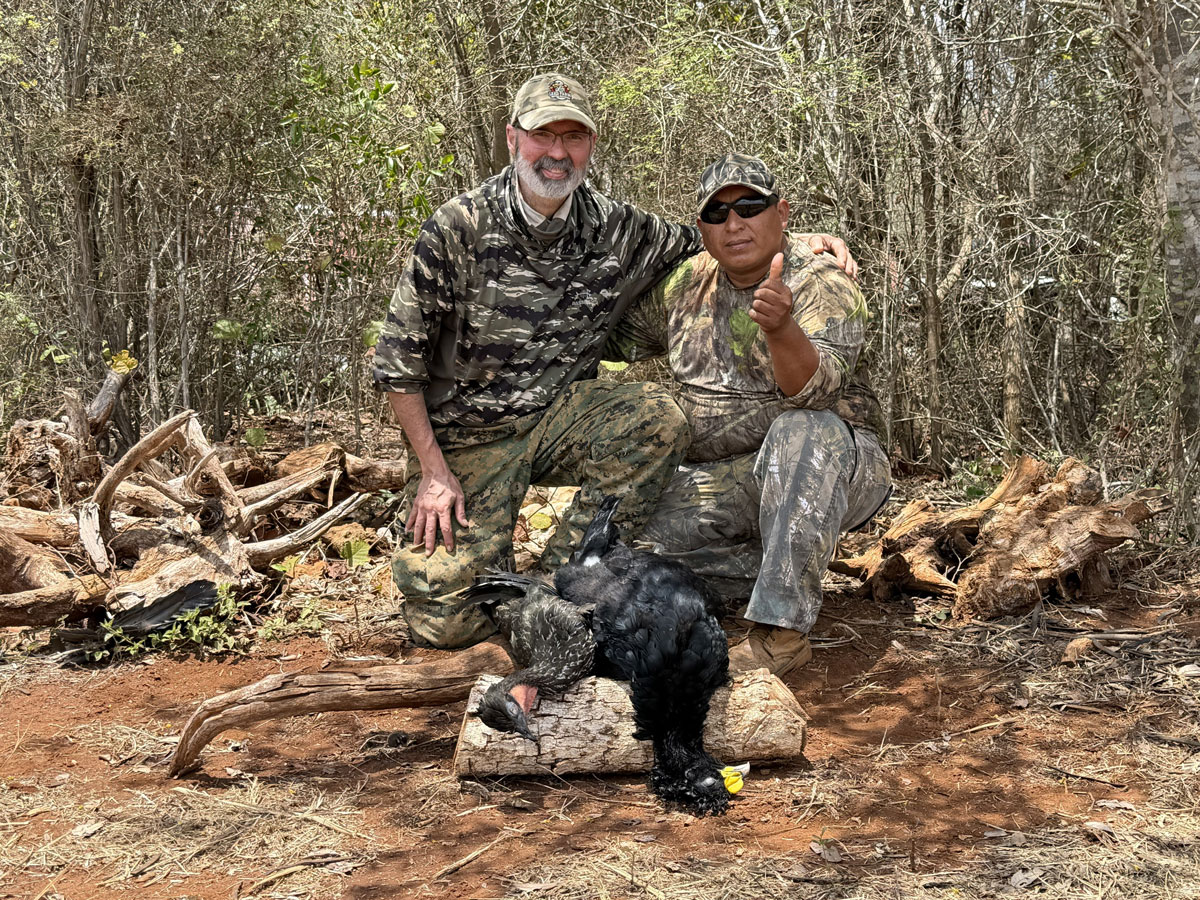
Chaac kept up his antics for an additional 12 hours, but after dropping off enough agua to float the Chicxulub meteor, he seems to have lost interest in us. My buddies both collected great toms – one lucky scoundrel collected two. Another hunter in camp took a tom and a brocket deer, and I managed to catch up to a great curassow and a crested guan. But those are stories for another time.
For two full days, Chaco, the prep-master in camp, waited for my turkey to dry enough for decent pictures. Finally, on the afternoon of the second day, he pulled out the heavy artillery and spent an hour with a battery-powered blow dryer and a fine paintbrush delicately fluffing every feather into its proper place. Truly, an artist at work. And time well spent, for Yuum kuutz takes the breath away — beautiful beyond the scope of language, an avian monarch, crowned in jewel-encrusted azure and royally swathed in the iridescent jade of his cerulean robe, his 4cm spurs the fitting armaments for a king.
Oh yeah. I finally patterned that shotgun. On the trunk of a Napche tree. While another kuutz strutted by at 20 yards. I’m pretty sure Noe is still laughing.