
I turned 16 in July of 1966. Kent Wellerby, Mr. Reed’s farm manager for as long as I could remember, took a string of Red Oak dogs every summer up to the prairies of North Dakota in Divide County. The August and September weather was much cooler there than in Mississippi, and young prairie chickens flushed just right to break Mr. Reed’s derbies. By the time Kent would show back up to Amite County in early fall, the dogs only needed a little polish. It wasn’t a little matter however, when Mr. Reed asked if I would make the trip with Kent that year. It would mean missing the first few weeks of school, a sore subject for Mother. It would take more than a little polish to convince her.
Mr. Reed started at the church’s July 4th picnic. “It’ll be very educational for the boy, I assure you,” Mr. Reed told Mother. “You know, my grounds up there are located right on the Continental Divide, and at night in September you can see the borealis.”
Even with little or no education Mother was the smartest person I’ve ever encountered. “He needs to be able to spell borealis, too,” Mother politely offered. “Can you spell borealis, Mr. Reed?”
“Ms. Sharp, I’ll speak with his teacher and have his studies sent with him. And I’ll have him back before the end of September,” said Mr. Reed. “He won’t miss a thing. I’ll see that he makes it into Canada. Ever see the prairies of Saskatchewan, Ms. Sharp? Those prairies just roll on like waves in the ocean, seems like they go to the end of the earth and just drop off.” He was descriptive and very eloquent, but it fell short with Mother.
“The earth isn’t flat, Mr. Reed. You learn that in school not behind a dog.”
We left it alone, but the seed had been planted. Later in July, on my birthday, Mr. Reed arranged for Ms. Priddy to stop by. She tilted the scales in our favor. “Sybil, I think it would be a good experience for Lane to spend some time in another part of the country. Especially if it becomes a school assignment. I’d say,” she continued, “that if he can manage to bring back, oh say, a 10-page journal of his trip and experiences, he will be, might even be, ahead of his classmates.”
Mother didn’t have a response. I sensed it wasn’t all about schooling. We were close, very close, and when leaving day arrived, who knew, it might very well be that I would be the one backing out. Other than my short stay in the hospital, we had never been apart.
But leaving day came and I didn’t back out and Mother wished me good luck. She drove me to Red Oak that morning well before daylight. It wasn’t a long goodbye. “Goodbye, Mother. I love you,” were my words.
Her words, however, have never left me. “Take me with you, Son, wherever you go. I won’t take up much room. I’ll only need a corner of your heart.” Mother was peculiar that way, peculiar in how she often spoke. Unlike most folks around, Mother spoke in colors and images, and in sounds and smells. She didn’t speak to you, she spoke into you. That summer I learned that I was peculiar in much the same way, but not in how I spoke.
My first entry read: Monday, August 1, 1966. 6:15 headed out. After we crossed the Mississippi in Memphis we were in farm country all the way. We stopped regularly to walk and water the stock, and spent the first night just south of St. Joseph, Missouri. Starting to see a lot of cottonwood trees, they shimmer in the breeze.
We made the trip with no failures. All went as Kent had planned. We arrived at camp after dark on the second day and chained dogs and tethered horses for the night. The old farmhouse was dusty, but it slept well.
Keeping a journal didn’t go as I had figured. I couldn’t think of what to record. Just horses and dogs and wide open country.
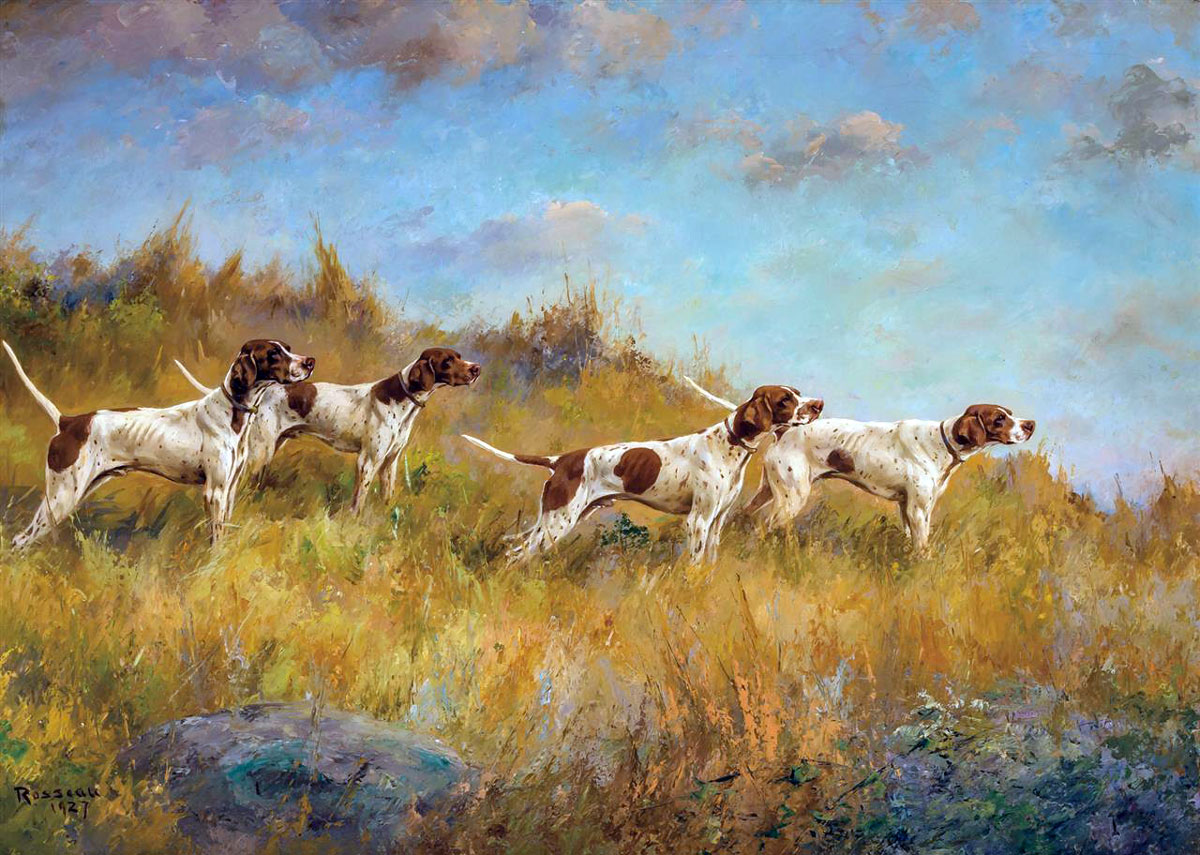
Pointers on the Hunt, 1927, Percival Rosseau, oil on canvas, 23 x 32 inches.
On our fourth day my entry simply read: Thursday August 4…very chipper in the morning, like a late October day at home, no frost, just breezy and cool. Dogs getting used to the dry country. We run them by ponds, the people up here call them potholes. Finding pheasants and chickens in the valleys. They call those bluffs. They aren’t bluffs, just groups of trees. Met the Lurvicks yesterday. The Lurvick family owns a farm nearby. It’s called “Hus Av Stein,” Norwegian for “House of Stone.” They are Very nice people.
Buck was by far the best derby we had. He was an orphan pup I raised and sold to Mr. Reed. As a yearling pup he sailed around the fields and through the big yellow pine timber of Red Oak. I was anxious to see the prairies and what Buck would look like on them. He did not disappoint. He seemed to be like me, exhilarated in the wide open country. It excited him and me. Our gaited horses were in full stride when Buck was released. He stretched to full length with every bound, nose in the breeze and eyes searching for the next bluff. He learned quickly that’s where the birds were.
When I first began the journal, I doubted 10 pages would result from my slight entries. As the days passed though, slight entries evolved into easily written pages. I surprised myself, especially when I directed an entry toward Mother.
One entry began: Dear Mother, I do miss seeing you and sampling your apple pie, however I am having a wonderful time. Of course you know all of this because I’ve brought you with me, haha. You have, however, taken more room than you requested.
Vayne Lurvick is a stone mason, a “journeyman” he says. He is home now having just finished working on a cathedral in St. Paul. He tells me (because I asked) that a journeyman in any trade can travel the world working, but only if he is a true journeyman. He will be found out very soon if he isn’t.
He is a very interesting man who no doubt knows his trade. They set large stones, chiseled to fit perfectly against another. The stones weigh as much as a ton each and are lifted by boom and rope threaded through pulleys called block and tackle. I would like to see that cathedral some day and I think I would like to be a journeyman. I do not know what trade.
We divided the dogs into two groups, and ran each group every other day. Dogs were then paired and ran for an hour or more each time down. My job was to ride as an outrider. I rode to one side and then the other as needed to turn dogs toward the front if they strayed to the side or in rear, continually pushing the derbies toward the front, scolding them if they ventured anywhere beyond the imaginary 10 to two o’clock positions. Kent handled the dogs, singing to them, encouraging them to hunt in a forward pattern. He would sometimes turn suddenly to teach the dogs to sweep out around the clock face and gain the front again. Some picked it up, some never did. Buck always did.
After a month, we had a good idea which dogs would make field trial competitors, and which would not. The ones destined for competition got the most attention. Those I began to yard break. I set them up on wooden benches one at a time and curried their tails and whispered, barely audible, “wup.” A week of this and I could turn five loose on the prairie and, with the same “wup,” stop all five in their tracks. It was a beautiful sight, five rangy pointers belly deep in the waving broom straw, all pointing, posing, at my command.
Part of a September entry read: Starting to stay cool all day now. Buck is really showing well. He finds birds and runs to the front, way to the front. He often is seen at a distance of what I can easily say is a mile away, but a rider can’t lose him. He seems as fit for this wide open country as he does in our tight country at home. He is really turning out well. Kent says Mr. Reed is flying up to Minot next week to watch him in the Saskatchewan Open.
Mr. Reed arrived at the Minot airport for our last week of training. Kent was there to pick him up. I stayed at camp, cleaning the dog barrels and spraying for flies.
An entry told of that day: Mr. Vayne visits regularly and I am always eager to see him. Today he came to say goodbye. He is headed to St. Louis. There he will supervise the masonry and granite construction of a large new hospital. Masons, he tells me, will arrive from Chicago, New Orleans, Denver and various other places spread out across the country. I quizzed him as to how he knew all those people? How do you know if they are journeymen? “We all speak the same language,” he said. “Line, not string; rowlock, header, stretcher, shiner, hahaha,” he laughed. “I can spot a ‘boot’ the first day just from which end he pulls the line. Go anywhere in the world I tell ya.” His Norwegian tongue curls around his words. “A journeyman will fit in any crew, I tell ya, a true journeyman. And he will know how to build a Roman arch and set a keystone and breech a Flemish bond.” Mr. Lurvick sure lives in a big world. Much larger than mine, I’m sure.
We crossed the Canadian border at Portal. From there we traveled another three hours to Moose Jaw. Field trialers have been gathering there for more than a century to see what new blood would arrive to challenge the expanses offered on her prairie. Lone Survivor, Becky Broomhill, Silver Bullet, all left their marks there. Legends of the sport, none can boast being the best of the best until they have ridden the grassy waves to the edge of the horizons and been found on point in some distant bluff. Hundreds, thousands of frauds have toed the line, but here on the prairie venue where nothing can be hidden, they were found out.
In one of my last entries, I wrote: Buck ran at midday. Hot for up here and dry. A few before him seemed like good ones, but when Buck lit off, a new standard was written. None before him nor after him came close. He had been rested for three days and today he wanted to tour the country. He did. I watched him from my outrider position and twice when he failed to show for Kent, I rode hard and found him in bluffs pointing. Each time I left him and rode to a knoll for sight vantage and waved my cap for the gallery and judges to see. Each time Kent led the galloping gallery to me and I was able to point to the big dog standing tall, pointing native prairie chicken.
Mr. Reed was happy to say the least. When the winners were announced, one of the judges asked where we all could hear, “What’s his proper name, his registered name?”
I knew he had not been properly named. He was, like me, from Amite County, away from home for the first time. “Buck” was all he knew. I knew there was a larger world out there for him and me. It wouldn’t be our last time away from home. Mr. Reed thought just a minute too long, so I spoke up. “The Journeyman,” I said loudly. “His name is The Journeyman and he can run anywhere in the world, and he’ll show the boots for what they are.”
No one said a word until Mr. Reed spoke. “Y’all heard the boy, The Journeyman.” Everyone cheered again for his performance and the newly named winner.
At school, very late in September, I thought it peculiar that I had amassed 60 pages of writing—peculiar because I was able to create something that held my classmates in awe. Ms. Priddy took the wrinkled pages and for the rest of the school year she often read passages from them to our class. She titled the work, my first, The Journeyman.