
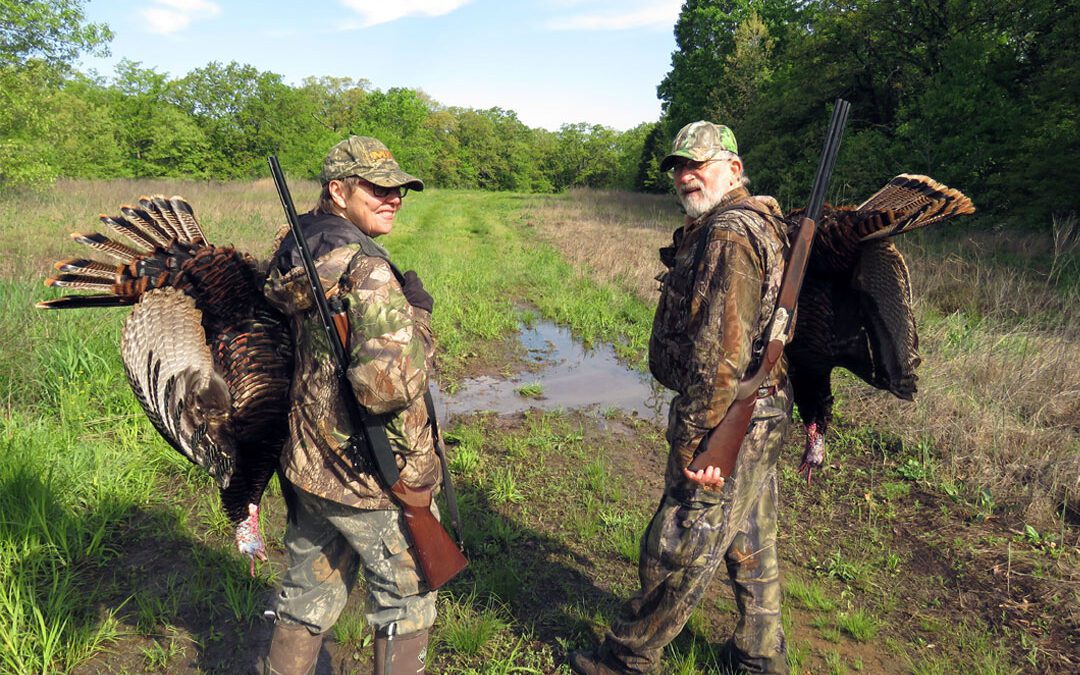
There wasn’t a turkey gobbling anywhere as I moseyed toward the log landing where Jill and I were to rendezvous at midmorning. We’d selected the spot because it was convenient, because we could both find it with no problem from where we’d each started, and because it was a good place from which to launch a late-morning Plan B hunt. Easing through the greening woods, I thought about how fortunate I was to be sharing this hunt with my favorite hunting partner on this fine April morning. Six months earlier, the odds that both of us would be here hovered somewhere between slim and none.
“Jim, this is Connie, Dr. Wright’s nurse,” said the voice on the phone. “I don’t want to scare you, but you need to bring Jill to the clinic immediately. Don’t let her drive. Stop at the drugstore on the way and pick up the prescription I’ve called in. Have her take the pill right away and come straight to the clinic. Please do it right now.”
Maybe Connie wasn’t trying to scare me, but she did anyway. Not that I hadn’t been expecting something. For several months, there’d been a gradual but profound change in my wife—a steady decline in her normally boundless curiosity and energy, substantial weight gain and a noticeable lack of enthusiasm for the outdoor lifestyle we both loved so much. A lack of enthusiasm for everything else, for that matter.
I’d always admired Jill’s work ethic and punctuality regarding writing assignments and deadlines, but those had been slipping, too. For the first time since I’d known her, she was missing deadlines and giving editors less than her best work.
But the most alarming thing was her increasing difficulty with short-term memory lapses.
“What do you want for supper tonight?” she’d ask, sitting down with her morning coffee. We’d decide that evening’s menu. Before her cup was empty, she’d say, “What do you want for supper tonight?”
I tried to convince myself these were normal functions of aging. We were pushing 60, after all, and Father Time is cruel. We all get older, fatter and lazier—or at least I do. But that memory thing was worrisome, and I nagged Jill until she made a doctor’s appointment.
After her private appointment with the doctor, I asked for a consultation. When I told him about Jill’s increasing memory problems and recent loss of vitality, he was concerned enough to schedule an MRI the following morning.
Bright and early the next day, I held the phone and heard the controlled urgency in the nurse’s voice.
“I know you’re not a trained radiologist, but that’s not required here,” Dr. Wright said when we arrived at the clinic and were ushered immediately to his office. The MRI film showed an image of Jill’s head from above, and square in the center front of her cranium was an oval tumor the size of a turkey egg. I am not exaggerating; I can show you the damn film. And the doctor was right. An imbecile could have read it.
My memory of the next few minutes is hazy. Through the blur and buzz of incipient panic, I heard Dr. Wright telling us both Springfield and Little Rock had excellent neurosurgery units. I needed to take Jill to one or the other immediately, and he’d handle the arrangements while we were making the two-hour trip. He said he could arrange for an ambulance, but that would take time and he thought I’d be able to deliver her faster. And time, he said, was of the essence.
“Don’t go home to pack,” he said, handing me the MRI envelope and ushering us to the door. “Don’t stop for lunch. Don’t get stupid and have a wreck, but drive as fast as you’re comfortable with. She needs to be there yesterday.”
The one-pill prescription, he said, was a potent anti-seizure drug, and though he didn’t say it, he was obviously thinking Jill should be in convulsions already.
We talked during the drive to Little Rock, but I couldn’t begin to tell you what we said. We arrived at the hospital at 10:30 a.m. At 1 p.m., my wife went into surgery, and I went into a tailspin.
Depending on context and situation, a minute can pass in the blink of an eye or last a lifetime. Jill was under the surgeon’s knife for 20 hours. Every one of those 1,200 minutes was a lifetime, and only the calming presence of our daughter, Leslie, who sat beside me almost the whole time, got me through. The only good news in that 1,200 lifetimes was the information a scrub nurse brought out—that the tumor wasn’t malignant.
But of course, I wasn’t the one who had it rough. While I sat in relative comfort in a hospital waiting room, Jill was on a surgeon’s table with her head cut open. She was unconscious through the ordeal, naturally, but still it was her, not me, who had a big slice of her skull sawed loose and laid down over her face like a wedge of cantaloupe, while the neurosurgeon carefully separated the huge tumor from the delicate tissues of her frontal lobes.
To be brief: she pulled through it. You already knew that, but here’s something you didn’t know. When they let me into recovery, where Jill was still coming out of anesthesia, I could see in her eyes she was already back. Still groggy, black-eyed as a raccoon and wearing a turbanesque bandage that looked like a 1960s beehive hairdo, she gave me a woozy grin and a wink. “Told you I’d be okay,” she said.
And all of a sudden, I was, too. Jill came out of surgery on a Thursday morning. On the following Thursday I brought her home—appropriately, on Thanksgiving Day.
Jill’s work ethic and sense of responsibility resurfaced, and so did her love of living. She quickly got back in good graces with her editors, and she started an exercise regime that still astounds me. You’d have thought she was training for the Olympics. She walked, jogged, dieted, exercised—not making a fuss about it, just doing it—and the pounds melted away. She still refuses to let me tell anyone how much she’d gained, but you wouldn’t believe it anyway. The impressive thing, though, is between Thanksgiving and April she lost every pound, plus a few more. By the time turkey season opened, she was her old self—slim, trim and in considerably better shape than her husband.
My morning hunt had been rather unproductive. We’d split up at first light to take on different gobblers—Jill to hunt a bird she’d worked the day before, me to challenge one near the lake in the opposite direction.
My bird was near the lake, all right, but on the other side. By the time I got to the water and figured it out, he’d flown down and shut up. Except for Jill’s bird, no other toms were gobbling within earshot. It flew down and walked away from her, passing near the spot where we’d been standing an hour earlier. Then it also shut up.
Outcomes like that are par for the course, especially on the public lands we hunt. After Jill’s gobbler got quiet, I went on a roundabout through some pretty good country, trying to find a turkey to play with.
I didn’t find one, though, and about 8:30 I started moving toward our pre-established meeting spot. Jill was already there, reading a book and wearing a smug look. A very nice gobbler lay on the ground beside her. We quietly bantered for a few minutes, like hunting partners do:
“Who gave you that turkey, girlie?”
“Whassa matter, big boy, can’t you find a turkey to shoot?”
“I save my tags for big turkeys. But that’s a fat one for such a little guy, ain’t it?”
After that and more trash talk, we decided to go north, where we’d heard several birds gobbling early. But we couldn’t get anything going, and with Missouri’s 1 p.m. curfew approaching, we decided to drive to a nearby spot that sometimes held a midday gobbler.
We stopped just short of the truck to give our customary final call. I yelped with my Lohman box and got no response. I gave Jill an exaggerated, now-it’s-your-turn finger roll, and when she hit her high-pitched Black Mystik box, a gobbler cut her off. He was close, but not so close we panicked.
He was in a shady little draw to the south. We angled downhill to his level, then closed the gap another 30 yards. We set up with Jill 15 yards back, and she raked another series of yelps off the top of her box call. The turkey gobbled hard.
But he seemed content to stay put, and time was running out. Jill cranked up the excitement and tempo, trying to force the play, but the gobbler wasn’t impressed and wouldn’t answer the insistent stuff. But another gobbler did. This one sounded like it was next to the truck, less than
250 yards away, and he started toward
us immediately.
Then a third gobbler cranked up from somewhere past the truck, and that one started toward us as well. Then another one started gobbling on private land across a nearby county road, maybe
250 yards away. This one didn’t figure to cross the road and join the party, but he was noisy and he got everybody else stirred up.
Finally, as if four weren’t enough, another gobbler came in silent behind Jill—I didn’t know this until later—and started drumming nonstop, practically in her ear.
Rags to riches. From nothing a scant few minutes ago, we were now hip-deep in interested gobblers.
I already had my gun shouldered, but in my haste I’d forgotten to stick a diaphragm call in my mouth. Now it was too late; I was handcuffed.
The closest turkey was right there, killable if he’d stick up his head, or take a few steps uphill, or something. The truck turkey was steadily getting closer, as was the one just behind him. Jill told me later the drumming turkey was getting closer, too.
That’s when the thought hit me like a fist: whichever of these gobblers showed up first was going to be the most significant turkey of my life.
Here I was, sitting in front of a woman who just five months before had been at death’s door. Following an ordeal most of us can’t begin to imagine, she had without complaint fought her way back to health.
Now, after calling in and killing a fine gobbler for herself earlier that morning, she was attempting to call in another one for her husband, who already thought she was Wonder Woman.
It’s always important to do things right when a turkey is under the gun. The hunt is about much more than the kill, true enough, but the kill is still pretty important. You don’t want to screw it up at the moment of truth. But this one was so far beyond important it was off the chart. I absolutely had to get this one right.
You think you know something about pressure? Think again. I’m normally pretty cool when a gobbler is coming. Sure, my pulse races and the adrenaline courses, but I generally keep myself under control until the gobbler is down and I’m standing on its head. Only then do I get the shakes and the heebie-jeebies.
Not this time. As soon as the above thought came to me, I broke into a drenching sweat and became a quivering mess. My gun barrel, until then steady as a rock, gyrated like a coochie dancer on speed. The turkey in front of me gobbled again and my quivering ramped up another notch.
Those lifetime-long minutes that had tortured me in the waiting room were gone, and in their place on this hunt were the blink-of-an-eye kind. I knew quitting time was perilously close, but I couldn’t look at my watch.
The turkey held his ground. Finally, with only a few minutes left, Jill changed strategy. Ignoring the hung-up gobbler in front of me, she started conversing with the gabby one across the road. When the close turkey would gobble she did nothing, but every time the private land bird said anything, she was all over him with yelps, cuts and excited clucks.
It drove the close bird nuts. After Jill ignored him the fourth or fifth time, he took a few steps up the hill and suddenly there he was, all of him, searching suspiciously for the fickle hen.
When things are that important, they become easy. The sight of the gobbler calmed me instantly; my world-class case of the yips melted away. My gun barrel quit waving, and I put the bead on the line where wattles met neck feathers. When he ran his head up for a better look, I uncapped it for him.
When he collapsed, I glanced at my watch. Now, only six minutes of hunting time remained.
I’d killed many gobblers before that day, and I’ve killed a bunch since. But none of them compare with that one, nor will I ever kill one that does. He wasn’t a bad turkey—22 pounds, 10-inch beard, one-inch spurs if I fibbed a smidgen. Not as good as Jill’s bird, but still a good one. But he could have weighed 13 or 30, could have had a nubbin beard or a bell-rope, could have had no spurs at all or two-inch hay hooks, and none of it would have made any difference.
Because this one, this most important gobbler that I will ever shoot, was a gift from my hunting partner.
And also a gift from God.
 Jim Spencer’s A Life Well Misspent is not just a collection of stories. It’s a rich and unforgettable journey through a life that has been anything but ordinary. With a keen eye for detail and a deep connection to the natural world, Spencer invites you to walk in his footsteps, feel the thrill (and disappointments) of the hunt, the serenity of quiet streams and the satisfaction of a life well-lived. Buy Now