
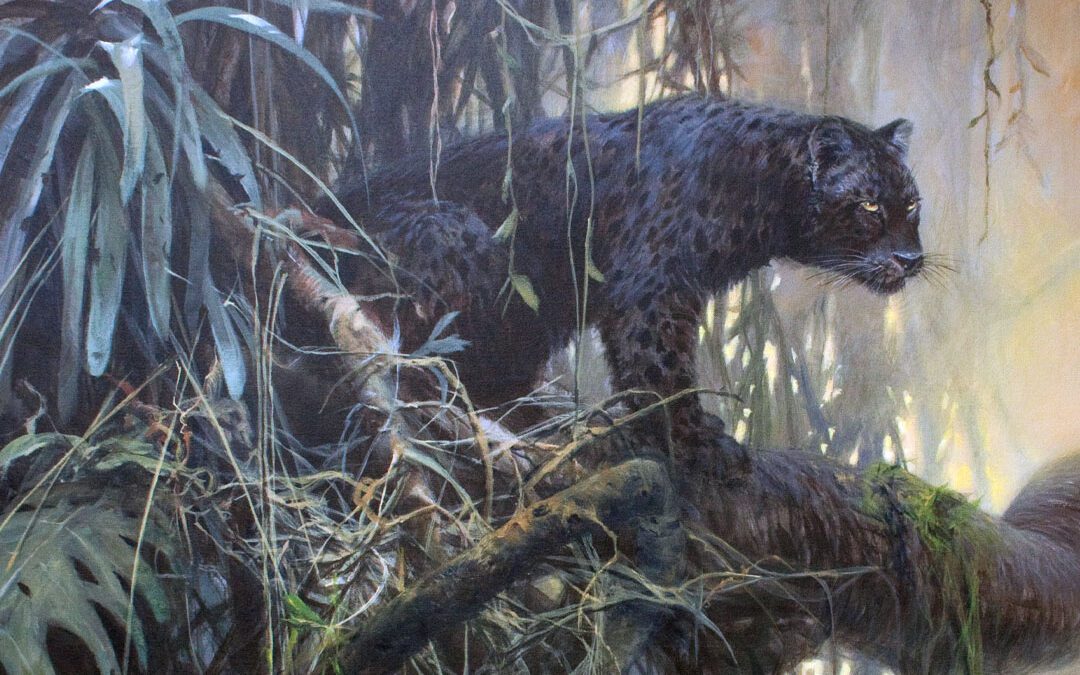
The night was warm and still and, although there was no moon, the myriad stars cast a bright glow over the village as the hunter took his position outside one of the huts. He had just arrived in the Bangalore region of southern India where he was waiting for one of the country’s most cunning man-eating leopards.
The leopard had been terrorizing the occupants of several villages for quite a while. Making almost nightly visits, the unbelievably clever cat had managed to kill some 42 people, always escaping unseen. The villagers trembled in fear behind locked doors as one neighbor after another had been dragged screaming from their homes by the deadly panther.
So determined was the man-eater that one night it burrowed its way through the straw and mud walls of a hut. Frustrated at being unable to carry away one of the occupants, the panther killed and partially devoured every person in the hut.
The leopard had been stalking and killing Bangalore residents for a long time, and British authorities, who ruled the region, knew something had to be done to protect the hundreds of people who lived there from the man-eater that had come to be known as “the spotted devil of Gummalapur.”
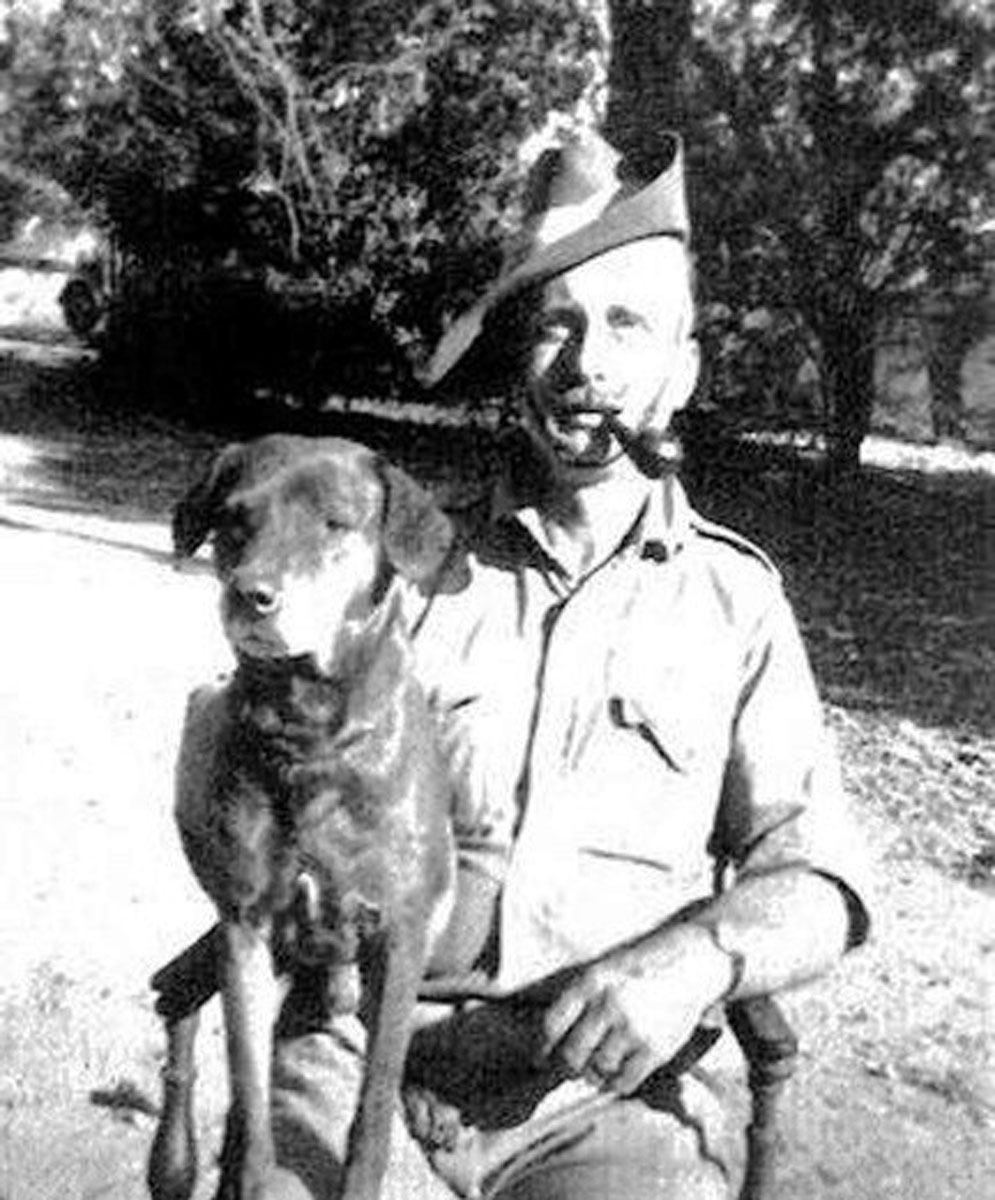
Kenneth Anderson and his pariah dog Nipper, whom he adopted during his hunt for the Leopard of Gummalapur.
It was this village that Kenneth Anderson, a British-born Indian resident and big game hunter, had chosen to hold his vigil at the request of the District Magistrate, who was desperate to rid the area of the killer leopard.
Anderson sat in a chair with his back against the wall of a hut, knowing he was up against a very clever and determined predator. From his position, he had a full view of the dirt road that was the main entrance to the village.
Unfortunately, the villagers had not been helpful after his arrival through fear of revenge from the killer cat. At sundown, all of the residents had sought sanctuary in their homes behind locked doors. The hunter sat alone with his 405 Winchester across his lap, staring into the dim shadows of the street before him.
To prevent an attack from the rear, he had placed a thick layer of thornbushes along the edge of the roof. He had to persuade a villager to cut bushes from the surrounding forest and haul them back to the village, but the man would do this only with an armed escort by Anderson.
The village was eerily silent except for distant muffled voices coming from the many huts. Anderson felt extremely vulnerable, even though he was an experienced hunter. He was more accustomed to being in the forest where deer, jungle cocks, peahens and various primates alerted him to the presence of predators such as tigers or leopards. Sitting in the center of the village, he had no such allies and had to rely on his own instincts.
Anderson clutched his rifle tightly, keeping his finger on the trigger while holding a flashlight in his other hand. Intermittently he would scan his surroundings for any sign of movement. With his pipe for comfort and a thermos of hot tea at his side, he continued to sit through the long night.
Then, in the early hours of the morning, a wind began to pick up and thick clouds rolled in, obscuring the bright stars. Now Anderson was even more anxious.
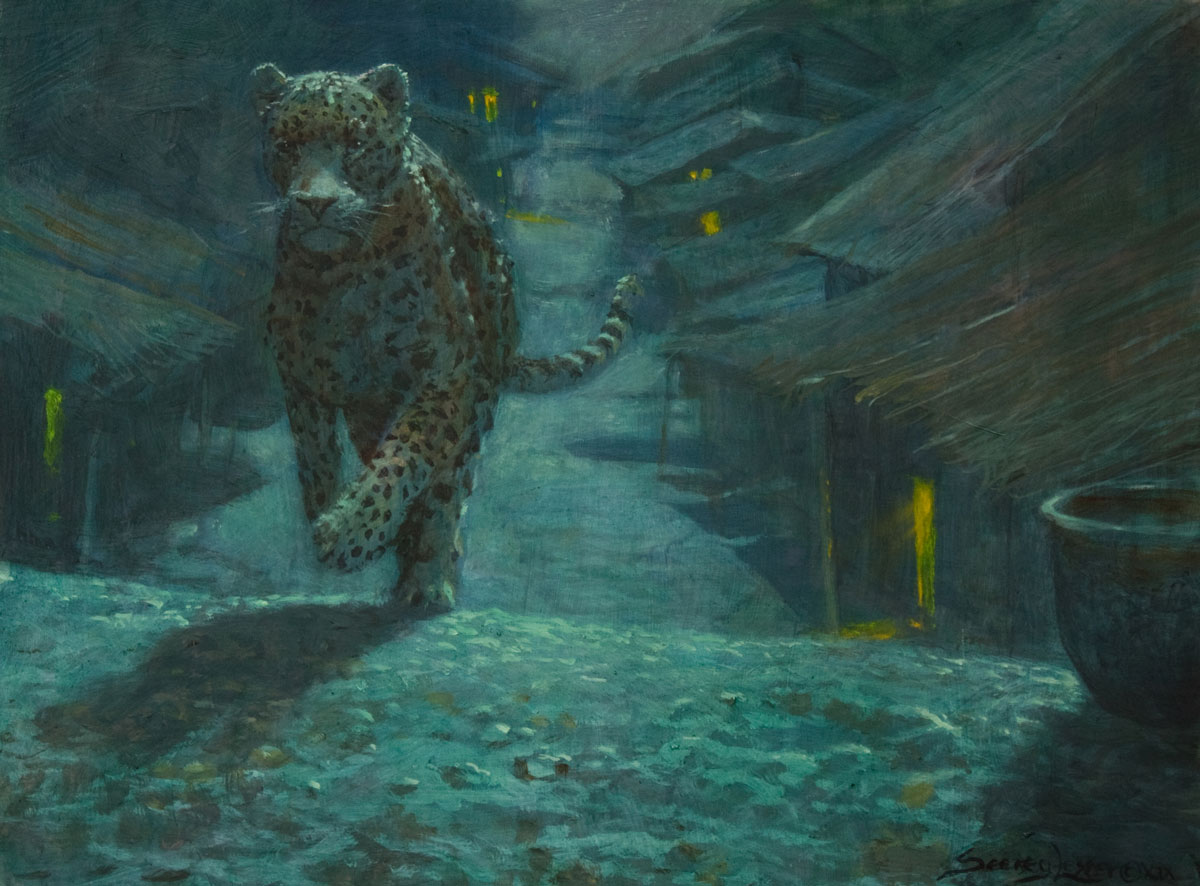
India Nights by John Seerey-Lester
Anderson was at the mercy of a killer leopard that was somewhere out there in the inky blackness. He soon realized that even if the animal were a mere yard away, he would not be able to see it. His only hope was to catch a glimpse of the beast in his flashlight and have time to shoot it, or at the very least, the light would scare it away.
When daylight arrived, he was still in his chair, much to his own surprise and that of the villagers. Obviously disappointed that he’d not seen the spotted devil, he decided to take a different approach the next night, once he’d taken a well-needed nap.
The villagers were impressed with what Anderson had done the night before on their behalf and were much more communicative that day. They agreed to go along with his idea of hiding inside one of the huts behind a barricade of boxes, where in a chair at the open doorway he would set up a lifelike dummy made of straw, a pillow and an old jacket.
They also decided that a group of residents would mingle in an adjacent hut and talk loudly enough to convince the leopard that all was normal. Should the leopard decide to break through the walls of the hut next door, it was agreed that the villagers would yell for help as loudly as they could.
That evening, from behind his barricade in the corner of the room, Anderson could clearly see the dummy silhouetted in the doorway. But the night passed without incident, except for an adventurous rat that startled the intrepid hunter in his hide.
The next night, Anderson tried the same approach, but hoped for better results. The night began the same, complete with scurrying rats and muffled voices from next door. But soon things changed drastically—a strong wind picked up, threatening to destroy the straw roof and making it impossible to hear the people next door over the roaring of the wind. Nor could he see the dummy now that the light had diminished in the storm.
Then, as the storm eased, Anderson nodded off only to be wakened by a sound coming from the open doorway. Although a little disorientated at first, he quickly realized that the cunning leopard had crawled unseen up to the dummy and was attempting to drag it off the chair.
Anderson grabbed his rifle and hurdled over the barricade as he made a dash for the door, but by the time he got there, the devil-cat was nowhere to be seen. He made a quick search of the street, but found no sign of the man-eater. Once again, it had vanished into the night.
Anderson knew that the leopard was unlikely to return to Gummalapur in the very near future. He therefore decided it would be more prudent to stake out another village.
Kenneth Anderson was still on the trail of the elusive man-eating leopard as he moved on to the village of Devarabetta about 20 miles away from Gummalapur, his previous location. The deadly cat had already claimed five victims in Devarabetta, but because it had not returned in the past four weeks, Anderson felt confident it was due to make another visit.
On his journey to the village, Anderson passed the fresh pugmarks of a male tiger, which he ignored so he could arrive before sundown. Reaching the village, he began his vigil just as the sun was replaced by the thin crescent of a new moon.
Once again, he positioned himself on a chair outside a hut that offered the best view of the village. As usual, his back was to the wall of the hut, but this time, the village was adjacent to a jungle where he hoped its resident fauna would provide some warning of an approaching predator.
As the moon rose, it cast an eerie light on the white sand of the street stretching into the distance before him. Soon, the stillness of the night was interrupted by the loud warning cries of a sambar hind somewhere in the forest, which was followed by the low moan of a tiger.
Now Anderson had to be on alert for both the tiger and the killer leopard. With the flashlight taped to his rifle, he carefully scanned the village for signs movement. He knew the light would more than likely scare his quarry, so he used it sparingly.
Not sure if his eyes were playing tricks, he noticed a movement at the bottom of the street. It appeared to be an animal walking down the center of the road, so he felt it was unlikely to be the secretive leopard.
As the animal drew nearer, it began to look thinner and smaller, and he soon realized it was a cur dog. Anderson offered the curious dog one of his tea biscuits, which it readily accepted. It was probably the only food the poor animal had enjoyed in several days and, now with a bit of food in its belly, it lied down by Anderson’s feet.
The dog rested quietly for some time until the alarm cry of a distant plover with its familiar Did-you-do-it, Did-you-do-it caused the dog to raise his head and prick his ears. Then he began trembling violently against the hunter’s legs as he stared at something down the road.
Anderson strained his eyes in the same direction, trying to make out what his companion had seen. Finally, he managed to see what was troubling the dog. Something was moving furtively in and out of the shadows just a few huts away.
Anderson rose from his chair and stood with his back against the straw and mud wall under the eaves, which protruded about 18 inches. With his right finger on the trigger of the rifle and his left thumb on the flashlight’s button, he anxiously looked all around, expecting the cat to pounce at any moment.
Suddenly, Anderson saw the lithe form of a leopard spring silently onto the roof of a hut just 20 yards away. All of huts were attached to one another, so he assumed the man-eater would make its way across the rooftops to approach him. It wasn’t long before Anderson heard a rustling nearby, convincing him that it was the leopard navigating the thornbushes he had placed on the roof.
The village was now completely silent, and Anderson was left wondering where the killer could be.
With his 405 Winchester at the ready, he waited with bated breath for any indication of the leopard’s location. While he was anxiously looking in all directions, the little cur, which had been whining at his feet, suddenly charged into the street and then, looking back at one corner of Anderson’s hut, let out a shrill bark.
Anderson switched his gaze to that corner of the hut just in time to see the man-eater leap at him with bared teeth and glowing eyes. The hunter had just enough time to catch the cat in the beam of his flashlight and fire a snap shot from the hip.
Though hit squarely in the chest, the leopard’s momentum carried it toward the hunter, who had to jump to one side to avoid being hit. As the leopard crashed against the wall, Anderson finished it off with two more shots.
The hunter’s canine companion ran and grabbed the leopard’s throat, demonstrating its faithfulness to his new master. Anderson had already decided to adopt the cur and, after skinning the leopard next morning, he took the dog home where he bathed and fed the heroic little animal.
Anderson had no doubt that the dog had saved his life that night. He named him Nipper, and his new friend became a constant companion for the hunter, who went on to track down and kill eight man-eating leopards and seven tigers that between them had killed hundreds of villagers.
Editor’s Note:
This article is adapted from John Seerey-Lester’s book, Legendary Hunters and Explorers. All of the men and women featured on these pages shared an unquenchable thirst for adventure and a remarkable ability to survive in the face of extreme hardship and dangerous encounters in the wild outdoors. Spanning the years from 1800 to the mid-1900s, the careers of these dedicated hunters and explorers were filled with all sorts of adversity and challenges they somehow managed to overcome. Altogether, these pages relive the most compelling stories of 25 acclaimed hunters and explorers, all complemented by more than 120 paintings of wildlife from around the world. Order your copy today!