
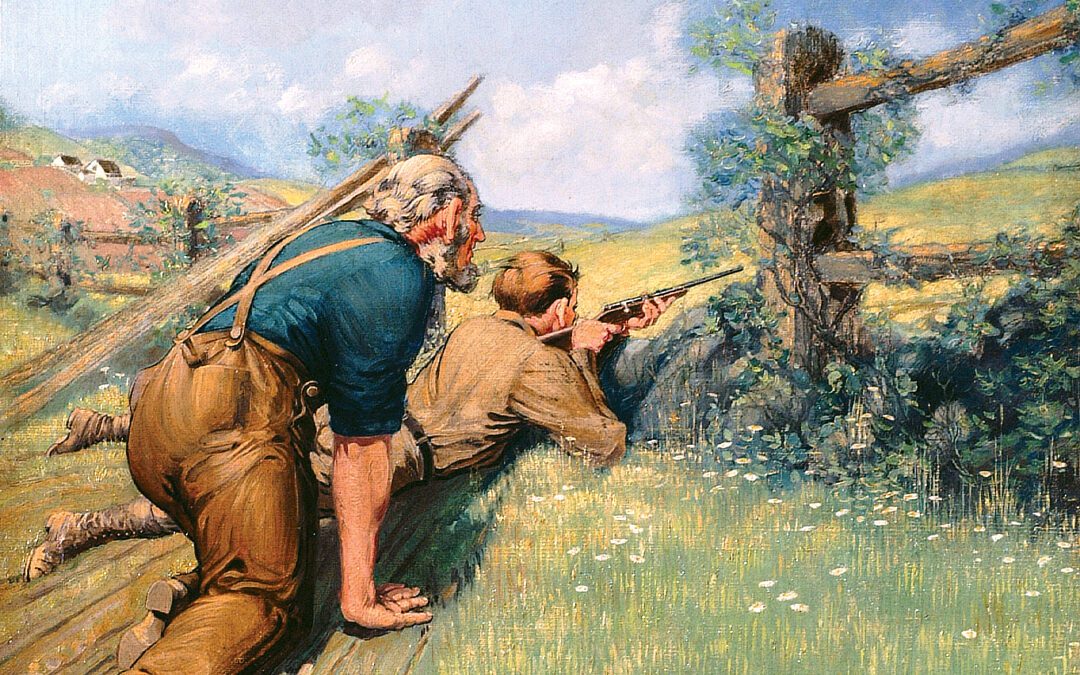
“Oh, no,” the old woman said as she pulled the curtain back from the kitchen window for a better view. “There he goes again!”
The old man looked up from the newspaper. “Who goes where?”
“Your grandson,” she said.
“You only call him my grandson when he’s acting up.”
“Well—he’s at it again.”
The old man glanced out the window. A yellow cat raced across the front of the barn, back legs swinging wide when the animal turned the corner. The boy stood in front of the weathered structure, hay bales rising above his head.
The old man smiled and resumed reading the paper. “The boy is persistent—I’ll give him that!”
“It’s your fault, you know—telling him how you used to hunt deer. Back when you had your health.”
“Oh—so now he’s my grandson, and it’s my fault he sneaks up on the cat?”
“Yes,” she declared flatly.
“I see.” The old man raised the newspaper and continued reading. “Boys will be boys.”
Yet he felt his wife’s stare through the printed word and eased the paper back to the table.
“It’s the boy’s last week of summer vacation—why don’t you just leave him alone?”
“He’s only in the second grade, for goodness sake,” she said. “He’s too young to be hunting.”
“He’s just trying to sneak up on a cat.”
“Next he’ll be wanting a gun!”
“Sounds about right,” the old man mumbled. “Relax. It’s just nature running its course.”
He returned to his paper for a moment, then set it down again. Reaching across the table, he touched his wife’s hand. “Sort of like growing up and finding a good woman.”
The old woman snatched her hand away from his grasp. “Ain’t any such thing like that!” She continued her stare through the window. “But I asked you not to put any more ideas in his head.” Her eyes darted outside, then back to her husband.
“I never broached the subject again.”
“Not even once?”
“Not a whisper.”
“And he never asked anymore about it?”
“Well, that might be another story.” The old man aligned the edges of the paper with his fingers. “He might have asked me something, once or twice.”
The old woman’s shoulders slumped. “Then go ahead.” She shook her head sideways. “Just go ahead and get it over with.” A faint smile appeared. “I know you’re been dying to teach him.”
The sun reappeared and the cottonwood leaves settled.
The old man studied the top of the stacked hay where the cat liked to nap. The pile rose several feet above the boy’s head. “The first thing you’ve gotta keep in mind is the three senses,” the old man said. “Sight, scent and sound—these are the senses an animal will use to find you—while you’re trying to find him. And these apply to whether you’re sitting, or still-hunting.”
The boy absently scratched a leg. “What’s ‘still-hunting?’”
The old man paused a moment. “Some people say stalking and still-hunting are the same. But I always said still-hunting was when you moved quiet and slow looking for an animal—and stalking was when you tried to sneak up on it after you had found it.”
“Oh.”
“Either way, you need to constantly be aware of those animal senses.”
“Why?”
“Because if an animal sees you, smells you or hears you, the hunt is over. Done. Kaput. And that goes for anywhere in the world—whether you’re hunting mule deer or elk here in Wyoming, tigers in India or elephants in Africa.” He frowned. “Well—maybe not elephants,” he added. “I hear they can’t see too well.”
The boy waited.
“First of all, when you’re moving, it’s easy to be seen. But if you move real slow, then you’ll blend in with your surroundings. And the easiest way to move slow is to take small steps. If you walk fast with long strides—like you’re late and trying to catch the school bus—then you’ll be real easy to spot. But not so much if you take smaller steps.”
The old man strolled across the yard with his arms swinging, then turned and walked back slowly, taking small steps. His arms hung loosely by his side. “See the difference?” The old man’s breathing came heavy.
“Sure—but wouldn’t you be wearing camouflage when you’re hunting?”
“Camouflage helps, but your outline will still be moving. Then you’ll become a camouflaged shape moving. And if an animal sees movement, it’ll look to see what’s doing the moving.”
The boy’s eyebrows squeezed together.
“Plus, if you take little steps, you won’t lose your balance if you need to stop suddenly.”
The old man stretched a leg out, then slowly raised his foot and fell sideways, waving his arms in wild exaggeration. He regained his balance and took a short step and lifted his foot, his arms still at his side. “See what I mean?”
The boy laughed and said he did.
The old man glanced toward the house.
The kitchen curtains drew shut.
“It’s also important to only take four or five steps—then stop and look around. You don’t want to be constantly moving.” The old man looked out across the meadow ringed with birch, his eyesight falling on the distant Absaroka Mountains. “I used to try and stop beside a tree or a stump. Or maybe some brush or a rock. Anything that helped my silhouette blend in with the scenery.”
“Sil-o-what?”
“Silhouette.”
“What’s that?”
“That’s just a fancy word for how an animal sees the outline of your body against the rest of the woods behind you.”
“Then why didn’t you just say that?”
“Because silhouette says all those words—and only uses one word. That’s why it’s in the dictionary.”
The boy hmmpted.
“You do know what a dictionary is, don’t you?”
“Of course I do—there’s one on my computer.” The boy laughed and bent into a crouched position and began taking small steps forward.
“You don’t need to bend over like that.”
“That’s how they do it in cowboy movies.”
“Those are movies. How long do you think you can walk like that without your back and knees hurting?”
“Well….”
“You should just walk straight-up, natural-like.”
“It looks natural in the movies,” the boy said.
“Only if you ring a bell at Notre Dame.”
“Do what?”
“Never mind. That’s an old movie.”
The boy drew himself up, keeping his arms and legs stiff and straight as he walked.
“Now you’re walking like Frankenstein’s monster,” the old man said. “Just walk normal, but don’t be swinging your arms around when you’re moving. If your arms swing, then you’re just making more motion—in a different place.”
The boy took small steps, his arms limply hanging at his side.
“Now you’ve got it,” the old man said. “And when you’re carrying a gun or bow, you need to keep that still, too. You can’t let it be swinging around.”
“Was this how you snuck up on those two bucks fighting in that creek?”
“You have a good memory,” the old man laughed, “and I did love hunting along the creek.”
“I remember all your stories,” the boy grinned, “like that time your arrow hit a limb and you missed a really big deer!”
“That’s right, rub my nose in it. I rushed my shot and it deflected off a tiny aspen branch.”
“Did you get mad?”
“I probably did. I know in my younger days I would have been hopping mad if I missed,” he smiled, “but if you hunt long enough, you’ll come to appreciate the opportunities you get—even if you don’t take meat home. That’s all part of hunting.”
“I’d want the deer.”
“I guess I did, too.”
The boy squinted and looked up at the old man. “Wouldn’t it be easier to sit in a tree like they do on TV?”
“It would.”
“Then why didn’t you do that?”
“I did when I first started hunting.
But back in those days you didn’t buy treestands—you built them. But I enjoyed building the stands more than I liked sitting, so I started hunting on the ground.”
The boy looked puzzled.
“Still-hunting is more of a challenge. You need to know how to hunt—not just how to sit,” the old man laughed, “and if you’re lucky, you might even get a shot!”
“But didn’t you get tired of moving all the time?”
“I used to stop and rest plenty. Sometimes beside a trail, or at a creek crossing. Sometimes at a place that simply felt right. Then I’d try to blend in and become part of the scenery while I rested.”
“But where did you sit?”
“A log or downed tree with a few well-placed dead limbs always makes a dandy spot. Especially if it’s beside a standing tree—then you can sit and rest your back and stretch your legs out. But you still need to remember those three senses.” The old man’s brow furrowed. “You remember what they are?”
“Sure—sight, scent and sound!”
“Your grandma always said you got your brains from her side of the family.”
The cat came around the corner of the barn and the boy called to the kitty and the animal quickly disappeared back around the corner. Daylight dulled and a breeze arose.
“And another thing,” the old man said, “the best time to move is when the wind is blowing. Try and move when the leaves or grasses are moving—then you won’t be the only thing moving.”
“But what if the wind ain’t blowing?”
“You need to move slower.”
The boy scrunched his mouth sideways.
“But even if it’s a still day, little spurts of breeze can blow when a cloud covers the sun. Keep that in mind.”
The boy looked skyward. “Why does that happen?”
“Because the air cools and sudden differences in temperature can cause wind.” The old man nodded to himself. “And while we’re talking about wind—remember that wind will also carry your scent—the second sense I told you to remember. That’s why you always try and move forward with the wind in your face. Otherwise, they’ll smell you coming—like that cat did this morning.”
The boy’s head snapped to attention.
“You never had a chance,” the old man laughed, “even if he didn’t hear you coming, a little breeze was pushing at your backside most of the morning.” The old man bent and scooped some dried dirt and shifted it through his fingers. “See that? See how it’s drifting in the direction the cat ran?”
“Wow,” the boy said. “I never thought about that!”
“You’ll remember it now.” The old man wiped his hand against his pants.
“But what if I took a bath first?”
“Then you’d smell like soap, or shampoo. Folks always smell like something.”
The boy sniffed at his arm.
“But one thing you can do is scrape the ground with your boot wherever you stop. Dirt and moldy leaves will add a real nice natural smell.” The old man looked to the mountains again. “Old timers used to hold traps and guns over a smoking fire to hide their human smell—but I don’t think your grandma would want you making any fires just yet.”
The boy scuffed the ground with his tennis shoe. “That would be neat!”
Hay chaff swirled in the sunlight and the boy sneezed.
“I suppose now’s a good time to bring up sound—the third sense.” The old man ran his hand over his chin. “Nature’s sounds will always be around you in the woods, but if you hunt when the ground is wet, or there’s a heavy dew—it’ll help quiet your footfalls.”
“I thought you were supposed to always be quiet?”
“You are, but if you make any noise—and you will—then it’s best to disguise it.”
“How?”
“If you need to cough, cough into the crook of your arm to muffle the noise. Animals cough all the time. Just remember to move your arm real slow. Another trick is to press your finger against the tip of your nose if you have to sneeze. That’ll usually work.”
“No way!”
“Cross my heart,” the old man said, “and a grunt call will help disguise sounds, too.”
“A what?”
“It’s a tube you blow into. It makes a grunting noise that sounds like a deer talking.”
“Deer talk?”
“Sure—just not like you and me,” the old man said tousling the boy’s hair, “and if a stick snaps real loud under your foot, then you can use the grunt call to sound like a deer coming through the woods.”
“If I do all these things, will I become a good hunter one day?”
“It’ll be a good start.”
An overnight cold front had brought rain and the cottonwood leaves dripped outside the kitchen window.
“Would you look at that?” The old woman stared out the window, the curtain in her hand.
The old man stopped eating breakfast and followed his wife’s gaze. “Well I’ll be danged! He’s finally getting the hang of it.”
“Well, he does have a good teacher.” The old woman reached across the table and touched her husband’s hand and smiled.
Outside, the boy approached the sleeping cat. He stood still for a moment, then whacked the haystack with a stick. The cat sprang upright and jumped down and raced around the corner of the barn as the boy sighted along the stick like a gun barrel.