
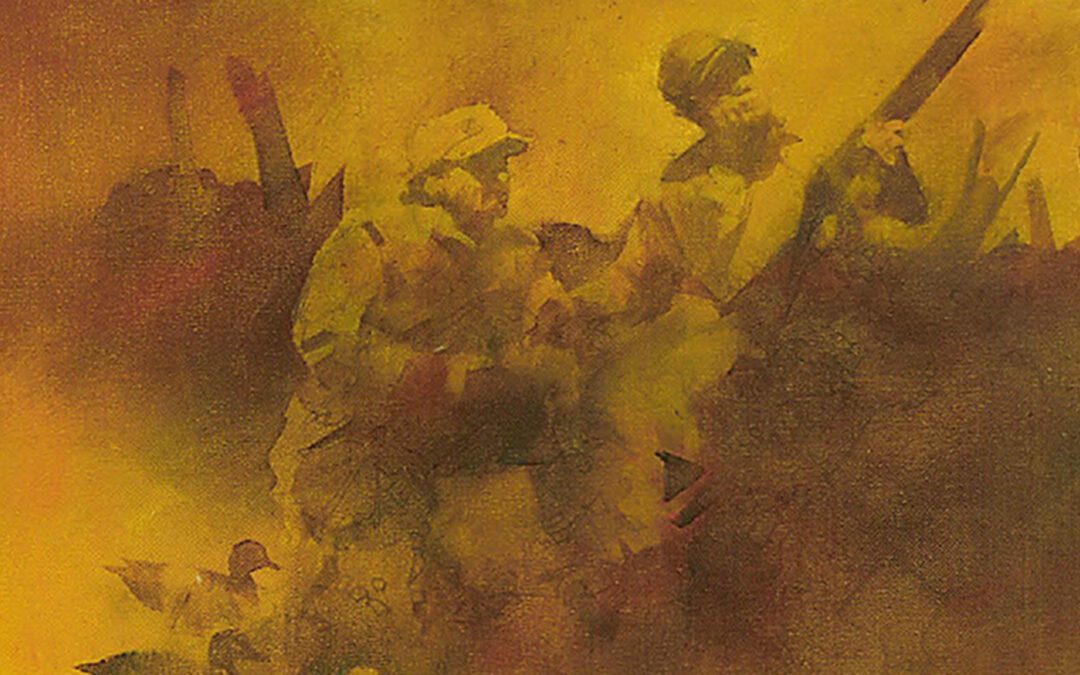
In a single defining moment, a young boy comes to understand both privilege and purpose.
I suppose there is truly a time for all things, and that only in their own time will they spark with the unique consecration of all that is original, as in a scarlet dawn, a lover’s dance or the eyes of a boy as he is transformed to his own point in time, the manhood by which he will be defined. And though these rites of passage are as inevitable as the burnishing of green to the hues of autumn, they bear no guarantee of product, no surety of discernment or promise of grace. Far subtler than the fiery brilliance of a hard maple as it passes through its own transformation, their occurrence usually passes without remark, and it is only with the gravity of time that one fully appreciates the depth of their impact. But for the countless years of fallen canopy and vanishing landscape, the memory of that particular autumn and the blessing of its offering are yet fixed in my soul with the singular wonder of their own day.
I was in my sixteenth year, born in a town of a purpose as clear cut as the fields within which it rolled. The rich soil that was given to that country, combined with the value of its stock, produced a population for whom life was paramount devotion to the hard task of responsibility fulfilled. No truer example of which was my father, a man imbued with the fundamental need for challenge and the expedient belief that when God bestowed such, it was never more than faith could manage. He was what people called “solid,” of an oaken will that bent only to reason and never to tempest, an honest man who expected no more of others than of himself, which for me, seemed endless.
Each day began among the long rows of grain, well before sun and school, driving machinery that we might nurture our animals, the motorized droning within the furrows of those blackened hours the only softness to be found in it. It was a life at odds with me, with transformation itself, the perfect opposition to all fresh and restless that lay inherent in the landscape, its abject flatness unwavering testimony to the power of its inevitability.
Yet if there is clemency inherent in all mandate, my measure of mercy was working those same fields with another tool. I would sneak away, disregarding chores and the reprimand sure to follow, to stalk the thick copses of hedgerow and reedy skirts of the sump pond with my little setter Meg and a mail-order 20 gauge, a purchase for which I had saved like a miser monk. Neither Meg nor I had much training, but determination and pedigree balanced our inexperience.
We roamed and stalked until Mamma clanged the dinner bell, each rock-steady point a contract implied, feathery tail pledged to the task at hand, pushed to the sudden burst of rushing wings that I might fulfill my part. Those were the days torn within their own uniqueness, of sudden weather and low light that happily rose to the corona of promise and fulfillment, only to fall with the sinking of both sun and spirit as I walked the winding path home, lost in thought on the dreaded road to accountability.
“Chin up boy. What’s gaining on you?”
I had been unaware that Dr. Harvey Tyree had been watching. He was a great bear of a man with an affable manner that seemed at odds with this no-nonsense life, and though I have heard that every man is made for one purpose, I am quite sure he had not. He was my godfather and the towns only doctor, yet no degree could alter his bond with the soil. Not a day went by that he could not be seen trudging about his piece of it, from one long end of our neighboring tracts to the other, tending to what his profession had reduced to hobby. But there was also more about him unique to the landscape, a thing unseen yet familiar, not objectionable yet odd nonetheless. Like singing too loud in services when endowed with an ear of pure tin, of which he was guilty of both, though I only the latter.
It seemed that we shared common boundaries of many sorts, for he carried a gun also, cracked open and shoulder-draped, its purpose owing to the day’s end. As he eyed my empty game pack, I felt my face flush red, embarrassed that my shortcomings were so plainly evident to the man acknowledged as the best wingshot in the county.
“Boy, you’ve sure been raising a racket over to your place.”
‘Yes sir. Sorry if it’s a bother. My brother throws clay birds off the shed roof and I bust ’em…” I stammered. “Or try to.”
Harv smiled and a broad grin creased his face, the full beam of his steel blue eyes warming to a notion. “Anybody that practices like that ought to have something to show for it. I’m sure your father taught you about getting up early. Why don’t I meet you next Saturday, say, a half-hour before dawn, at the fork by my beech stand, and we’ll see what the day brings.” He chuckled. “Oh, and Charley… don’t forget to bring your gun.”
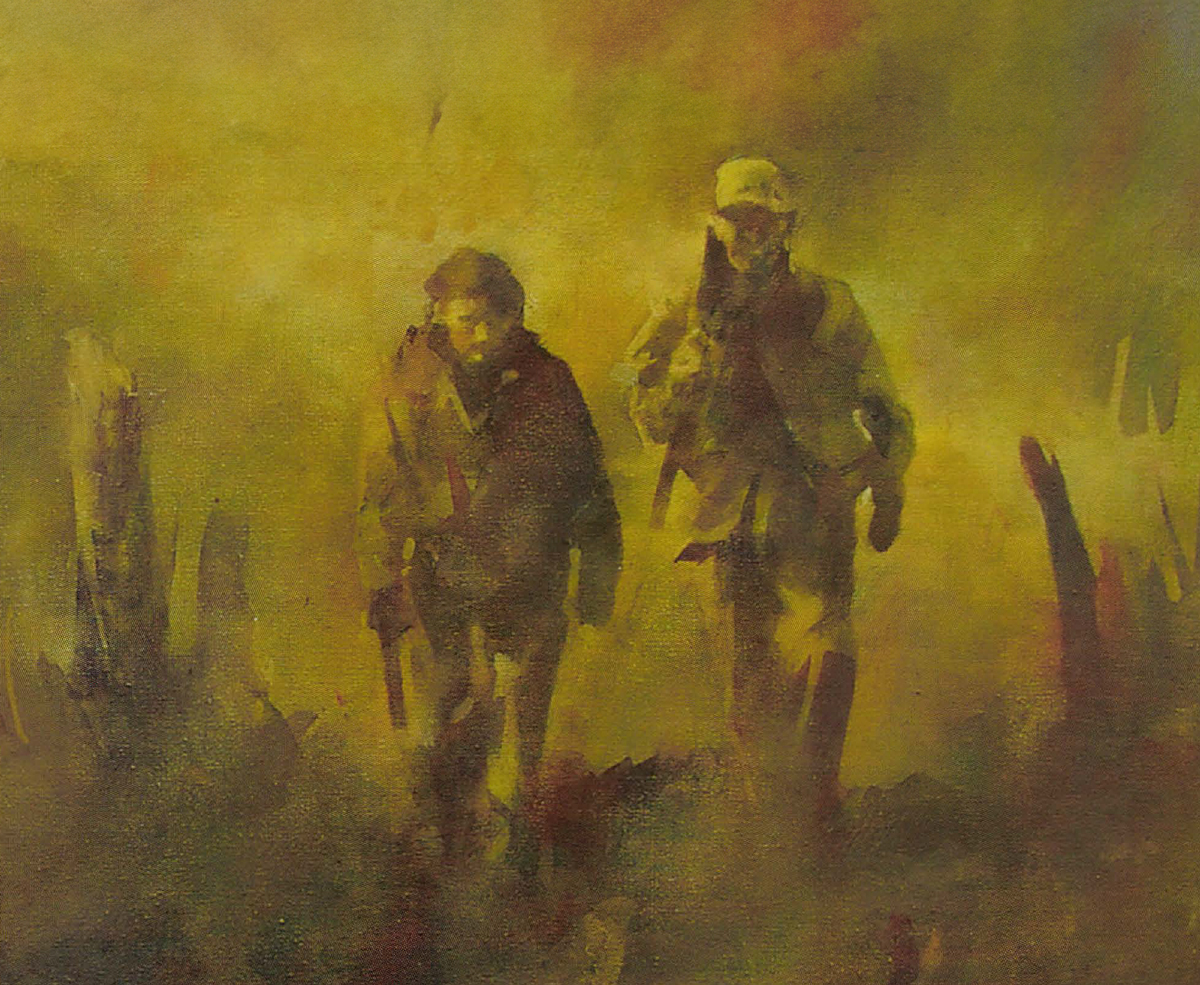
It seemed as if the ensuing days, now flush with more promise than routine, had slowed to a standstill, and I, caught fully in the great vigor of expectation, struggled to keep both myself and the clock hands on task. Permission had not come easily, for father had a list, but Mamma had settled the discussion with something about, “You and that brother of yours” and all being boys once, “least till we get some sense in you.” Then she had pointed her finger at father and winked at me, and that was that. And on the anointed day she hung my gear to warm by the stove, labored over a huge breakfast and packed a lunch, tending to it all with the swift economy of experience.
I grabbed one last mouthful on my way to the mud room, dressed in my heavy woolens and stiff wax cloth, grabbed my gun, shells and gloves, and was about to go when she called my name.
“You’ll need this today,” she said as she tucked a heavy muffler, into which the likeness of drake mallards had been woven, around my neck and into my parka. I rolled my eyes. “Never you mind. This was your grandpas, so you just wear it.”
With a kiss on my forehead and the simple instruction to “be safe,” she shooed me into the frozen darkness. I walked to the gambrel barn and waited by the tractor for the ride out.
“Nice scarf,” my father said as he came into view, and I started to snap back, but froze instead in stupefaction as he handed me a case I knew to be hidden under his bed. “Here. If I know anything about a high northern, I know exactly what Harv’s got in mind for you, and that popgun of yours won’t cut it. I put some shells in your pack.”
He cut his eyes low. “Don’t act so innocent. I know you’ve messed with this before. Just remember, use only one finger for both triggers and keep it shoulder tight, or I promise you’ll wish you had.”
I could feel the contours of the big 12 gauge plainly through the soft canvas case – a rare thing, beautiful and dangerous in one.
He throttled the tractor to life, calling over his shoulder, “Get in. And don’t plan on nothing but your chores when you get back.”
I stowed the gear in the gang box and hopped on the trailer. It bumped and labored through the dark clods, locked solid with crystalline dew, waiting to dazzle like diamonds in the sunrise. I laid back, knees up, my pack a pillow, mesmerized by the stars that glittered softly overhead within the unknown depth of eternity. The half moon mingled with the frost and cloaked the treetops in a special glitter of blue light and stillness that was the surest indication of a dawn that would break clear and deadly calm, perilous moments that hang on the movement of all prey.
We no sooner crossed the break in the north border wall when the darkness was broken by the flickering signal of a flashlight beam that waved me onward to where Harv was waiting. I said goodbye to father and walked to the trees.
“We’re heading on a bit. C’mon,” was all Harv said and I followed, walking in silence along a utility road rutted from a long autumn of rain, the only sound the occasional crunch of ice as we broke through the deep ruts.
We came to the backside of a small pond that lay within an endless field of ankle-high stubble when Harv stopped just outside a small spread of decoys and lifted a stalk- covered panel from the ground, exposing a wide hole in which a concrete tank, complete with gas lamp and bench, had been buried.
There are certain novelties in life of a purpose immediately apparent, and being done once, one knows with certainty that they would be done again as often as possible. Without getting into particulars, hunting from a sunken blind in a newly cut field of corn, was one. Harv took my gear so that I might descend safely and I the same for him.
“The wind and the sun are at our back. They’ll come from out front. Get your gun loaded. They’ll pickup from the river not long after first light.” He pulled the cover halfway shut, and we settled in.
I heard them long before I ever saw a wing, a chaotic hodgepodge of squawks and yelps, each tone broken and unique yet wholly blended to a dissonant sound of its own, like the sound of raindrops on a roof or children playing in a distant schoolyard. And then they simply appeared, rising off a distant field, filling the horizon with a thousand dots of clamor. Harv barked on his call, and a small flight broke off, banked to the west and once again, their wings locked rigid as they floated ever so slowly to us.
“They’ll be swinging on your side,” Harv whispered. “Just go up on me.”
I crouched low as they swung, gun in hand, mesmerized by their fluid grace. The rush of air under their wings mixed with the soft pulse of my breath, and I was somehow among them, if only for a moment.
“Take ’em,” Harv called as he threw back our cover and rose. It seemed as if the universe had ceased that I might stand with my father’s gun in a moment unique to any, sight set on a trailing bird as it fluttered down, breast reared back to a purpose of its own. Cheek tight to stock, one finger up, I touched it to action. The bird folded in an instant, falling just inside the decoys, far closer than the two Harv had taken, a fact he dryly noted as I returned with all three.
“That’s a fine piece you’re gunning with today,” Harv mentioned as I climbed back into the blind. “Grade two Ithaca double, Damascus patterning on the barrels, auto ejectors, full and modified chokes. Know it well.”
“It’s father’s, but you’d never know it. He keeps it put away. I can’t believe he let me use it. Shoot, I can’t believe he let me even go today.”
“Why’s that?” Harv asked.
“He doesn’t approve of it — doesn’t approve much of anything I do. Says if I’m going to be out here I might as well be doing something useful. I’d bet he’s never even shot this thing.”
“That’s a bet you’d lose. Bill’s the best shot I ever saw.” Harv chuckled at me with my mouth agape and my chin on my chest.
“What I’d bet is there’s a lot of things you don’t know. Like that gun was your grandfather’s passed down, and your father dumped doubles of greenheads with it from the tree-line into that pond when he wasn’t any older than you with that same damn scarf around his neck. Ha! That he and your Uncle Tim and I were as tight as bedbugs, and there isn’t a field or a swamp or a cow pond in this county we didn’t shoot.
“Nobody, nobody, loved it more than your dad, and let me tell you, your Grandpa wore his butt for every chore he dodged to do it. God knows we had fun.”
His voice trailed off. “Least off ’till things changed.”
“What happened?” was all I could manage.
“Life happened, Charlie. Your grandpa died and your Uncle Tim grabbed an opportunity and it all came down to your dad. Never said a word, just worked that farm alone, did what most said was impossible, and what he got come market time put his brother through school, supported his momma and soon, a wife.
“After I brought you into this world, I saw him at the hospital, watching the dawn with you in his arms, and there was more than sunlight in his eyes. Soon after he up and loaded his truck with his share of the rig and came by my place. We talked about it for the first and only time, how he had little for it anymore with a mother and a wife and now a baby to provide for. Said he’d come back to it when he had a little more time on his hands, maybe even take his son.”
Harv shrugged. ‘‘Guess he’s still a little short.”
“I … I didn’t know.”
“No fault in not knowing. That’s what makes us human, Charlie. It’s how we handle what we do know, that counts.”
I took the long way home that day, doing the shaggy edges of willow run and rain-gullied bottoms of pin oak and persimmon that rose steeply to the north tract that was the first my grandfather had sown. From there I could see our little house, ringed by split rail and generations of leeward cedar, the faded clapboards gleaming in the random emancipation of shafted sun that pierced the clouds and lapped the outlying fields of gold and black like seashore waves.
Beyond, a lonely figure was turning chaff for winter compost in one long run after another, and the sound of the tractor straining in the heavy soil mixed with the burden of its driver, and in that moment, as the midday bells rose softly to toll their due, the heartland of my father once young, once like me, did the same.
For the first time little details revealed their life to me. I could almost see my father’s father piling boundary claim between neighbor and forest, the low walls of stone ever ambling toward their purpose, still solid despite the attrition that is time itself. Or how the rusted strands of barbed fencing, in the promised accord of all wedded partners, now supported their tired locust posts, the sheer labor of setting so much wire bearing timeless homage to the hidden hand of intention, though of whose I could not know. Father used to say we were like bottom oaks, forever rooted to our circumstance for “acorns don’t roll uphill,” but sitting in the high meadow light, I could see how it truly touched all that we had, its simple abundance rising like a wellspring that I might be cleansed and christened to it.
And so it happened, without sentiment or words marking my change, quietly, without notice excepting Meg, who was not happy at all with the prospects. She would quake in anticipation when I came home from school, only to settle reluctantly in her pillow when it was my work coat taken from the peg and not my hunting clothes. My brother asked more than once if I’d gone crazy, but Mamma smiled knowingly when I replied he ought to try rolling a few acorns himself. True to form, father said very little, a slight nod the only acknowledgment of a job well done.
It seemed autumn fell quickly after harvest that year, moving inexorably to grey sky and barren landscape with the lonely certitude of all fulfilled of its primary purpose. It had been a success, at least by the measure of our livelihood. Every inch of silo and feed bin was crammed with the food crop for our livestock, augmented by uniform blocks of clover, some lying dry in the field sheds, some scattered randomly as they were baled along the south slopes. Cords of hardwood had been split, hauled and stacked neatly by the cellar well doors, close at hand for the loading and stoking. I had even mastered the intricacies of a three-point hitch. But for all the effort, something still remained unclaimed in the November fields.
I readied my gear and stood it by the back door for the morning hunt, thrilled yet calm, for it had now passed to privilege. Awakening early, I listened for Meg, knowing she would have seen the signs by now, and as she pranced up the stairs to my room, I heard another footfall, heavy yet soft, accompany her down the hallway. The door opened and my father peered inside, dressed in faded green tin cloth, my scarf, his scarf, my grandfather’s scarf around his neck.
“Happy Thanksgiving, Charlie. The truck’s warming, so hurry up and get dressed. They’ll be flying soon.”