

Na, ja, my father hated all hunting and hunters. He didn’t understand. He thought, first of all, that all they did was destroy, and my father lived only to preserve things. And hunters in Germany wear a uniform, green loden cloth, you know, and my father hated uniforms, anyone who wore a uniform. But the worst of all was that hunters spoke their own language instead of proper hoch Deutsch [high, ‘formal’ German]. They would say, for example, a fox does not have a tail, he has a brush. It is not a flock of quail, it is a covey, and so on.
“Also, his brother was a hunter and they never got along. You see, my uncle was a lawyer, and because they never got along, my father wanted always to sell his half of the estate in Miltenberg, and he had told my uncle he would sell for one-and-one-half million Marks. He meant of course gold Marks, but when the depression came and there was so much inflation, my uncle sent to my father a postage stamp for one-and-one-half million Marks and said, ‘Good. Now it is paid and I own all.’ This was how he cheated him. But he was a lawyer, my uncle, so what do you expect? Get down, you miserable whore. You are worthless and I hate you.”

“Bodo” Winterhelt
This last was said with great affection to a lean and wiry brown pudelpointer bitch that wriggled with delight at each insult. We were standing in a strip of milo planted beside a vast expanse of CRP land, normally a Mecca for pheasants, but Quella—the brown bitch—had found nothing and had circled back to check in with the boss, putting her front paws against his chest and stretching luxuriously as he played with her ears. To the southwest the land rolled away to the great Missouri River, not far from where Lewis and Clark met up with the Frenchman Jean Vallé; in every other direction it rolled away to infinity, but it was hard to say what Bodo saw as he stroked Quella’s head and gazed out over the grasses that ran in waves before the wind.
Sigbot “Bodo” Winterhelt was born the heir to one of Germany’s grand old aristocratic fortunes, the equivalent of being born a Mellon, Vanderbilt or Astor. At age 16 he was marched off to the Russian front. Two years later he marched home again, holding his intestines in his hands, and found he had gone from being one of the wealthiest men in Germany to not even owning the bloody clothes he stood up in, those clothes being a regulation German Army uniform.
Bodo’s father was an architect, but his primary passion was for antiques, studying and collecting anything antique: he owned furniture that had once belonged to Napoleon; jewelry that had once belonged to the Empress Josephine; priceless early books; furniture that dated back to the Reformation; paintings that dated back to the Renaissance; china, crystal, silverware; and—the prize of his collection—a congeries of pewter, 23,000 pieces, going back to medieval times.
Some of Bodo’s earliest memories were of the mansion in Berlin where they lived among his father’s many collections, with one room on the ground floor being devoted to nothing but shelves and cabinets of priceless and irreplaceable pewter. After the war, after he had recuperated from his wounds, Bodo went back to the house in an effort to find his parents. A bomb had hit the house dead center, and where the prized collection had been there was a layer of melted pewter, six to eight inches deep.
Another early memory of that house: Bodo slipping out of his bed in the middle of the night to look down into the garden where a Jewish couple his father had rescued would take the air, walking in the dark every night for almost a year, until Bodo’s father was able to smuggle them out of Germany.
“Of course, this was a dangerous thing for my father to do. If he had been caught, he would have been sent immediately to a concentration camp. My father hated Hitler, but Hitler had put him in charge of all antique German buildings, so that if someone wanted to tear down a house, he had first to come to my father for permission. And my father wanted so much to preserve all antiques. What else could he do?”
That memory shaped Bodo in many ways, just as similar memories shaped for good or for ill an entire generation that grew up under the Nazis.
Once, driving back from a pheasant hunt in South Dakota, we got into a long conversation about the war, the Nazis, things Bodo had seen and endured, the bloody horrors of the Eastern Front, the killing he had done, some of it up close and personal, his family’s loss of virtually everything, the destruction of Germany. Finally, he was silent for so long I thought he had fallen asleep and I drove on in the dark. Suddenly he spoke.
“They should never have killed all those generals in Nuremberg after the war. They should have killed the teachers.”
“What? What do you mean, Bodo?”
“It was war. In a war it is the duty of generals to kill people. But it was the teachers who said to us, ‘God is dead. Hitler is God. Kill the Jews.’ Over and over they said this to us because they were scared and they wanted to keep their jobs and not get sent to a concentration camp. And when you are a child, you believe what these grown-ups say to you. They should have killed the goddamned teachers.”
Bodo and his brother Volkmar provide a lesson to all breeders: the traits a breeder wishes to pass along and preserve may frequently skip a generation. While his uncles and grandfathers and great-grandfathers were all hunters and horsemen, lovers of the land and dogs, Bodo’s father disliked horses, dogs, hunting and anything that wasn’t antique, cultured and urban.
So of course Volkmar grew up obsessed with riding (after the war he ended up in Canada, training dressage horses) and Bodo grew up obsessed with dogs and hunting and being outside. One of his earliest memories was of attempting to poach carp from one of the streams in the Grosser Tiergarten, the great park that winds through Berlin, where it was strictly illegal to fish.
His plan was ingenious in its simplicity. He put bait in one pocket of his trousers, cut a hole in the other pocket, ran a fishing line and baited hook down his leg, and stood on a little bridge over the carp. All went well until he managed to actually catch a giant carp just as one of the park wardens happened to walk by. The fishing line had gotten wrapped around his hand, so he couldn’t let go, and the fish was so big he couldn’t pretend nothing was happening.
“Oh, my God, I caught it then, I can tell you. He boxed my ears. Bam! Bam! Bam! Then he wrote a little note and I had to take the note to my teacher and he boxed my ears. Bam! Bam! Bam! And then my teacher wrote another note and I had to take that note to my father and then he boxed my ears. Bam! Bam! Bam! Since then I have never liked fish.”
It took a little longer to get a dog and the results were equally disastrous.
“My father wouldn’t hear of having a dog. He didn’t like dogs, but he claimed it was because the tax the Nazis imposed on all dogs was too high, so when I was nine, I wrote Hitler a letter asking him to waive the taxes for me. I never heard back from that bastard. But I was lucky.”
His luck came from the family doctor who was both a hunter and a dog lover. He was the president of the local Deutsch kurzhaar [German shorthair] club, and being sympathetic to Bodo’s passion, the good doctor stretched the truth some and told Bodo’s father that it would be best for the boy’s health if he could spend more time outdoors and around dogs, getting some physical activity by following around in the wake of field trials.
The gamekeeper on one of the Winterhelt family holdings was a legendary breeder and trainer, Edmund Löns, and Bodo was allowed to spend his vacations with him. It was there that Bodo fell in love with the famed—or infamous—German hunting machine known as the jagdterrier, or German hunting terrier.
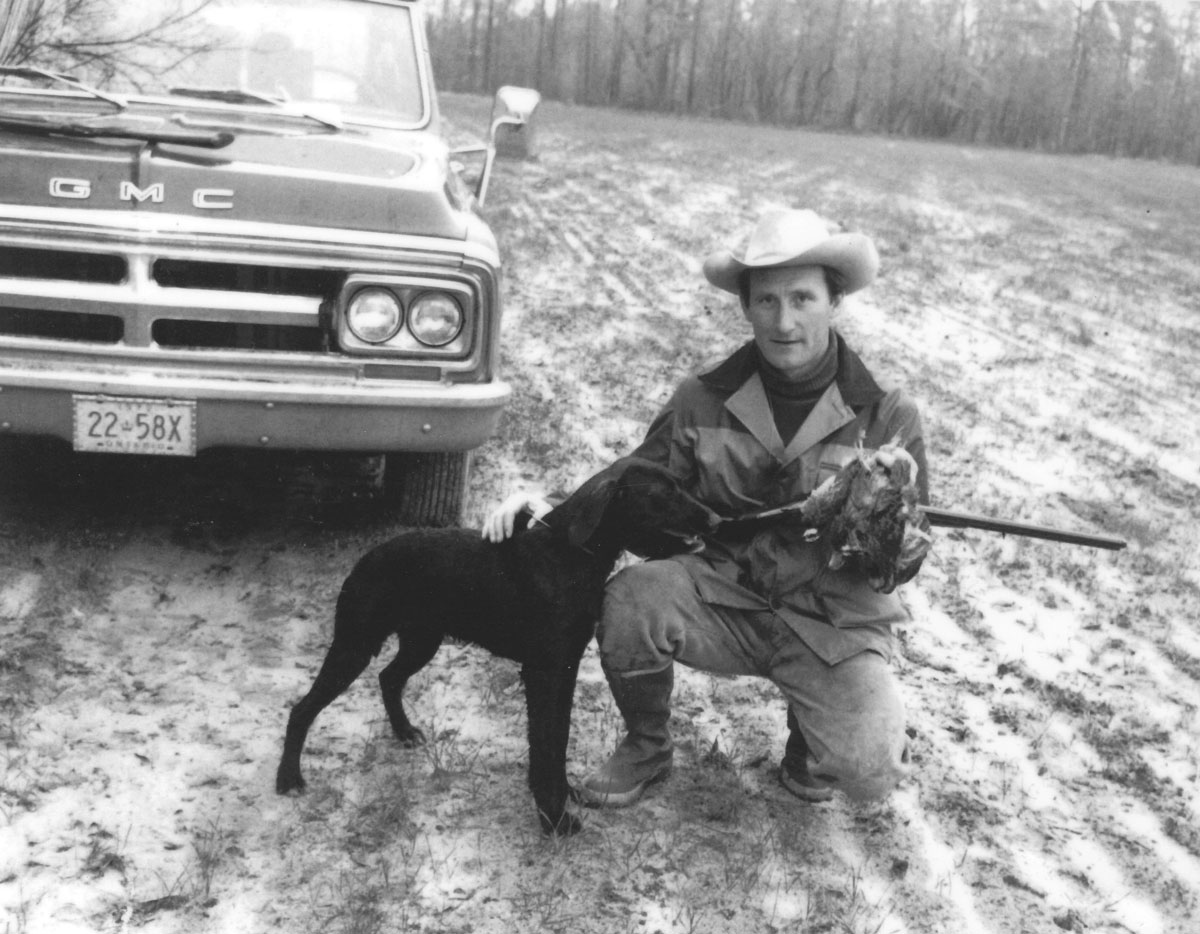
All terriers are strong-willed, idiosyncratic, single-minded and convinced of their superiority to all other species, including their owners, but the German hunting terrier takes these traits to their maximum extreme. That includes, from the dog’s point of view, killing anything it happens to think might need killing. In the country that could include everything from the neighbor’s chickens to a wild boar; in an elegant mansion in Berlin, packed to the gills with rare and priceless antiques, it included a chair that had once held the famous, silk-clad backside of Napoleon Bonaparte.
“Oh, my God! I grabbed my little dog and ran. We spent the night in the Grosser Tiergarten and in the morning one of the maids found me. She told me my mother had made my father promise not to kill my dog, so I came home.”
Bodo went on with his jagdterrier to become the youngest handler and prize winner in German field trial history. He also became, at 15, the youngest man ever to pass all his hunting tests, though he had to wait until he turned 16 to become a licensed hunter. Hunting is taken very seriously in Germany, with centuries of tradition and rituals behind it: licensed hunters must study game management, habitat management, forestry, hunting regulations, the law, marksmanship, tracking and then pass extensive tests in each of those subjects. If they pass, they are allowed to lease a piece of land that they are then expected to manage for game. They are also expected to enforce the law. As civilian game wardens, back in those days, they were required to carry a sidearm, which meant the day after he got his license, Bodo showed up at school with a Walther PP in a holster.
“My teacher was also a hunter, and every morning when he came in, he would take his pistol off his belt and place it on his desk. So that morning when I came in, he congratulated me on my earning my license, and then he had me stand up in front of the class and demonstrate how to disassemble and reassemble my pistol. Can you imagine such a thing today?”
It was a very brief and transitory period of hunting paradise.
It says much about the murderous desperation of the Nazis that Bodo was conscripted not long after he turned 16, and by the time he came home, wounded, but with the war finally over, he was already an officer at the ripe old age of 18.
“I was shot on Hitler’s birthday, and everyone told me what a great honor it was to be shot on der Führer’s birthday, but a bullet in your guts does not feel like so great an honor, I can tell you. But I was lucky. I hadn’t eaten in three days; I hadn’t even had a drink of water in 24 hours, so the bullet didn’t do as much damage as it might have.
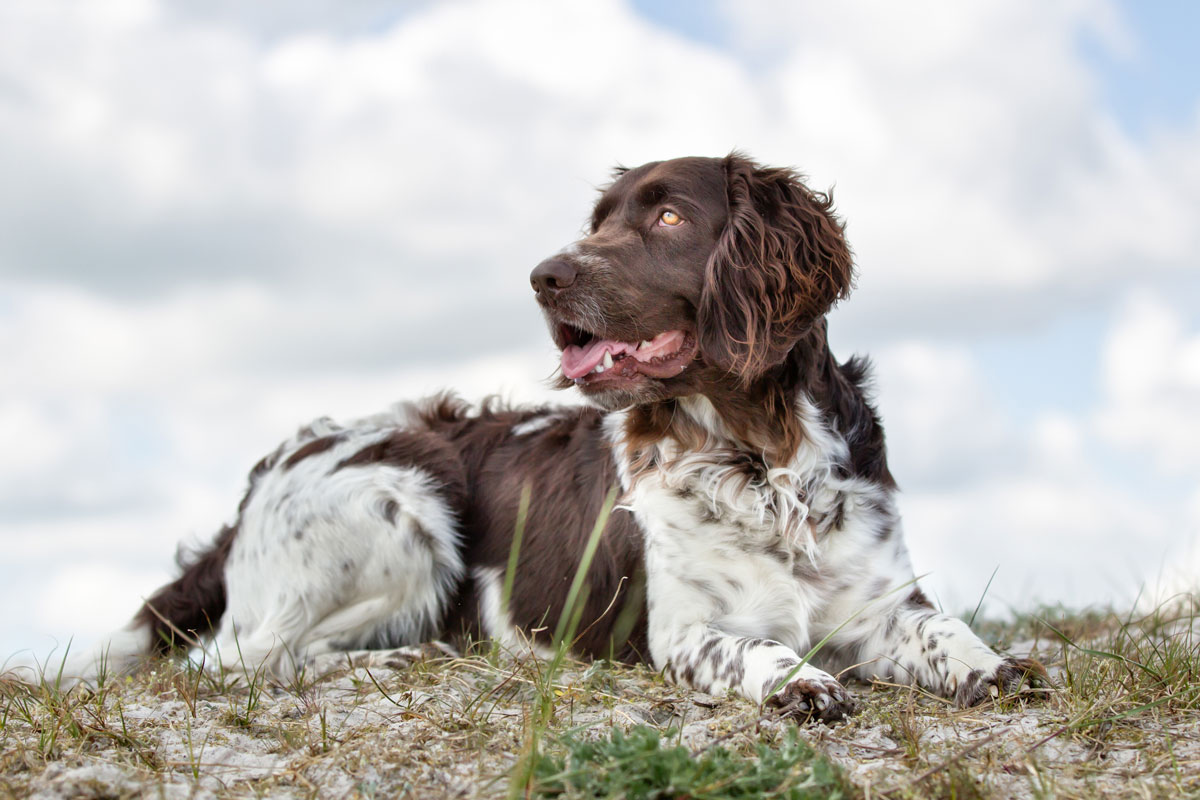
Small Munsterlander
“Another very lucky thing happened to me. Because I had no home left and no place to go, I was put into a British military prison/hospital camp. If you had no one to vouch for you, no place to go live, they kept you in a camp, but in the British one it was not so bad. And one day I was sitting in the sun with another guy and this English colonel walked by. Absolutely typical Englishman, very straight, with a little waxed mustache and the little stick under his arm and two dogs at his heels. And as he went by I said to my friend, ‘Those are kleiner Munsterlanders’ [small Munsterlanders].
“Well, this English colonel heard me and right away he spun around and started asking me about these dogs and how did I know about them. My English was not so good, and I couldn’t explain to him how I knew Edmund Löns, so I just said he was my uncle.
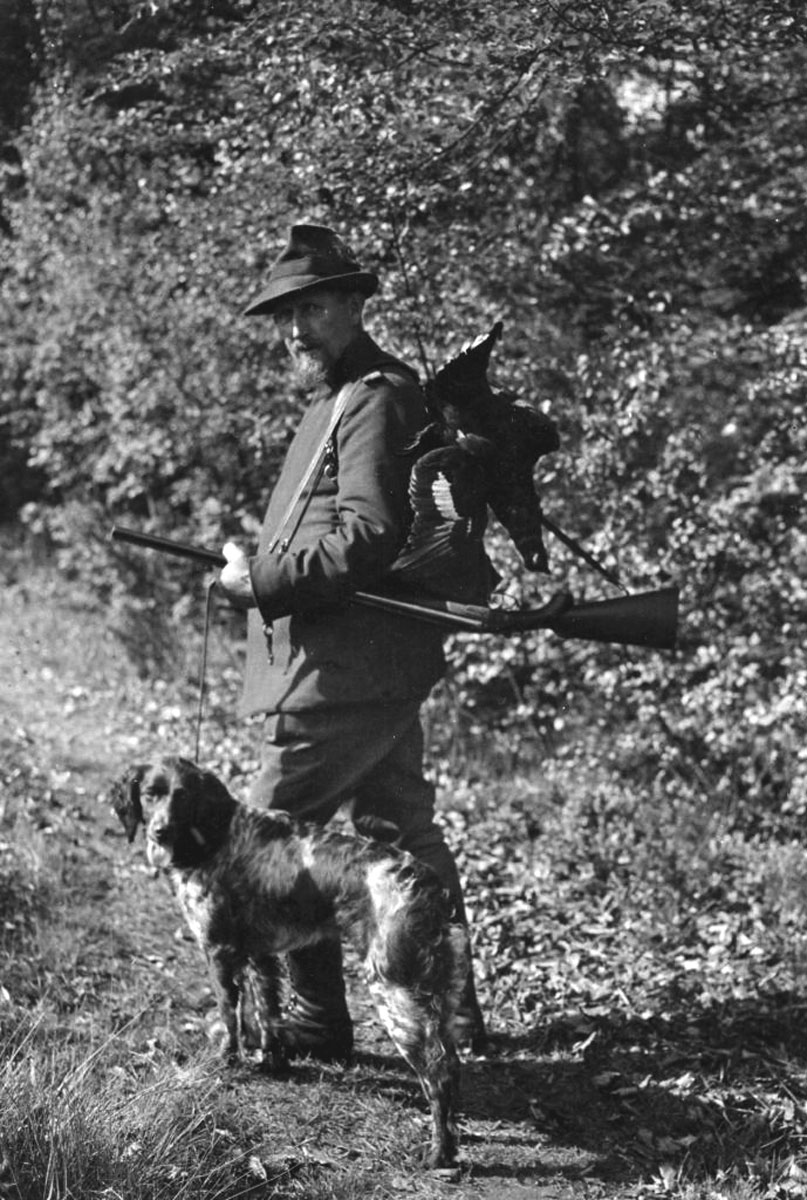
Edmund Löns with Ilse II
“Oh, my God! If I had told him Winston Churchill was my uncle he wouldn’t have cared so much. He had a copy of der Alter’s [the old man’s] book about breeding kleiner Munsterlanders. It was all in German, of course; he couldn’t read a word of it, but that didn’t matter. He was so excited. Was Edmund Löns still alive? Did I know where he lived? Could I take him there? He was a real dog man, this colonel.
“So, two days later, he came for me in a Jeep, and we drove to der Alter’s. And that was how I came home, in a Jeep driven by an English colonel.”
There was nothing to do but start making a life for himself. He married one of Edmund Löns’s daughters, finished high school, enrolled in veterinary school and paid for his room and board and tuition by helping der Alter rebuild his kennel of small Munsterlanders.
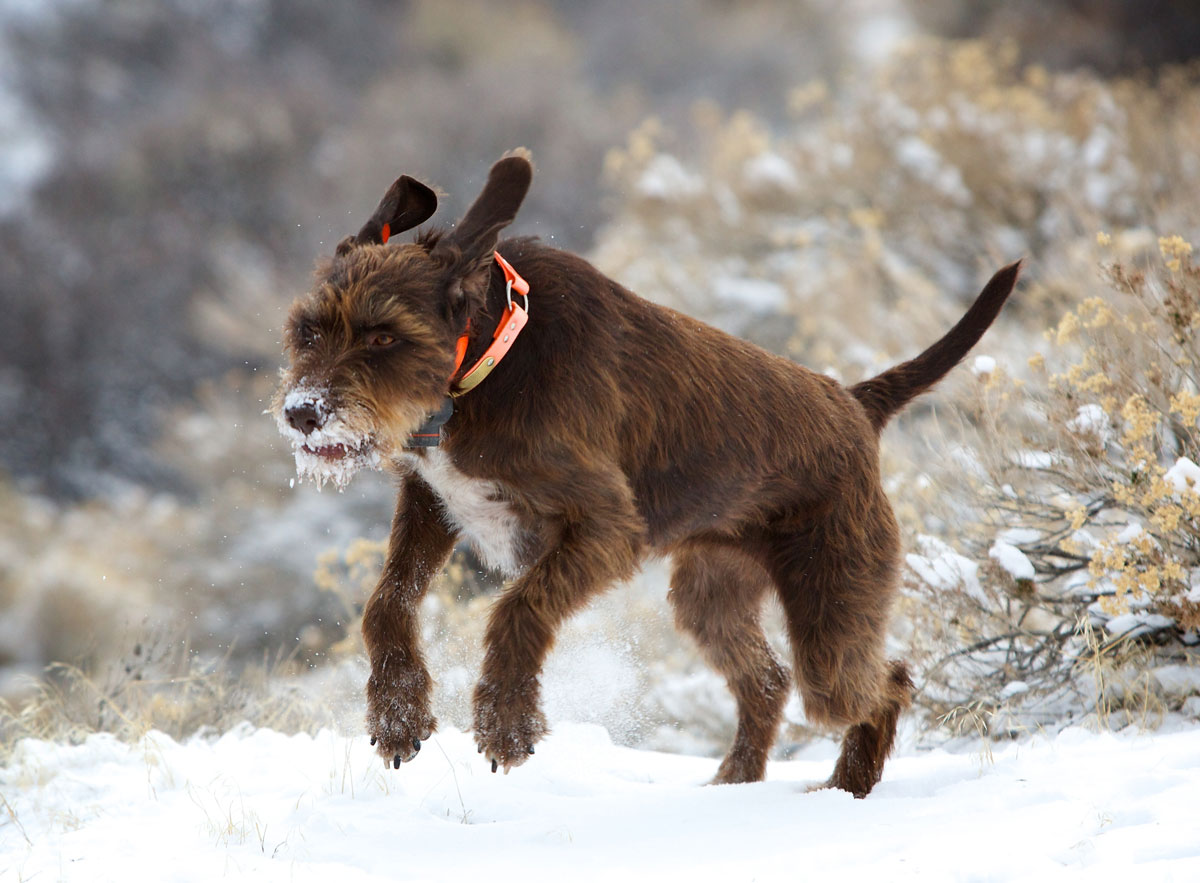
Pudelpointer
Bodo Winterhelt’s name will forever be linked with pudelpointers, the versatile hunting breed he introduced to North America and promoted tirelessly, and with the North American Versatile Hunting Dog Association, the training and breeding organization he founded. But how did he go from the kleiner Munsterlander to the pudelpointer?
“There was in those days no vaccine for distemper, and twice we lost nearly everything. The second time we had also a pudelpointer in the kennel, there for training, and I watched this pudelpointer lick the saliva from the mouth of a dying Munsterlander and not get sick. I couldn’t take it, the dogs dying like that, so I said, ‘That’s the dog for me.’
“But when I told der Alter I was going to switch to pudelpointers, ah! he threw me out, me and his own daughter! He had a temper, that one. So, that was the end of veterinary school. I had to go to work, training full time.
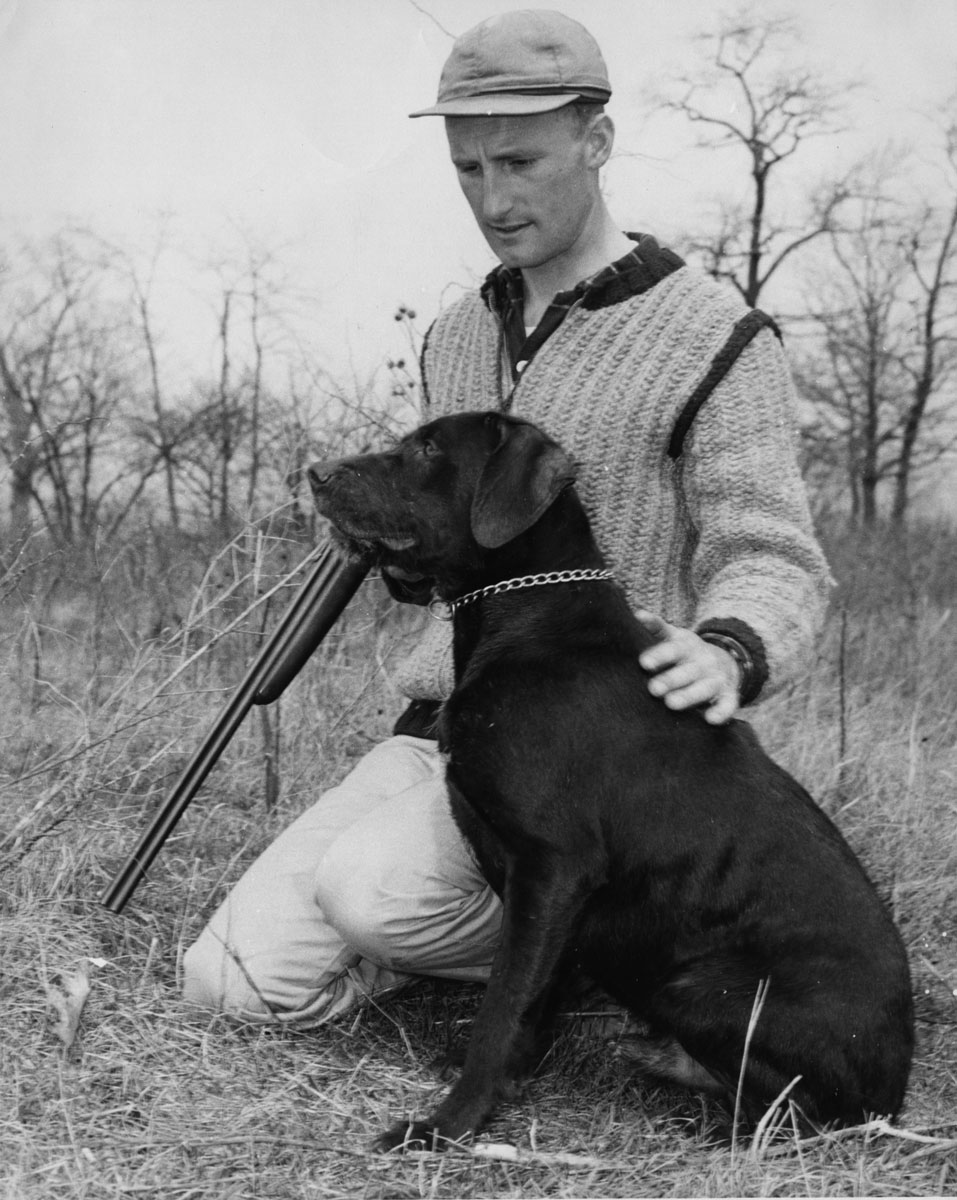
Bodo claimed the coat was the hardest thing to cement, hence the variety found in pudelpointers. This one has a short, smooth coat.
“But then another lucky thing happened. A friend of the family saw my name where I had written it on a wall. [note: due to lack of telephone service or any kind of communications after the war, and due to the displacement of so many people, survivors would write their names on standing walls among the ruins, along with notes on where they were and how they could be contacted.] He got in touch with me and told me that my parents were alive and living back in Miltenberg. But they weren’t living in the castle. Oh, no.”
To shorten a long story of privation, courage and stubborn determination to survive, his parents— his father in his 80s, his mother in her 60s— had not only endured the loss of virtually everything they owned and all their friends, the loss of the world and culture they knew, but they had endured lack of food, lack of shelter, lack of transportation, even the rampant crime made deadly by desperation.
“Everything was gone. But my father was so philosophical. He never expressed regret. Ever! He lost everything. The house in Berlin, his collections, the house by the sea, the castle in Miltenberg, all his money, everything and he never wept.
“So. At the end, there was nothing. What little had been saved, what was not stolen or destroyed, he traded for food. They made it back somehow to Miltenberg and the peasants gave them a little shack, because of course they could not stay with my uncle. They would not even ask, even though my uncle had 40 rooms and half this castle belonged really to my father. So they lived in a little shack with just a few chairs and a table that the peasants had given them, and two army cots.
“The only thing my father kept was a wine glass that once was Goethe’s. It was supposed to have been Goethe’s favorite, his special glass, and my father admired very much the writing of Goethe. So on the last night, he knew, he must have known, he was dying, but he never woke my mother. He got up and got this glass of Goethe’s and when my mother woke, he was lying on the army cot on his back holding Goethe’s wine glass to his chest.”
The tears had started to come while he was still speaking, before he was even aware of them. He covered his face with his hands and wept.
“Stupid.” His voice was high and pinched. “So stupid.”
After a few moments he pulled a handkerchief out of his hip pocket and wiped his eyes.
“Of course, that glass too was lucky for me. Many years later I was able to sell it, and with that money I was able to buy a very fine brood bitch.”
With Germany in ruins there was little call for hunting dogs, so Bodo emigrated to Canada. At first, things were little easier there for a very young, unknown trainer and his unknown breed of dogs. Bodo and his brother worked in the tobacco fields in the summer and as loggers during the winter until finally Bodo found a job with a veterinarian, which led to a job as manager of the famed Nicholson Island Hunting Club in Lake Ontario. Nicholson Island is the kind of place where the very wealthy go to enjoy themselves, but fortunately, most of the members are the kinds of people who take their hunting seriously and who are knowledgeable enough to recognize good dogs and good trainers when they see them.
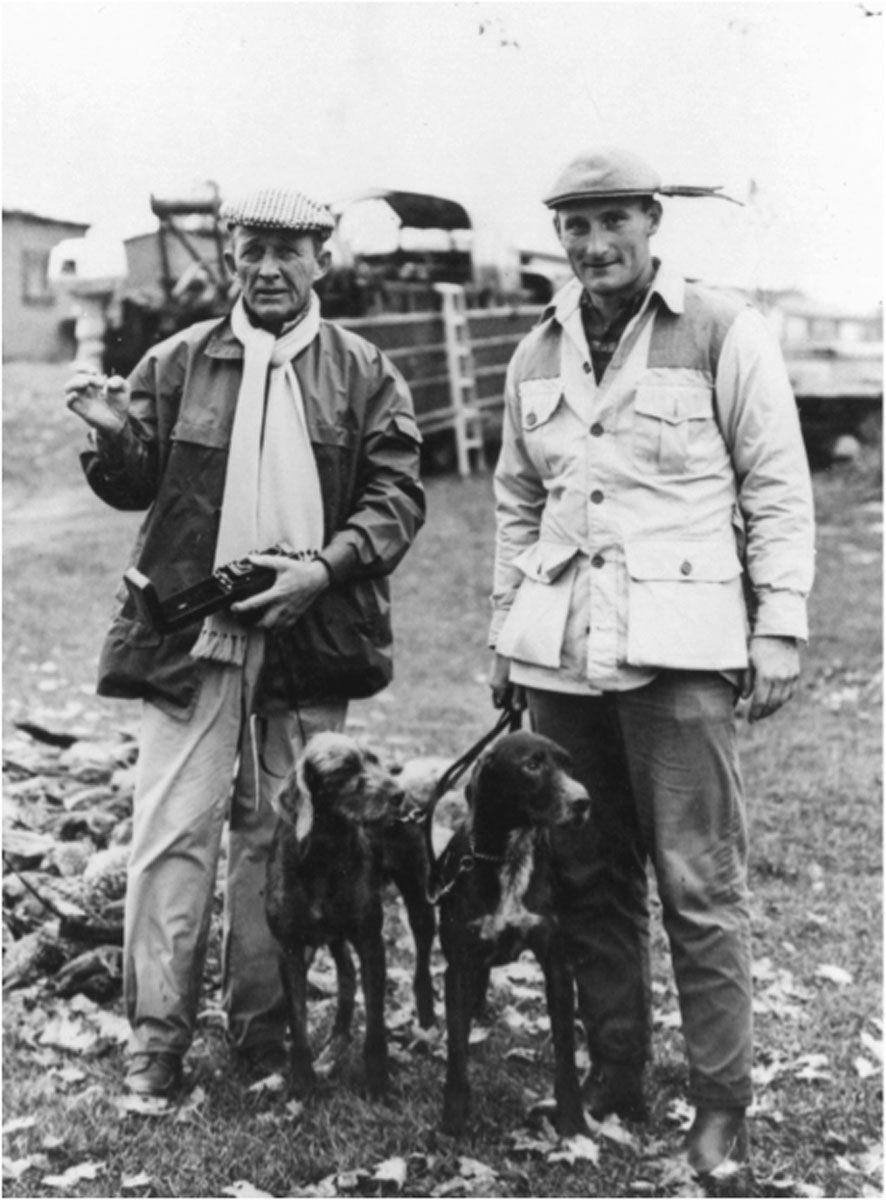
Bing Crosby with Winterhelle’s Paloma and Bodo with Winterhelle’s Olympia (1962).
One of the very wealthy who hunted there was Bing Crosby. Crosby was not only very famous and very wealthy; he was also a serious hunter and fisherman who already owned a pudelpointer. The story goes that while at Nicholson Island he was so impressed by Bodo’s great brood bitch, Paloma, he simply handed Bodo a blank check. He also offered Bodo a position as manager of his ranch in Nevada, near Elko. It says much about Bodo’s single-minded drive to perfect his beloved pudelpointers that both offers were turned down.
It was also during the Nicholson Island period that Bodo began to develop the concept of what would eventually come to be known as the North American Versatile Hunting Dog Association. Based on the individual breed testing system still in use in Germany today, it was the first time any organization in North America offered a chance for dogs to be judged against a standard, instead of in competition with each other.
He finally had to leave Nicholson Island, in part because there was no access to schools for his children, and in part because one winter he and his family became trapped by ice. They were reduced finally to eating the pheasants that were being raised for next season’s hunting. Things got so bad that they were near the end of their pheasant supply when Bodo’s mother-in-law, frantic because she hadn’t had any mail from her daughter, persuaded the Canadian military to fly over to the island where they saw the SOS Bodo had stamped out in the snow.
The story goes that Bodo emigrated to America because the oath of allegiance to Canada included swearing allegiance to the queen. This Bodo refused to do, arguing that he had once earlier been compelled to swear allegiance to an individual, albeit one less benign than the queen, and it had resulted in his getting shot on the Russian front. There is probably some truth to that, but as always, there was another reason as well, in the form of a woman. It might be most diplomatic to sum up Bodo’s relationships with women in general and his wives in particular by quoting Henry II in The Lion in Winter: “Europe. I could have conquered all of Europe, but I had women in my life.” It’s a sentiment I suspect many men have felt at one time or another.
America was very good to Bodo. America was very hard on Bodo. His life there was peripatetic, moving to California to Washington to Oregon to Indiana to different places in California again and once more, finally, to Oregon. He developed prostate cancer, survived and recovered, only for the doctors to find yet another ominous black spot on an X-ray during a checkup. A second surgery revealed a piece of the metal button of his German Army uniform that had been blown into him by the bullet fired on Hitler’s birthday.
America was where he probably suffered more than all through his earlier life because it was while he lived in different locations in California that both his sons died, tragically and unexpectedly. He spoke to me of both deaths, one a suicide, the other from unknown causes, but it was one of the few times I could tell it was a topic this most candid of men did not wish to pursue. I can think of nothing worse than outliving one’s children.
It is well known that he had a major stroke at the end, just a few years before he died, but I suspect he had a series of smaller, undiagnosed ones prior to that, because I could see personality changes in him, but typically, he soldiered on, never mentioning his troubles and making light of them when he did.
His last house dog was a wirehaired Dachshund from hunting lines, and on my final visit, I drove up to Oregon and found him standing, doing nothing, which was truly unusual, and gazing up at the woods that rose behind his little home. I asked him what was going on.
“I’m waiting for that little devil to come back. She’s hunting in there.”
I made some joke about the cobbler’s children never having shoes and that maybe he needed to work on the recall. He looked at me bleakly.
“It’s a hound. You don’t train a hound. You just have to wait in one spot and hope the bastard comes back.”
It somehow seemed a fitting cap to his legendary career. Sometimes you just have to wait.
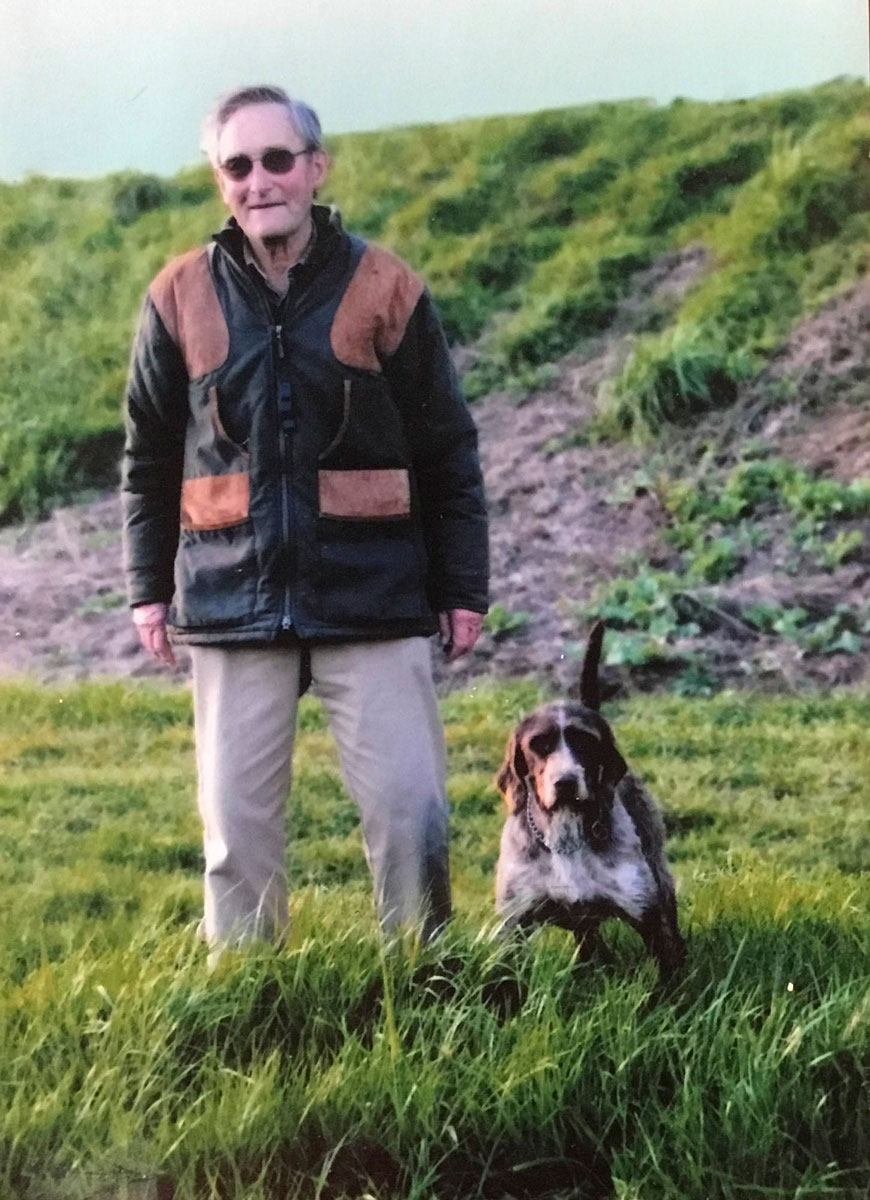
“Bodo” Winterhelt
I knew Bodo for 40 years. He told me many stories during that time, frequently repeating stories he had already told me, but changing details here and there. This is completely normal; we all change the emphasis of stories to suit our listeners. And more: a man’s history becomes his personal mythology and what might have been is sometimes just as valid as what was. On top of all that, time distorts truth just as a prism distorts light, so that looking back, one knows this particular event occurred, but time has dimmed the light that once shown so brightly on all, obscuring some players and emphasizing others, blurring place and chronology. Enough. He was an extraordinary man who enriched the lives of his many hundreds of friends, who endured far more than most of us are capable of enduring, and who left a double legacy in the form of NAVHDA and his beloved pudelpointers. When I see him next, it will be in a place where—if there’s any justice—there will be far more dogs than there are people, and we will sit up late over a bottle of brandy as he recites dreadful limericks and we reminisce about hunts and the dogs that crowd around our memories and the vanished time and the vanished country we both loved.