There is a certain knitting together of warmish air temperature and moisture in the environment that forces the upland bird hunter to pick his poison. A “wardrobe dilemma,” you might call it.
You can dress to prevent the moisture—in the form of rain and/or wet vegetation—from penetrating to your skin, in which case you steam from the inside out like a Christmas pudding. Or, you can dress to beat the heat, in which case your clothes will soon be squishily plastered against your arms, legs and torso, eroding your thermal equilibrium if not shattering it altogether.
The point being that there is no better option, really, or even a palatable compromise, for hunting in these conditions. (Gore-Tex pants are a cruel joke.) You’re going to be uncomfortable no matter what you do—and in danger, therefore, of being ruinously distracted from the business at hand.
This is a matter of some concern as I grow older and find it harder to maintain focus in the face of the long silences that are increasingly the rule of 21st century pheasant hunting. The fire in the belly doesn’t burn as hot as it once did; my attention is more likely to wander. There isn’t a lot of time to react under the best of circumstances when a rooster busts from cover, and if your mind’s someplace else—dwelling on how physically miserable you are, for example—you already have one foot in a gopher hole.
Part of the problem, too, is that for most of my life I hunted with pointing dogs, most recently an English setter savant named Tina. Hunting pheasants with Tina, you didn’t have to worry much about being caught off-guard by a surprise flush, because the overwhelming majority of encounters were mediated by the rare combination of qualities—nose, intelligence, tenacity and sheer, unbridled bird sense—that she brought to the table.
If a rooster tried to run, she’d stick to him like glue until, one way or another, the drama resolved itself; if he chose to hunker down she’d point him with the finality of a vault being closed, and she’d hold that point for as long as it took to get there and flush the bird. Indeed, she took a fierce professional pride in not being the agent of a premature flush, meaning that when I hunted with Tina I could just sort of saunter along with the dial at a minimal level of mental intensity, powering up as necessary when she danced into a point.
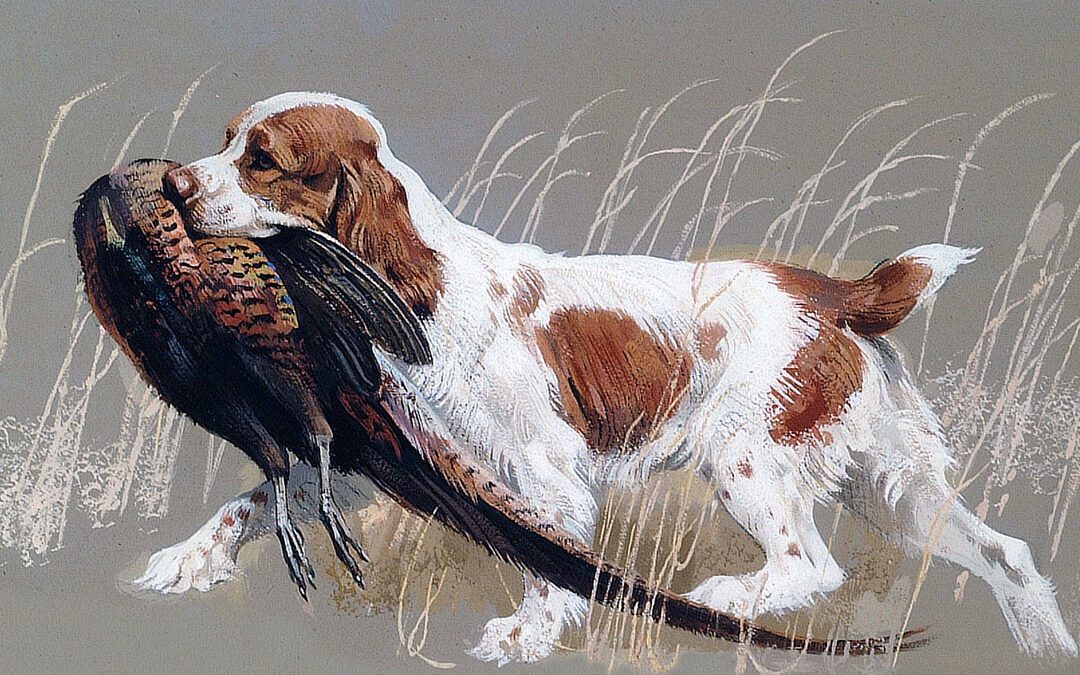
Most of us are lucky to get one Tina in our lifetime; having had two—the other, also an English setter, was named Emmylou—I decided upon Tina’s retirement to strike off in an entirely different direction, follow through on a threat I’d been making for years, and try to pick up a trained, or at least well-started, English cocker spaniel. You can’t help but be charmed by these irrepressible scamps, and their abilities in the field—abilities that belie their stature—led someone to describe them, delightfully, as “Little Big Dogs.”
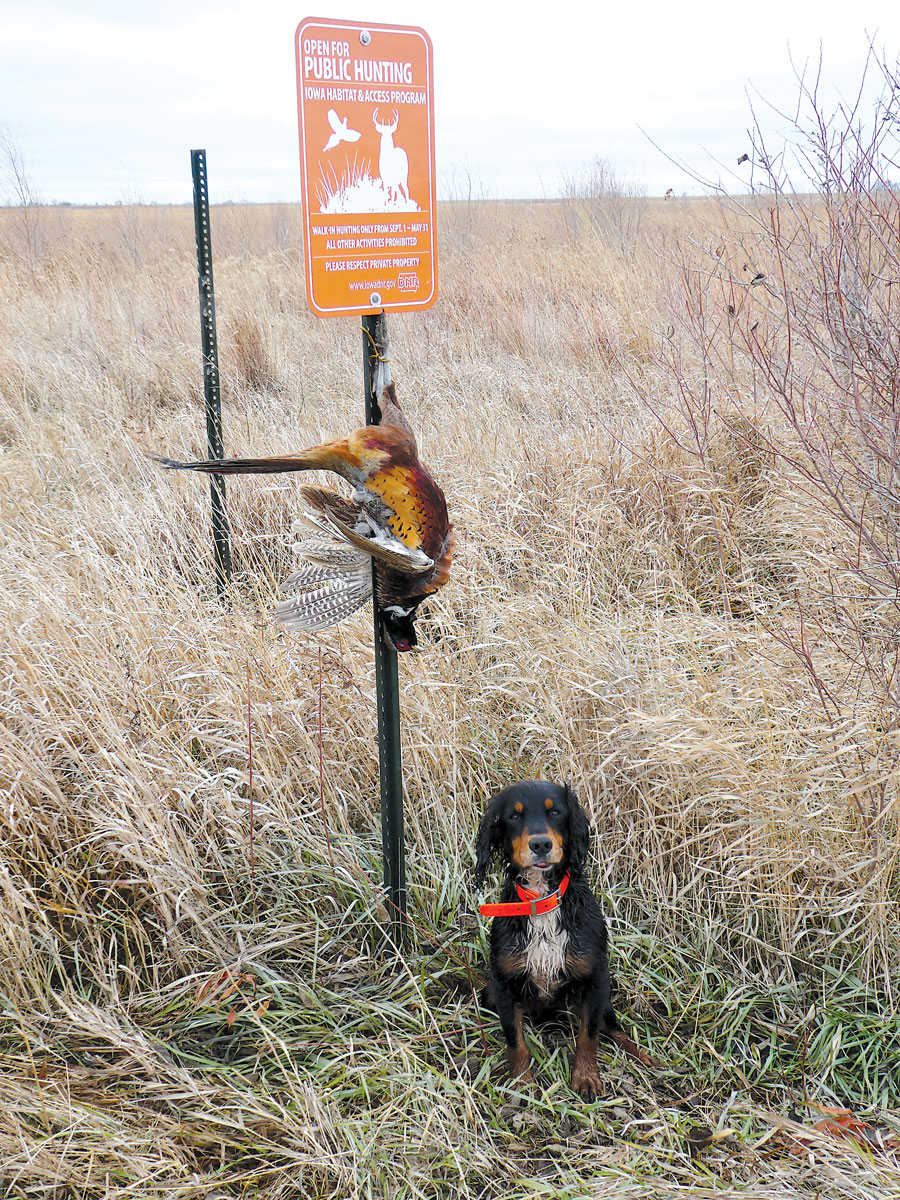
I put out some feelers among my contacts in the cocker camp—and got so outrageously lucky (again!) that I feel a twinge of guilt about it. It so happened that a husband-and-wife team of cocker field trialers from Minnesota, Kim and Bethann Wiley, had a six-year-old Field Champion, a black-and-tan female named Rumor, that they’d retired from competition. Wanting to devote as much time as possible to developing and campaigning their younger dogs, they were looking to place her in a good “hunting home.”
Well, you know what they say about being in the right place at the right time. The price was unbeatable, too. When I related the details of the transaction to one of my hunting buddies, his jaw went a little slack.
“You could fall out of a 12th story window,” he marveled, “and land in a feather bed.”
I couldn’t disagree.
The transition to hunting grouse and woodcock with a flushing dog was almost frictionless, like stepping from one side of a foot-wide creek to the other. I’d spent enough time beating the bushes of northern Wisconsin behind my friends’ Labs and goldens to know what to expect; plus, the number of flushes, especially when the woodcock are “in” (or “down,” as the old-timers put it), makes it easy to stay engaged and on task—even for a graybeard like me.
But if Rumor and I hit the ground running in the grouse-and-woodcock cover, hunting public-land roosters in Iowa was proving to be a bumpy ride. If you were charitably inclined you could call our performance a work-in-progress—but calling it a train wreck was just as valid. The fault was all mine, of course, and it came back to that tendency, absent any galvanizing signals, for my thoughts to wander.
This came to a pathetic nadir one afternoon on a shaggy piece of public ground when, after a lengthy period of inactivity (read: birdlessness), a rooster flushed in what should have been my wheelhouse. Not point-blank range, but darn close—and my mind was so desperately far away that by the time I disentangled it from whatever lurid fantasy I was having, I was left with a barrel-stretcher shot that, predictably, didn’t cut a feather.
I said some bad words then.
When Rumor and I found ourselves at another piece of public land, faced with the prospect of hunting wet, heavy prairie grass on an unseasonably warm, humid day, I foresaw that no matter what combination of clothing I selected it would be wrong—and that the “distraction index,” in turn, was likely to be extremely high. Armed with this knowledge, I made a concerted effort to buckle down and keep my head in the game. When the stout little cocker flushed that rooster I was going to be ready, dammit.
And, despite having to unbutton my shirt to the navel to vent the sweaty heat I’d built up, I was. The rooster, the first pheasant we’d seen, burst from a fringe of sloughgrass and flared to my left. I swung the Superposed and dumped it; Rumor retrieved it, lickety-split, at my command.
Funny how easy it can seem when all the pieces fall in place, isn’t it? We’re still a work in progress, but we’re heading in the right direction.