
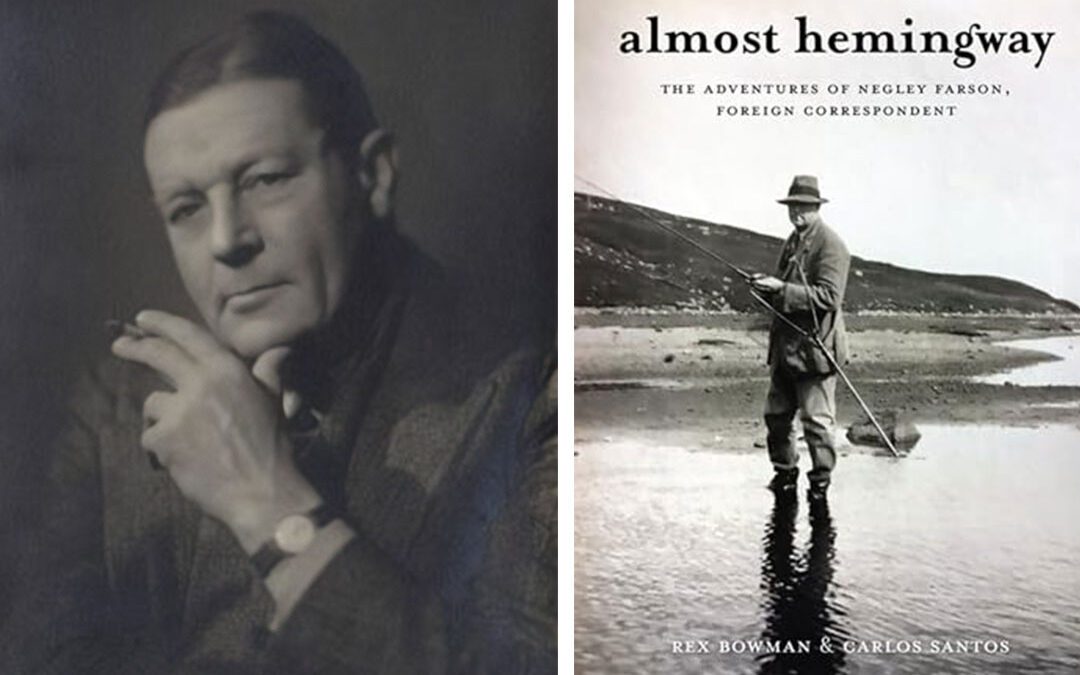
Over the years I’ve read what I personally consider one of the great books of angling literature, Negley Farson’s Going Fishing, three or four times. It’s a book, similar to Robert Ruark’s The Old Man and the Boy or Nash Buckingham’s De Shootinest Gent’man, that delights with each new reading. A recently published life of Farson, Almost Hemingway: The Adventures of Negley Farson, Foreign Correspondent, reminded me of just how appealing I’ve always found his tribute to one of his life’s consuming passions. Written by Rex Bowman and Carlos Santos, the well-researched biography is in no way a chronicle of the man as an angler, although the authors rightly recognize how fishing (mainly fly rodding) ran as a bright, consistent thread through the entire fabric of Farson’s remarkably diverse career.
As one of the shining lights in the golden age of foreign correspondents (the first half of the 20th century, with the 1920s to mid-century being particularly important), Farson’s personal star shone every bit as brightly as those of contemporaries or near-contemporaries such as Ernest Hemingway, Robert Ruark, John Parris and John Gunther. During a decidedly peripatetic period in his life, and he was always a sojourner, Farson had experiences that from today’s perspective seem almost incredible. He was in Russia with John Reed at the time of the great upheaval that led to the emergence of Bolshevism, Lenin and Trotsky; he met Mahatma Gandhi at the time of his famed march to the sea in protest of British imperialism; he covered Hitler’s activities in the lead up to World War II; he flew airplanes when doing so was jeopardy writ large; and there were interludes of journalistic vagabondizing across the globe. Always though, there was fishing.
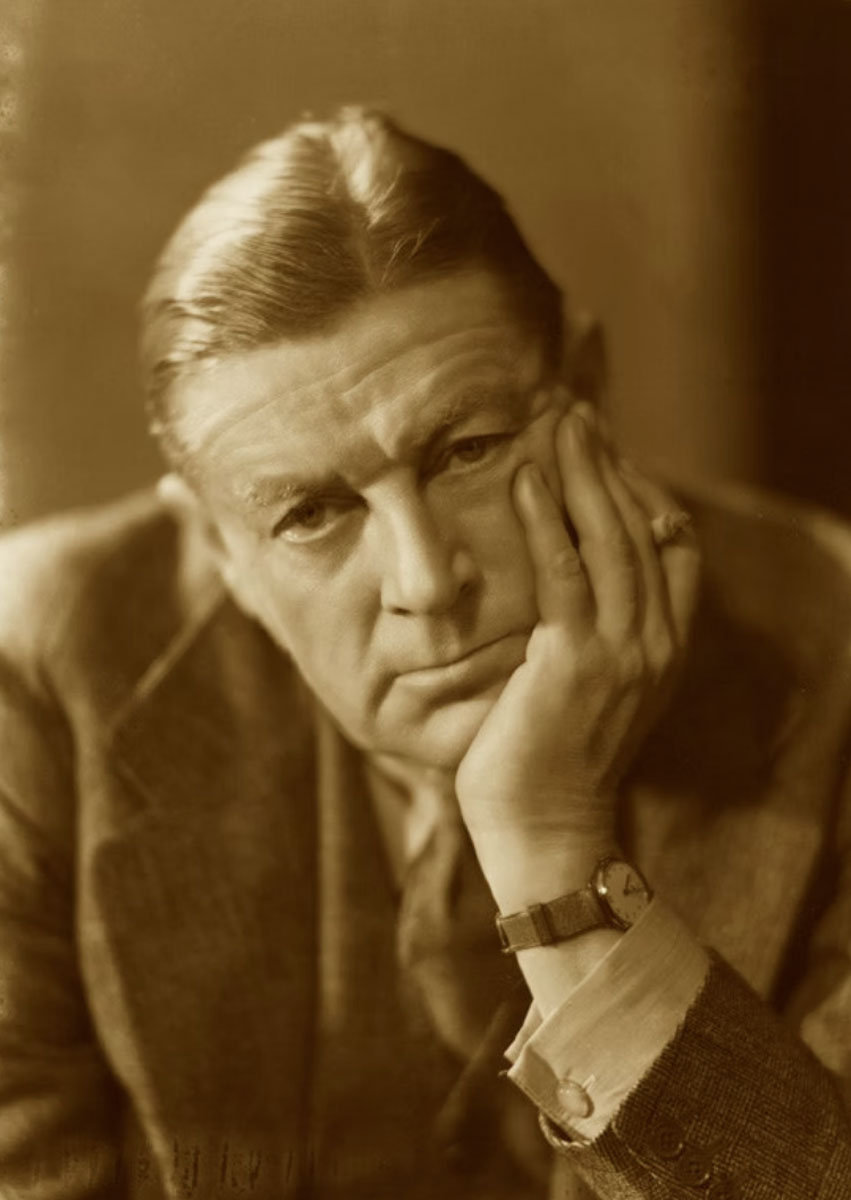
Then, in the middle of the 1930s, and to use the words of his recent biographers, he “captured lightning in a bottle” with his massive autobiographical work, The Way of a Transgressor. The title was well calculated to draw the attention of potential readers, and reviewers gushed over the lengthy, adventure-filled work. Its lightning was nothing more or less than the author’s variegated experiences—fishing, flying, drinking, hobnobbing with the famous and infamous, traveling the world and always seeking new worlds to conquer. His genius was an uncanny ability to bring his adventures to life for readers, with a reviewer for the New York Times styling it a “bombshell of vitality” and “the raciest reading of the year.” Copies sold like hotcakes and suddenly the often impecunious wanderer found himself rather flush.
That comparative financial stability may have translated to more leisure for fishing, but in truth financial straits had never in any fashion kept Farson from wielding the long rod, whistling line and delicate deceits of fur and feather. He seemed to find a place to fish, most often for trout, wherever he went. In fact, fishing was in many ways his muse. While enjoying the magnificent solitude of some remote stream he found his thoughts wonderfully organized, memories of angling moments past a spur to literary flights of fancy and dealing with wary trout and magical ways to produce meaningful words. “Fishing streams was my Nirvana,” he wrote, reckoning that almost as soon as he entered a stream “my mind was miles away from it…[and] I had moments when I was as close to some of the intuitive truths as any Hindu practicing yoga.”
That lifelong love of fishing, one that persisted through Farson’s struggles with alcoholism, marital problems, career misgivings and a life where vicissitudes seemed almost the norm, led to what must, from today’s perspective, be considered his masterpiece. Going Fishing was written at a time and with the author in a geographical place (London during Hitler’s unrelenting aerial blitz) that seems at an impossibly distant remove from the tranquility of a remote and peaceful trout stream. Yet surely it was dreams of those streams, along with the fact that the 50-year-old author was at the height of his literary powers and the turmoil of the times, that gave the book some of its power. Going Fishing is, quite simply, a fishing tour de force. While it contains a fair share of the same old stuff found in countless angling chronicles, accounts of epic battles with the one that got away, listings of lengths and weights and the lacunae of equipment, the whole transcends those piddling parts.
In his introduction to the book, Farson said it was “just a story of some rods, and the places they take you to.” But it was his evocation of those places, his ability to transport the reader to locales where mystique and magic rule the day, that gives the little book its great appeal. I say little because it is just that, a short work (147 pages in the 1942 original, which was published by the venerable Country Life Limited in London) that somehow manages to cram an incredible amount of material into its pages. We join the author vicariously in far-flung parts of the earth—remote British Columbia, the windswept and sparsely populated Shetlands, wild Norway, a patch of poaching on rich men’s retreats in Ireland, the lovely streams of France, Chilean solitude and much, much more. For all of the globetrotting his angling involved though, England was the home of his fisherman’s heart.
He writes of his love affair with hallowed waters of “this almost unchanging English scene” and “its quiet decency…and rich rustic worth” in lyrical fashion. Reviewers loved the book, and perhaps one gauge to its appeal is the fact that the U. S. Army bought a whopping 80,000 copies to give to soldiers during the war. Obviously, the brass considered it a grand means of easing some of the stress and depression confronting the ranks. But for a truly telling reflection on the book’s appeal, none is better than that offered by a World War II British pilot, Hugh Falkus, who would later become a famed angler and angling writer. Farson’s biographers relate the story of how Falkus first read Going Fishing while a prisoner of war in solitary confinement. “For a couple of months,” Falkus wrote, after a guard had given him a copy of the work, “it was my only literature, so I can claim to have read it pretty thoroughly! But Negley Farson proved more than a solace; he was a revelation. Of all the fishing books I had read, his was the best. It still is.”
Not only was it the finest in angling literature in the view of this astute judge, the publisher did things right by obtaining the services of noted artist C. E. Tunnicliffe as illustrator. His woodcuts unquestionably enhance the aesthetic appeal of Going Fishing, and reviewers at the time waxed enthusiastic. A New York Times reviewer found it “a wise and amiable volume” and “an explanation of an outstanding literary personality.” Kirkus Reviews reckoned it a “perfect book,” one “of quiet delight.” But particularly perceptive were the comments of H. E. Bates in what might be reckoned a bit of an unusual outlet for coverage of a book of this sort, Cosmopolitan magazine. Bates said it was not necessary “to be a fisherman to enjoy this book any more than you need to be an expert to enjoy fishing. The title is a piece of skillful bait. It is designed to lure you into the reminiscences of an excellent foreign correspondent who spends his off-days, quite properly, in a more intelligent occupation than politics.”
Farson would write several other books, among them Behind God’s Back, Last Chance in Africa, Caucasian Journey, Sailing Across Europe and The Sons of Noah. There are tidbits of fishing in most of them. After all, a couple of rods and reels, along with the necessary accessories, were as much a part of Farson’s traveling kit as his clothing and notepads. But it was Going Fishing that put his indelible and incredibly important imprint on the literature of fishing. It’s an enduring, wonderfully enchanting little work that every reading angler should have on his shelves and should welcome as a friend during quiet moments of armchair adventure. Farson had his share of unlikeable traits as a man, as holds true for other great writers of his time and nature such as Ruark and Hemingway. Yet those sordid shortcomings vanish like milkweed spores caught in an autumn dust devil when you read his material on fishing. He has that rare genius, the ability to erase cares and concern and replace them with bliss and peace amidst sparkling water and rising fish. That’s what masterful angling writers do, and rest assured Farson is right at the top of their ranks. ν
Jim Casada is the longtime Books Columnist and Editor-at-Large for Sporting Classics. His latest books include Lords of the Veldt and Vlei, available through the Sporting Classics Store, and the just published Celebrating Southern Appalachian Food: Recipes & Stories from Mountain Kitchens, coauthored with Tipper Pressley and available through is website, jimcasadaoutdoors.com.