
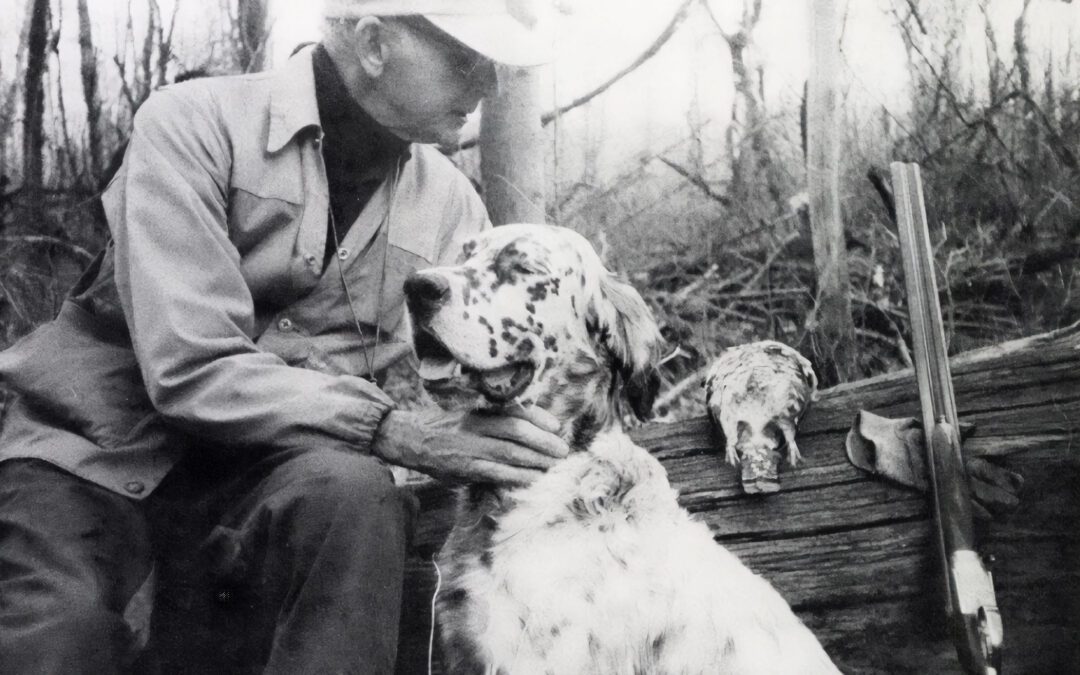
Endowed with seven decades of shooting tradition and the souls of two men, Purdey No. 21390 came as a gift and will be passed on as such. But for now, it is a living extension of its owner’s nerves and brain.
If a man lives in the gun he loves and shoots, then my Purdey is endowed with the souls of two men, with a place reserved for me as Number Three. Those others were the gunners who shot it before me, this lovely thing alive between my hands. This is the story of 12-bore Purdey No. 21390 with two pairs of 26-inch barrels, standard rose engraving, and third grip and clips to action. It has been mine to shoot for 25 seasons; I sometimes feel it has been mine for the 71 years since it was built, showing where hands have brightened the temper color on the sidelocks.
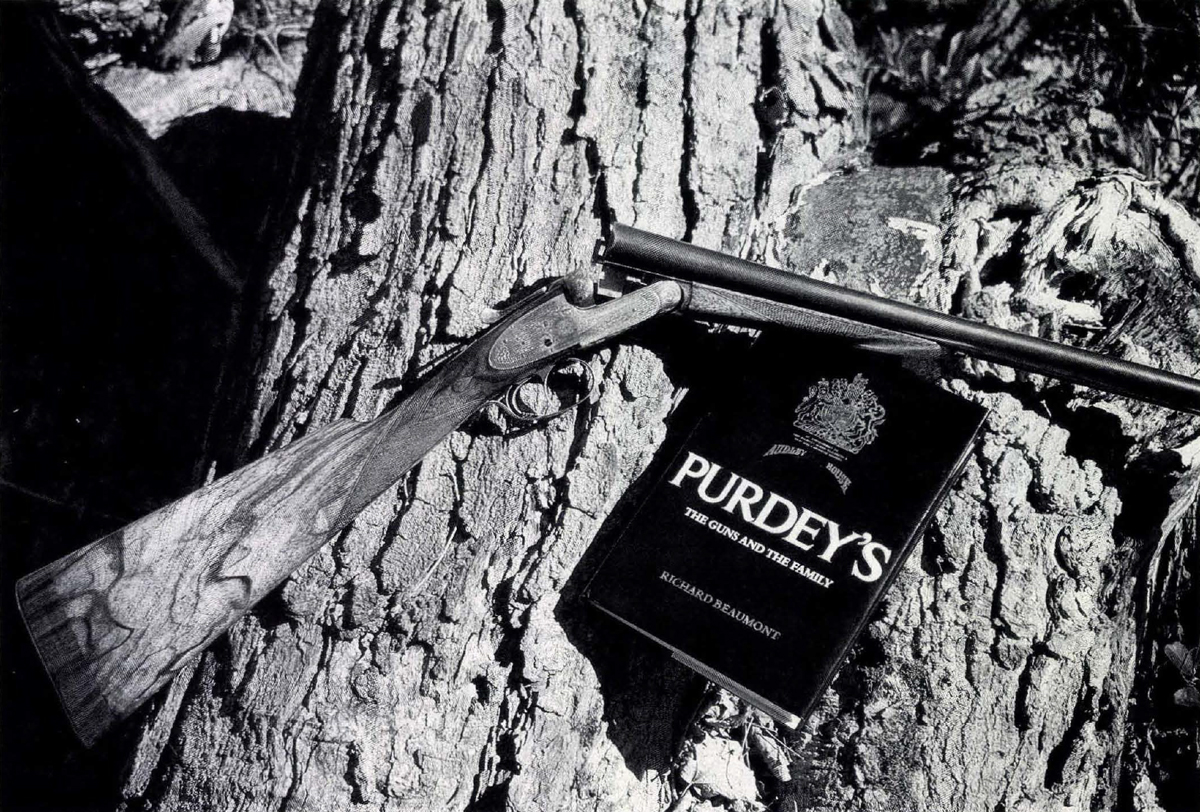
Purdey No. 21390 and Purdey’s The Guns and the Family by Richard Beaumont. All three craftsmen whose initials appear on the shotgun are mentioned in Beaumont’s book.
The gun was made for the post-Edwardian Philadelphia sportsman Lynford Biddle in 1915, the second year Britain was fighting the Hun. London gunmakers had converted to production of wartime materiel for the Crown, and Purdey’s skeleton crew of their top gunsmiths built a minimal number of sporting guns for the duration. A thousand Purdey game guns and rifles had been produced in the three years prior to the outbreak of World War I; seven years passed before the next thousand were built.
Lynford Biddle fired thousands of rounds through No. 21390 for 26 years at upland game, wildfowl, and live pigeons. At his death he left it to his close friend and shooting companion Dr. Charles Camblos Norris of Chestnut Hill and later Fairhill, Pennsylvania.
It was characteristic of Dr. Norris to inquire in detail as to the specifications of the gun. In the flat oak and leather case I found the following letter on Purdey’s stationery, dated 19 October 1943:
We find from our records that the gun No. 21390 was originally chambered for 2 5/8″ cartridges and was fitted with an extra pair of barrels. The No. 1 pair was bored right barrel choke, and the left full choke, whilst the No. 2 pair was bored right barrel tight cylinder, and the left modified choke.
The No. 1 pair shot with cartridges loaded with 33 grains of E. C. powder, with one ounce of No. 6 shot averaged 196 with the right barrel, and 207 with the left barrel in a thirty-inch circle at 40 yards. The No. 2 pair of barrels shot with cartridges loaded with the same charge and shot at same distance, averaged 147 with the right barrel and 194 with the left. Trusting this gun will give you every satisfaction,
The letter was signed by Capt. James A. Purdey, then a director of the firm. On a lower corner of the letter Dr. Norris had written: No. 1 right 72%, left 76%; No. 2 right 54%, left 71 %. One ounce English No. 6 contains 270 pellets.
I find Capt. Purdey’s “tight cylinder’’ for 54% and “modified choke” for 71% interesting.
In 1956 on one of our shooting visits to Fairhill I had the opportunity to examine “the little Purdey,” together with Dr. Norris’s other Purdey and his Churchill.
Having this gun in my gloved hands was like holding the Holy Grail. I will never forget the dim light in that bedroom in that big old house, with Charm the fat setter lying on a chaise longue specially hers, Nellie the equally fat pointer lying on Dr. Norris’s bed with her head on his pillow, snoring, and Dr. Norris standing at my side wreathed in blue pipe smoke, watching me thoughtfully.
For those of us who grew up with American shotguns, the feel of a London Best is a new experience with the nice balance between the gracefully slender straight “hand” of the stock and the small splinter fore-end. Soft light from the bedside lamp illuminated the fine English scroll engraving on the sidelocks, and the stock and action and barrels pointed like my extended arm. I can still see Dr. Norris’s unspoken approval when I closed the hermetically tight breech and let the top lever down carefully with my gloved thumb.
Five short years later I was back in that gray stone house so like a country place in Norfolk, empty now without him and Nellie and Charm. Kay and I came away with the little Purdey, and my mind kept reverting to lines from a poem by Edna M. Cass in the Shooting Times:
Grandfather’s left me his Purdey,
The lad said, half awestruck, half sad,…
and the last line:
Grandfather left me much more than a gun.
In spite of the 30-year spread in our ages, Dr. Norris and I had much in common. As he had done in 1943, I wrote to Purdey’s in 1961 and again in 1966. The reply to my second letter was written by Harry Lawrence, managing director:
I have checked on your gun No. 21390, which was built in 1915 and weighs 6 lbs. 2 ozs.
As you rightly say we build only one quality so therefore, there is no need for us to put a grade name such as “Royal” or “Crown” etc. Our gun in its standard state is finished with our fine rose pattern engraving but, of course, we do finish some of our guns with special engraving such as large scroll, game scenes, or deeply carved with gold inlays, etc., for which we naturally charge extra, but the actual gun itself is of one standard quality.
In the latter part of the last century we did for a short time build two or three qualities which were marked “B,” “C,” and “D” quality; very few were made for it was found to be a bad policy and was stopped.
Regarding the marks on the lower surface of the left barrel, the W. H. were the initials of the barrel filer, William Hill, for it has always been a policy of the Company that each individual craftsman should have the right to put his initials on the part of the gun he made, and this is still carried out today. You should, if you examine your gun carefully, find the initials of the man who made the action, the ejector etc., but you would have to strip the gun to find some of these…
The numbers 50047-48-49-50 are the actual numbers of each individual tube, for it enables us to check each tube back to any particular batch of steel and forging, for we keep perfect records of every tube used, and for which gun.
I have made some enquiries regarding the poem by Alaric Alexander Watts, but so far have not been able to find a copy, but I will continue with the search and should I find one I will immediately let you know.
The 6 lb. 2 oz. weight surprised me, for our local butcher had weighed the gun for me at 6 lbs. 7 ozs. It appears we may have been buying that butchers thumb for years!
Some people have been overawed when entering Purdey’s Audley House in London’s West End, but there is no place where lovers of fine guns receive more considerate attention, as with Harry Lawrence’s personal effort to locate a copy of Watts’ poem Shooting Flying for me.
Quoting the price of Purdey guns is a game of keeping abreast of the exchange rate of currencies. When it was built, No. 21390 with its extras sold for £118.13.0; today an equivalent gun costs £21,300, or $32,802 exclusive of tax and insurance charges. What has not changed in a Purdey is quality, which like old money is unobtrusive but present.
A wood engraving of an 1886 hammerless Purdey game gun shows the same standard rose engraving that is on my 1915 Purdey and the same as on standard Purdey shotguns today, as nearly identical as hand work can be. There is a photo on page 31 of the March/April issue of Sporting Classics of a Purdey double rifle that bears the same rose engraving on its sidelocks, which have the same screwhead, pins, and discharge indicator as on my game gun.
The legend on the smooth top rib of my gun barrels states: Made of Sir Joseph Whitworth’s Fluid-Pressed Steel, the steel that replaced the figured Damascus barrels in the 1880s. The Purdey bolt and top lever locking mechanism patented in 1870, and the Beesley self-opening action patented in 1880 are used on Purdey guns today. Retaining something that was good over 100 years ago because it is still the best, is an immutable essence of tradition. The action on my Purdey is so fine-tuned it gives off a tone like a C-sharp harp string when rapped on the sidelocks.
Some collectors would, I suspect, undergo corrective surgery on their neck and shoulder rather than have a Purdey altered to their dimensions. But a gun, no matter how fine, serves its destiny only if it is shot and if it fits its gunner.
Most London Bests throw their patterns high at 40 yards, achieved with an “elevating rib,” conceived by Joseph Manton. Unlike the elevated rib, which is raised the entire length of the barrels, the elevating rib is set high at the breech and slants to a small bead below the tops of the muzzles, causing an ascending or “elevating” line of fire in relation to the shooter’s line of sight. To lower the muzzles to throw parallel with my vision, I had my gunsmith install a small platform with a white bead raised to my calculations, centering the patterns where I look.
Certain characteristics contribute to the gunner’s performance — length of barrels, weight of trigger pull, balance, and gun weight — but gun fit can be said to be in the gunstock. When the Purdey came to me the stock required a bit more drop at comb and heel, considerably more length, and more cast-off. My gunsmith would normally have obtained the cast-off with hot oil and pressure, but hesitated to risk that because of the age of the wood, fearing it might not withstand the stress.
The blank for my stock had been cut from the root of a walnut tree that began to grow in France around 1700. The rough blanks are seasoned for six years before they come to Purdey’s where they are kept for five or more years in the factory. To select outstanding patterns in the wood, the blanks are given a coat of stock oil, which brings out the configuration in the walnut.
I first obtained the extra length with a recoil pad but, dissatisfied with that, I sent the stock to a former Stocker with Purdey’s now in the States, who added an extension of French walnut and matched the grain with uncanny skill.
I carefully worked down the comb for more drop, and the cheek side of the stock for the additional cast-off, using fine sandpaper. The wood was as dull and dark as the old leather trunk case, not from abuse but from overuse of gun oil that had discolored the stock. I can still hear Dr. Norris saying: “Oil never hurt metal.”
In my process of sanding I cut into the clear unstained wood of the stock. I finished it with 22 coats of Tru-Oil rubbed to a “London dull” sheen. The old stock seemed to take fire with the sublime smoky black flame of French walnut, formed where the roots join the trunk. I have not seen a London Best stock to surpass it.
When I inherited the Purdey 25 years ago, it was difficult to obtain the short British cartridges, living where I do. I had the chambers lengthened to accommodate 2 3/4-inch shells. A modern 3 dram equivalent 1 ounce load is within the bounds of the recommended 40 grains Schultze or 33 grains E.C. loads for which the gun was regulated with 1 ounce of shot. Heavier loads used for proofing these guns represent a margin of safety, not recommended loads. I have shot hundreds of 3 dram, 1 1/8-ounce loads in the gun, which is the “maximum service load” of shot indicated in the proof marks.
If, as has been accused, I “butchered” my Purdey, I achieved a gun that performs like an extension of my nerves, vascular system, and brain.
Since I have had it, Purdey No. 21390 has been shot in remote wild valleys, on rugged mountainsides, and on high windswept plateaus not unlike the Scottish moors of other Purdeys. The day after the “Glorious Twenty-Fifth” of October, when traditionally the woodcock flights come through, Kay and I were in a covert where we could expect both cock and grouse. I uncased the gun, assembled it and dropped in shells, bringing the stock up to the barrels, thinking as I always do of Dr. Norris at such times. Belton and Quest, unhampered by meditations, were watching me for my signal and I waved them into dense thorn cover. Kay and I pushed after them.
At the upper end of a woods road festooned with grapevines, I paused to substitute a woodcock load in the right barrel before entering cover along a small run. As I broke the breech, the top lever opened without resistance and hung loosely like a fractured arm.
I closed the gun and tried mounting it, holding the lever in place with my thumb to determine if I could shoot in that manner, but there was no way to be certain my thumb might not slip and let the self-opening breech separate when the gun discharged. Kay located a heavy rubber band in her camera case and I looped it around the trigger guard and up over the top lever with enough tension to hold it closed. The dogs were already working cover and I followed. Belton pointed on the bank of the little stream. Kay was kneeling beside me for a photo of the point, and Quest swung in and honored Belton. Everything was perfect except my performance. The woodcock didn’t give me much, going through a hole in the alders, and I didn’t make much of it, but getting off a shot with the rubber band in place was something.
Back home I phoned a gunsmith and without taking time to eat, we were soon driving over the mountain to his shop, still in our shooting clothes.
Melvin Forbes had been recommended by my old gunsmith when he retired, and we found him at his bench, surrounded by the clutter and filings that are part of a gunsmith’s shop. Kay and I watched him select a turn-screw from a pile and begin to strip the Purdey action, starting with the trigger guard, then the under assembly and both sidelocks, spreading the parts over an oil-and-graphite-blackened deerskin on his workbench.
During the years I had shot my gun I had never seen its viscera. Off the gun, the wafer-thin sidelocks looked smaller, the mirror-polished high carbon steel parts fitting the space with jigsaw-puzzle precision. After seven decades of shooting, the locks were immaculate.
Although Harry Lawrence had said the actioner had put his initials on the inside of the action, I never expected to see them. They were there: LSD on the inner surface of one of the sidelocks, stamped by the British craftsman who had fabricated this piece of jewelry 71 years ago.
My thoughts were interrupted by Forbes’s words: “Here’s your trouble.” He was holding two segments of a small V-type leaf spring, broken near the base of one prong.
That spring was entitled to metal fatigue. It had been flexed each time the gun was assembled, the thousands of times the gun was loaded, each time it was opened to eject a shell, each time the barrels were removed when the gun was cleaned.
Forbes was selecting a strip of high carbon steel and comparing it with the thickness of the broken spring. “We’ll make one,” he said, moving down the aisle of the shop.
For four hours Kay and I watched him work the strip of steel — tooling, heating, forging a duplicate of the broken spring hand wrought in the same manner early in the century. Exchange his plaid shirt and blue jeans for a collarless white shirt and bib apron, and you might be seeing one of Purdey’s craftsmen leaning over a vise with the same intent expression.
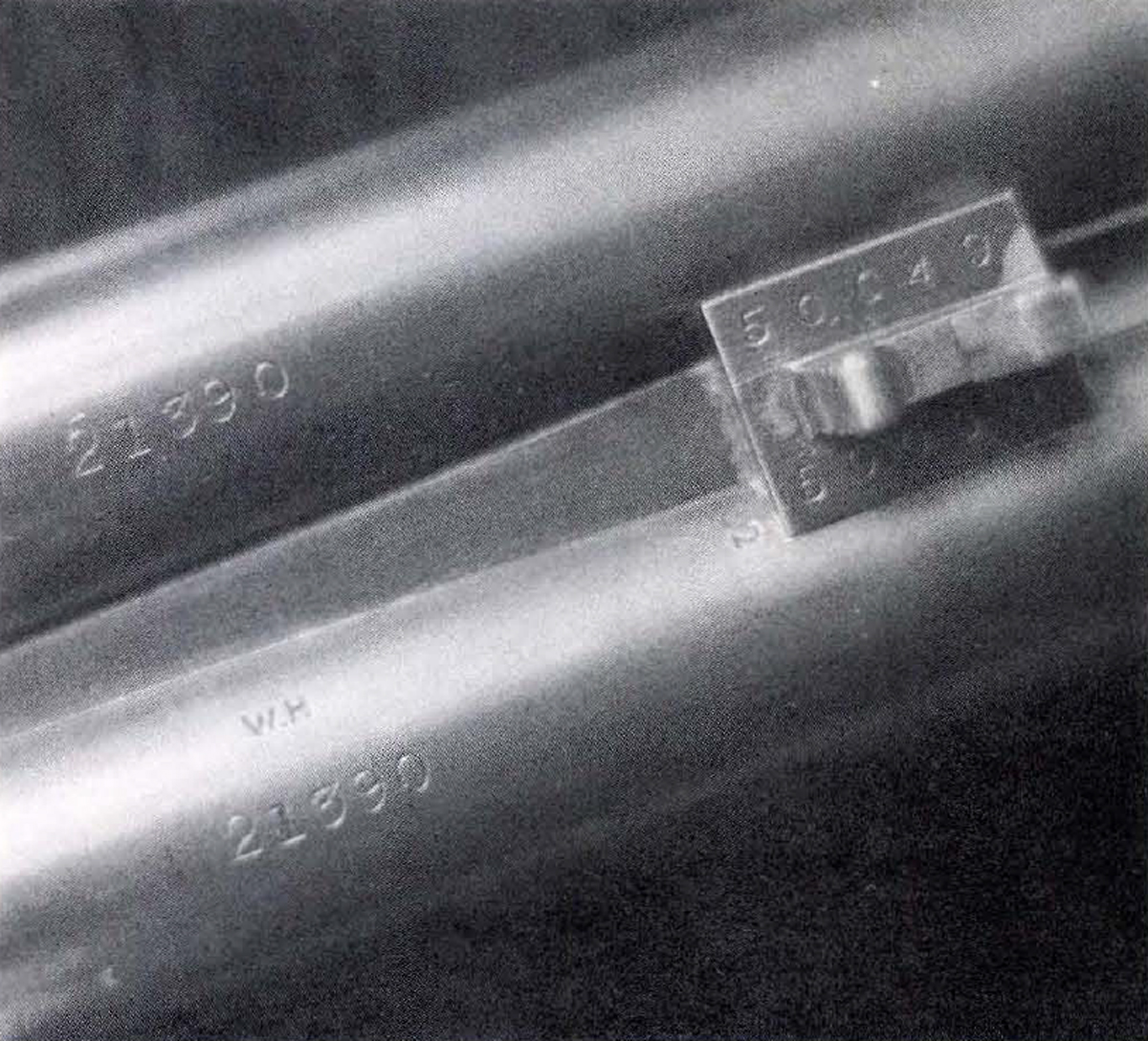
W.H. are the initials of William Hill, the barrel filer. The numbers 50049 and 50050 are for the individual tubes. S on early guns signified steel barrels vs Damascus.
Partway through the evening Forbes went into his house and returned with a plate of breast meat from a wild turkey he had shot east of Allegheny Mountain two days before. Kay and I ate it ravenously.
The piece of metal, well formed by now, was being heated to a cherry red, then immersed in water and tempered. In the final process it was submerged in a trough of burning oil, then dropped in dry lime to cool slowly. At last, at 11:30, after finish work with a file, Forbes laid the new spring in my palm like the gem it was.
While he was installing the action on the stock, I was able to see the exquisite fit of wood to metal, the interior tooling in the walnut with small spurs protruding to fit openings in the action, the dark wood still crisp after all those years. Melvin Forbes carefully assembled the gun, and Purdey No. 21390 was once again whole, only a few hours after the day’s breakdown.
The new spring enabled me to be back in coverts without delay, but beneath the relief, I felt a curious need to regain total integrity in the gun with a spring from Purdey’s. I placed my problem in the hands of Richard Beaumont, chairman of Purdey’s. In my letter I mentioned the initials inside the action and requested a rundown on the workmen who had made the gun. In less than two weeks I received a Purdey top lever spring, together with the following:
The initials A. F. on your fore-end are those of Alfred Fullalove, and you will find reference to him in my book as being the man who trained Harry Lawrence during his apprenticeship. The initials L. S. D. are those of Davidson, and he was the man who told off Tom Purdey for coming to the factory in an intoxicated state! It is very lucky that you have managed to acquire a gun made by three people who I mentioned in the book!!
Thank you so much for writing and I do hope that this spring arrives in good order.
Yours sincerely,
Richard Beaumont
The third man was William Hill, the barrel filer whose initials had been identified for me by Harry Lawrence. I later learned from Richard Beaumont that the man who made my stock was Alfred Dean.
So now I have the missing parts to the story of my Purdey — the men who made the gun. They worked on Purdey guns from pre-World War I until just before World War II, during which guns numbered 20,000 through 25,000 were built, and I feel fortunate that mine is one of them.
Richard Beaumont’s Purdey’s, The Guns and the Family (David & Charles Ltd., London, 1984) is rich in information about the people and the guns. I went back to it to read about William Hill and “Tommy” Davidson and Alfred Fullalove. Purdey craftsmen have always worked under the old guild system, from apprenticeship to a specialized skill, which each man would follow for life. There are records of which men worked on each gun.
Harry Lawrence was serving his apprenticeship under Alfred Fullalove at the time Fullalove was working on No. 21390. I feel the touch of hand, for no doubt Harry Lawrence did some of the preliminary work on the ejector mechanism.
To me a gun, like a dog, is dearer for being old. My Purdey is more than a London Best with all the trappings of tradition. It is important to me that it has never been sold, other than by Purdey’s; it came to Dr. Norris as a gift from Lynford Biddle; it came to me as a gift from Dr. Norris; it will someday go to another gunner as a gift from me. Purdey No. 21390 has bestowed pleasure and values on three of us so far. I contemplate what it will do for that other man who will shoot it handsomely over gun dogs worthy of the gun.
For many shooting men Purdey’s is a realm to be roamed in imagination, a land where there is no compromise in quality, a place that has existed in shining glory. That glory has lasted for 172 years.
Note: This article originally appeared in the 1986 September/October issue of Sporting Classics magazine.