
A Life on the Lunatic Express
Some four decades ago, when both this magazine and writer were young, I wrote a feature bearing the title “The Lunatic Express.” It later appeared as the lead story in an anthology of grand tales of derring-do carrying the title Africa: 41 Tales of Adventure from the Dark Continent. At the time, my familiarity with the hero of the tale, John Henry Patterson, was somewhat narrow and linked primarily to his dandy pair of works on sport, adventure and animal life in East Africa, The Man-Eaters of Tsavo and Other East African Adventures (1907) and In the Grip of the Nyika; Further Adventures in British East Africa (1909). My perspective on Patterson at that juncture was viewing the man as a prime example of the peripatetic souls who first explored and then pioneered the British imperial presence across the globe in general and Africa in particular.
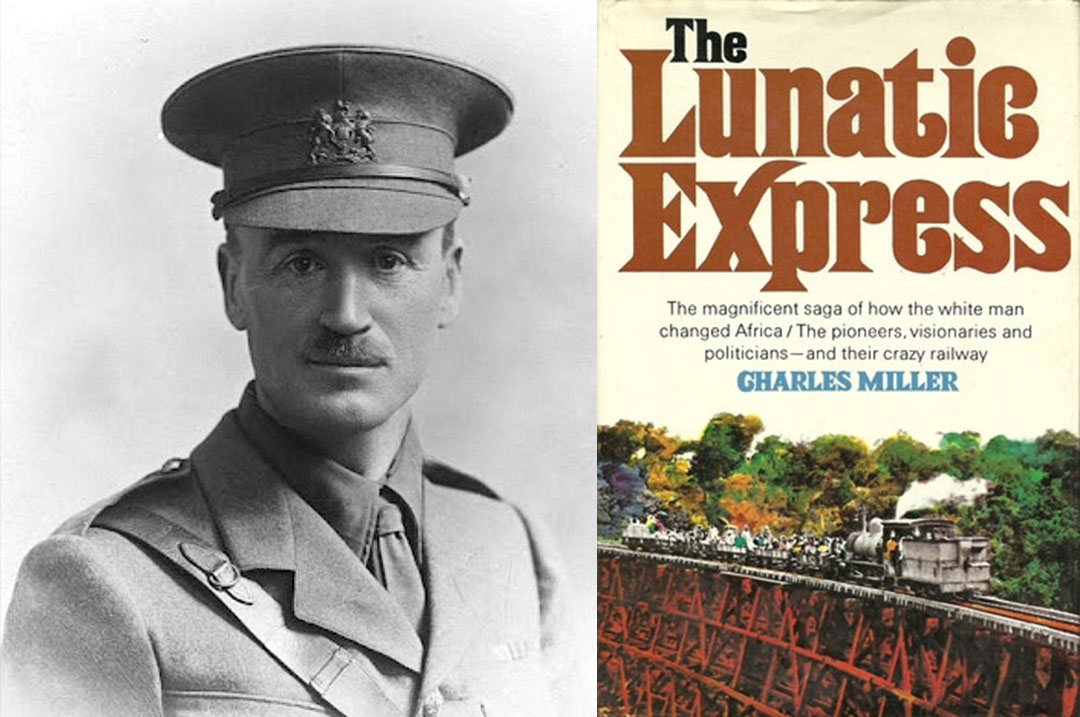
In some ways, the exploits of the hero of Tsvao associated with the “Lunatic Express” were a harbinger of his entire life. As for the Express, more commonly known as the Uganda Railway, leading pro-Empire advocates, led by Lord George Curzon, a noted explorer and recent Viceroy of India, saw it as a part of their “forward policy” of imperial expansion. On the other hand, “little Englanders” considered the whole undertaking an exercise in the utmost folly. One of them, Henry Labouchere, a strident and vociferous anti-imperialist in the British House of Commons, addressed that august body with a clever bit of invective disguised as doggerel in connection with plans of the sitting Conservative government to build a railway from the East African coast to the interior around Lake Victoria:
What will it cost no words can express;
What is its object no brain can suppose;
Where it will start from no one can guess;
Where it is going to nobody knows.
What is the use of it none can conjecture;
What it will carry there’s none can define;
And in spite of George Curzon’s superior lecture,
It is clearly nought but a lunatic line.
From the perspective of budgetary pounds and pence, there was more than a modicum of truth in Labouchere’s poetic diatribe, yet in a sense it could have almost been a prophecy foretelling the future of the name most associated with the railway. Patterson’s entire lifeline was something of a lunatic express, a runaway train forming a fascinating and singularly complex life.
John Henry Patterson was born in 1867 in County Longford, Ireland, to a mother who was Catholic and a Protestant father. Perhaps that mixed religious background in a place where differences in matters of belief have caused angst and deep animosity, all too often giving way to outright violence for centuries, helped shape the man. Similarly, such considerations likely were a factor in Patterson’s later advocacy of Zionism, something for which he was posthumously honored by the state of Israel.
A few months short of his 18th birthday, Patterson joined the British Army, a career approach that was commonplace at the time. His service extended over parts of four decades and saw him achieve the rank of lieutenant colonel (and he should have risen higher) before retirement in 1920. As so often was the case, from African explorers such as Sir Richard Burton and John Hanning Speke to participants in the “Great Game” in India such as Alexander Burnes and Francis Younghusband, Patterson would use his military service as a springboard for involvement in a variety of extracurricular activities on foreign soil. This was commonplace throughout the Victorian era and on into the early 20th century, with liberal leave policies and tacit encouragement from authorities allowing adventurous souls all sorts of leeway. The unspoken but quite real expectations were a sort of imperial quid pro quo whereby involvement in remote places or problematic situations had the potential to benefit the Union Jack on one hand while offering plausible governmental deniability on the other should something go wrong.
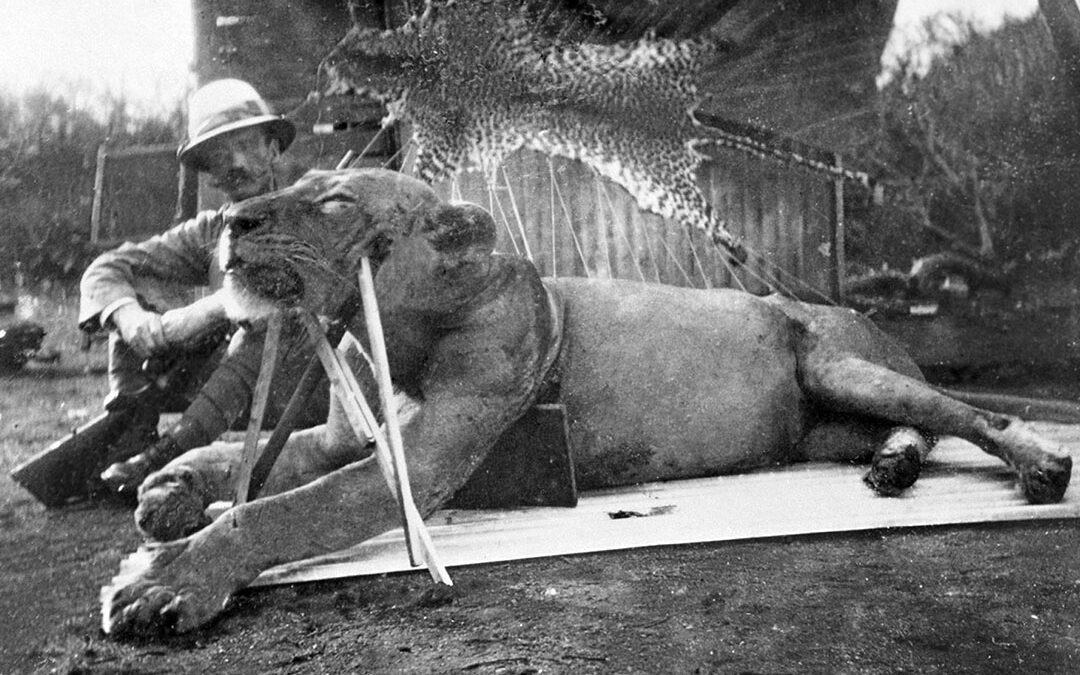
Patterson’s career, up to 1898, was unremarkable. In that year he was assigned to the Uganda Railway as overseer of bridge construction over the Tsavo River. It was there that a pair of man-killing lions brought the railway to a complete halt as they killed more than two dozen construction workers along with a number of local residents. The story of what ensued has passed into legend and was described by Patterson in his best-selling book of a few years later (replete with a glowing Introduction by his friend and noted old African hand, Fred Selous) and has since figured prominently in three movies, “Bwana Devil” (1953), “Killers of Kilimanjaro” (1959) and the more recent “The Ghost and the Darkness” (1996) starring the late Val Kilmer.
There are also numerous books dealing entirely or in large measure with the subject including the two-volume official history, Permanent Way (1949), Ronald Hardy’s The Iron Snake (1965), Charles Miller’s The Lunatic Express (1971—the most readable of the lot) and Stephen Mills’ A Railway to Nowhere (2012).
The events at Tsavo, which resulted in Patterson killing two aging lions with worn-down teeth and a taste for easily available human flesh, gave him his place in history. The lion’s skins and skulls eventually ended up at Chicago’s famed Field Museum when Patterson sold them in the mid-1920s, and his career moved rapidly in other directions. For a time, he saw active duty in the Second Boer War, distinguishing himself to such a degree he was recognized with the Distinguished Service Order and temporarily promoted to the rank of lieutenant-colonel.
Not too long after the Treaty of Vereeniging concluded hostilities in that conflict, Patterson found himself back in his old Tsavo haunts, having been appointed a sort of game warden extraordinaire whose primary duty was oversight of the sprawling reserves of the region. Those experiences led to the discovery of a new species of eland, subsequently named Patterson’s Eland (Taurotragus oryx pattersonianus) and providing the material for In the Grip of the Nyika. However, another episode from this period of Patterson’s life caused considerable controversy, spawned an enduring piece of literature and remains to this day a matter of mystery.
His position as the head game ranger in what would become Kenya gave Patterson considerable leeway in terms of duties and that explains, at least in part, why he was on a hunting safari with a well-placed and affluent English couple, Audley Blyth, the son of James, the first Baron Blyth, and his wife, Ethel. During that ill-fated outing that Patterson would subsequently describe as “a grave revolver accident,” the life of Audley Blyth was taken. Some suggested it was a suicide, others that his wife murdered him, and still others that Patterson pulled the trigger. There were widespread rumors of an affair between the hero of Tsavo and Ethel, and the incident created a storm of controversy in East Africa, so much so that even among those involved in the wild lifestyle associated with what would become known as Kenya’s “Happy Valley” crowd were scandalized.
Whatever the exact details of the occurrence (native witnesses said Patterson was not in the tent when the shot rang out but that Ethel was), subsequent events can only be described as bizarre. The deceased Blyth was buried on the spot, and the safari continued without any effort to terminate it and report the sad occurrence at the nearest outpost. Gossip and scandal subsequently ruled the scene in East Africa,
Patterson was ordered home on “sick leave” as soon as he and Mrs. Blyth were back in Nairobi, and there were official inquiries in Parliament. Colonial Office records on the event reveal little of substance, but unquestionably the event tainted Patterson’s career for years to come. As some may have realized by now, hearing tales of the matter decades later provided Ernest Hemingway with the underpinning for his famous story, “The Short Happy Life of Francis Macomber.” The piece, which first appeared in Cosmopolitan in 1936 and subsequently in collections of Papa’s work, rivals “The Snows of Kilimanjaro” in Hemingway’s overall oeuvre. It was made into a movie, “The Macomber Affair,” that starred Gregory Peck.
Dogged by controversy, never mind that he had been married since 1895 to Frances Gray, among the first women in the United Kingdom to receive a Doctor of Laws degree (they had a son, Bryan, who became a noted researcher working at the Field Museum), Patterson managed to hold on to his military career. The years immediately prior to World War I found him again involved in controversial events, this time as commander of a regiment of the Ulster Volunteers, a militia unit formed in Northern Ireland as a bulwark against Home Rule. Although unproven, it is quite likely that Patterson had a hand in smuggling some 20,000 German-made rifles and hundreds of thousands of rounds of ammunition into Ulster during this period.
With the outbreak of World War I, Irish troubles temporarily took a back seat and Patterson found himself something of a pivotal figure in the Middle East as commander first of the Zion Mule Corps and later the Jewish Legion. These were twin foundation stones of what would, long afterward, come to be known as the Israeli Defense Force. The Mule Corps gained fame in the ill-fated Gallipoli Campaign, as would subsequently be true of the Jewish Legion in the Palestine Campaign. Although Patterson was a Protestant, he became a revered figure among Jews and his advocacy on their behalf, then and afterward during the Holocaust, made him a hero to Israelis. He was a close friend of the father of today’s leader of Israel, Benjamin Netanyahu, and was godfather of the senior Netanyahu’s first-born son. Decades later, adhering to wishes of Patterson, the remains of he and his wife were disinterred from the Los Angeles Cemetery where they had been buried and reinterred in Israel. They now rest in the Israeli village of Avihayil alongside the graves of many of the men he commanded during World War I. At the 2014 reinterring, Prime Minister Netanyahu described Patterson as, “the godfather of the Israeli Army” and lauded the man as, “a great friend of our people.”
During his World War I service, he was consistently outspoken in his criticism of antisemitism, with some of his words and actions coming rather too close to home for those back in London. Indeed, his advocacy for Jews likely cost him dearly in officialdom and was almost certainly a factor in his lack of further promotion in rank and shoddy treatment in the post-war years. He wrote two books, With the Zionists at Gallipoli (1916) and With the Judeans in the Palestine Campaign (1922), about his war years. He retired in 1920 and subsequently moved to the United States. There he continued his strong support of Jewish causes, served as an active member of the
Emergency Committee of Save the Jewish People, and did all he could as an elderly man to battle against the Holocaust. Far from applauding these efforts, the British government actually cut off his pension during World War II, and Patterson would die in California at the age of 79, poverty-stricken and largely forgotten, at the home of a friend in that state. His wife passed away a few weeks later.
In retrospect, Patterson seems in many ways to have been a man born too late. His sense of adventure, willingness to follow his heart and studied indifference to the dictates of what society deemed right and proper belong more to the golden age of African exploration and sport than to the 20th century that embraced more than half his life. He rode a sort of one-man “lunatic express,” almost out of control and certainly far removed from the norm, for all his adult years. Pass judgment as you wish on some of his questionable actions and, for that matter, the overall nature of his years and career—one conclusion is inescapable. His was a life filled with fascination.
Further Reading on Patterson
Patterson’s books are mentioned in the text, and the two African-based ones are recommended reading for anyone fascinated by tales of African sport and adventure. He is the subject of a full biography, Patrick Streeter’s Mad for Zion (2004), and an assiduous search of sources on his life will unearth a wealth of information. His book, The Man-Eaters of Tsavo, is available at sportingclassicsstore.com.
Jim Casada is Editor at Large for Sporting Classics and a lifelong student of the history of hunting and fishing. To learn more about his work or to receive his free monthly e-newsletter, visit jimcasadaoutdoors.com, or check out books offered through the sporting Classics Store.