
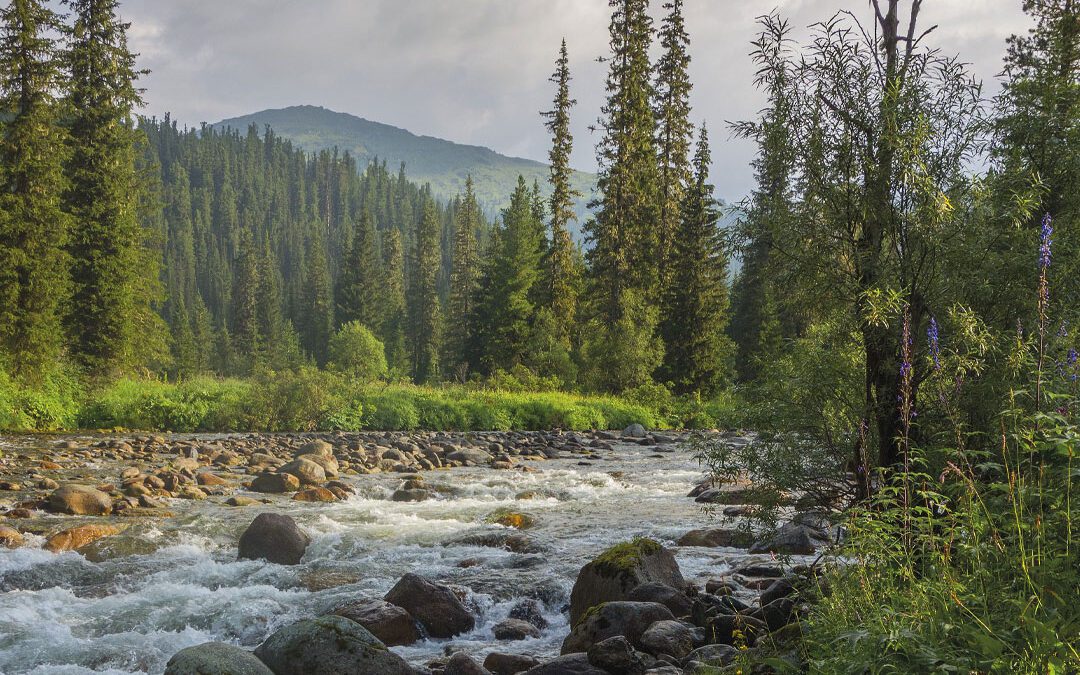
He drove 70 miles of rugged road carved through bush country in the Outaouais region of western Quebec. The final leg of a long haul. Three weeks into May along the Canadian Shield meant rutting bears. Jack had bow sights set on a big boar. He followed camp owner Gille Charbonneau from the lodge to an old logger road crossing birch and conifer forest. It led to a clearing where two cabins faced the Coulonge River. Gille outfitted fishermen and moose hunters and boarded woodsmen in winter. He hired Raymond Lafleur to guide bear hunters.
The two men walked from the guide cabin. Lafleur, old with white hair, introduced his nephew, Roger Picard. Both spoke good English. Roger ran a moose camp in another territory. He’d come to help stock baits. He was burly, pushing sixty; his squared jaw whisker black.
Jack unpacked and sorted the gear in his cabin. He carried in an armload of split birch and stacked it by the woodstove. He ate a can of sardines and then shot his bow before the evening hunt.
Raymond Lafleur watched from the porch as three arrows struck bullseye.
“That’s a dead bear,” he said, lifting his coffee mug. “I had to make sure you were accurate with the bow. Nothing wounded on my watch. For the animal’s sake and yours. A wounded bear is a pissed off bear, and we’re too deep in the bush to get a mauled hunter out. No sawbones here.”
He was in his 80s, a tough French Canadian with enough Cree blood to blaze a warpath. He’d stormed life, fist and guts, lived hard and drank harder, but the brawler retired to legend, and cough drops and coffee replaced Lucky Strikes and Canadian Rye.
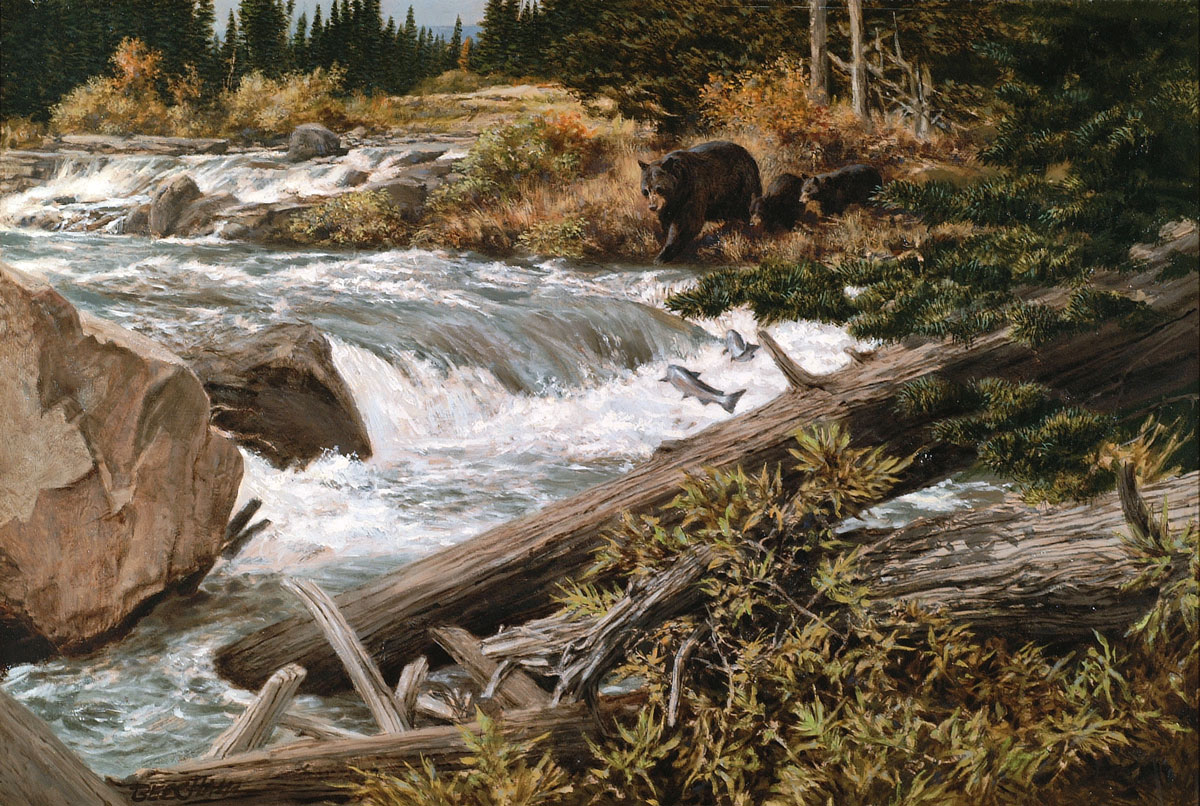
Black Bear Salmon by Greg Beecham
Jack took a dip of Copenhagen and joined him on the porch. The old man’s steel blue eyes reflected the wild North. He cut his teeth there, rigging choker chains and swinging an axe before he was old enough to read labor laws. Pain lingered from a log stampede that crushed bones and forever disfigured his left hand. He’d conquered death longer than most, and now lived for the challenge to beat the unbeatable.
“I want you to do something for me,” Raymond said. “There’s a bear that needs taken out. I know you’re after a big bear but this one is old and suffering. I’ve guided the territory for 20 years and he was always the dominant male. You’ll know him. His front foot was mangled years ago on the Indian Reservation north of here. It never slowed him but old wounds pain him now. Do me this favor, then you don’t owe my share for the hunt. Pay Gille his half but I don’t want anything. Just shoot the bear.
He suffers and is not long for this life.”
He stood to go to his cabin. “He is feeding where the redhorse spawn at the far end of Lac Indian. There’s an old moose stand by a feeder stream. You’ll hunt from it. The fish gather behind a beaver lodge where the current brakes. He travels there every day. There’s a lone sow in the area. It’s early, but she could be coming into heat and that’ll attract other boars. Roger will take you by canoe. South winds will push your scent over the lake.”
The men rowed across Lac Indian, a second canoe in tow. Roger pointed out the beaver lodge near the stream mouth. Black flies swarmed as they landed canoes.
Bear tracks lined the bank. Jack gauged pad width with his hand. Spoor made by a big boar.
“Fresh, eh?” Roger said. “That’s one stout-ass bear. He must be scent checking for sow. Good chance he’ll be back through this evening. One that big you’ve got to shoot. My uncle wouldn’t blame you if you did.”
Jack climbed the stand of sawed birch logs as Roger canoed back across the lake. He heard the redhorse splashing. His eyes followed a bruin trail from forest to stream. It crossed within range. Spruce limbs concealed the stand but with nothing in the way to deflect an arrow. He looked at the lake behind him. A beaver slapped its tail near the shore. Stiffer winds drove the black flies away.
He didn’t wait long. His heart hammered as a black shape shifted through the hemlocks. He anticipated the big bear but what emerged made a slow and difficult walk toward the stream. Rubbed hide and distinct limp confirmed the old boar.
Jack wanted to pass despite the deal. He’d travelled far for a big bear, but silent words from his spirit hunter, Two Hawks Soaring, compelled him to draw his bow and hone its sights on something greater. Breath and bowstring released as one. A bladed shaft disappeared through frontal ribs. The bear fled on his backtrail. Jack heard the crash. He knew it’d been a clean kill but waited before climbing down. Half an hour passed when he pulled the arrow from the ground. He smelled the blood; confident it’d pierced the heart.
He didn’t need a blood trail for recovery. The boar piled up 50 yards from the shot. He looked at the old, battle-scarred warrior, its left paw bent under, worn hide exposing bone at the joint. He field dressed it, saving the liver and heart and rinsed his knife in the stream. The bear carried half its prime weight, and Jack made the 200-pound drag without seeing the eagle overhead.
Jack oared from the stern, his harvest in the bow of the boat. His headlight cut a path through the dark. The moon lifted. Fog crept over the lake. He heard voices shoreward. The guides stood, waiting.
“You got him, eh?” Roger asked.
Raymond knelt by the bear slumped over gunwales. He stroked the fur, headlamp aimed on scarred face and muzzle. “I know you lived a good life,” he said, ignoring the mosquito horde. “You defended it well.” His light swung over the lake and the far-flung wilderness.
“His territory ranged far, many kilometers out,” Roger said. “He ruled it long years. I’d put hunters onto him but he was always too smart. Drove me crazy. Then he got old and lost his rank, and retreated to here.”
Gille heard truck tires grind gravel and left the lodge. It was late by the time the bear hung from the meatpole; lifted by a chain hoist. Roger opened the bear’s mouth revealing stained and worn teeth. “Look how they are ground to almost nothing,” he said. “The old boy was ready to go, Uncle. It’s cold enough. We’ll skin him first thing in morning, eh?”
“That bear was a badass in his day,” Raymond said, staring long. “He never lost his courage but knew there was nothing left to defend.” He said something to Gille in French, and then grabbed the chain. “We finish the job now.”
He couldn’t leave an old warrior hang in dishonor.
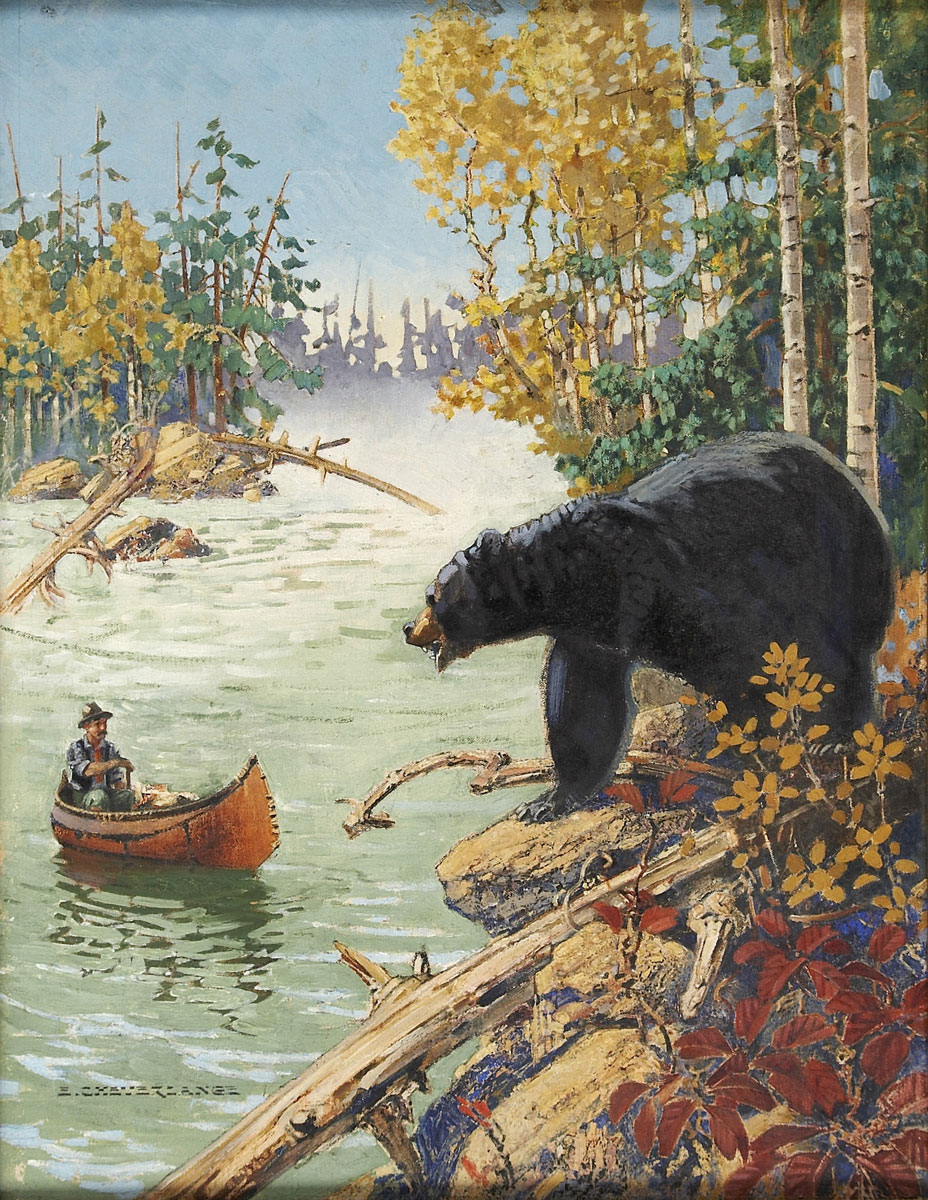
Black Bear by Elie Cheverlange. Book illustration, circa 1935, oil on board, 22 x 17 inches.
Raymond stopped by Jack’s cabin the next morning. He looked at the skillet of bacon and eggs. “Un petit-déjeuner bûcheron,” he said.
“A woodsman’s breakfast,” Jack agreed. “Hungry?”
“I ate already. Save the bacon grease for the walleye you catch.” He poured coffee. “I had a rough night sleeping. How far did the bear run after the shot?”
“Not far. He was dead on his feet.”
“I knew you were the right hunter to harvest him. I am a good judge of men. Come with me to restock the baits. I’ll show you around the area.”
The territory spanned the southwest boundary of La Verendrye Wildlife Reserve. Thick wilderness stretched hundreds of miles around. They navigated fir-crowded roads, rutted deep. Most led to remote lakes.
“I set each bait at least three kilometers apart so as not to attract the same bears,” Raymond said. “The boars roam far during rut.”
He stopped the truck, pointing to a section of tamarack marshland. “I had a bait site there, far back on high ground. Never produced. Hard to figure these bears. I’ve worked the Northwoods all my life. Hell, I started guiding hunters as a kid at my old man’s camp. He was tough to work for so I had to be tougher. He fought on the Front during the First World War. Mean when he left, meaner when he returned. He carried that war with him his entire life.”
He poured coffee from his thermos and drove on. “I had his rebel blood in me,” he said. “I boozed, fought and hung with a rough pack. Bûcherons we were. Busted ass timbering all winter; but post-thaw, after sluicing the logs downriver, we wreaked havoc. Crashed every beer joint we could find. I was the bull of the woods. The Iron Bull, they called me. Not as strong as I was but still bullhead.” He looked skyward. “I hope the man upstairs can make room for a hardcase like me. What do you think, Jack?”
“I think that a man who ran with hellraisers can still walk with God.”
The old man smiled.
That night the men ate caribou steaks from a bull Roger shot on the Nunavik tundra last fall.
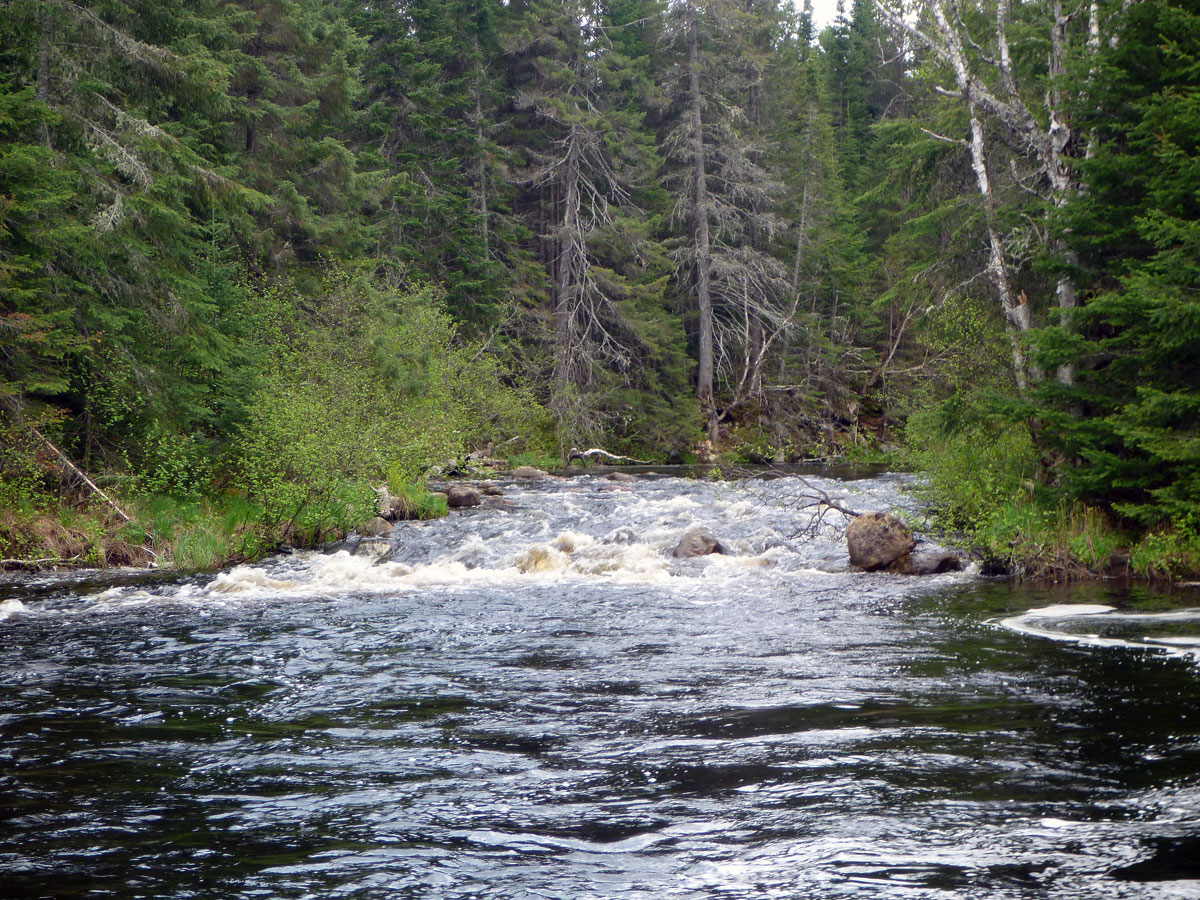
The following morning Jack and Roger motored a boat to a bay on the Coulonge River. A week before Jack arrived, Raymond fished it alone. He’d killed the motor to change lures and got swept in boulder-packed rapids. The boat sank. Luck spit him ashore, cold, battered and hacking up river water. He sparked fire with flint and steel, and staved off death before fishermen found him the next morning.
“I told him not to go without me,” Roger said. “He’s too damn stubborn to listen.”
Jack cast a line. “I’m glad I shot the bear.”
“It meant a lot to him. See it as an honor. He wanted to shoot him, but couldn’t. He saw something in you. Uncle Raymond is a good man but hard to understand. He’s going downhill fast.” He lit a cigarette. “I think he saw himself in that old bear.”
The beers were cold, the fishing good. An eagle rode high currents above.
The last night in camp, Jack fried walleye fillets in leftover bacon grease—the Lafleur way—and ate on the front porch. The fish tasted good in the clean air. The moon lifted over staggered lines of conifer and its light struck the river. The rapids sang.
Jack had just finished packing when the old man stopped in.
“I see you’re all set to go,” Raymond said. “Don’t forget to register your bear once you leave the forest road.” He sat at the table. “A group of hunters are due in tomorrow. Another week and then I’m through for the season.”
“Tough to leave it?”
“Damn right it is. I’ve always liked the bush country. My wife used to say that it did me good.” He stared out the window. “I miss her terrible.” His jaw tightened and the deformed hand swiped glazed eyes in the struggle to shield pride.
Pain had been his ally. He’d endured it enough to harden him for the next wave; but he wasn’t equipped to withstand the latest. It fanged deeper than that gnawing old wound and it broke him.
Jack knew it then. The old war horse had nothing left to fight for.
“Let’s have a beer,” Raymond said, “between men.”
They talked long; one man turning back time while the other looked ahead. Jack could relate to the old renegade. He blasted his own road in life and now saw what waited in the late years of it.
As the old man got up to leave, Jack stuck payment in his shirt pocket.
“We made a deal,” Raymond said. “I don’t expect to be paid.”
“I got more than expected,” Jack said.
They shook hands. The old man closed the door behind him. Jack cracked another beer and drank in the dark.
He pulled out early in the morning with a mug of strong coffee. It’d been a good hunt; but he hadn’t come this far just to fill a tag. He filled something deeper.
Dawn lifted as he ended the forest road. He looked in his rearview. Sights trailed off to memory. He’d be back next season to hunt for a big bear; but he knew he would never see the old man again, and somewhere behind him the eagle soared.