In the pine barren, the pasture’s edge, the orchard, this is his court . . . and we are honored to be there.
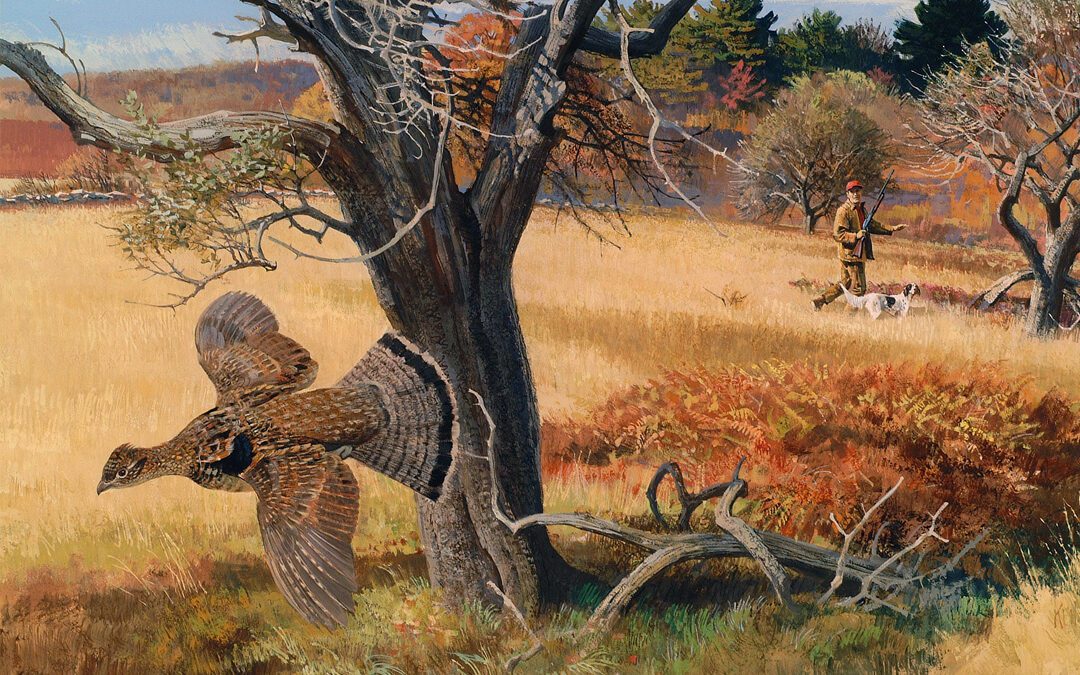
In an orchard, long abandoned, we make our way toward a solitary tree, one of few bearing apples this fall. That it has fruit at all strikes me as promising for a number of reasons, the least of which is grouse eat apples. The mythic part of me is taken by the notion that this tree, in its last throes, gasping for breath beneath the strangling grape vines that have overtaken it, still has the force to drive through its green fuse that which becomes fruit—if I may mangle Dylan Thomas. It’s as if its dying wish is to provide a meal for the congregation that thrives on this hill.
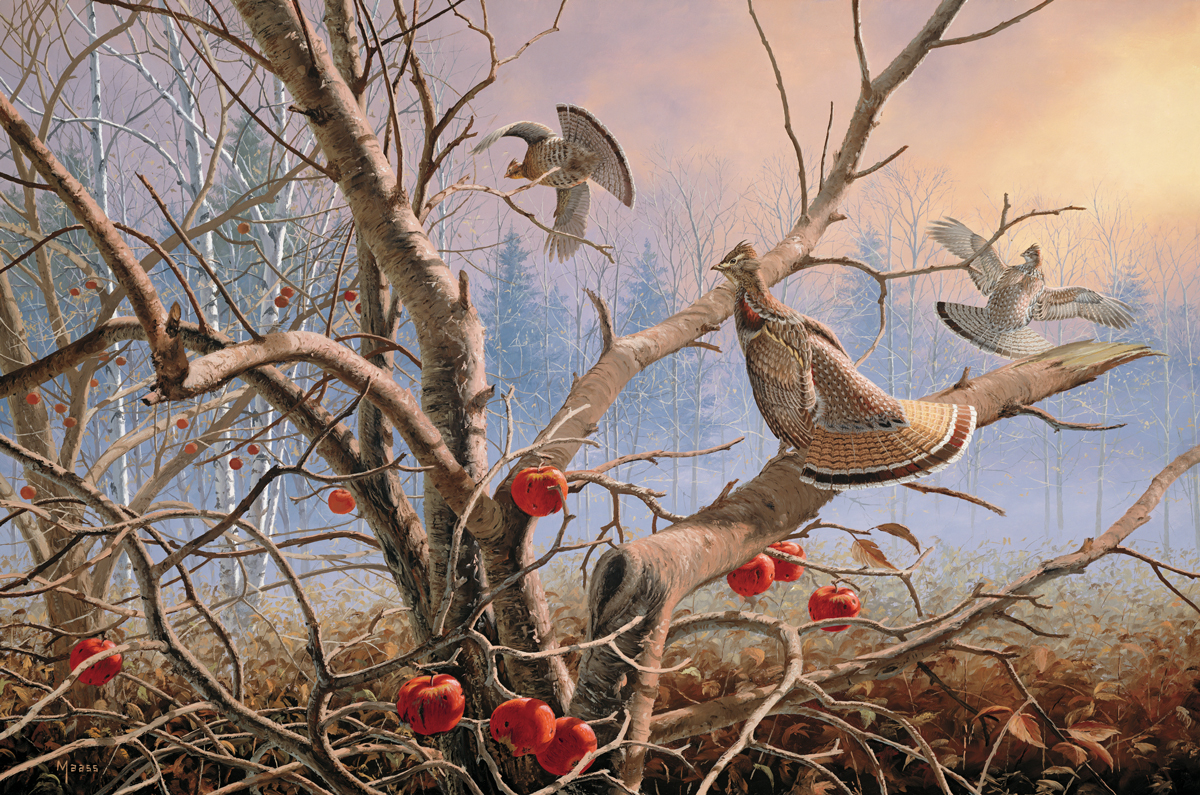
Autumn Orchard—Ruffed Grouse by David Maass. Courtesy Wild Wings.
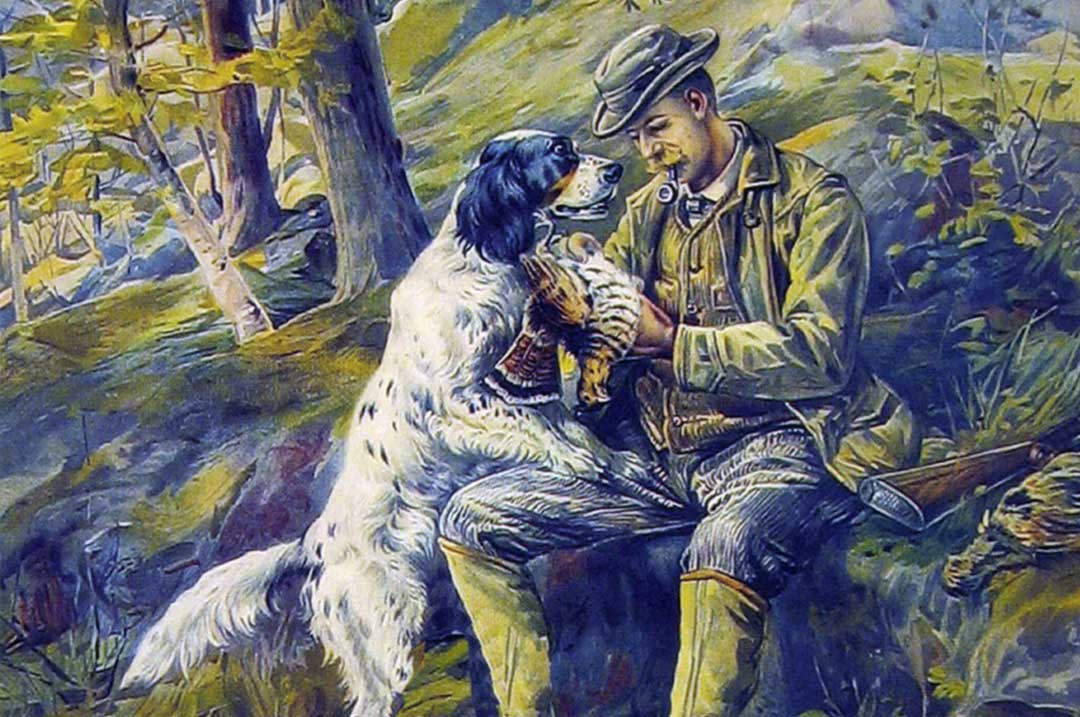
We have been looking for birds, and finding them, all along this hillside in Vermont. It has been an afternoon of misses. I can smell the smoke from the chimneys down in the valley, and I begin to think more about a fire than a grouse. I am surrendering, giving in to the impulse to try again another day. However, my confederate, Peter, has not. He leans into his every step, watching my setter for her tells. His motion is that of a trooper. Instead of foxholes, it’s apple trees. And now it’s this particular tree.
Peter is tall—I imagine him often in a long plastic apron in his ancestral Sweden, cutting herring on the docks or mending nets, an image that bears no resemblance to him at all. He hates fish and doesn’t sew; such is the power of imagination.
I like that he knows things. Shotguns—he once found for me a between-the-wars British double that seemed to have been priced by rubes—but other things too, such as canoe paddling tricks, under-appreciated Russian novelists, how to balance a portfolio. Aside from being eminently agreeable, he is a fabulous shot. An unassuming demeanor belies this. In fact, I often think he is too affable to kill game—too kind. But one should not be fooled; he is devastating with a smooth-bore.
I bring him along not only for companionship, but so that grouse may fall to the plate. If it were left to me, we would both starve. I provide the dogs, the cover and he the birds. This is how it works—in theory. But as I said, it had been an afternoon of misses.
I call to him: “This corner produces birds, be ready.”
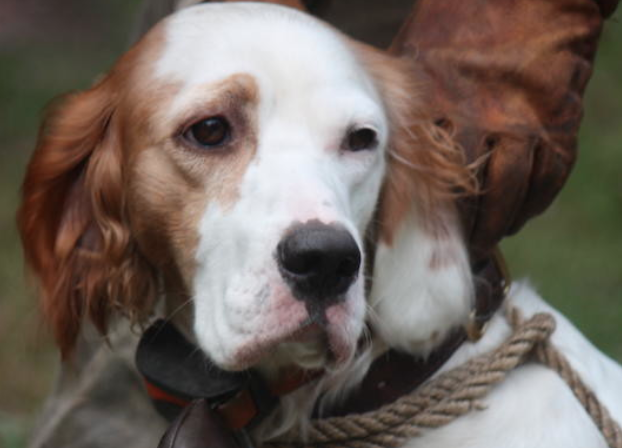
I can’t see him. The dog is already ahead. She is excited, and she is irritated. She points, we miss. This has been our day. There is no bargain in it for her. Unlike me, though, she is not ready to quit.
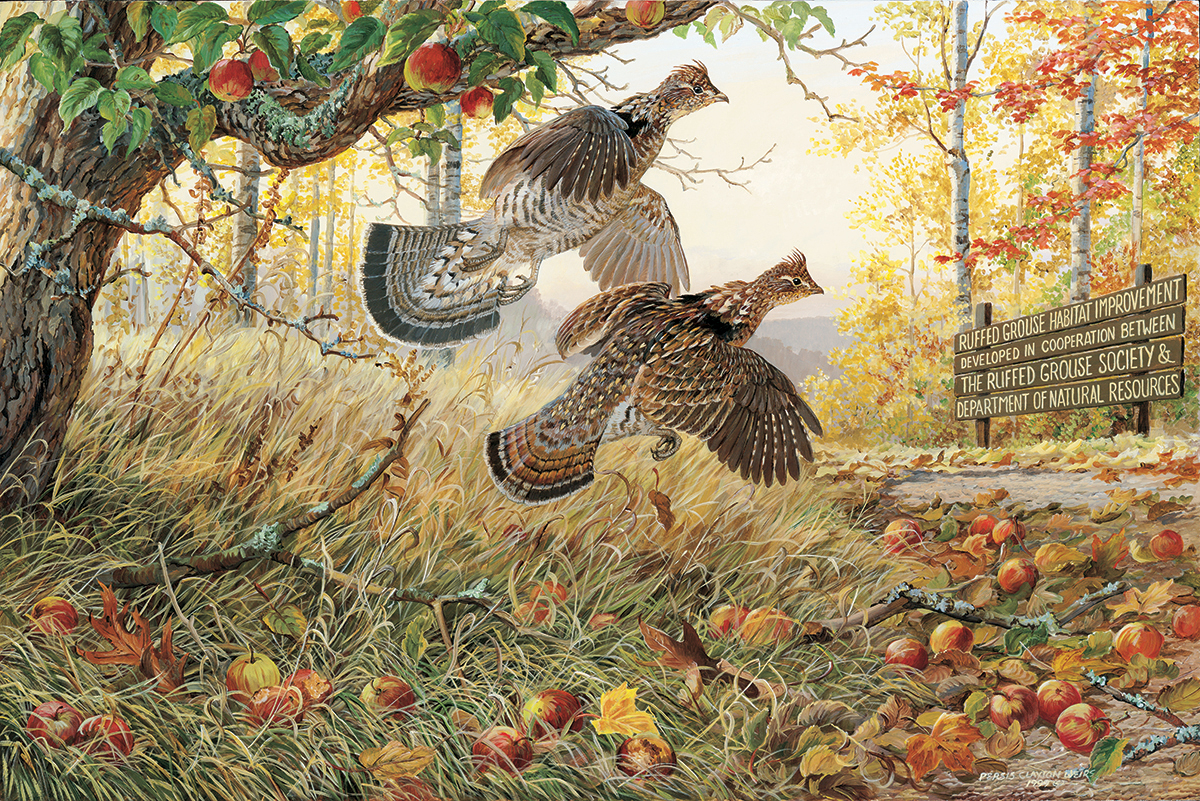
Fruits of Your Labor by Persis C. Weirs. Courtesy Wild Wings.
The bell quickens, then stops. Lazy focus, the result of our wearying uphill walk, gives way to fomenting nerves. We measure our breath, await the curtain rise, the
main act.
I am thinking, if there is no bird, will I still think this place is sacrosanct? What if there are no birds at all? All this tragic beauty. Silos winking in the weak autumn light; the fields with their forgotten trees and upturned stones; rusted cattle-wire and split-rail fences crisscrossing the pastures.
It’s a pointless question, for of course the flush occurs, just as it has a half-dozen times that day. The rush of feathers—it’s like thunder, no, like a pull-shade suddenly released. The sound recalls in us the regret of a missed exit, the shudder of a car suddenly in our blind spot as we switch lanes, that inability to alter something that is already happening. We’ve heard it so many times and still it jangles us, so much that we fumble like biddies at bridge, throwing the wrong card.
Safeties stay on, triggers are missed, mostly it’s our cheeks, we never get them onto the stocks. We know the drill, yet we do it again and again.
I hear no report. Why not? The bird must have started right in front of him. Peter tells me later that he dropped both hammers, but now I hear only his wistful refrain.
“Misfire,” he shouts. “Both rounds, can you believe that?”
I can. I’d heard the grouse flush, all flipping cards and feather, but not the sound of his Parker. The dog is still pointing, refusing to give into our despair.
“I shot that grouse. I know everyone says that, but I did.”
He watches me carefully. Am I going to be sympathetic? He isn’t sure. And, no I’m not. I look at Ruby, still pointing where the bird had fled, then at him.
“What do I tell the dog, Peter?”
“It was in the open. Lumbering, like a goddamned goose. I killed it. I did, I did.”
He is still watching me, insistent. I shift self-consciously. I call the dog to distract from the awkwardness. But I believe him; if he says he shot the grouse, he shot the grouse. He’s that good.
“Well I didn’t, but I would have had I put fresh shells in. Damned grouse, get you every time.”
And he is right, they do. Some even hex you, trick you into thinking you’ve reloaded. I can’t tell you how we both wished, just then, to smell the sweet odor of burned powder.
Ruffed grouse are not gentlemen, my friend Frank Miniter writes, rather well I might add. And they aren’t. They are survivalists, like anything wild. Keen masters of escape, Houdini had nothing on them. I’ve had them use the back door too many times to think it’s chance. And when that door is covered, they fly out the side window.
I am convinced they thumb their noses at us. In fact, I know it. If every route is covered, if there are no blinding branches, no thorn hanging us up; if the dog’s point is hard, the shooting lanes clear and we know that we’ll mount and swing with aplomb, still there are no guarantees.
I have had those stars align. I’ve had birds that were as good as in the freezer, only to have them rise in a flourish, flip me off and fly directly at my dog. The only route of escape, there is no other. I don’t even get to mount the gun. Perhaps if my dogs had been trained to snatch zipping birds from the air in their mouths, I think, instead of pointing them. I give the merits of such training too much attention, often when I am trudging back to the truck, my game vest lighter then when I started. Such is the bird’s specter.
What is it about the grouse that agitates the shooter? The rise? The flight? Is it the miles walked to find and then miss the fleeting shadows? Perhaps it’s all of it. No bird is like it. Not woodcock, not pheasant. The quail is too well behaved. The duck, over decoys, too diffident.
“They get you every time.”
In another few years, this orchard will be overrun. Moribund now, bramble will have throttled the last of it. The grouse will have moved on. The apple trees, starting into rigor mortis, their blackened, spidery limbs will scratch feebly at the sky. No food, no grouse, Peter tells me each year, when another covert fallows. Some years, it’s our mantra, sadly repeated as we hunt one after another.
We look for new ground. Most of it is posted now, newcomers from down-state unfamiliar with rural notions of sharing and using the land can’t abide us hunters. Some of it falls to the plow, or worse, the bulldozer. Still we look, hopeful always for that sleeve of cover along a creek bed, that fir-bordered swale, that something holding birds.
Tonight calls for a full moon, tomorrow a frost. The woodcock will be in again. Steady, consistent work for the dogs, they provide both of us a chance to prove we can still shoot. But we aren’t thinking about that.
There on the hill, the country opening beneath us, we curse the barbed wire biting at our boots—it’s torn my chaps already today. There is the pungent odor of rotting apples, of pine. I’m watching the dog on eager point again. Her coat is knotted with burrs, her belly cut by thorns. Overhead, a raven watches with some amusement, his croak as dispiriting as the missed flushes echoing in our heads. I remind Peter that he needs to make this shot. Redemption, I say.
Some of us like the pined cathedrals of the South and breaking up quail coveys, others the unending cornrows of the Dakotas and their hard-charging roosters. There is, too, waterfowling. Decoys and sneak boats. Chest waders and hand-warmers. Biting sleet, off-shore winds. It lacks the glamor.
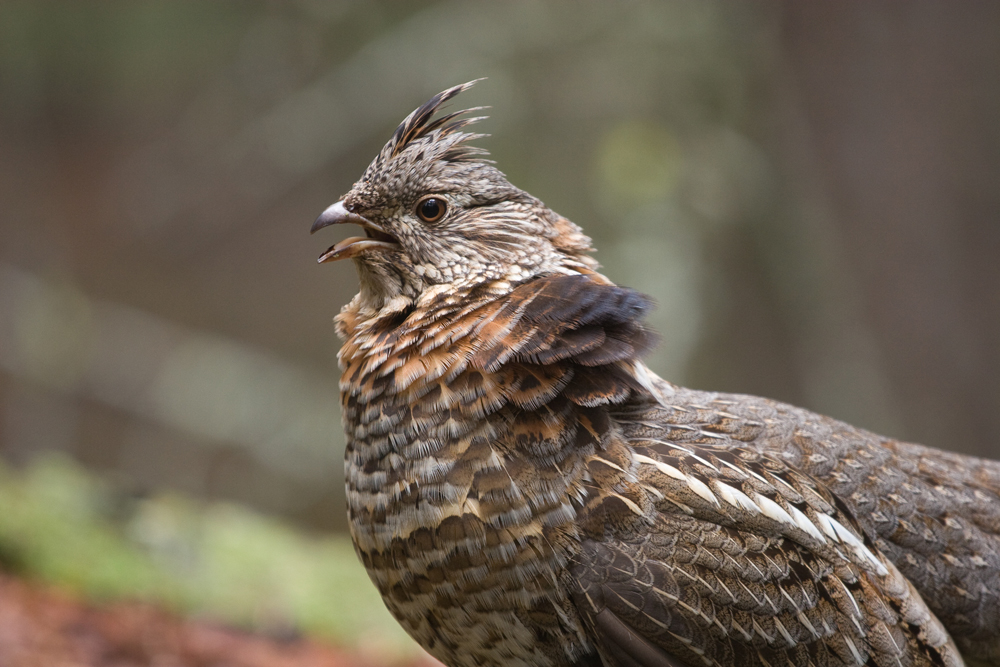
For Peter and me, it’s New England and its grouse, chasing him in the hills. He’s called the King, not for idle reason. To watch one hop onto a log is to see one set upon his throne. Yes, that is a crown he wears. The pine barren, the pasture’s edge, the orchard, this is his court. We are honored to be there.
Note: This article originally appeared in the 2019 September/October issue of Sporting Classics magazine.