
“I have never missed a deer!” proudly proclaimed a relatively new hunter sitting across from me at a late November campfire. I glanced at Luke Clayton, my longtime friend and hunting partner, who was sitting next to him. He smiled and wagged his head in a negative manner, then looked my way and winked.
“That’s quite a feat!” quietly commented Luke. “Larry, those chicken thighs you grilled earlier sure were tasty, and it took you no time to prepare them.”
Edgar Cotton, on whose Becker Bottom Ranch we were hunting, added, “They surely were. In the past we’ve seldom had chicken after the evening hunt because we always thought they would take too long to prepare. But the way you do it, they’re both really quick and absolutely delicious.”
David Cotton, Edgar’s son, continued the food “talk,” avoiding any comment about the hunter’s boast. “How are Lambert, Zumbo, Luke and you coming on the cookbook y’all are jointly writing?” I told him we were on track with our schedule and most likely it would be out in a few months.
It tickled me the way my compadres circuited the “never missed a deer” comment. The four of us had over 270 years of hunting experience between us. Our “friend” had been hunting deer three or four years.
His statement did, however, cause me to recall some of my more “interesting misses.” Yes, I have missed deer and on more than one occasion.
My first time miss came when I was in my teens, hunting “behind our house” in Texas’ Zimmerscheidt Community between Houston and Austin. My dad could not go hunting that particular morning, so he allowed me to use his Model 94 .30-30 Winchester. He had recently mounted (side mount) a Weaver K4 scope on his rifle and I was more than eager to take it hunting.
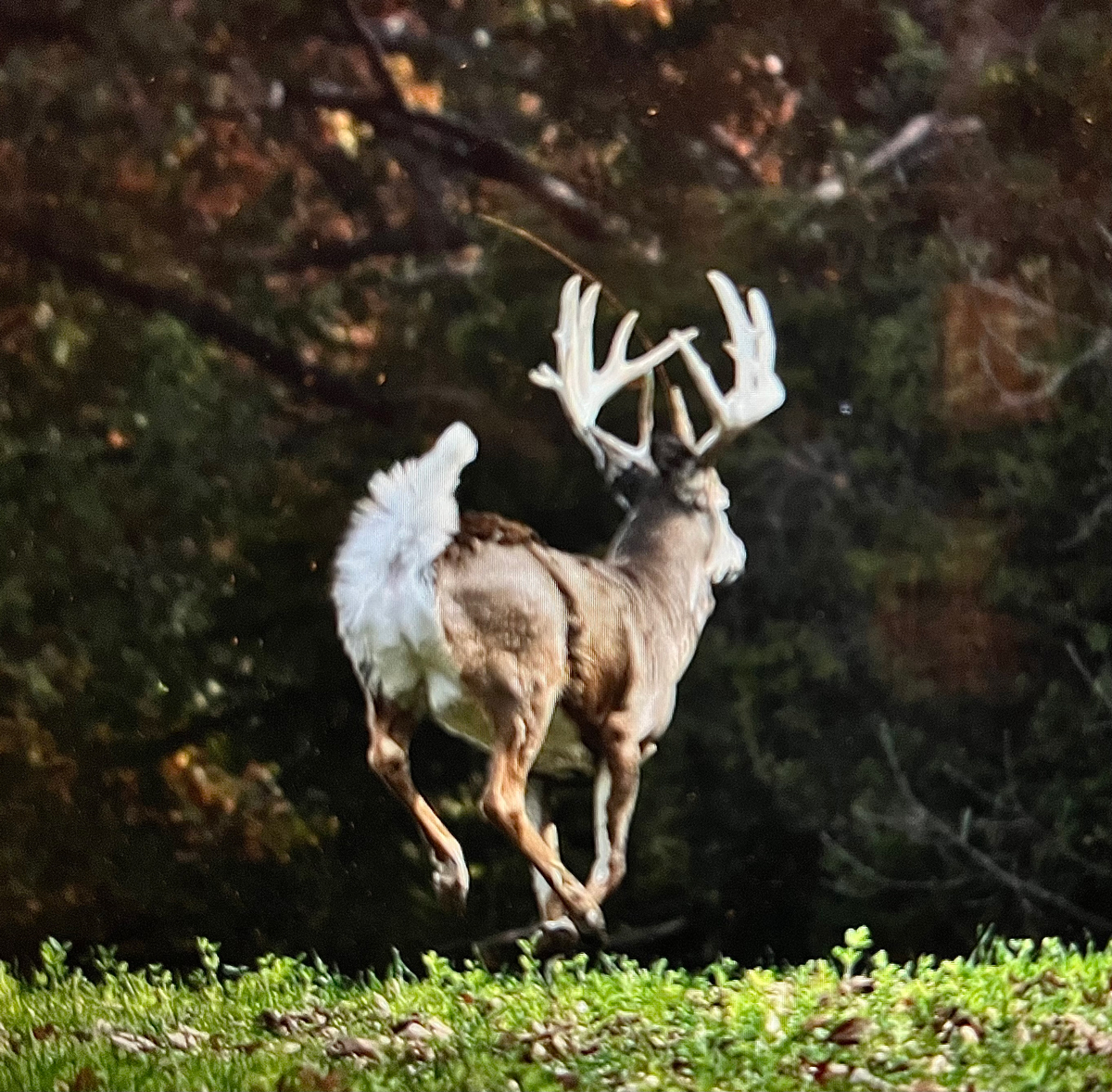
The morning broke cold, but also foggy. Shortly after black turned to a foggy gray, I spotted two bucks walking toward me, a six and an eight point. I raised the rifle and peered through the scope, which had “fogged lenses.” In my excitement, I did not take the time to wipe the condensation from the scope’s lenses. Nor did I have the presence of mind to use the open sights. Looking through the scope, I shot mostly in the direction of the nearest buck. Then, I immediately sent a second shot at the departing bucks but failed to connect. As the excitement of the moment eased, the realization set in. I had blown it. Missed. But in so doing, I learned a lesson about scopes, one that I remember even today.
Several years later, I was hunting in Mexico on a ranch known for muy grandes. Greg Aguilar, who invited me, told me days before heading across the Rio Grande about a really big ten-point he had recently seen. Before hanging up the phone, he noted: “Larry, no need to bring a rifle. I’ll have one for you in camp!”
Great! That will make my border crossing a lot easier. I was most appreciative of his gesture.
When I arrived in camp, Greg handed me a Winchester Model 70 chambered in .264 Win. Mag. topped with an older Zeiss scope, and two cartridges. I asked if there was more ammunition. I wanted to be sure the rifle was properly sighted in.
“Sorry, that’s all the ammo I have for that rifle.” Greg admitted. “Last week, the ranch owner shot it and said it shot good.” I should have asked if he hit the target he was shooting at!
“Hmmmmm! OK!” I replied. Greg then told me the the monster ten-point crossed a particular sendero at ten in the morning, but not every day. However, the buck he described was certainly big enough to invest several days of pursuing him.
For the next six days, all day long, I hunted that buck sitting in an open tripod through freezing temperatures and occasional flurries of sleet accompanied by a bone-chilling north winds. At 10 a.m. on the seventh morning, the buck stepped out of the brush a hundred yards away. From a solid rest, my crosshairs literally planted on the buck’s broadside shoulder, I squeezed the trigger. At my shot, the buck ran and was gone before I could take a second shot.
I waited a few minutes, then crawled out of the tripod and walked to where I could see the buck’s tracks in the wet sand. I followed his tracks for a half-mile, hoping to find blood or any sign that my bullet had connected. None was found.
Dejected, I headed back to camp, knowing I would have to return home that afternoon. With one shell remaining, I decided to shoot at a paper target to see where the bullet would strike and determine whether the miss was due to me or the rifle.
From a rock-solid rest, I shot at a feed sack set up 100 yards away. My bullet hit the target 14 inches above where I held!
Another lesson learned. Even with only two shells, I should have fired one shot at a target to confirm where the bullet would hit, then make corrections as necessary. After all, I still had one more bullet. Had I done so, my name would be in the Boone and Crockett record book under Typical Whitetail.
Like almost every hunter I know, I do get excited when I am about to pull the trigger on an animal. These days, even with 70 years of hunting under my belt and having pursued not only white-tailed deer but also big game throughout the world, I still have to calm myself, pick a spot where I want to place the bullet and squeeze the trigger. But that does not always happen.
A few years ago, my then hunting partner, Ron Davidson, owned a fabulous ranch near Cotulla in the South Texas Brush Country. Upon my arrival at the ranch, Ron said: “Larry, there’s a massive, ancient six-point we’ve been after all season long. You’re welcome to shoot anything you see, but I’d really appreciate it if you would hunt for that buck. Maybe you can get him. We can’t seem to get it done!”
I love a challenge, particularly when it involves whitetail bucks. Back then, I was doing my One Good Shot television show, and I hunted primarily with Thompson/Center Contenders and Encores handguns. This was back in the mid- to late 1990s.
Ron then showed me where the big six-point had been seen most recently running across a pasture road. After a bit of scouting, I found a long, relatively narrow open area in the blackbrush and prickly pear cactus on the north side of the road. There, too, I found several fresh rubs and scrapes.
I made a natural ground blind on the south side of the opening, which ran north and south, in hopes the rubs and scrapes had been made by old six-point. At the time, the wind was mostly out of the north.
I hunted that spot for two days, saw some really nice bucks, but not the six-point. Still, the spot just “felt right,” so I returned the third morning, determined to spend the day.
Several bucks walked through the area, visited and freshened their scrapes. At 2 p.m., the six-point stepped out of the brush 75 yards away. Suddenly, it was like a switch had been flipped inside me. I went from being serenely calm to almost uncontrollably excited and started shaking with a horrible case of buck fever. ! cocked the single-shot handgun and fired at the buck, which was standing broadside. My shot hit the ground about 30 yards away. The buck did not wait around to give me a second chance.
When my cameraman asked “on camera” what had happened, I simply said, “I got overly excited! Jerked the trigger and missed! It happens!”
Several other misses fleeted through my mind as I sat there watching the glowing embers. My memories had left me staring into the campfire. When I “returned,” I noticed the new hunter who had never missed had walked away.
“One of these days, he’ll learn anyone can miss, even him,” I said. “Hunters who tell you they never have missed a shot have either not been hunting very long, or they’re simply lying!” Those remaining around the campfire nodded in agreement.