
A classic Story from 1900 by H.S. Canfield.
It took Robert Lee Briggs five years, working off and on, to slay the red-winged mallard. The pursuit got to be so much of a passion with him that it hurt his business, for he was a market-hunter on the southwestern coast of Texas. In summer he caught red-snappers, pompanos, sheepsheads and turtles. All winter he shot ducks, snipe and wild geese, which he sold to produce dealers in Corpus Christi. He put in so much time trying to kill the drake with the crimson feathers that the dealers were wroth. They said he was ruining one of the brightest careers that ever opened before a young man in the Southwest.
Briggs believed that to look straight over the gun-barrels in all sorts of weather, to judge correctly, distance, speed of the firing quarry and wind velocity; to be wise in the habits of beasts and birds, to be able, by a glance at the sun, to tell the time of day within five minutes; to be expert in the building of blinds and the use of decoys, were enough for any man. Nature was his book, and he studied it. He had three maxims handed down to him by his father, who died just after the last Indian raid, and these governed his life:
“When you’ve got money, he’p a feller that hain’t got money.
“Shootin’ on Sunday makes bad luck on Monday.
“Pers’verunce and feesh-ile on the gun-locks’ll do a heap.”
It was the last maxim which sustained him during his five years’ chase — off and on — of the bird that he came to know as “Red Wing,” and he was proud of the ending of this contest of wits.
Back of Corpus Christi the land rises and rolls away to the northward in a prairie covered by rich grasses. Between the rolls are hollows or swales, in many of which there are ponds of fresh water, averaging a mile in length by a half-mile across. They are not generally more than waist-deep in the center, and are grown up thickly with senna weeds. Senna weeds are tall and slender and bear long, slim, bean-like pods, which rattle in ghostly fashion in the winds of winter nights.
Each of the pods contains several round jet-black, shiny seeds, and of these seeds wild fowl are fond.
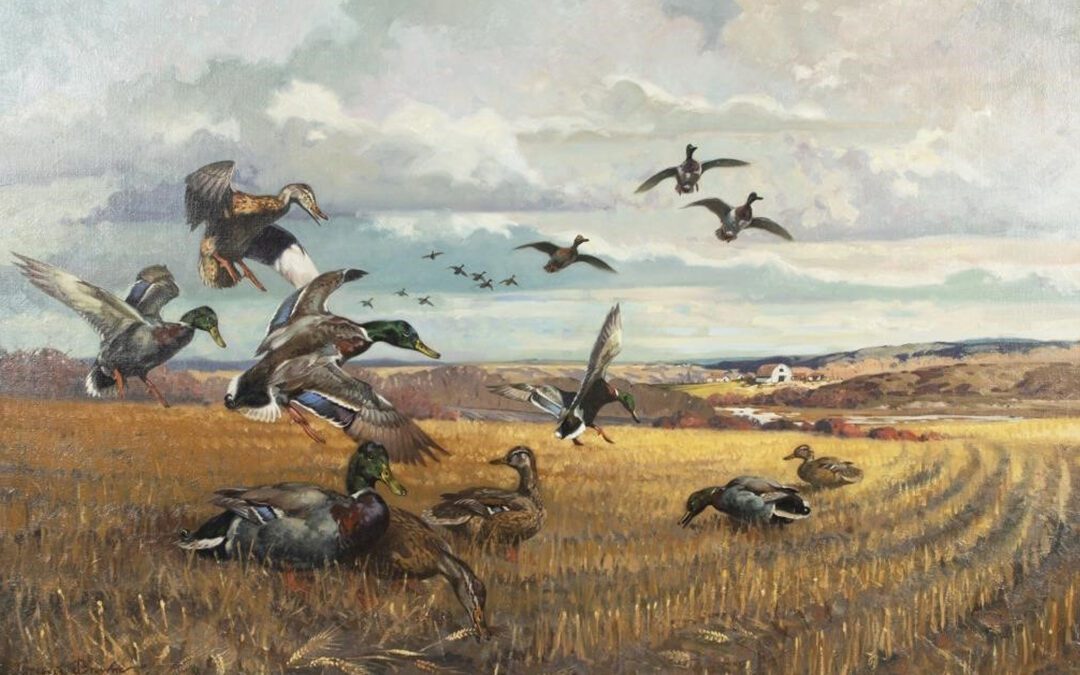
The ducks roost upon the gulf, but they feed in the senna ponds all day, flying from one to another in clouds. So thick are they that if a camera were focused on a pond and the ducks flushed, the negative would show a solid black wall of them. When they are scared by the down-swooping of a hawk, the thunder of their wings may sometimes be heard two miles away, and a man, crouched at one end of a pond, though the day be clear, will be shaded by the mass of birds streaming two hundred yards above him as completely as if he held an umbrella. With the sun flashing upon heads and wings, the tens of thousands of them show every hue of the jewels of the mines, yellow and pink and bronze and carmine, white and brown and gray and purple – blue, glossy green and velvet black, like the snakes of the Ancient Mariner. It is gorgeous.
Here and there are groves of live-oaks, sometimes covering acres, and often circular in form. They are called “mottes,” and viewed from a distance, are not unlike islands of darker green, rising from the sea of grass around them. Mustang motte stands fifteen miles northeast of Corpus Christi, and near it is one of the larger senna ponds.
On an early day in November, Briggs was making his way on horseback to this pond. When he reached it he staked out the horse with a rope fifty feet long, and walked to the edge of the pond, where he hid himself in the weeds along shore. A gadwall buzzed past, which he shot. Wading out, he picked up the duck and went back to his hiding-place. There he sharpened a dark stick, three feet long. One end he stuck into the mud twenty yards from the bank. He pressed it down until only two inches of it protruded. On this end he hung the gadwall by inserting the point in its throat, just under the head. The duck floated, with its bill slightly raised, as if it were alive and swallowing a tasty’ morsel. This was his decoy. In an hour a half-dozen ducks of various kinds were set out and they made a flock.
The afternoon had grown old and there was a cessation in the flight. Briggs decided to permit himself a pipe. Suddenly he heard a splash, and peering cautiously, saw something which kept him thinking for a long time. A hundred yards away, in a lake-like expanse of water, sat a mallard drake of great size. The nearly level rays of the declining sun beamed on him ruddily, and every feather of him shone like the facet of a gem. Briggs marked the lustrous emerald of his massive head, the reddish bronze of his neck, the pearly gray of his breast. He was a beautiful, powerful wild thing, as noble a masterpiece as ever came from Nature’s incessant workshop. Glorying in his strength and loveliness, he swam in small, rapid circles, or floated idly, gazing down at his own reflection and pleased with himself to the last degree. He preened his feathers until each lay as smoothly as if ironed, dived boldly and reappeared twenty yards away, merely to show that he could do it, spurted for fifty feet at lightning speed, checked suddenly, whirled as if upon a pivot, then threw his bill high and uttered a hoarse, strident challenge that boomed upon the mild air like the bellow of some huge horn.
The man, his pipe forgotten, crouched until the ooze came up to his waistband. Then, as he looked and longed, the bird threw half of his body out of water, spread his wings upwards to their full reach and revolved slowly. The sunlight rested upon the pinions, and Briggs, to his wonder, saw that in each wing were brilliant crimson feathers. They were not more than four or five in number, but were of the largest, and deeply hued. He knew that the fowl was a freak, of course, just as there are birds that are albinos, but he believed that it was the only one of its kind in the world. He wished to possess it, as a collector of coins will wish to possess an ugly circular bit of copper, not half so attractive as a new nickel.
He raised his chin slightly and emitted a soft noise, much similar to the sound made by a man when clucking to a lazy horse. This is the note of mallards when swallowing acorns. It was his deadliest call. In response the great drake became motionless and listened intently. The fowler waited a full minute, then repeated the cluck. The mallard, his crimson pinions flashing like the wings of the cardinal, sprang twenty feet in air and was away like a shot, dropping a squawk of derision as he went. Briggs rose, stretching his cramped limbs. Then he said:
“Sure, he ain’t no this year’s bird. He’s smart. That swaller call oughter got him. I never done it better. Howsomever, pers’verunce and feesh-ile on the gun-locks’ll do a heap.”
He stayed at Mustang motte three days, but he did not see the red-winged mallard again. When he returned to Corpus Christi he sold his ducks, and before the wood-fire in Nic Constantin’s smoking room, told the story of the red-wing.
’Lige Hawkins, skipper of the schooner Oriole, felt his pulse and asked him to put out his tongue; Andy Faulkner, a surveyor who never surveyed, said that he was “daffy,” and “Doc” Payne, who had had two patients in three years, prescribed boneset tea and castor oil.
Standing at Chiltapin dam in the first part of the following October, engaged in killing teal, Briggs noted a solitary flyer moving quietly but fast out of the north, the long neck stretched forwards and the wings sharply elbowed. Something in its size or poise sent a reminiscent thrill, and he stood with rapt gaze. Soon, with a steady rush, each pulsation of the smitten air distinctly audible, the bird passed over him and the crimson feathers shone like a tongue of flame in each broad wing.
The man set himself to guard the pond at Mustang motte. He waited and watched with admirable patience and skill through the cold months. Thrice he was rewarded by a sight of the quarry, and always alone. Once the drake passed above him, not more than fifty yards up. Making allowance for speed and trusting to a stray pellet to do the work, he pitched up his 10-gauge and pulled the hindward trigger. A red feather floated downwards. Briggs took it to silhouette decoys made of tin, dead mallard decoys. He even rode to Corpus Christi and returned with a couple of tame Muscovies. These he set out with strings hitched to their legs, and they quacked merrily. Other mallards came to them in plenty, but “Red Wing” and his mate kept aloof. They were at the Mustang pond for hours each day, but the drake did not swim within a hundred yards of the man, though he devised a fresh blind in a new part of the water each night and occupied it at daybreak.
He noticed a temerity on the part of the hen. She was less intelligent or less cautious than her companion. Several times he could have killed her with a long shot, but he cared nothing about her. When she showed a disposition to approach him closely, she was brought back by a muttered warning from her spouse, who had eyes, as the hunter said, “in his head, in his tail, in both wings, and in his flippers.”
Finally, determined, it seemed, to make Briggs’ days as miserable as possible, the pair forsook the pond at large and confined their visits to a part of it which, for two hundred yards in every direction, was bare of weeds or cover of any kind.
Here, safe from harm, they floated and made love. So surely as Briggs drew near to the edge of the clear water, the male’s deep voice sounded and they were away to the gulf for another plunge into salt waves. They did not roost on the pond, and Briggs spent some time in endeavoring to find where they did roost, thinking that he might get near to them with a “fire-boat” in the black dark, but he failed. As distance is nothing at all to a mallard, he concluded that they went fifty miles down the coast-line before pitching upon some still, inland bay. They returned each morning at sunrise, getting their feed by diving to the bottom, which was thick with senna seeds.
Then he absented himself from the pond for several days, and did his shooting miles away. When he returned he bore, besides his game, a large bundle of senna weeds. He amassed a pile of them. The fourth day he spent in considering the making of his armor of deception. On the fifth day he went to Corpus Christi, bought a cheap shotgun and had the barrels cut to a foot in length, so that it could be used easily with one hand. On the sixth day he went back to camp, feeling composed and hopeful. The seventh day was Sunday, and, in obedience to the maxim of his father, he loafed heartily. The remainder of the time he put in binding the senna weeds about an iron barrel-hoop, just big enough to go over his head and rest firmly on his shoulders. When he had finished he had a most natural clump of stalks, massive enough to deceive any bird, no matter how super-duck its intellect might be. He tried on the thing, and, turning it round and round, found that there was one crevice through which he could see with his right eye. Then he went to sleep.
At daybreak he was at the edge of the pond’s clear space, with all his body submerged. The shortened gun was held up among the weeds about his head. His teeth chattered, but he clenched them and waited. When the sun was two degrees above the horizon, Red Wing and his wife pitched in the center of the open water. They swam about each other and clucked mutual congratulations on the day and the certainty of a good breakfast. The clump of senna, inch by inch, drifted out from the tangle of growth. So slowly it moved that it might have been driven by the gentlest and most fitful of breezes.
One thing troubled the man in the moving weeds: The hen was nearest him. She dashed gaily about, but always came back to her position between him and the drake, which was forty yards further away, the crimson pinions lying like smears of blood against his sides.
Not more than a hundred feet separated Briggs and the female, when Red Wing, moved by a sudden impulse, no man can say what – a slight disarrangement of the disguise of weeds, something too swift in its advance, some recognition that it had no place in the clear spruce – threw back his emerald head, gave the danger note and launched himself afar. The hen followed instantly, upspringing with the activity of the dragon-fly, but she was too late. Jets of smoke leaped from the weed clump and she checked, a shapeless mass in air, then struck the water, dead, making a shower of spray.
Muttering volubly in anger, the hunter threw off his covering, waded to the body, grasped a limp wing and made his way to shore. The warm rays of the sun fell on him and took away something of the chill, he was stooping over the wife, noting the beauty of her pale plumage, when a rush of wings startled him. He glanced up. Not seventy-five yards distant the male was darting by. He went a half-mile down the wind, came back, circled out of gunshot and headed for the Gulf. As he went he uttered a despairing call. Briggs whistled softly, put on dry clothing, boiled a pot of coffee, smoked a pipe and sprawled upon his blanket.
Next morning, just as the last few stars were paling in the west, he placed the dead bird as a decoy only twenty yards from the weeds which ringed the open space. At sunrise Red Wing came flying swiftly, not turning to the right or to the left, speeding as an arrow, seeking his lost love. Made desperate by loneliness, and all caution gone, he darted downwards and hovered for a moment above his consort. That instant the gun spoke and he dropped beside her, shot through head, throat and heart.
Briggs told this tale before the wood fire in Nic Constantin’s smoking-room, holding the body of the red-winged mallard in his hands. He felt hurt because the men did not praise him.