
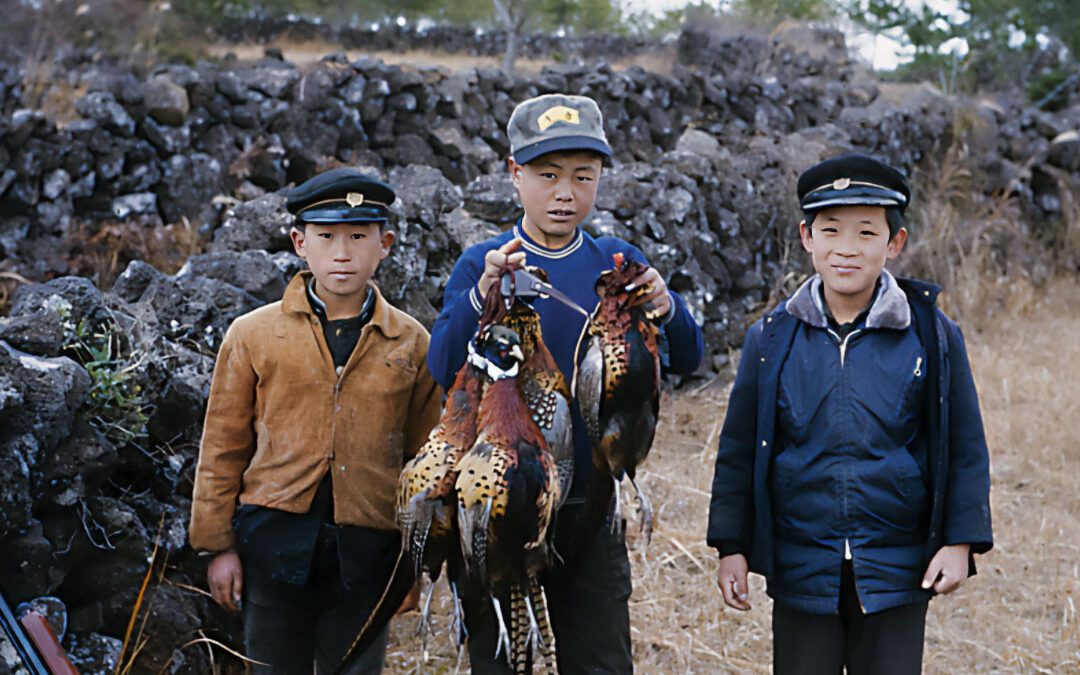
Back in 1968 I was doing penance for some perceived past sins at Kwang Ju, a remote air base in Korea. I had arrived there on a hot, sweltering night in mid-August to serve a 13-month tour as an Air Force munitions officer. As I staggered out the rear cargo door of a C-130 aircraft in a sleep-deprived state of mind, I wondered as to the predicament into which I had fallen. The pilot had seemed to be in a hurry to depart, not even bothering to shut off the engines as I exited. The crew hastily buttoned up the plane’s rear door and headed out to the main runway again for an immediate takeoff.
I was left to my own devices to find my way to the terminal and base operations, where I was able to catch a ride to my new home, a converted Republic of Korea Air Force barracks. My job would be to provide munitions support to the U.S. Air Force buildup of planes and personnel following the seizure of the USS Pueblo by North Korea eight months previously.
Prior to leaving the U.S. for my tour of duty in Korea, several friends had told me about the excellent bird hunting opportunities there. One sergeant friend with whom I had hunted birds in Utah told me about an island off the coast named Cheju Do (“Do” in Korean means island), where the U.S. military had an R&R (Rest and Relaxation) facility called the Far East Hunting Lodge. Bob had spent several days there while on leave from Vietnam in 1965, and he said the pheasant hunting had been fabulous.
Following my arrival at Kwang Ju, I could readily see that the area had real possibilities for bird hunting. The South Koreans grew an abundance of crops, including rice, barley, sorghum, millet and even some wheat. A major floodplain behind the base would provide some excellent waterfowl hunting come fall.
Because my friend had raved about the lodge at Cheju Island, I set about to determine if I could hunt there during my tour of duty. I made a few calls to the Air Division Headquarters where a sergeant curtly informed me that the facility at Cheju Do was no longer open to all military personnel, but was “limited to Code 6 and above,” which is military jargon for “bird colonels” and generals.
I was a little put out that such discriminatory practices were in place, though the situation did not last long. Apparently, one miffed peon who had been denied access complained to his congressman, with the result that the following year, 1969, the lodge was once again open to all, regardless of rank.
Later that fall a friend of mine, an explosive ordinance disposal captain named Charlie Ventimiglia found out about my wish to hunt on Cheju Do and he suggested we should make plans for a hunting trip on the island.
A few words about Charlie. Put together like the proverbial brick privy, he stood about 5-8 and weighed in at 260, give or take a few pounds. He was an Italian from New York City, and I could easily picture him as a hit man for the Mafia. Intensely intelligent, a master at chess, he was also a near mechanical genius.
I once assisted him in disposing of some outdated five-inch rocket motors at a munitions disposal site. He told me before setting off the charges that he had rigged the motors with the plastic explosive C-4 so they would go “high order” (detonate), rather than just burn intensely. He hoped to set off the equivalent of a 250-pound bomb. When he finally did touch off the charge, he blew off the top of a small mountain at the disposal site! I just stood there with dust raining down on us, looking in awe at what had just happened. Charlie was beside himself, laughing gleefully like a little kid on the fourth of July.
Charlie had a high-pitched voice, so uncharacteristic of someone with such a large body mass, and his words came out in rapid-fire staccato like a machine gun burst. His laugh was almost a maniacal sounding giggle, which along with his other weird traits, made him a spooky sort of character to be around.
To think I was going pheasant hunting on some remote Korean island with this guy. We looked like Mutt and Jeff together; a tall, skinny Irishman and a short, squat Italian Mafia hit man.
We finalized our plans for the week after New Year’s Day, 1969. Korean Air Lines (KAL) flew commercial flights into Kwang Ju Air Base, which was the only airport in the region. All we had to do was purchase tickets and board the plane to Cheju.
We made reservations for Charlie, his Korean girlfriend and myself at the Cheju Tourist Hotel, supposedly a Western-style operation located in the principal island city of Cheju.
The day before our departure, Charlie approached me with an attache’ case held firmly in his grasp. As he came up to me, he asked, “Hey, Terry, have you ever seen a suitcase full of money?”
With that, he cradled the case in one arm and flipped open the lid. The inside was stuffed full of Korean 10 Won notes (worth about three cents each in U.S. currency). He had about $150 U.S. equivalent dollars in Won in the case.
Once again I heard that high-pitched, maniacal laugh as Charlie showed me the money, and I began to wonder about my own sanity for agreeing to go hunting with such an odd character.
Cheju Do lies in the Korea Straight about 80 miles off the southwestern tip of the Korean Peninsula. The island is roughly 50 miles long and 20 wide. Our flight was booked for a Sunday afternoon. Charlie and I each had five days leave authorized, so we hoped to get in three or four days of pheasant hunting.
The little KAL twin turboprop looked like a small version of the amphibious PBY of World War II fame, with its wings on top of the fuselage. We piled aboard along with some 30 South Koreans and soon we were on our way south over the Korea Strait. It was a stormy, blustery day, and I looked with some apprehension at the wind-tossed whitecaps far below, hoping that we would not have any flight problems and have to ditch at sea. I don’t recall seeing any life jackets aboard, but they were probably tucked away somewhere. The turboprops on the little plane were screaming like banshees, as if they were trying to tear themselves apart, and we were subjected to a lot of violent swaying as strong winds slammed into the plane.
After a harrowing hour-long flight, we descended into the Cheju airport shortly before dusk. Upon landing, we went to the luggage pick-up where I was approached by a small Korean man fashionably dressed in a suit. He started talking to me, but I could not understand him. His English and my Korean were simply inadequate for each other. I had also concluded that he was a con artist trying to take advantage of me, so I more or less ignored him. Seeing that he was having no success with me, he walked over to Charlie and his girlfriend and began talking
with them.
After a few minutes, Charlie came over to me and, lowering his voice, said in a conspiratorial manner: “He told us that we have to buy a hunting license.”
“Charlie,” I responded, “I already have a valid Republic of Korea hunting license.”
“No. No! Terry, you don’t understand. This is a license good only for Cheju Do.”
“You mean they want their palms greased with some of our money, too?”
“Yeah . . . you might say that, but my girlfriend says that it’s a license to kill. They don’t enforce their bag limits. She just heard about some Japanese hunter who was here that shot about eighty birds in two or three days.”
I looked at Charlie—there was that wild glimmer in his eyes as he issued a very subdued laugh. I was mulling over the words “license to kill” as thoughts of the Mafia, hit man and The Family raced through my mind again.
“All right. I’ll pay their blood money, especially since we don’t have any choice if we want to hunt pheasants here.”
The dapper little man in the expensive suit wrote out our licenses on the spot for about 2800 Won apiece, or about $10 American. Then he handed them to us and disappeared. We now had our ”licenses to kill.”
Upon reaching the Cheju Tourist Hotel, we saw that it was, in fact, quite modern, clean and pleasant. It was virtually empty, too, since this was the off-season for tourists. We checked into our rooms and agreed upon a set time to meet for dinner in the hotel restaurant. At the restaurant that evening, we were presented with a rather expansive, Western-style menu that offered steak, seafood and poultry. I ordered a steak, but the waiter proceeded to inform me that although no steak was available, the grilled abalone was very good. I retreated to the menu and ask for chicken, but was told that no chicken was available, but that the grilled abalone was very good.
What the heck, I thought, I guess I’ll have the abalone steak. Not having eaten abalone before, I was pleasantly surprised. It really was quite good. As I recall, I had abalone for dinner every night in Cheju, for lack of anything else on the menu.
The next morning we climbed into a taxi that Charlie had hired for the entire day. He even recruited the driver to serve as a beater. The ride out to the hunting area was simply gorgeous, even if the weather was not. Cheju Do is an island of volcanic origin. The main peak, which rises to about 6,400 feet and was covered with snow, is situated roughly in the center of the island. Big chunks of black lava were scattered everywhere we looked.
The road we traveled clung to the coastline where below us lay the most beautiful white sand beaches I have ever seen. The white sand made a striking contrast to the black lava flows and turquoise water along the shoreline. I could readily see how the island attracted tourists from all over East Asia who basked on those lovely beaches during the warm summer months.
Once we reached the hunting area, I took off on my own while Charlie and his retinue, consisting of his woman friend, the cab driver and a couple of local children he had commandeered as “guides,” went in another direction.
I headed uphill away from the coast and soon arrived at some good-looking pheasant cover. The uncultivated areas that were too rocky or shallow-soiled to farm had reverted to native grasses sprinkled with small pine trees. The cultivated areas were planted to a variety of cereal crops and hay. It was literally like walking through a giant jigsaw puzzle.
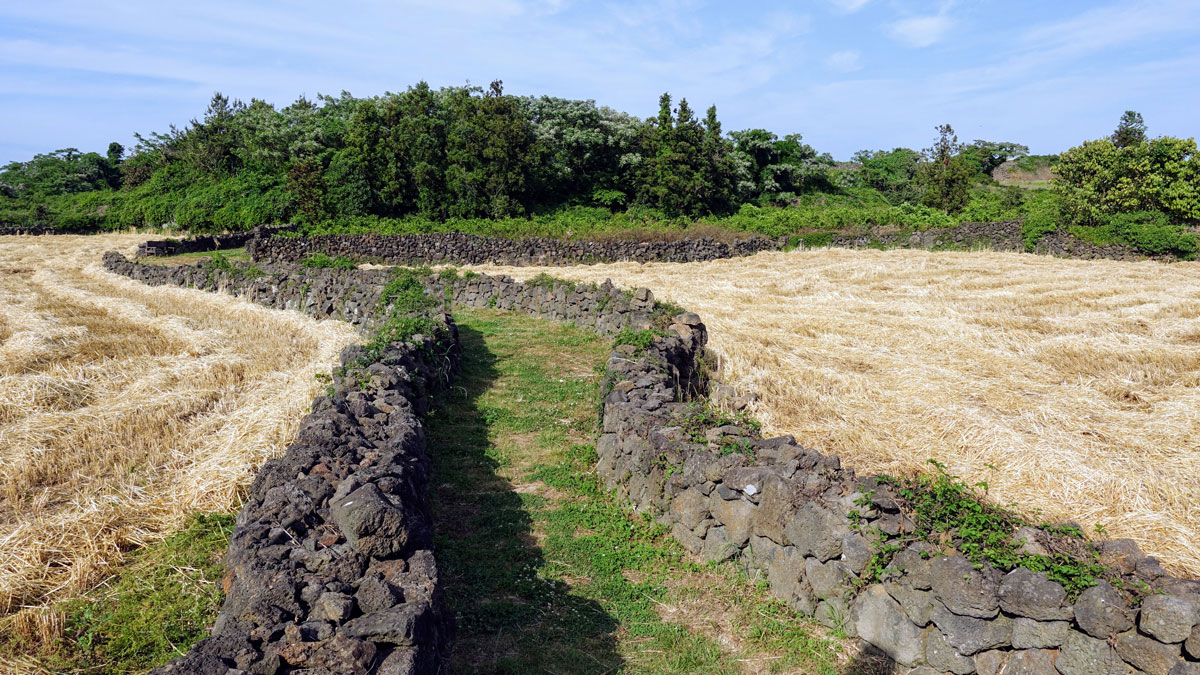
Walls of volcanic rock separated the tiny farm fields, appearing at a distance like a giant jigsaw puzzle.
The fields were tiny, ranging in size from a tenth of an acre to two or three acres. The perimeter of each field contained a fence of black lava piled three to four feet high. I soon discovered that these rock fences concealed me from any birds in the adjacent fields. By the time they spotted me, I was usually within shotgun range, at which point they flushed and provided me with a shot.
The weather was not cooperative that first day, with snow, sleet and rain coming down intermittently, and a cold wind blowing off the strait. As a result, the birds were not moving around much. In about four hours, I managed to flush four roosters and a dove, all of which I bagged. I headed back to the cab at the appointed time to find that Charlie and his safari had bagged two pheasants.
The next two days were nasty weather-wise, so we held out for the last day, hoping conditions would improve. It began as mild, overcast and quiet, so we headed out. Once again we hired a taxi, which took us a little farther down the coast. Finally, we stopped near a secluded area of mixed forest and tiny croplands.
Once again I set out alone, but within an hour, I had my own following of three boys who must have decided to play hooky from school in order to follow me around. Their leader was a pleasant-looking young fellow who seemed quite intelligent.
As we stalked through the jigsaw maze, whenever we spotted a pheasant the boys would get excited and start chattering like little chipmunks. I would then have to turn around, put my index finger to my lips and make an exaggerated sshhh sound. At that, the trio would mimic me to one another by going sshhh for several seconds, then giggle loudly before finally settling down and staying quiet.
The pheasant hunting that day was exceptional. I poked and sneaked around the rock piles and the miniature fields with those three kids in tow for about five hours, during which I shot 13 roosters.
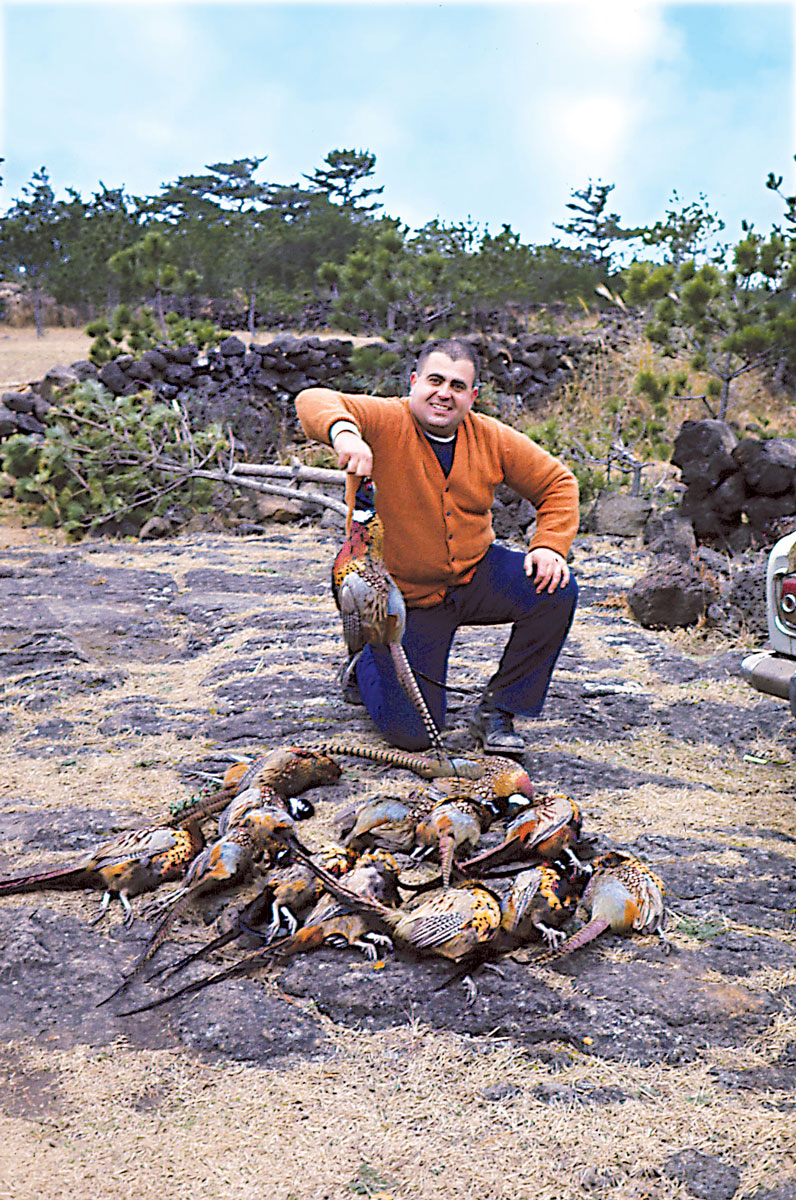
Charlie Ventimiglia shows off the hunters’ bag of colorful ringnecks taken
at Cheju Do, an island off the Korean Peninsula.
Using the rock walls as screens, I approached to within good shooting range of a number of birds. The pheasants I flushed were either loners or in small flocks of two or three birds. There were no large bunches of 20 to 30 birds such as a late-season pheasant hunter would find in America. All of the roosters were in good shape, with long tails and dazzling colors, just like our pheasants back home.
At the end of my hunt, I gave each boy a little money and some pastry and other food we had brought along for lunch and snacks. They were appreciative and polite, and we parted as friends after a fun day afield.
The next day we flew back to the base with our birds. The trip had cost me about $125 for the plane fare, food and hotel accommodations. Charlie had gone through at least twice that amount, and his suitcase full of money was completely gone when we arrived at Kwang Ju.
Back at the base, Tom O’Brien, a fellow Irishman and close friend of both Charlie and me, discretely approached each of us and asked how the trip had gone.
My reply to Tom was: “We had a really great time, but that damned spendthrift Charlie was so intent on blowing all of his money and mine that we barely had enough to
get back.”
Charlie, meanwhile, had replied: “We had a really great time, but that damned cheapskate Dailey was so tight-fisted with his money that we could hardly enjoy ourselves.”
The day after our return I got in touch with the sergeant who ran the Air Force chow hall. I asked if his crew would prepare our birds for a special dinner for all the senior non-commissioned officers and junior offices in our squadron, about 25 people in all. Charlie and I, meanwhile, located and purchased several bottles of white wine for the occasion.
That evening we were ushered into a cordoned-off section of the dining hall where tables for four had been arranged, complete with white tablecloths and even candles. The pheasants those young airmen chefs served to us were excellent, as was the rest of the dinner. I recall that several toasts were made, not only to the chefs, but to the skinny Irishman and the Mafia hit man. A good time was had by all that evening.
Author’s Note:
This story was drawn from my hunting journal while I was stationed at Kwang Ju Air Base in the Republic of Korea from August 1968 to September 1969. About the Artist: Alabama-based artist Andrew Lee has created a set of 300 signed and numbered limited edition prints of his Ring-Necked Pheasant. for more information, visit andrewleedesigns.com