

From a time-worn and battered old leather-bound hunting journal, a dried sprig of heather slipped from between embrowned pages. It was picked from the moor on a walk up grouse shoot spent on the Glorious 12th in the Scottish Highlands many years ago. As I read the passages from whence it came, I was reminded of the horizontal rain that assailed us that day, the lovely purple hue of the heather and the satisfaction of having my first red grouse brought to hand by a small but energetic Labrador retriever named Angus.
I relived the lively banter and collegiality that exists among hunters regardless of their nationality, age or station in life. I was there once again, feeling the wind in my face, smelling the damp heath and stumbling across the rough ground hidden beneath a thick verdant mat of sphagnum moss.
My passages reminded me of drinking the peat-stained water that was the color of tea and the delicious and delicately flavored brace of grouse we had that evening for dinner. Even though decades have passed since that trip to the heather, I was transported back with a level of clarity and detail that would have been lost had I not taken the time to commit the memories of that day to paper.
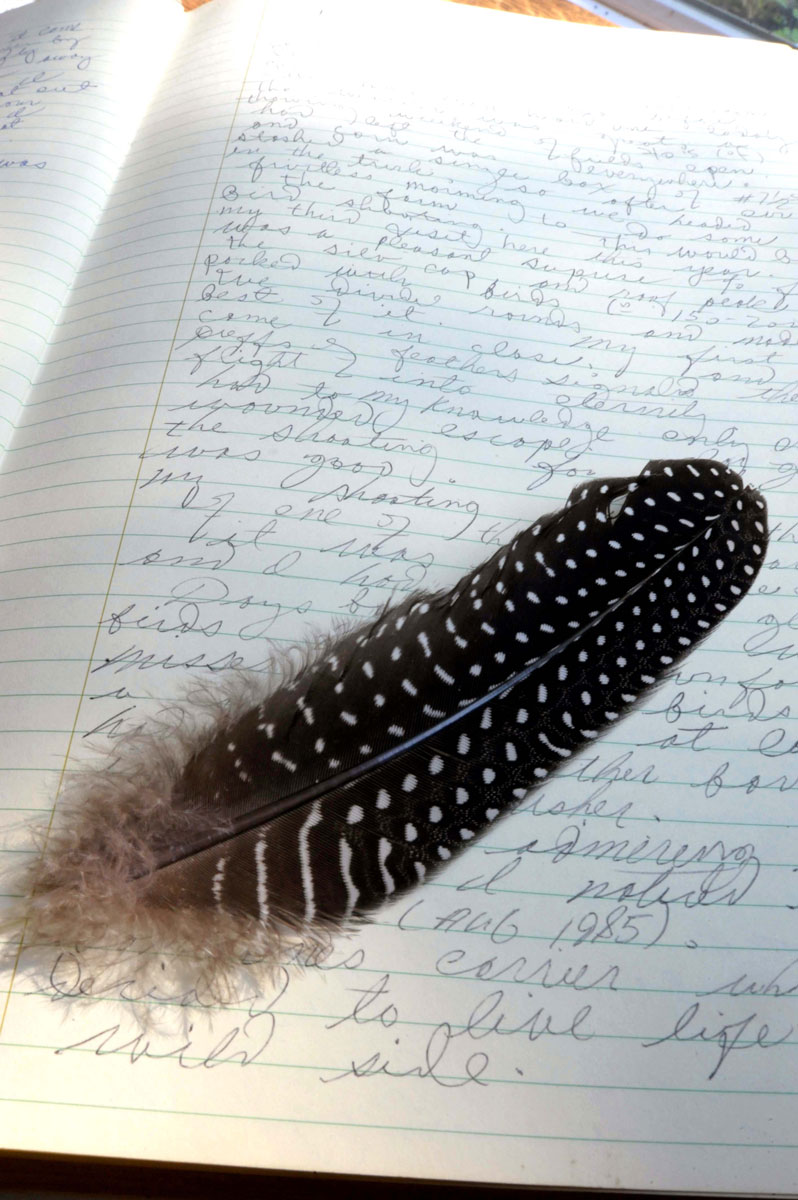
In this ever-intrusive electronic age, the act of keeping a hunting journal may seem to be an antiquated pastime, a throwback to the Edwardian gunning era. It would seem that hunting diaries have been largely supplanted by a brief email or text to family or fellow hunting companions, describing in the barest details possible the highlights of a hunt. Unfortunately, even those details vanish into the ether as soon as they are deleted. I started keeping a hunting journal shortly after I was married.
One of my first entries describes the “Huntingmoon” my new bride and I took for a Canadian moose. Still in graduate school and as poor as proverbial church mice, we saved every penny to cover the cost of a bush plane flight that would land us, our well-traveled canoe and a borrowed rifle, on a small lake nestled deep amid the vast Boreal forest of northern Ontario.
I can still see how immense that bull moose looked laying there among the spruce trees with steam coming off his body and dissipating in the weak sunlight of a fall morning. I can still hear the lonely croaking sound of ravens echoing through the woods as they began to congregate near the kill site.
Originally, like most young hunters, I was obsessed with noting the size of my game bag or trophy quality, the weather conditions or the tactics successfully employed in harvesting game. As I matured as a hunter, the entries began to reflect more on the personalities of the people I met, the qualities of the land, the great meals I experienced and simple things such as the smell of a well lathered horse on a steep mountain trail or the bone weary tiredness that comes at the end of a hard day afield.
As I hunt back through the years, passages remind me of the taste of fine Argentinian beef prepared as carne asada in the field, or the cacophonous sound that a troop of baboons make screaming in abject terror as a leopard carries off one of their own into the night.
To be certain, there are detailed descriptions of how the animals I harvested were brought down, their beauty, their cunning or their truculence and technical descriptions of the equipment used or the loads that I assembled. But focusing only on the technical details of a hunt is akin to playing a violin with earmuffs on. The notes are there but their richness and tonal quality are somehow muted or lost entirely.
Aside from wanting to capture and relive the details of my time afield, I also wanted to leave an indelible legacy to my children and perhaps even their children. I want them to know and understand my passion for the outdoors, my love of adventure and the deep respect I have for protecting and preserving wildlife and wild places. I want them to see me as a young man fully possessed with the joie de vivre and before the infirmities of age had set in. I want them to know all the places around the globe where I had been fortunate enough to leave my boot prints and perhaps make them want to leave their own boot prints in the lesser traveled corners of the world.
I hope someday, after I have gone to my reward of an endless fall, that they pull out these gentle reminders of my past and relive part of my life in a way that I chose to live it and in a way that mere pictures fail to adequately convey. These passages contain no profound moral or ethical imperatives, no missives on social injustice or comments on the human condition. Rather, they are simple recollections of a lifetime spent afield with family, dear friends and faithful dogs. I do hope that my passages portray me as an ethical hunter who cared deeply about the animals I was privileged to hunt and the people and places I was fortunate enough to visit.
An added benefit to keeping my outdoor journals, and something that I would have never predicted when I first started, is their value to me as a writer. My adult life’s collection of experiences in the outdoors are contained within these tattered journals and they have been an invaluable source of inspiration as well as the factual details from which many of my hunting stories spring forth. The indelibly committed information contained therein keeps my writing as accurate as possible and prevents me from applying too much “varnish” to old stories.
Relatedly, I have found that writing, much like reading my old journal entries, is yet another way for me to relive the rich store of experiences accumulated over a lifetime of hunting. Although I am far from hanging up my rifle and fowling piece, I know that I am on the back side, of course, and that many of the places I have been, I will likely never visit again. After all, there are simply too many other hunting destinations I have yet to visit and only so much time!
Here and there, tangible reminders of the past peek out from between the journal pages—the curled tail feather from a drake mallard, the whiskers from a bull hippo, a polka-dotted flight feather from a guinea fowl, a pressed sprig of heather—all of these are talismans to the past, much like the inscriptions that surround them, and they are a testament to a sporting life well spent.
Scattered throughout those pages are also reminiscences with old friends, some now gone and some now too frail to enjoy what was once their life’s passion. I am reminded of a passage found in the book entitled Tranquility by Colonel Harold P. Sheldon. In the introduction, Nash Buckingham penned these poignant words about his friend and mentor William Arthur Wheatley (1843-1901) and the significance of a shooting diary:
“In my youth a very dear old gentleman presented to me a shooting diary hand penned through many decades. Child that I was, I sensed when he put it in my hands that somehow it’s giving was linked mysteriously to tears that shone in his eyes. I asked, wonderingly, ‘for me?’ And he whispered—‘Yes, Boy, I give you back my years!’” —Nash Buckingham 1936
For in the end, all we have left are our memories.