
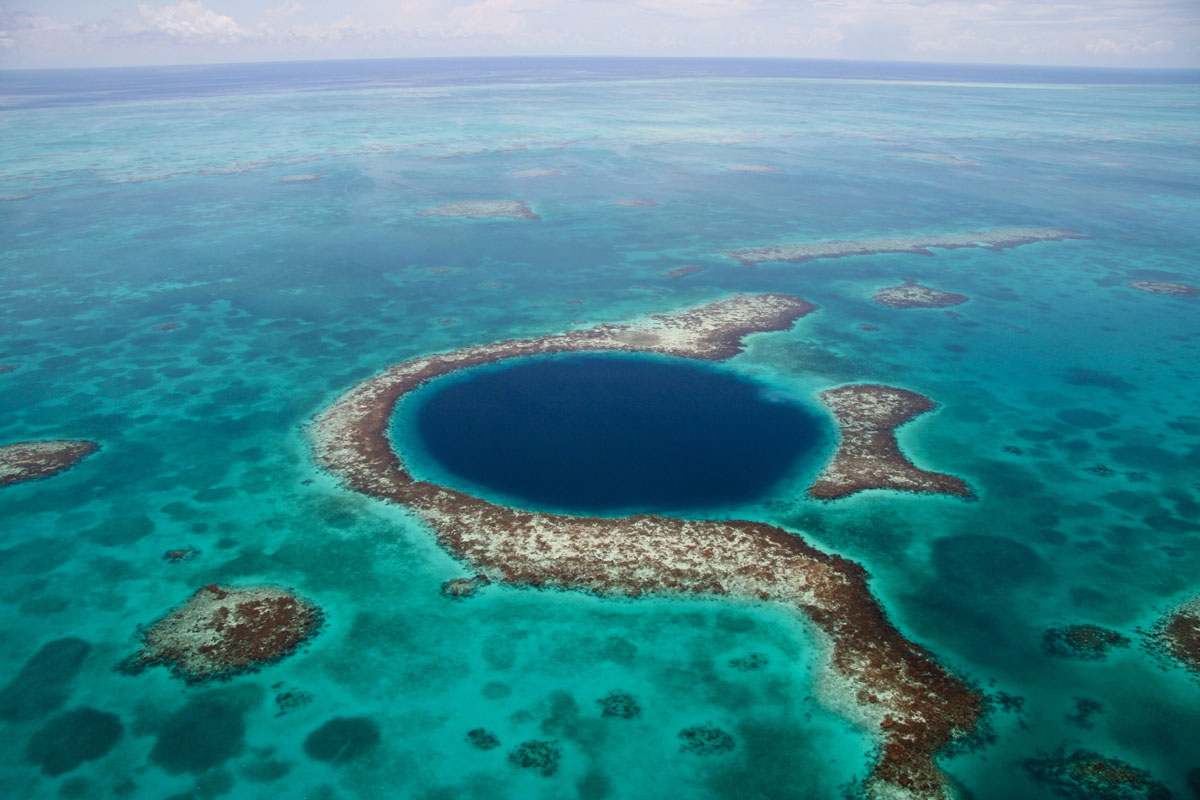
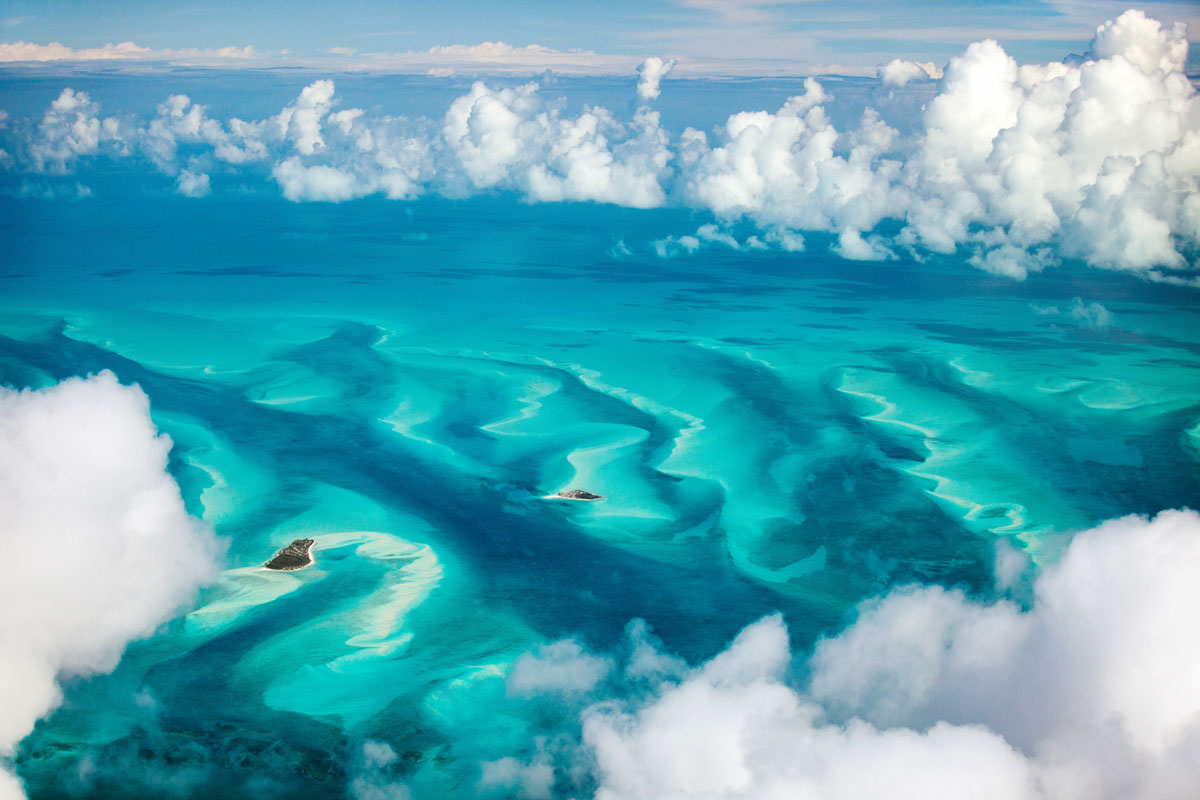
Shortly after one o’clock that Sunday afternoon as the plane began its approach into Andros, the first thing Tate noticed was where the deep water met the shallow bank of the coast. There, plainly visible on the white bottom beneath the clear, light green water, were what looked to be perfectly round, solid blue craters—blue holes coming from somewhere far out in the ocean ending up in the shallow waters of the islands of the Bahamas.
“Mr. Tate?”
Four hours later he was sitting with a Manhattan at one of the tables scattered around the dock fronting Fresh Creek harbor behind Frank’s Joint, the lodge where he was staying. Nursing his drink, Tate watched the tide just starting to come in from the ocean, turning the water of the little harbor from listless brown to a light green you could see the bottom through.
“Jim Tate?”
“Yes?”
Standing up from the table, he turned to see a Bahamian dressed in a light blue fishing shirt, a pair of blue jeans with the legs rolled up at his shins and his hand held out to be shaken. Taking this outstretched hand Tate added, “And you are?”
“Howard, sir, and I be your guide for the next week. Mr. Frank told me you were down here, so I come to introduce meself. Mebbe see if we can figure out what is good, or mebbe bad,” said Howard flashing a grin Tate couldn’t imagine anyone not liking. “You know, mah’n, for your fishing?”
Howard looked to be in his mid- to late-forties, but he could have been years younger, or even close to Tate’s 65; it was hard to tell. He was built strong, that much was certain, probably from his years of the hard work of being a guide in the Bahamas.
“Please, Howard, let’s not come up with anything bad relating to the fishing. I can find plenty of that just by staying home.”
“I heard that, mah’n. Yes, I heard that. You come to Andros you want to enjoy. Now that I can understand very well.”
“And Howard? Just call me Jim, OK? None of that Mr. Tate, or sir stuff.”
“How ’bout Jimmy? OK, I call you Jimmy?”
“Sure,” Tate replied, unable to say no to the huge smile on the Bahamian’s face. “Jimmy will be just fine.”
A good way to start the week, Tate thought later as he was sitting down in the main dining room of Frank’s Joint for dinner. The dining area was a wide-open room with wooden tables covered by checked tablecloths placed carefully here and there. The wooden walls, painted a worn gray, were lined with photographs of Frank as a much younger man than the 80 he was now, dining with various people Tate didn’t know. A mounted marlin hung on the back wall bordered by framed maps of Andros and the rest of the Bahamas chain. Absent from this comfortable space were the plush furnishings, candelabra and shining silverware Tate remembered from the lodge outside of Hope Town on Abaco where he and his brother Phil had stayed 15 years before.
Hopefully this trip would turn out better than that one, the last time he had been to the islands. They had come to celebrate Tate’s 50th birthday. Some celebration. It had started off good enough with excellent fishing the first two days and swimming in a blue hole on the third day—all of that was amazing. But the night of that third day they had argued the way brothers could sometimes when heavy drinking was involved. And as those sorts of arguments could be, it had started over something stupid—something Phil’s wife had accused Tate of and that was not true. Words were said, punches were thrown, the end result being that when Tate woke up the next morning, Phil was gone, having caught the early flight back to Fort Lauderdale, except the plane never made it, crashing just after takeoff and killing all aboard.
But the drinks on the dock, meeting Howard and the good food at dinner, helped push that bad memory aside and Tate slept like a baby that night, and when Howard pulled up in the driveway outside of Tate’s room at eight o’clock sharp the next morning, Tate was up and ready.
“Come along, mah’n.” Howard grabbed Tate’s gear and stowed it in the boat hooked up to the truck. “We got a bit of a ride ahead of us.”
This “bit of a ride”—almost to the tip of the north end of the island—took more than an hour, Howard perpetually smiling as he drove, one hand on the wheel the other waving at every car going by the other way. They went past little settlements dotting the Queen’s Highway, that, for the most part, consisted of some sort of ratty looking store, a few rundown houses, more than one of them with a tired looking old man sitting on the front steps while a rangy looking dog lay out in the ragged yard. The bigger settlements had actual commercial buildings, maybe a gas station, bank, cell phone store and a bar down by the water. These settlements were a reminder of how hard life could be on the islands unless one lived in one of the more built-up towns such as Nassau or Freeport. All of these settlements, big or small, were a not-so-subtle reminder for Tate that, though short in miles perhaps, he was a long way from home.
“Not far now, Jimmy,” Howard said as they crossed a wooden bridge over Stafford Creek. “We be fishing the Joulters today, mah’n. Plenty of bonefish out there, Jimmy. Some big ones, too.”
“I like the sound of that.” Tate had never considered big fish the be-all, end-all of any fishing trip, but he wouldn’t mind catching one, either. “Like it a lot, actually.”
“I make no promise, Jimmy,” Howard said. “If I see one of those big fish, I’ll do my best to put you on it.” He shrugged, flashing his big grin at Tate. “But after that, mah’n? After that it’s all you.”
“I’ll do my best, Howard.”
“I know you will, Jimmy. I know you will.”
Soon afterward they were on the water, the flats skiff up on plane and Howard at the wheel as they ripped across Lowes Sounds toward the scattered keys to the east that made up the Joulters. Other than some thunderheads to the west, behind them the sky was blue and empty, the unfiltered sunlight lighting up the white sand and waving grasses in the blue-green water beneath the speeding boat. As always, Tate was amazed at the ability of these shallow-draft skiffs to run in such skinny water, sometimes in less than a foot of draft. Once he saw no way they wouldn’t run aground on what looked to be a sandy beach that Howard either didn’t see or didn’t care about, but was coming up quick right in front of them. At what had to be the last possible moment to do so, Howard, without backing off on the throttle, pulled the wheel hard to the right. In the next second they were across, the outboard growling as Howard trimmed it up, the prop dragging sand, true, but they were in the deeper water on the other side of the sandbar, Tate still gripping hard to the side of the boat as it continued on its way.
“You think we not going to make it, Jimmy?” Howard asked, his smile flashing wide in the sunlight.
“Never doubted it, Howard.”
“That’s funny, Jimmy. I did! A different tide and we’d be pushing this boat off for sure!”
Five, maybe 10 minutes later when they were off the tip of a scraggly cay, Howard shut the boat down. Lifting the push pole from its holders on the port side of the skiff, he clambered up on the platform over the outboard. “You up, Jimmy,” he said, pointing at the bow fishing platform. “Bonefish coming around the point right now!”
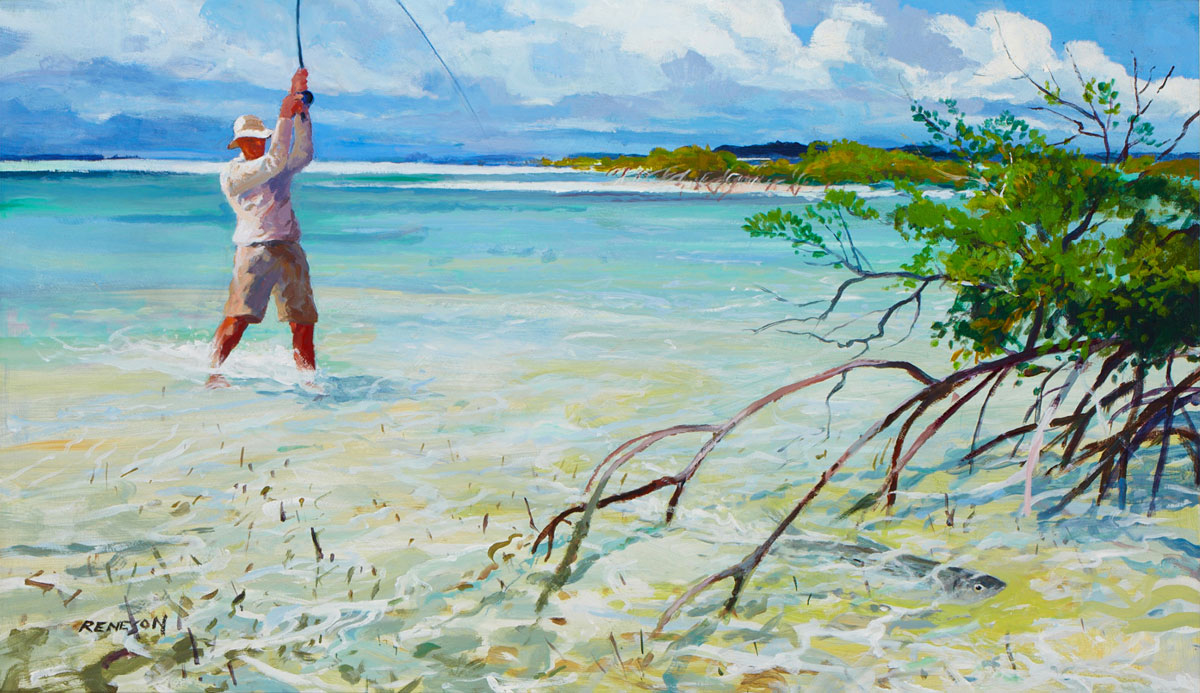
A Tricky Situation by Chet Reneson, acrylic, 28 X 42 inches
Standing on the front casting deck, stripping line off the reel so as to be ready to cast, Tate couldn’t see the fish Howard was talking about. A cloud overhead covered the white sandy bottom stretching out from the key with its shade. Then the cloud moved away, and there they were, bonefish, looking like dark torpedoes moving across the flat, a big school of them, too, Tate thinking as he looked at them, How can I miss?
“One o’clock, mah’n,” Howard said from the poling platform. “Eighty feet, so give me a long cast.”
At just that minute another cloud came overhead and Tate lost the fish in its shadow. He cast anyway, letting the fly settle gently into the water where he hoped the bonefish still was.
“Nice cast, Jimmy, now strip!” Howard said.
Tate did, one, two, three short strips of the fly line between the fingers of his left hand, but there was nothing.
“He turned away, mah’n. Cast again, same place, three more fish behind him. There you go, nice cast, now strip, strip, strip one more time, stop, long strip, now! Yah, mah’n, he’s on it. Hit him!”
Tate struck the fish, seeing it as he did so. A decent fish, hard to truly judge with it in the water and still 50 feet or so away, but lifting the rod tip he could feel the mass of it as it bolted away, safely hooked. The fish ran for deeper water off the flat in the distance; Tate laughed as the fish peeled fly line off the reel until all of it was gone, only the backing running off the reel, with the fish somewhere out there, maybe 100 yards from the boat. Tate could not see the fish, but knew it was there from the pressure on the rod bent at a 90-degree angle toward the horizon.
“Go nice and steady, Jimmy. He a good fish and we don’t want to lose him.”
“No,” Tate said. “We certainly don’t want that.”
He reeled, gaining some of the backing back onto the reel, feeling the pressure. The fish was nowhere tired enough to give up and burned off again, taking half of the line Tate had regained. He bent to the fish, rod pointed straight out toward where it was running, and when the fish slowed after this burning run, managed to reel the line back. Finally, after two more runs from the fish, neither of them quite as intense as the one preceding it, Tate had the fly line back on the reel and knew the fight was coming to a close. Just a little way to go, and then he could lift the fish into the boat, unhook it and gently release it back into the elements from whence it came.
Tate, after unhooking the fish, turned to Howard kneeling next to him, hoping the smile on his face was as big as the one on Howard’s, and said, “Thanks, man. Thanks.”
“Don’t thank me, Jimmy!” Howard high-fived him, black palm against white in the light of the morning flowing across the flat. “You did all the work, mah’n!”
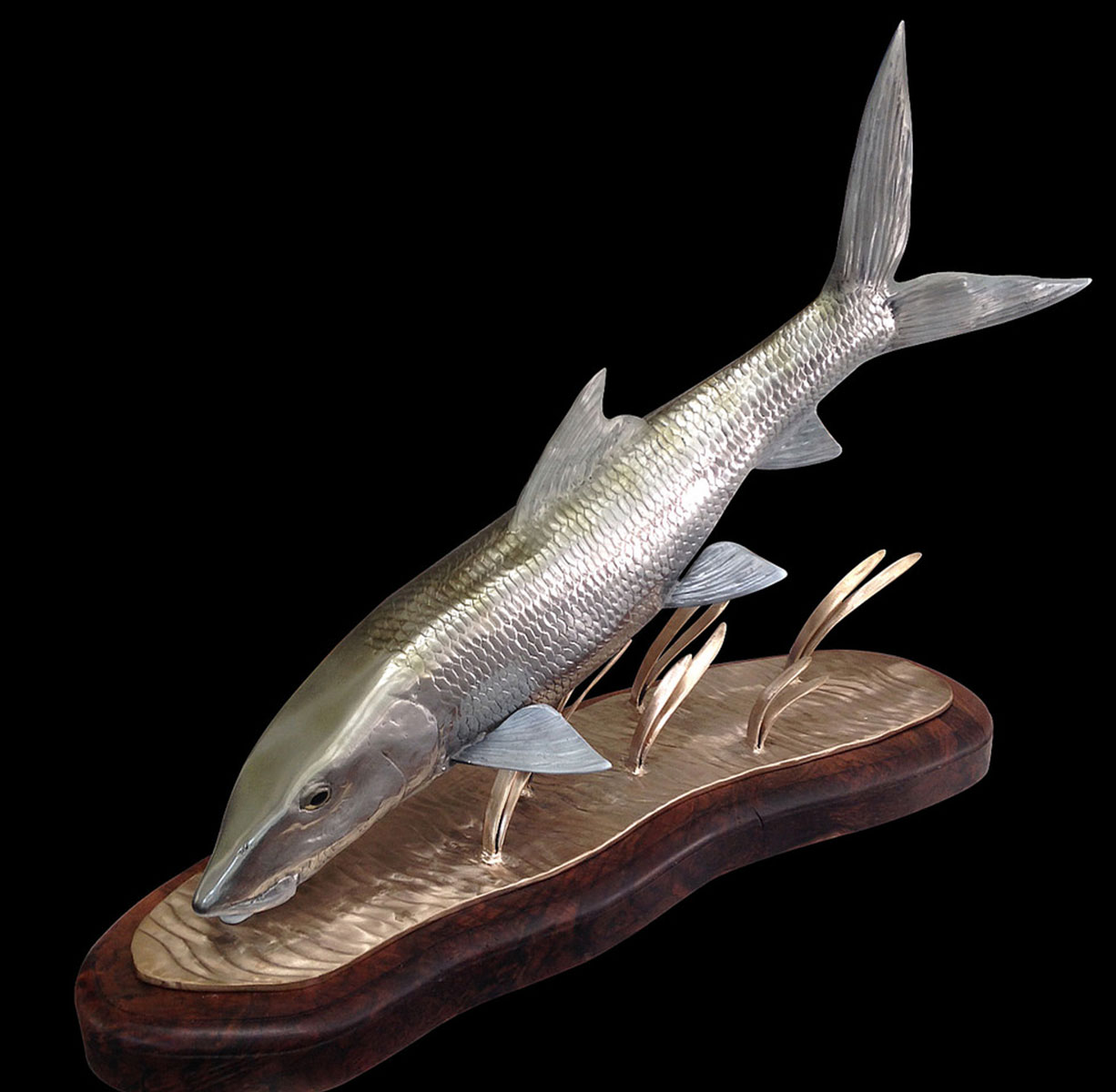
Tailing Bonefish .30 by John Rogers Fowler
Stainless steel, 28″L x 10″W x 20″H
That night as he drifted to sleep after another fine meal at Frank’s Joint, Tate thought back on the day of the fish he caught and the ones he lost—looking very much forward to the next day he leaned over and turned off the bedside light.
But the next morning, and as it would the day after that, the day dawned black and thick with rain. Howard was outside Tate’s room promptly at eight o’clock, and Tate was ready for him, even though he knew fishing for the day was probably a wash—a fact Howard quickly confirmed as he came up on the porch.
“No fishing today, Jimmy. Sorry mah’n, but I see you tomorrow.”
The rain started shortly after Howard left and Tate spent most of the morning on the porch with coffee and one of the books on bonefishing in the Bahamas he’d brought along for down time. Finally, late in the afternoon, the rain slacked off a little and, tired of reading and dozing, Tate put his slicker on and walked up the hill into Fresh Creek proper. With the skies still heavy with the promise of more rain to come, the homes and stores on the main street of town looked deserted and gloomy in the gray light of the day. Few people were out and about other than children home from school and eager to play outside, despite the lousy conditions. Even the one funky old bar next to the town’s lone grocery store seemed to be empty. Loud music from a boom box playing somewhere deep inside came reverberating out into the street with only Tate, it appeared, there to hear it.
His brother would have dragged Tate inside that bar if he were there. Phil was always eager to see, as he put it, “What the locals were up to.” It was a good thing he hadn’t gone to Abaco Tate told himself on the walk back to his room. The thought of Phil was with him enough on the trip as it was. His guilt was certainly long lasting, he thought as he turned into the driveway of Frank’s Joint. Never ending, he guessed. Even if it was time—past time, really—for that guilt to come to an end.
The rain hung in there, not truly fading out until late Wednesday evening. But come Thursday morning— the front blown away at last, the day all bright and shining—Tate was up and ready when Howard arrived at eight o’clock.
“I see you all set to go,” Howard said as he was getting out of the SUV. Tate was already stowing his rods and tackle bag in the boat.
“Damn straight.”
He was, too. It was his last day on the island. In the morning he would catch the ten o’clock flight out of Fresh Creek and be back in the so-called real world by noon.
The drive out of Fresh Creek to the put-in on the west side of the island was every bit as long, if not more so, than the run to Lowes Sound on Monday had been. But once they were on the water with the boat up on plane, hauling south away from the ramp past the white sand beaches running down from the mangrove-lined shoreline to the sparkling green water the Bahamas were famous for, Tate breathed what he hated to think was a sigh of relief—even if it was.
After maybe an hour, give or take a little, Howard turned the boat in toward the coast. The mouth of a creek, not visible to Tate at first, suddenly came into view. Howard ran the boat in between two mangrove points guarding the creek until they reached where the creek narrowed down into a small, mangrove-lined cut. Howard killed the outboard, grabbed the pole and scrambled up on the platform to bring the skiff back around facing the direction from which they came.
“Time to fish, Jimmy,” he yelled from the platform. “You’re up, mah’n. Howard’s feeling big fish coming our way. I find him for you, just you see!”
But Howard didn’t find that big fish—Tate did, right after lunch as Howard pushed the boat off from the bank and began poling back up the way they had come in. Tate stepped back up on the bow where a few minutes later he saw something moving slowly in a little notch in the bank less than 20 feet from the boat. The “something” was a bonefish, Tate quickly realized. It was mudding on the bottom, its head down rooting out the little crustaceans buried in the mud. What’s more, the fish was a big one. A very big one.
When Howard didn’t say anything or give directions as he usually did, Tate took the plunge. It being way too close for a real cast, he turned a lazy roll cast dropping the mantis fly a foot or two in front of the feeding fish and stripped the fly slowly. Tate saw the fish lift its head up and begin to move, sped up his strip and the fish inhaled the fly. Tate set up on him, and just like that, all hell broke loose.
“Jimmy!” Howard yelled from the poling platform when he saw what was happening. “What you do, mah’n when I not looking? I guess you don’t need me anymore,” his laughter loud and encouraging as Tate let the fish run.
Fortunately for Tate—and boy, didn’t he know it—the bonefish took off right down the middle of the creek instead of back into the little notch where it had been feeding. Worse would have been it turning and racing back into where the creek narrowed down into a mess of mangroves with roots sticking up out of the shallow water where the fish could wrap the leader around and break off in a heartbeat. Tate was happier than he thought possible that the fish chose the center of the creek to battle it out. There would be no turning a fish the size of this one out of a mangling mess of mangrove roots.
In fact, all Tate could do at the moment was just to let the fish run, fly line cutting the surface of the water, as he held the rod tip up, watching backing disappear from the reel. With Howard using the pole to keep up with the fish as best he could, Tate just hung on, lifting the rod tip when the fish slowed—which was not often—and reeling to regain the backing the fish had peeled off and bowing the rod toward the fish when it invariably took off again. All the while, Howard, on the poling platform yelled, “Don’t lose him, Jimmy mah’n, he be the bonefish of a lifetime!” Tate thought how that was maybe the last thing he needed to hear at that minute, but hearing it also got him thinking, Oh man, oh man, just don’t screw up. You know how to do this.
The fish, not hearing any of what was said, ran up the creek using both its strength and the tidal current flowing out toward the mouth of the creek to its advantage so that every time Tate was able to reel backing onto the reel, in the very next moment it seemed, the fish surged again, the line he had regained, lost once more. Tate wondered how long the fish could keep this up, then how long he could keep it up?
But right then the fish slowed and stayed slowed. Tate reeled line in, all the time keeping the rod tip up keeping pressure on the fish and Tate thinking that maybe, just maybe, he held the upper hand, and wasn’t that just great? “The fish of a lifetime,” Howard said. How big could a fish like that be? Twelve pounds? Fifteen pounds? God, but he had no idea. Suddenly he didn’t care. The fish was a monster. A big, beautiful monster.
And somehow, there it was. Despite the rain of the past two days and his sorrowful ponderings of Phil, run through with a stupid guilt he had carried too long—all of that, the bad and the good—brought him here. To this place. To this fish. And wasn’t it so beautiful that words could never describe it.
Right then Tate felt the fish take off once more. Right then he felt a joy he had not felt in a long time flood over him.