
Pitted with rust and powder–scalds, the old musket would explode with a roar that sounded like the crack of doom. And now, in the dusky hands of the Hunterman, it was all that stood between life and a terrible death.
The negroes in the golden-wide ricefield, as they reaped rhythmically, were singing melodiously; there was the glamour of autumn and harvest-time. It was cool for September in South Carolina, and there were hints of fall in the air; though that radiant, reddening, ripening time had as yet been stayed from the heavy-foliaged trees that fringed the ricefield. Toward Ned Alston, the planter, who was watching the happy workers with delight, there now advanced the smiling Scipio, the grandson of the old professional slave hunter of Eldorado; and, much to the pride of this unique character Alston always addressed him as “My Hunterman.”
Scipio well deserved the title. No Cherokee Indian who ever ranged the pine forests and the cypress swamps of the South had understood them better than he. He possessed a certain untamed element in his nature which served to ally him to all wild things and their ways. His occupation was never fixed, unless roaming can be considered an occupation; real work he disdained. But Scipio was full of picturesque accomplishments. He could pick the guitar, pray with much emotion at revival meetings, arbitrate differences among the negroes, and prescribe medicines in cases of sickness; and these remedies, being gathered from plantation woods and fields, could be recommended in that they were without money and without price. But by birth and breeding Scipio was a hunter. He alone could, after night, make a direct road home out of the most desolate and trackless swamp; he alone knew where the wariest old buck of the branches would lie, and at just what point in the vast level pinewoods a running deer could be cut off. In all such matters, Alston had been accustomed to defer to him. The planter had to confess, however, that Scipio was hardly to be accounted an economic asset of Eldorado plantation; but he certainly made for sentiment and romance, and was as fine a figure of the black man as the Santee country had produced.
Tall and sparse, he had the power of endurance written in the movements of his limbs and in his easy attitudes of repose. All his actions appeared to be without effort, and he did things without appearing to strive. In feature, he was more like an Indian than a negro. His eyes were deep-set and keen, with a masked glitter of forest-wildness in them. The expression of his face was quiet but indescribably wary, while the gleam of his ready smile almost constantly lighted his cheerful countenance.
And now, as Scipio approached Alston, who stood under a gnarled live-oak on the ricefield-bank, the planter eyed the negro’s musket with mock disapproval.
“Well, Hunterman,” he said, “and what are you loaded for this summer day?”
“Cap’n,” the negro returned, “I come from Laurel Hill swamp. Two big bear done take up there, but I couldn’t find them to-day. I hab a ball-bullet in my musket, sail,” he went on, stroking the long barrel of his formidable weapon.
The eye of the planter rested with amusement yet with admiration on Scipio’s gun.
This musket was of an age unknown and of a fashion long forgotten. Short in the stock but marvelously long in the barrel, it was throughout so pitted with rust-spots and powder-scalds that it frequently, when fired, emitted spurts of angry flame. The misshaped hammer looked ancestral, almost prehistoric, while the nipple was nothing but a worn stub. But in the hands of the redoubtable Hunterman, and charged with the double load which he was accustomed to using, it was a deadly weapon. The sound it made was unlike that produced by any other kind of gun. Scipio’s musket blared, and it did so alarmingly. This fearsome roar was known to all dwellers in the Santee country, and what it meant filled everyone who heard it with deep pride in Scipio’s daring and prowess.
On stormy twilights, when the wild-ducks would be pouring into the old ricefields, a sound like the crack of doom would crash the stillness of the plantation regions, and would reverberate for miles up and down the misty river. Then the negroes, hugging their cabin fires, would say, “Eh, brudder, what chance is a duck got ’gainst a noise like dat?” Again, when the roar of the musket would come from the pine woods, there would always be some who would hear it and would remark, “Deer can jump and run, but he can’t jump powder and he can’t outrun shot — not when brudder Scipio opens fire on him.”
So now, when Scipio laid this extraordinary weapon down on the dewberry vines that had matted themselves on the slope of the ricefield bank, Alston eyed it with affectionate fun.
“Time you were getting a new gun, Hunterman,” he said; “some day she’s going to blow up and scatter you over a ten-acre field.”
But Ned Alston’s admiration for Scipio’s skill as a woodsman now suffered a certain eclipse and depreciation, as, looking across the brown stiff stubble, over which the heat-waves shimmered and swam, he saw the Hunterman’s wife toiling faithfully with the men and with the stronger women, though her own child was but a few weeks old. Yet it was hard to get angry with the picturesque Scipio; one might blame a domestic nature for such neglect, but not a nature which was essentially wild, restless, untamed. Yet the planter could not help saying:
“Scipio, you know this is no season for you to hunt bear. Why aren’t you in that field reaping rice? You know Amy ought not work as she is working yonder, while her baby is so young. She had to bring him down here with her to-day; he’s down the bank there, under the wahwoo bush. Amy ought to be at home with the child, and you ought to be in the field.”
But the Hunterman ignored the planter’s cogent reasoning.
“I done seen him yonder,” he smilingly said, the light of a deep, shy, wild, woodland affection for his one baby coming into his eyes; “he done been asleep,” he added softly, and still smiling, as if such a performance on the part of his baby was both wonderful and amusing.
The disagreeable subject of work was not again referred to; for Scipio, taking advantage of its temporary diversion, straightway began to tell Alston of a family of black fox-squirrels near the northern bound of the plantation that had been marked for the winter’s pastime of the planter. The talk continued to be of things woodland until Alston moved out from under the little oak, thinking he would step down the bank to see what progress the harvesting would show from a different angle. Like every planter the world over, when he emerged from the shelter which had cut off his view of the sky, with its tokens of fair or stormy weather, he glanced upward. Scipio, equally solicitous about such matters, but from far different reasons, also looked up. Both men saw at a glance the same dread apparition.
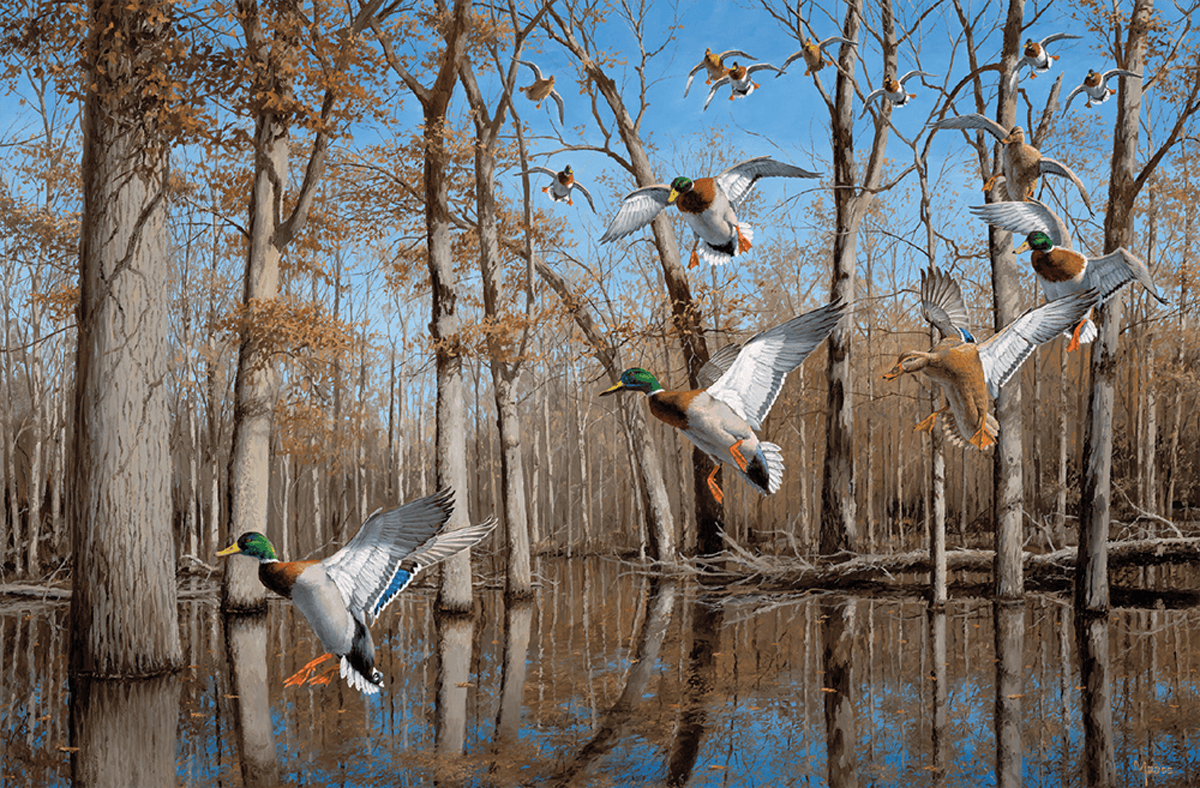
Heart of the Timber–Mallards by David Maass
With wide and powerful wings outspread in the heavens, in one of those last lowering circles ere he should fall, a great bald eagle was wheeling. Unconscious of the presence of the two men standing beneath the oak, he had been circling above them, they knew not for how long. And the moment they discerned him, certain at last of his reconnaissance and of the exact position of his prey, he eagerly arched his mighty wings and volplaned roaring out of the sky. His snowy head, with its cruel beak partly open in the heat of the hunt, was slightly outstretched. His stocky legs were letting down their talons to grip their prey. The fall of the eagle was terrible, a fearfully beautiful spectacle; impressive, but most sinister in its splendor.
Alston cried, “What an eagle, Scipio!”
But the dusky Hunterman, like lightning to think when wild life was in sight, had instantly discerned the goal of the great harrier’s fall. He marked the tragedy in an instant.
“My lil’ baby,” he cried brokenly — “dat big eagle’s gwine to get him!”
The negroes in the ricefield, who were working at a distance of some acres from the bank, were unaware of the impending disaster. They were reaping happily, laughing and singing. Even if they had seen and had realized what was taking place, they were far too distant to help. The eagle might have heard their shouts, but he would not have released his prey. Always bold, the bald eagle is amazingly so when a coveted victim, almost within his clutches, seems about to be taken from him. In the waving field, the little child’s mother was singing with the rest, swinging the flashing sickle rhythmically and laying the golden reaped grain in rich windrows on the brown stubble.
At first, only the planter and Scipio were aware of the terrible scene now being enacted before their very eyes. If the child was to be saved, they alone must do it. Yet what hope had they of succeeding?
The plumed wahwoo bush beside which Amy had laid her child was more than a hundred yards from them down the grass-grown, briar-matted bank. It would take the men fifteen seconds to reach the place; and by then the eagle, bearing his prey, might be far beyond the cypress trees on the river-bank, or even beating his powerful way over the broad river itself. It was a desperate moment.
From his great height in the sky, the eagle had detected the movement of life near the bank; and the colorless cloth in which the baby was wrapped had not given him reason for any suspicions. He saw prey before him, far from the workers in the wide field.
He wheeled lower, gauging the distance and marking his victim with the piercing sight of fierce, clairvoyant eyes. Whether it was a fawn or the young of some other animal, he knew not; it mattered not to the great bird of prey. The little creature was alive and defenseless; therefore he would fall upon it. With his curved talons wide, he dropped like a black thunderbolt out of the blue sky. The wind roared through the hollow arches of his wings. His talons ached for the fatal grip. His steady eyes were aflame with cruel hunger and the anticipation of its instant satisfaction.
The moment that Ned Alston realized the terrible import of Scipio’s words, he sprang forward with a shout, and would have raced down the bank, almost beside himself as he was with pity and horror. But the Hunterman, with a touch on his arm, stayed him.
“If you shout, Cap’n, he will fly faster,” said Scipio. “We couldn’t get him now no how. But wait a minute, please, suh.”
The huge eagle, whose fall had been completed, and which had for a moment been buried in the grass beside the bush, now rose heavily above the bank. Gripped in his talons and held close to his great body was Scipio’s baby.
But the Hunterman was going to have something to say in the matter. He was kneeling on the bank, his old musket at his shoulder.
“Scipio!” the planter cried out poignantly, “what are you going to do?”
“I’se gwine to shot him,” the negro returned, in tones that betrayed not a tremor.
Alston suppressed a wild desire to protest against what he felt sure would be a peril as grave to the child as the eagle’s attack. But instinct told him it was better not to speak. The Hunterman was taking aim. The shot would be most difficult as well as dangerous. It was at a small moving target, and the negro had told Alston that his musket was loaded with one ball — “a ball bullet,” meant for bear in the Laurel Hill swamp.
In the fleeting second while the planter crouched breathless beside the kneeling negro, he caught the expression on Scipio’s face. It was tense but not nervous, and flint-like in its determination. The eyes gleamed steadily. There was not a quiver in the statuesque black figure, immovable as marble.
The workers in the ricefield had heard Alston’s first shout, and the nature of the tragedy was borne in on them by one of their number, who, being a hunter, cried out the danger. The big eagle caught their gaze at once. Now they could see the child, wrapped in the drab cloth, struggling feebly. They could not hear the pitiful little cry that came to the ears of Alston and Scipio. Amy, the mother, had begun to run wildly across the stubble, waving her arms, shouting, and weeping impotently. But the great eagle had nothing to fear from those far-away pursuers.
Then on the air the musket of Scipio blared. The giant marauding bird collapsed in his skyward flight and fell heavily in the marsh on the edge of the field. The aim of the Hunterman, even in such a crisis, had been true; and the ball-bullet of the Hunterman had gone home.
In a few moments, Amy had her child in her arms. And then something happened which pleased the planter even more than the wonderful shot Scipio had just made. “Give me yo’ sickle, Amy,” he said; “as long as we’se got a lil’ baby, I will never let you wuk no mo’.”
That eagle, the largest ever taken in the Santee country, now stuffed and mounted, is one of Ned Alston’s treasured trophies. Though he cannot look at it without something akin to a shudder, yet it always vividly recalls one of the most thrilling moments of his life, when an innocent child was saved, without scathe, from a terrible death. When he and Scipio look at the eagle together, they understand each other with a perfect affection. And the planter is wont to say: “Scipio, to this day I don’t know how you did it.”
And Scipio answers, as if the feat had been simple enough:
“How, Cap’n, ain’t I is yo’ Hunterman?”