
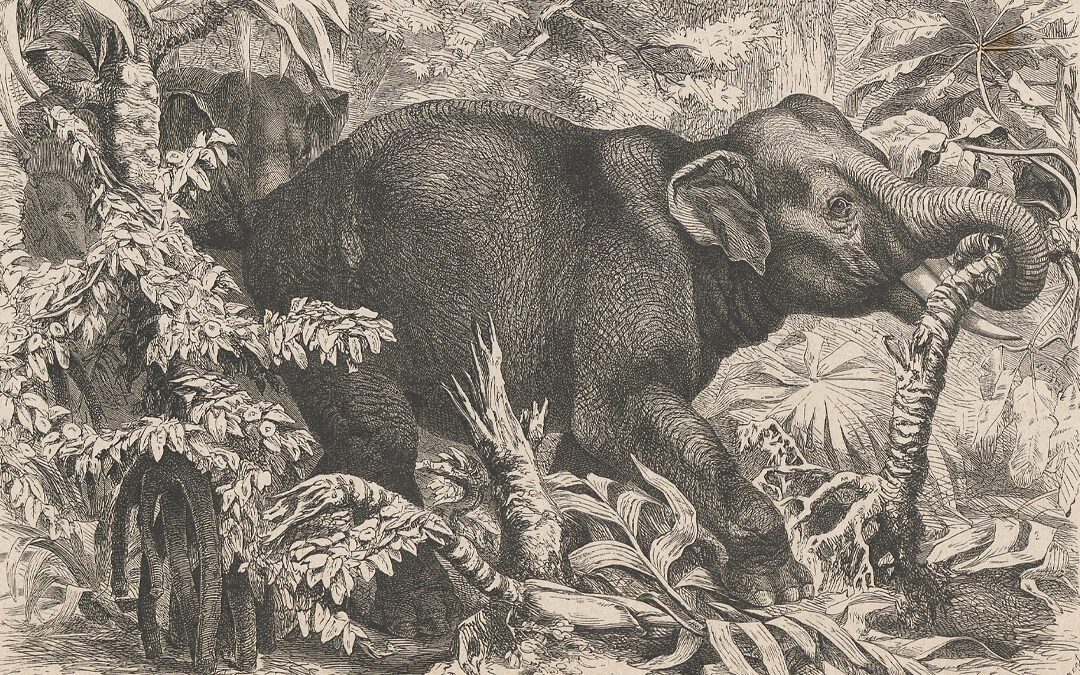
This article originally appeared in the December 1892 issue of Outing.
Some 10 ten years ago, toward the close of the hot season, I was traveling through the somewhat sparsely inhabited district of Bintenna, in the Eastern province of Ceylon. The country was wild in the extreme and abounding with all the luxuriance of tropical vegetation. Game was very abundant and, as might be expected, the natives were inclined to neglect the cultivation of their lands and to depend upon their skill in snaring and shooting small game, such as jungle fowl, wild pigs and porcupines.
Nearly every man carried a gun with him, not only for the purpose of securing his dinner, but as a protection from the many beasts of prey which lurked in the dense undergrowth. It was the paradise of the sportsman. Although it suffered from lack of communication with the outside world, the people appeared to be contented and happy. Many earned a living by shooting deer for the sake of the hides and horns, for which they readily found a market with the Moorish traders, who periodically visited them, exchanging tobacco, cloths and small articles of finery for the spoils of the chase.
At the time of the year of which I speak the country was dried and parched, the rivers shrunken and the pools a mere hard bed of mud with perhaps a few square feet of water in the middle, affording a wallow and refuge for the wild pigs from the swarms of flies and mosquitoes that followed them even through the thickest scrub. It was an easy matter to select a favorite drinking place and, securely seated on a little platform in the spreading branches of an overshadowing tree, to pot the unsuspecting deer as they came down at night to quench their thirst. It was doubtless a murderous proceeding, but it was their custom, and a native’s “custom,” let me add, is a thing, like the laws of the Medes and the Persians, which alters not.
I was traveling, as is usual when on such journeys, in a bullock cart, which for the time being constituted my home. A mattress and a couple of pillows, a box with a few provisions and other necessaries and a double-barreled gun No. 12 C. F., constituted my whole equipment. I was out on business, not on a shooting trip. Nevertheless, I was by no means averse to an occasional day’s sport.
Ordinarily, I would stroll out in the early morning along the road ahead of the cart, which toiled slowly on, drawn by a couple of long-horned, mouse-colored, big-humped oxen, and shoot a jungle-cock, pigeon or peacock as I got the chance, enjoying at once a little sport and providing for the next meal.
The cart was driven by an old Tamil, called Valan, and my “boy” (every servant in Ceylon is so termed, whatever may be his age), Raman, acted as cook and general factotum. He was a keen sportsman himself, and took great interest in my success. Nothing gave him greater pleasure than to be entrusted for an afternoon with my gun, and it was amusing to see the pride with which he would exhibit whatever he brought to bag.
As we proceeded on our way, we would at intervals come upon a village, composed of a rest-house, erected by the Government for passing travelers, the hut of the keeper of it and a little shop or two where native vegetables, salt-fish and one or two little articles required in their simple cookery were sold. It was the duty of the rest-house keeper to see that the mail was properly carried by the Tappal-runners, who passed along once a week carrying on their heads the few letters that traversed that lonely road, bearing in their hands a spear with a couple of jangling bells to frighten away wild beasts.
I always pitied these runners and watched them with a good deal of interest as they trotted past on their way, looking dusty and weary. Each man was expected to run about 16 miles when he handed over his mailbag to a successor who was ready, waiting for him. These men were the carriers of news also from one locality to another, and the villagers looked to them for such items of gossip as came within their simple understanding.
One day I noticed that my driver seemed very uneasy, hurrying the oxen in a most unusual manner, evidently wishing to reach our destination, a neighboring village, before sundown. “What is the matter, Valan? “ I asked. “Why are you hurrying the oxen? It is too hot to do that; see how their tongues hang out.”
The man muttered something and allowed them to resume their ordinary snail-like pace, but presently, when he thought my attention was elsewhere, resumed his tactics, to the astonishment of the beasts, who could not understand why they should be called upon to hurry at all. Feeling sure that there was something the matter, I resumed my inquiries and learned that the Tappal-runner who had passed us some hours before had warned him that we were approaching a thick forest, the haunt of a dreaded rogue elephant whose depredations were the talk of the road and who had only a day or two before destroyed an entire village plantation of yams and plantains.
I had heard rumors of this rogue, and naturally felt interested in the thought that I was now approaching his haunt and might probably run against him. So on we went, old Valan’s mind being apparently somewhat relieved at confiding his fears to me and knowing that I was, at any rate, ready to show fight if need be.
About sunset, at the end of a long, straight stretch of the road, we saw the graceful branches of some coconut palms, and knew that we were close to the village. By and by we turned a corner and found ourselves in the midst of a group of frightened and excited villagers who stood around a something the very thought of which makes me shudder. There, on a rude shutter formed of jungle poles hastily tied together with creepers, lay, now crushed and mangled out of all semblance to humanity, what had been the unfortunate Tappal-runner who had passed us but a few short hours before.
Hastily joining the group, I questioned the people as to the cause of the trouble, and was answered by all, “Arné! Arné! Thunniaven! Thiunniaven!” (The elephant! The elephant! The rogue! The rogue!) Quieting their excited speaking, I pitched upon one who seemed to have more authority than the rest, and who turned out to be the rest-house keeper, and from him I learned that a little while ago, a couple of villagers coming in from a patch of cultivated ground a quarter of a mile away, had found the unfortunate runner lying crushed and dead by the roadside, his mangled remains and the torn and scattered mail showing clearly that the rogue had been the cause of his death. Had any proof been required, the prints of the brute’s huge feet in the loose soil on the edge of the road were sufficient to condemn him.
In Ceylon the advent of an European is always looked upon as a sign that there is going to be shooting of one sort or another, and under the circumstances, I found myself in the position of St. George—bound to deliver the country from the ravages of the dragon. I was not altogether prepared to accomplish this feat, as I was not provided with the heavy artillery usually considered necessary for elephant shooting, but as I had plenty of confidence in my 12-bore, I did not decline the invitation.
Before proceeding any further I might, for the benefit of the uninitiated, say something about a rogue elephant. A rogue is one that has been driven from a herd, generally after a fierce encounter with the lord of it, some mighty old bull who does not care to have the beauties of his harem interfered with. The discomfited rival invariably takes to a solitary existence and gets a living in the easiest possible manner. He hangs around villages, tears up plantain trees and feeds upon their succulent stems, drags up bunches of growing paddy (rice) and, if interfered with, fiercely attacks and kills the natives who endeavor to defend their crops.
Once having slain someone, he takes to waylaying solitary travelers, merely for the love of slaughter, and becomes the terror of the neighborhood until he is either slain by some wandering Nimrod, or, for reasons best known to himself, departs for “fresh fields and pastures new.”
There was no rest for anyone in the village that night. A state of suppressed excitement prevailed. The men, wrapped in their blankets to protect them from the dew, sat out in the moonlight around fires built on the road, whilst the women, collected in the hut where lay the remains of the unfortunate runner, added their lamentations to those of the widow, ever and anon raising the dreadful death-wail. To add to the general depression, the village sweeper beat a tom-tom continuously in that particular rhythm that is never heard among the natives except in case of a death.
As if things were not bad enough, a band of jackals, led by their keen scent, congregated at the spot where the disaster occurred and made night hideous with their howlings, whilst the village curs answered by fierce barking and yelpings. Sleep was altogether out of the question, and I lay under my mosquito netting, thinking over the day’s occurrence and forming plans for the punishment of the rogue, until at last I fell asleep toward morning from sheer exhaustion, and awoke only when the boy appeared with a cup of coffee and the announcement that my bath was ready.
At day-dawn, messengers had been dispatched to one or two neighboring villages to warn the people of what had occurred and, before long, groups of excited men and women could be seen wending their way to attend the burial of the elephant’s victim. At about noon, all being ready, the body was laid on a rude bier, wrapped in white cotton and decked with marigolds (a flower that plays a prominent part in all native ceremonies) and, to the accompaniment of the tom-toms, pipes and conch-shells, the village curs adding their howls to the general noise, the funeral procession departed for the neighboring burial ground where, in a shallow grave, the poor body was laid.
About sunset, when the heat of the day was over, all the men present waited on me in a body to know how I proposed to rid them of their enemy. I thought it a good opportunity to learn something about the animal and of his particular habits; so, addressing the head man, a venerable individual, I questioned him, listening in silence.
“This rogue,” said the old man, “is visiting us for the second time. Seven years ago, he haunted our jungles and destroyed our fields. He went away and left us because a large herd of elephants happened to stray into our neighborhood, but now he has come back again.”
“How do you know it is the same rogue?” I naturally asked.
“Because,” he replied, “he is blind of one eye and has a broken tusk.” Turning to a young man who sat beside him, he added, “Tell the Thoray (master), my son, how it was the rogue became blind.”
“Sir,” said the young man, “it was seven years ago when it happened, and at this time of the year, when the paddy was beginning to ripen and the tanks were drying up. I was then but a lad, and my father had sent me to the paddy field to scare away the birds that came down in clouds to feed on the grain. On the lower branches of an ironwood tree, I had some time before constructed a platform on which to sit in order that I might survey the whole field. I had chosen this particular tree because it was well situated for the purpose and because, as the Thoray knows, the ironwood tree bears a fruit of which I, boy-like, was very fond.
“As events proved, it was a lucky selection. I had been sitting there,” continued the man, “for some hours and was beginning to feel sleepy when suddenly my attention was attracted by the sound of breaking boughs and, looking in the direction, I saw the form of an immense elephant. It walked right into the middle of the field and began pulling up bunches of paddy and feeding on their heads.
“Without calculating the consequences, I shouted, thinking perhaps to scare it. I had with me a gun that my father, the Vunnier, had bought from Ismail Lebbé, the Moorish trader. It was only loaded with shot, and I did not dream of discharging it. But, sir, when the elephant heard me shout, he turned ’round and walked straight to my watching place.
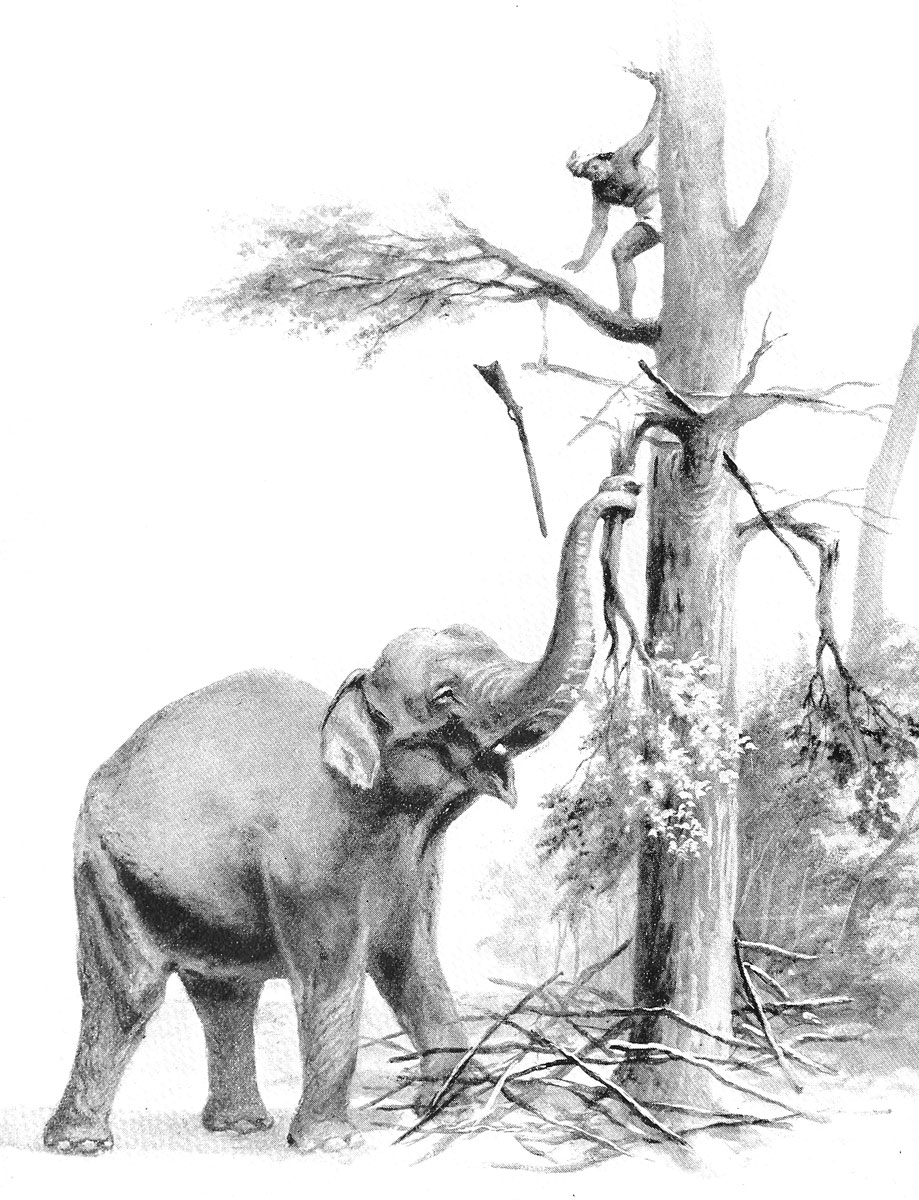
“I was too frightened to move, and it was only when the beast put up his trunk to seize me that I attempted to defend myself. Putting the gun to my shoulder, I aimed at its left eye and fired. Dropping the gun quickly, I climbed up the higher branches of the tree, only in time to save myself from the elephant, for, maddened by the shot which had destroyed the sight of one eye, it rushed furiously at me and tore down the platform, shrieking with rage and breaking the poles of which it was constructed into a hundred pieces.
“The gun, alas! Thoray, was broken, too, by the beast. May dogs defile his grave! It then tried to break down the tree. It twisted its trunk around it and swayed it backward and forward so that I nearly fell upon its back. At last it gave up and trotted off into the jungle, and I ran home to my father.”
A low murmur of approval ran ’round the little audience as the young man finished his story. Then the head man, turning to a female form crouching in the background, said, “Paravathi, my daughter, come and tell the Thoray what happened to you.”
A woman with hair disheveled and with streaming eyes threw herself upon the earth at my feet, sobbing incoherently, at the same time telling her tale. Her story was as follows:
About a week ago, she had left her hut and gone to the garden, wherein she and her husband grew a few vegetables, for the purpose of digging up some sweet potatoes with which to make a curry. She had taken her only child, an infant of less than a year. Whilst digging, she had laid the little one, wrapped in a linen cloth, under the shade of a tree. Presently, while busily at work, she heard the child cry and, turning quickly, oh, horror, saw an immense elephant, the same rogue—for she recognized it by its single tusk—standing over it, turning over the little bundle with the tip of its trunk.
Petrified with fear and apprehension, she stood rooted to the spot, and it was only when the beast suddenly lifted its forefoot and placed it on the baby, crushing it before her eyes into a shapeless mass, that she gave vent to a shriek of agony. Taking up the little bleeding form in its trunk, the elephant threw it from it as if satisfied with its work, and then looked at the distracted mother, who, lost to all sense of fear, rushed to her child.
Strange to say, the beast did not attempt to do her any harm but turned back into the jungle and disappeared. This was her story, and the sympathetic murmurs and ejaculations showed how deeply the listeners felt for the unfortunate Paravathi. Had I needed any incentive to confirm me in my determination to rid the country of this demon, I think I should have certainly found it in the story I had just listened to, for poor Paravathi’s distress, and the harrowing details of her recital, would have moved the most unsportsmanlike of men.
When I announced my intention of starting out the following day and asked for a guide, a dozen eager voices volunteered. I picked out the man who had wounded the elephant before and told him to be ready. The head man told me that it was the invariable habit of the rogue to bathe in a neighboring tank during the hot hours of the day, and that I might save myself a good deal of trouble by simply going there and intercepting him as he returned to the jungle.
The next day I was ready for the fray. I had spent the morning in carefully cleaning and oiling the locks of my gun, for I was determined to leave nothing to chance. I also loaded a few special cartridges. Four drams of Curtis & Harvey and a spherical No. 12 bullet I felt confident would do what I wanted, if only properly placed.
At about 11:00, accompanied by my guide, whose name, by the by, was Thévan, I started. It was hot—awfully hot—and I knew that his rogueship would be found cooling his wicked hide in the tank. Our path lay along the government road for about a mile; after that, we struck off on a cattle track that led to the water. For about an hour we walked silently on; not a breath of air stirred and, in the dense scrub, which rose about 10 or 15 feet on either side, the heat was like that of an oven.
On we went, occasionally disturbing a snake basking on a rock or a hare that hopped off from her form in the long grass. As I looked up on either side and saw the tangled scrub, composed of thorns and creepers of the most impenetrable kind, in which it would be utterly impossible to force a passage, I felt how utterly I should be at the mercy of the brute should he come suddenly upon me in such quarters. However, it was no use anticipating trouble, and on we went.
After about an hour of this work, Thévan touched me on the arm and, pointing to a cassia-tree, whose delicate acacia-like leaves trembled in a gentle breeze, whispered that it was on the edge of the scrub and that from there the lake was in full view. Advancing with more caution than before, we peered through an opening in the bushes, and there before us lay the tank, a silver sheet of water about a quarter of a mile across. It had originally been much bigger, probably a mile or so, but the drought had dried it up and a long stretch of mud and turf lay between us and the water’s edge, making approach under cover utterly impossible.
I looked for the rogue and was beginning to experience a sense of disappointment, when all of a sudden from a clump of rushes growing about 50 yards from the brink there arose an elephant of a size and appearance that almost took my breath away. He had been lying down on his side and now stood up facing us, revealing his full height. He certainly seemed gigantic, and I at once realized that I had my work cut out for me. One tusk he had, and it gleamed white and polished in the sunlight; the other was apparently broken off short, done, I dare say, in the battle royale that drove him a wanderer from the herd.
After watching him for a short time, I determined to try and reach a clump of tall forest which Thévan, by signs, indicated was the place the rogue would probably make for, and as the wind was favorable for the attempt, we started off, keeping well away from the edge of the bush. Fortunately, we struck a deer path that led in the desired direction, and so were able to proceed with comparative ease. Before, however, we got halfway across to our destination, the track brought us pretty close to the edge again and, although we kept out of sight of the rogue, we startled a couple of lapwings that commenced fluttering round and round, uttering their plaintive cries to attract us away from what was probably their nest.
A smothered exclamation from Thévan drew my attention to the elephant who, although a long way off and splashing itself over with water, had detected the alarm of the birds and, with cunning, stood watching the spot to detect the cause of it. We did not move; we almost held our breath so silently did we stand. But presently, as if convinced that some foe lay hidden there, it marched straight for the clump we were making for, causing the water to fly into spray as it strode along.
We had to skirt the edge of the tank, the arc of a circle; the rogue went in a straight line and consequently got the cover long before we could hope to intercept him. I did not attempt it, however, but thought it better to let him alone for a little while and then to take up his trail and trust to luck.
Accordingly, in about an hour we resumed our course and at length struck the point where the elephant entered the jungle. I looked at his footprints. Ye gods! What a size! Stooping down, I placed my outstretched hands across one and estimated it to be 21 inches across, and as twice the circumference of the foot is the height of the beast, I put this one down at 11 feet—no mean size, let me add.
We now took up the trail and cautiously followed it, keeping a watchful ear for the slightest sound. The cunning of the brute was at once apparent. After entering the jungle, it returned to the edge of the bush at a different point to see if the object of his alarm should show itself. Our wisdom therefore in remaining hidden for so long was apparent. After waiting some little while, the beast started off leisurely, feeding as it went, pulling up a cardamom plant here or a tempting bunch of bamboo there. Steadily and silently we followed, expecting to come up with it at any moment.
The jungle was very thick, but not as dense and thorny as before. Huge trees grew up around us and a mass of interlacing creepers made a network that rendered everything dim and indistinct. Thévan was leading, his body bent, looking for the footprints for, strange as it may seem, unless the ground is quite soft the tread of an elephant scarcely leaves an impression, and in the dim light of the forest it is difficult indeed to follow it. For about half a mile the track continued in a pretty straight line then, to my surprise, it turned sharp off to the left. This struck me as somewhat strange and I placed my hand upon Thévan’s shoulder in order that we might halt for a moment to take the direction of the wind. He turned at my touch, and as he did so I saw a look of terror come into his face, as he started back, gasping “Arné!” (The elephant!)
Looking quickly over my shoulder, what did I see but an enormous head and trunk towering over me as the brute made a sudden rush forward. It had evidently described a semicircle, gone back on its track, having discovered it was followed, and then charged down on us. As quick as thought I made a jump to one side, but as I did so my foot caught in the tendrils of a vine and I fell almost in the very path of the brute. I instinctively held my breath, expecting to be crushed under its ponderous feet, but what was my relief to see the dark mountain-like form rush past me in pursuit of Thévan.
Picking myself up as quickly as I could, I was yet too late for a shot, as it all took place in less time than I could tell it, and the distant crashing of the underbrush told the progress of the rogue. I felt horribly sick at the thought of the fate of my poor companion, but with joy beheld him slide down a neighboring tree, up which with monkey-like agility he had climbed.
Feeling now on our mettle and determined not to be caught tripping again, we resumed our way.
I know full well that I owed escape solely to the fact of having jumped aside under his blind eye; had it been the other—well, I should probably not be telling this story.
On we went. This time I took the lead, keeping well on the qui vive, as indeed we both were. We had no wish of being again attacked from the rear. For some distance, as long as the rush of the rogue had lasted, the trail was well defined, but as he slackened his pace, having been foiled in his cunning attempt, he had apparently resumed his stealthy mode of progression; and I might here remark that an elephant can go through the densest forest with scarcely a sound to betray its whereabouts, far less indeed than an ordinary white man.
Steadily we advanced, peering ahead in case the rogue should be waiting for us and, pausing for a few minutes at intervals, endeavoring to catch a sound. Presently, after about three miles of this work, we crossed a little bit of soft ground deeply pitted by the prints of his feet, and I noticed with pleasure that we were close on him, for the moisture was yet trickling into them. Pointing this out to Thévan, I went on.
So far the jungle had been composed of large trees with light underbrush, but now it began to get much more scrubby and dense, containing a good deal of rattan canes, whose hooked tendrils would have effectually barred our passage only for the fact that the way had been cleared for us. Occasionally we would cross a little bit of turf, which was a relief. This went on for some little while and, as we were walking pretty fast, I felt sure that we were not far off.
Suddenly I felt my arm clutched by Thévan and, stopping, immediately, saw that he was pointing with the other hand to a clump of tangled rattan jungle some 25 yards ahead of us. I strained my eyes to discover what he had seen—but no, I could make nothing out. I shook my head and, as I did so, Thévan with his arm imitated the action of the beast’s trunk when sensitively seeking anything. I looked again, and sure enough, I saw what I had not noticed before—about a couple of feet of the trunk, with the little finger-like attachment, projecting beyond the clump, bent in our direction, evidently with the idea of getting our wind, the body of the owner being meanwhile hidden from view.
His tactics were now obvious. He had stepped aside from his straight course and, hidden as he was, would have charged straight down on us as we got opposite him. Fortunately, in the dense scrub there was no breeze moving, and as we had been walking with catlike softness, he had not become aware of our presence. We could not go on, and the only thing was to wait until he had abandoned his position. So crouching behind the thick leaves of a clump of cardamoms, we waited, expecting to see him move off.
Presently the trunk was withdrawn, and with scarcely a rustle to betray his progress, he retired by the rear, carefully keeping out of sight of his own trail. We understood his cunning and smiled. Evidently, he was bent on showing a fight, but if he could he did not intend to give us a chance. I, on the other hand, was determined to stick to him until I could get him into the open.
My chance of success I knew lay in the forehead shot. There are only two fatal places in the skull of the elephant: one in the forehead, in a depression shaped like a herald’s shield, right between the eyes, and the other on the temple, between the eye and the ear. One of those I determined to get, and I was willing to wait for the opportunity.
I could see from the position of the sun, which was now getting low, that we were working back toward the tank from which we had started, and this fact lent me fresh energy, for it meant that I had so much less to tramp homeward. The rogue, like all wild animals, had his beat, and was not disposed to wander into strange country. He had evidently reached its limit, and was now heading back.
Silently we kept on the trail, walking with every possible caution, with eye and ear on the alert, and expecting to see our quarry every moment. We could see by his tracks that he was going slower and wavering a little in his line of march, evidently contemplating a halt. The tension on my nerves was intense.
The scrub ended and a few large trees gave the surroundings a park-like appearance, and with a more extensive range of vision, I knew we should soon come within sight of the elephant. We did so even sooner than I had expected. Turning a clump of prickly tangle of rattan scrub, we came into full view of the tank where we had first sighted him. Now, once more, not far from where we first stood, we beheld the rogue, ready and waiting for us.
What a magnificent picture he made, standing on a little rise with his trunk gracefully curved, pointing toward us to get our wind, his ears cocked to catch the slightest noise! As we came into full view, he turned his head a little so as to bring his one eye to bear fully upon us, and I could see that he now disdained to fly and was prepared to do battle. I knew I was in for a duel now à la morte. Who was to be the victor I could not say. Quickly stepping clear of the scrub so as to be free of all impediments, I stood there ready for him. He was about 50 yards off and ready for me. For about a minute we stood eyeing one another, then he gradually approached me, reducing the distance by about 10 yards. Then up went his trunk, and with a shrill scream he charged!
What followed seemed like a brief dream. I remember my gun was up to my shoulder in an instant, pointing to his forehead, and I wondered how I was to reach the fatal spot because his trunk was up, covering it. Just as he was upon me—so close that I almost jumped aside—down came his trunk with a swish, revealing the depression between and above the line of the eyes I sought. In an instant I covered it with my gun and fired, springing clear only just in time. For an instant I thought I had missed the spot, and I brought my gun up again for another shot behind the ear. But it was unnecessary. Down came the mighty mountain of flesh onto its head, and lay there silent and motionless, except for a slight convulsive twitching of the tip of the trunk.
I drew a long breath, for I knew it had been touch and go. I gazed on the brute as it lay there, and almost regretted what I had done, but then came the feeling of pride in my achievement, and I threw up my cap with a “Hurrah!” Thévan, who had kept close to me all the time, grinned his approval and, after I had had a good look at my vanquished foe, I lighted my pipe and rested a little while, discussing with my faithful follower the incidents of the chase.
On measuring the rogue—now rogue no longer—the tape reached 11 feet 1 inch from heel to spine. A very fair specimen, as anyone will admit who is conversant with these things. Starting homeward, we covered the ground between us and the village in a very short time where, refreshed with a bath and a hearty meal, I sat outside smoking the pipe of peace, listening to the tales of the former doings, as recounted by the head man and other villagers, of the Bintenna rogue.