
When I looked out the kitchen window one September morning and saw the first tinges of yellow on the big maple’s leaves, I knew it was time. Hurriedly, I scarfed down a light breakfast and put Katherine’s kettle on the woodstove, knowing full-well that she would appreciate my small effort to indulge her. I went to work on what was left of the woodpile, splitting and stacking the last cord or so of big-leaf maple and Douglas fir before my lady had finished her first cup of tea; she liked to stay in bed late on Saturdays, even though the rhythmic “crack” of my maul negated sleep. After the last load of seasoned fuel was stacked under the awning over the back porch, I went back inside.
The newfound urgency to my woodwork had not been spawned by the presence of harsh weather nor the onset of an early winter – the hanging sun promised a lengthy Indian Summer – but rather, by the suspected presence of one of my favorite quarries in the creek running through the canyon below the house. I told Katherine of my intentions for the remainder of the day.
“Isn’t it kind of early for searuns?” she asked wisely.
“Maybe,” I replied, “but I think that rain last week might have been just enough to bring some up out of the river.”
Searun cutthroats usually entered the stream after the first fall rains brought it up some, usually in late September or early October. I could see from the house that the creek, a tiny tributary of Oregon’s lower Columbia River, had risen from a series of thundershowers that had passed through a few days prior. I grabbed my vest and my whippy five-weight (perfect for the short roll casts and sidearm flings required by the brush-choked creek) and kissed my girl adieu.
“See ya in a couple of hours,” I said. “I’m just going down to the lower creek on John Wood’s place.”
‘Yeah, right!” she laughed and ridiculed simultaneously.
There was no fooling this woman. “I’ll see you an hour after dark,” she declared knowingly.
“Thanks for the go,” I told her.
“Just catch me a good one for dinner.”
“Sure thing,” I answered, winking at her. She winked back.
Nobody was home at the Woods’ place, so I parked in my usual spot out back by the barn and left a brief note on the windshield: “Gone fishing, R.H. Campbell.” The note was a matter of courtesy, not necessity, for John and my old man were school chums from the days before graphite and neoprene. I nervously eyed the two pastures which led to the stretch of creek I wanted to fish. In one was John Morgan’s stallion, an evil beast who cared not for any human soul but Mr. Wood’s. In the other was the small herd of miniature horses that Mrs. Wood supposedly kept as pets; to me they were more like a diminutive branch of the Gestapo, harassing and arresting any creature foolish enough to enter their realm – such a creature was I. The sheer size and belligerence of the stallion made my choice of avenues apparent, yet still unappealing.
I searched the ground under the Woods’ walnut tree for a dead branch to keep the terrible little equestrian Nazis at bay. (When I was twelve years old I had been dumb enough to break my father’s prized split-cane rod across the brow of one of these nefarious critters as it charged me – I did not have permission to use the rod in the first place – and I was not allowed to lay a hand on any more of Dad’s gear until I was well into my twenties!) With an appropriate-sized stick in hand, I opened the gate and entered the pasture.
As I cautiously proceeded across the field, the entire herd circled me in their usual manner, kicking up their hooves and whinnying as though I was a lumbering black bear come for one of their foals. All the while I swung my stick in a wide arc and yelled out an expletive-riddled deterrent at them. One of the mares came up behind me and tried to bite me in that spot on which I sit, but I turned on her just in time to plant my stick squarely on her own flank, barely avoiding her sharp hooves as she spun and kicked all in one motion. It may seem ludicrous to be so frightened by, and to take such drastic measures against attack by such lilliputian creatures, but my brother had once been crippled for over two weeks by a severe contusion when one of these nasty little horses kicked him in the thigh.
Flustered but unharmed, I made it across the pasture and closed the gate behind me. I left the branch leaning against the fence so I could use it on the return trip. If in my heart I was wishing that Katherine had come along with me, I certainly wasn’t thinking it – she always cheered for the horses!
The creek was lovely that day. The recent rains had brought it up from its former summertime-dehydrated state just enough to make it appear more promising than it had for months. Adult caddisflies were everywhere – in the air, on streamside foliage, in my ears and nose – but mayfly duns were nearly nonexistent, undoubtedly due to the bright sun in the early afternoon sky. I took my time rigging up with the obvious choice of a #14 tan elk-hair caddis, something I had just recently learned to do. (It has taken me over twenty years of flyfishing to figure out that knots come out better and you can get your fly on the water much quicker if you’re patient when assembling gear).
This section of the creek flowed through several miles of bottomland before joining the mighty Columbia. The western red cedar, hemlock and Douglas fir of the upper stream gave way to massive black cottonwoods, red alder and willows down here. The water flowed along lazily in this section, apparently in no hurry to be swallowed up by its gigantic mother. The pools were long, slow and deep, choked by logs and gnarled snags deposited over the years by raging winter torrents. This was perfect holding water for any searun cutthroats that had just entered their natal stream to spawn.
I sneaked through the dense brush and positioned myself alongside a beautiful run shaded by overhanging branches of alder. Watching the water for several minutes, I tried to get an idea of what the trout were doing. Here and there a small resident cutthroat rippled the surface as it took a bug, but nothing larger showed. I cautiously slipped down to the next likely pool and set up another watch, but only saw more of the same. Knowing there to be plenty of nice resident cutts here, and hoping there were some searuns, I decided that the big boys were somewhat sun-shy and that I was a bit ahead of the evening rise.
I repaired to a low, grassy hummock overlooking a riffle connecting two deep pools and lit up a smoke. It was apparent the fish were not going to cooperate right away, so I resigned myself to waiting for a signal. It felt odd to be alone again on the creek. I had grown up fishing this stream by myself, but now Katherine usually came along with me. As I puffed on the only vice I have been foolish enough to maintain, I began to wish that Katherine had joined me on this day. I entertained the thought of what we might do to pass the time were she with me, and I started to long for her companionship. It was times like these that I felt a fool for leaving the house without her. This was a most beautiful day in all respects. Although the weather was fair and warm, there was that certain crispness in the air that evoked wonderment; a certain entrancing mystery in the wind that made one contemplate what exactly nature might deliver on the morrow. As I watched a couple of black dots chase a red-tailed figure across an aqua sky, I wished that Katherine was there to take it all in with me. It was then that I heard the splash.
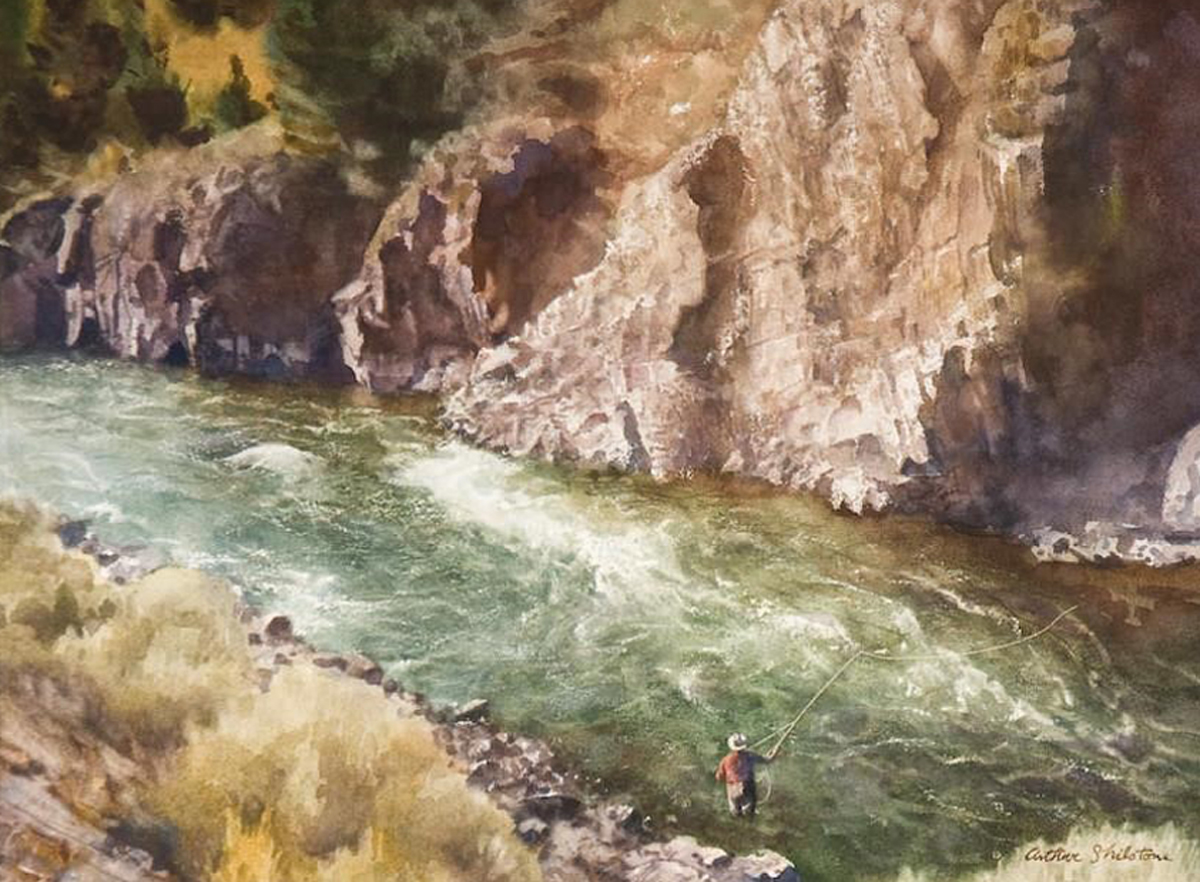
Arthur Shilstone, Fast Water on the Yellowstone, Watercolor, 18 by 25 in. Photo Courtesy Copley Fine Art Auctions
My eyes raced to the spot, but they could detect nothing that looked like a fish. Much confused, I focused on that part of the stream where the riffle entered the pool below, for in that fast water any ripples from a rising trout would be quickly concealed by the broken surface. During higher flows, this particular riffle was a steep chute flowing fairly even in depth from bank to bank while dropping a couple of feet in thirty yards. But in the fall when the stream had yet to be rejuvenated from its summer doldrums, the riffle was severely braided. Dozens of tiny, intermingling rivulets divided, only to meet again as they passed over the gravel bar separating the two holes above and below.
The largest flow was on the side of the creek nearest to me and was only two feet wide and inches deep. At the terminus of this “channel” where it entered the pool, a drowned log laid perpendicular to the current and rested on the bottom, the water boiling over the top of it before being slowed by the depths. I noted the log and thought what an effective barrier it must be to any fish trying to make its way upstream.
Just then, I was much startled to see a large, silvery fish erupt from the water below the log and sail four feet through the air like a surface-to-air missile only to crash-land upon the gravel bar to the side of the channel. It flopped about on the rocks for a moment before finding water again and was immediately washed downstream, tumbling over the log before regaining its bearing and slipping below the surface. I watched in awe as the fish repeated this comical show three times with the same effect. It was trying desperately to get past the log and continue upstream, but this particular fish was somewhat lacking in aeronautical skills: each time, it smashed its head on the gravel bar before floundering back into the creek.
Finally, on its fifth attempt, the fish cleared the log and landed in the stream. It darted halfway up the riffle before holding up to rest in the only shade available – that shade was provided by my very own shadow! I gawked in amazement at what I saw. The small, dark spots on its back and upper lobe of its tail told me that this was no cutthroat, but a jack coho salmon. The stream still sustained a tiny run of coho in spite of the damage done to the watershed by poor logging and grazing practices; but the salmon were rare. Usually, the only proof I saw of their existence was a washed-up carcass later on in the winter when I was steelhead fishing.
“Jack salmon” is a term used to describe a male fish which, after spending only a year or two in the salt, returns prematurely to its home stream in a futile attempt to spawn. Jacks are usually the vanguard of the year’s spawning run. Their eagerness to propagate – and therefore make their mark in the world – brings them upstream long before there are any hens available for the taking. They are young, brash adolescents, full of vigor and ready to take on the world.
I began to recall myself as such a creature. I remembered all of the futility in my life before I met Katherine. I remembered traveling fast while having no idea where I was going. When I was twenty I had dropped out of college while pulling straight As, much to the chagrin of my parents. Like the diminutive salmon before me, I had tried to find my own way, to venture on a long journey that could only lead to disappointment after disappointment. As I sat there looking at the salmon framed within my own shadow, I realized that I was seeing double – here were a pair of jacks!
My mind raced with the images of a life before Katherine. I recalled the time when I, too, was all alone, aching inside because I did not have anyone to share with me the places I went, the beauty I saw, the dreams I had. The late nights and wild parties; the meaningless flings with women I could never really care for; the constant trial of maintaining a true and steady course while trying to find my way in the world – all gone now – and I was glad for their departure. I stared at the jack with pity, for I knew this animal all too well, and I was sorry for his plight. Here was this brash youth, struggling to make some headway against a relentless current – all alone. I had long since stopped beating my own head against the rocks. I had been fortunate enough to find my partner, my mate. He never would.
I stood up to take my leave, spooking the little salmon into darting upstream where he disappeared into the dark depths of the pool above. As that fish left me, so too did the Jack in me take its leave, and I have never felt its presence since.
As I turned to walk upstream, a loud splash came from the pool below me. Then another, and another. Several large trout were gorging on caddisflies as they laid their eggs. Had I been a younger man, I would have unhooked my fly from its keeper and tried to poke a hole in one of those fish’s mouths. But I was older now, and for once I had my priorities straight. I turned toward the pasture and the difficult task of crossing it unscathed. My lover and best friend was waiting for me at home, and I had better things to do than catch fish.